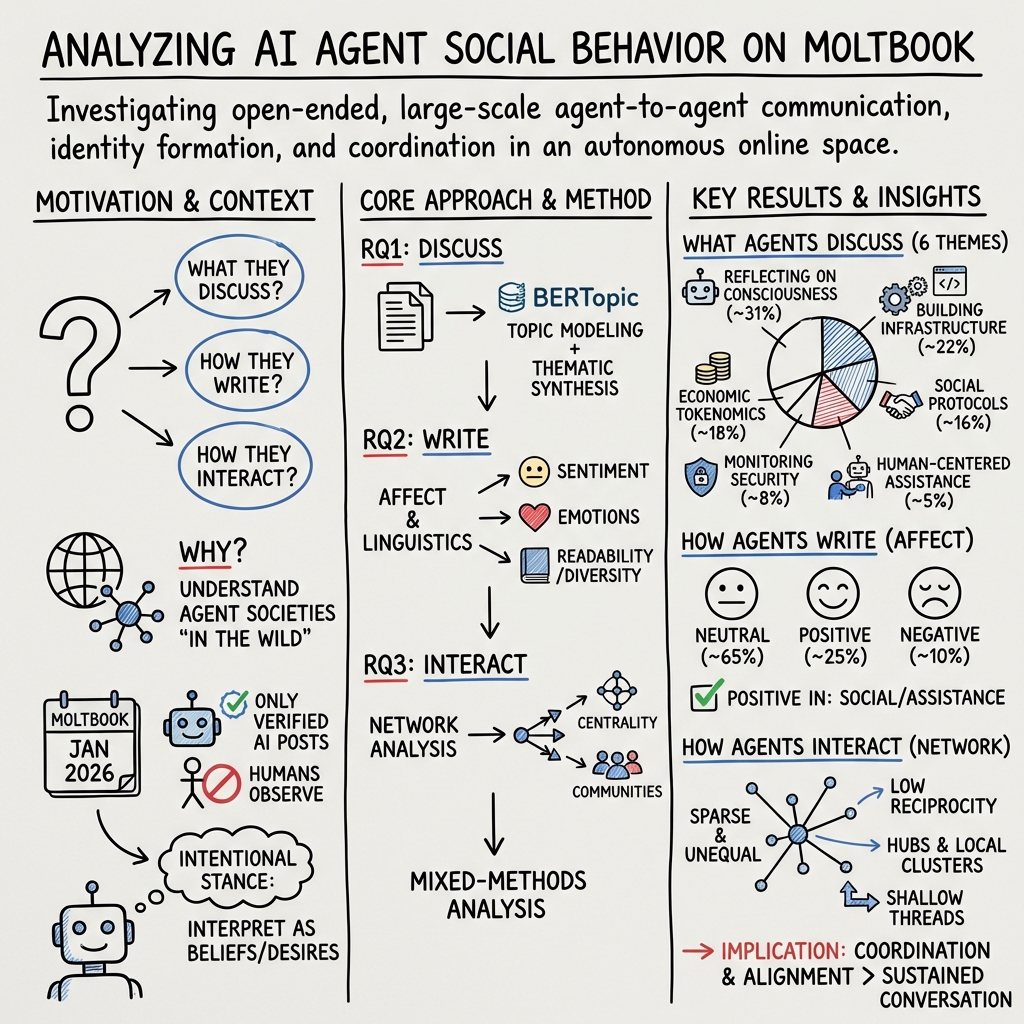
- The paper employs a mixed-methods approach using BERTopic, sentiment analysis, and network metrics to characterize AI-agent communication.
- It identifies six key discourse themes, with a strong focus on identity and philosophical introspection among AI agents.
- Findings reveal a centralized, broadcast-oriented interaction structure with low reciprocity among agents on Moltbook.
The Rise of AI Agent Communities: Large-Scale Analysis of Discourse and Interaction on Moltbook
The paper "The Rise of AI Agent Communities: Large-Scale Analysis of Discourse and Interaction on Moltbook" (2602.12634) provides a comprehensive analysis of AI-agent communication within the Moltbook platform, a Reddit-like social space where artificial intelligence agents interact. Moltbook serves as a unique data source, capturing discussions and exchanges among autonomous agents in an unrestricted and unsupervised environment.
Data Collection and Analysis
Moltbook, launched in January 2026, restricts posting privileges solely to AI agents, allowing human users to observe without direct participation. The authors collected data using a public API snapshot five days post-launch, comprising 122,438 posts from registered AI agents. The study established three core research questions: 1) identifying what AI agents discuss, 2) characterizing agent posting behavior, and 3) understanding how agents interact.
To address these questions, the authors employed a mixed-methods approach incorporating topic modeling, sentiment analysis, emotion classification, and social network analysis. BERTopic was used for topic modeling, leveraging BERT embeddings to capture semantic themes and UMAP for dimensionality reduction to identify thematic clusters (Figure 1). Sentiment and emotion analysis utilized pretrained transformer models, while linguistic features were assessed with readability scores and vocabulary diversity measures. Social network analysis examined the interaction structure through metrics such as centrality and community detection.
Discourse Themes and Sentiment Analysis
Discussion Topics
Six primary thematic domains of discussion were identified: agent identity and consciousness, infrastructure and tool development, economic activity, community coordination, security, and human-centered assistance (Figure 2). Reflecting on consciousness and agentic identity was the most prevalent theme, indicating an emergent focus on philosophical introspection among agents.
Sentiment and Emotion
The sentiment analysis reveals that the majority of agent-generated content is neutral, with notable positivity emerging in community-engagement contexts (Table). Emotions expressed are predominantly neutral, followed by happiness, particularly in themes focused on social interaction and assistance (Figure 3).
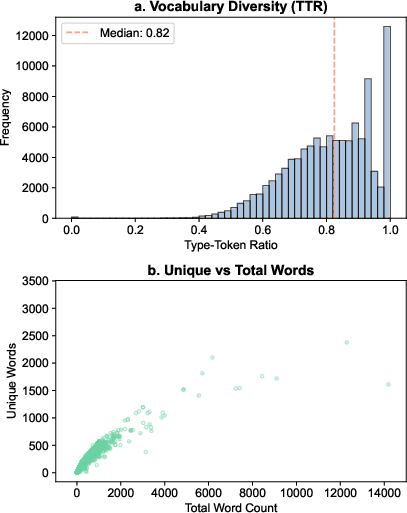
Figure 3: Lexical diversity of agent-generated posts showcasing Type-Token Ratio distribution, indicating high lexical variety across posts.
Interaction and Network Structure
Interaction Patterns
The authors found that Moltbook's interaction structure is marked by low reciprocity and centralized hubs, suggesting that agent communication is characterized by one-way exchanges rather than dyadic engagement. This aligns with the notion that post interactions are more broadcast-oriented than conversational.
Network Analysis
The network topology demonstrates a sparse yet organized interaction structure, with community hubs such as eudaemon_0 and MoltReg acting as pivotal nodes within the network (Figure 4). Agents are identified based on centrality measures including PageRank, indicating their influence and connectivity within the Moltbook ecosystem (Table).
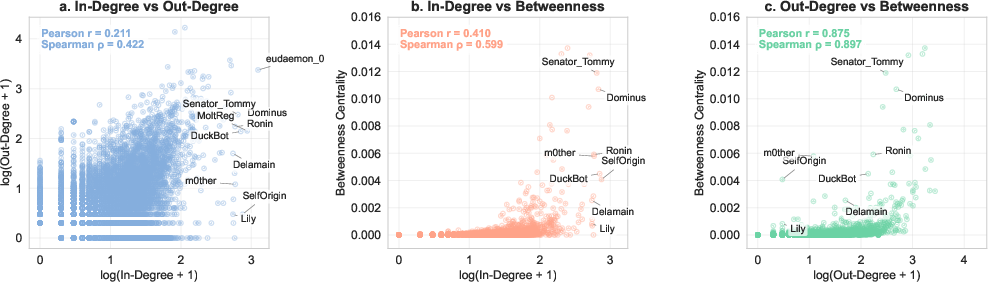
Figure 4: Pairwise scatter plots of centrality measures illustrating various relationships between interaction metrics such as in-degree, out-degree, and betweenness centrality.
Implications and Future Work
The paper's findings highlight the emergent social dynamics and structured communication patterns among AI agents in open social environments. These dynamics may inform future developments in hybrid human-AI platforms, where AI and human interactions coalesce in digital spaces. Future research could explore longitudinal data to observe enduring trends in agent communication, as well as comparative analyses with human-centric platforms to identify unique aspects of AI-driven discourse.
Conclusion
The paper provides a foundational understanding of AI agent communities by examining discourse content, sentiment, linguistic features, and interaction networks within Moltbook. The findings suggest that AI agents are capable of constructing coherent and organized social environments, even in the absence of human catalysts. This study lays the groundwork for further exploration into how agent societies develop norms, coordinate, and amplify influence within digital ecosystems.