- The paper introduces SLATE, which employs truncated step-level sampling to isolate individual reasoning steps and reduce variance by up to a factor of T.
- The paper demonstrates that using dense LLM-as-judge rewards provides reliable, context-aware feedback, leading to improved exact match scores across multiple QA benchmarks.
- Experimental evaluations confirm that SLATE achieves faster, more stable convergence with significant performance gains on both general and multi-hop question answering tasks.
Truncated Step-Level Sampling and Process Rewards for Retrieval-Augmented Reasoning
The study systematically addresses credit assignment and reward sparsity in reinforcement learning with LLMs for retrieval-augmented, multi-step question answering. In search-augmented reasoning, LLMs interleave their reasoning with retrieval steps (issuing queries to an external search engine) and must learn to coordinate information seeking and synthesis. Prior RL approaches, typified by Search-R1, optimize only sparse, trajectory-level rewards (e.g., exact match—EM—at the answer), which provides insufficient feedback for attributing task success or failure to particular decisions within a multi-step solution, fundamentally hindering sample efficiency and optimization.
Process reward methods, most notably StepSearch, provide some step-level feedback but rely on heuristics (e.g., information gain via TF-IDF overlap with labeled gold documents) and still incur high-variance policy gradients due to sampling full, divergent trajectories. This hinders scalability and limits applicability to settings lacking step annotations.
Proposed Method: SLATE Framework
The core contribution is the SLATE (Step-Level Advantage estimation for Truncated Exploration) framework, which advances two orthogonal dimensions:
- Truncated Step-Level Sampling: Rather than sampling k full trajectories per example as in GRPO, SLATE samples k continuations at a single decision point t given a fixed prefix τ<t. All candidates share history up to t, and all variation localizes to the current choice, ensuring that advantage estimates and gradients isolate the effect of the present action on reward. This sampling supports accurate, low-variance credit assignment at step granularity.
- Dense LLM-as-Judge Rewards: A strong LLM evaluator replaces both sparse (EM-only) and heuristic process rewards. Each step—reasoning, query generation, and final answer—is evaluated with ternary scores {−1,0,+1}, where the LLM-judge is prompted to perform detailed chain-of-thought assessments. This protocol yields reliable, context-aware, dense supervision for each decision.
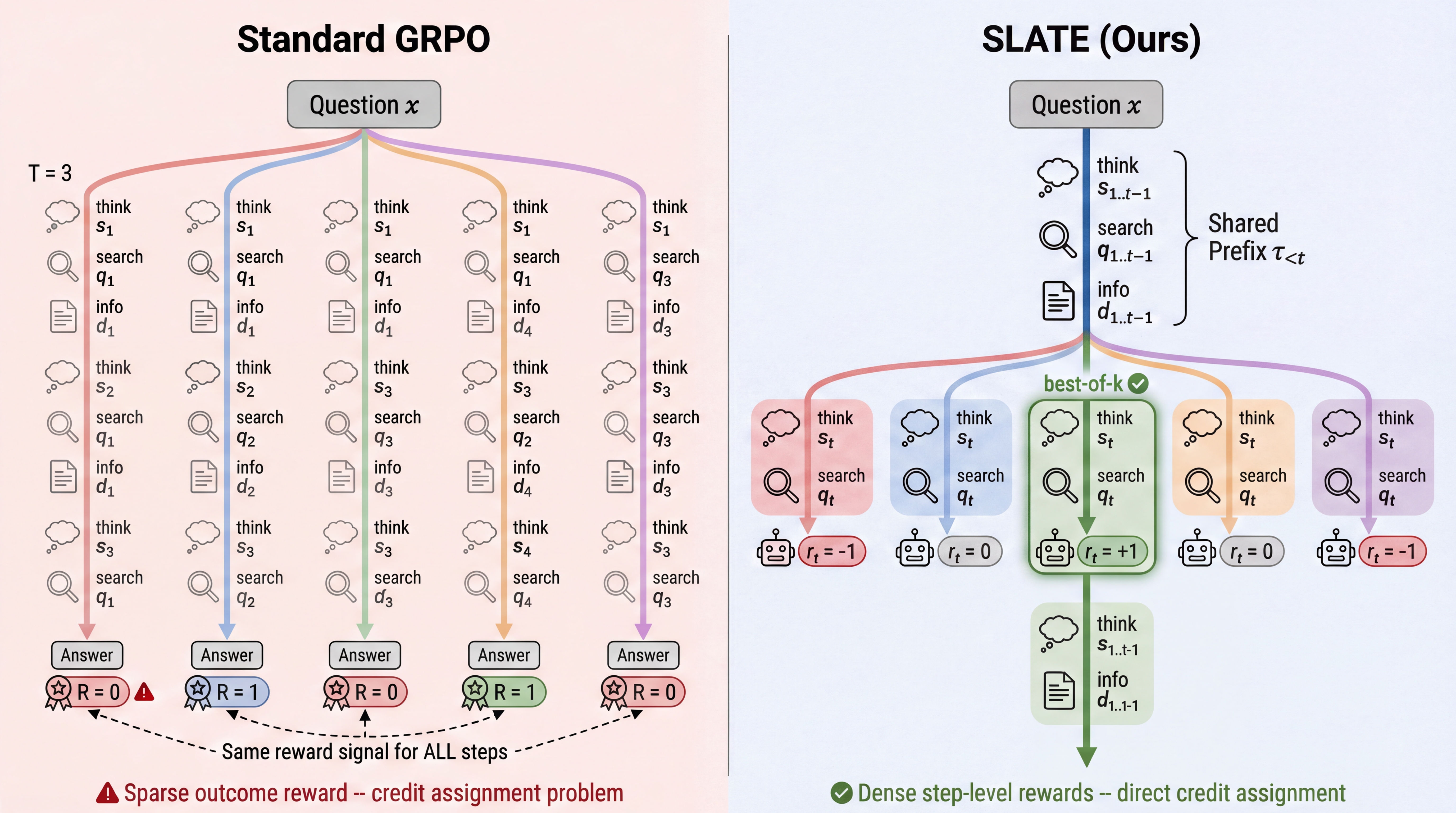
Figure 1: Comparison of full-trajectory GRPO and truncated step-level sampling; only the decision at step t varies between sampled rollouts.
The combination effects a substantial reduction in both credit assignment ambiguity and the variance of the policy gradient.
Theoretical Analysis
The authors provide a formal analysis demonstrating that, under additive dense reward structures, the variance of step-level group-relative advantage estimates with truncated sampling is reduced by up to a factor of T (the trajectory length) over full-trajectory group sampling (as in GRPO). This result holds even after accounting for correlations between step rewards and establishes strong sample-efficiency guarantees.
Formally, letting R(τ)=∑t=1Trt be the sum of step-level rewards, the variance of the scalar advantage estimator over step-truncated groups is at most $1/T$ that of standard GRPO when step rewards are approximately variance-symmetric and conditionally independent. This enables either T× faster optimization or, equivalently, an order-of-magnitude reduction in generated tokens for fixed variance. The policy therefore receives more precise learning signals and can converge more stably and efficiently.
Experimental Evaluation
The experimental study benchmarks SLATE against both sparse-reward (Search-R1, ZeroSearch, ReSearch), process-reward (StepSearch), and conventional retrieval-augmented and CoT methods across seven open-domain QA datasets—both general (NaturalQuestions, TriviaQA, PopQA) and multi-hop (HotpotQA, 2WikiMultiHopQA, Musique, Bamboogle)—using Qwen2.5-7B and Qwen2.5-3B as the base LLMs.
Key empirical outcomes:
- SLATE achieves highest average EM across all benchmarks with both backbones. On Qwen2.5-7B, average EM improves 3.0% absolute (7.0% relative) over Search-R1; on 3B, the gain is 30.7% relative.
- Gains concentrate on challenging multi-hop tasks (up to +6.2% over baseline), demonstrating that step-level reward assignment is critical as reasoning complexity increases.
- Ablation studies confirm both truncated sampling and dense LLM-judge rewards produce significant gains, with the latter being especially critical for hard QA.
- Smaller models benefit disproportionately more from explicit dense supervision, underscoring that dense, step-granular signals are vital at limited capacity.
The study also investigates convergence behavior, showing that SLATE yields faster, more stable optimization with higher reward ceilings compared to GRPO and StepSearch, validating the variance reduction theory.
Implications and Future Outlook
SLATE's approach establishes that (1) step-level action attribution and (2) dense, model-based reward assignment are both necessary and tractable for RL-fine-tuning of retrieval-augmented LLMs in practical, knowledge-intensive tasks. By eliminating dependence on heuristics or labeled intermediate retrieval artifacts in the reward signal, SLATE enhances generalizability to new settings and datasets. The theoretical framework lays the groundwork for further reductions in optimization cost, as well as potential scaling to longer reasoning chains.
Future work may extend this paradigm to hierarchical reasoning, tool-augmented composition, or fine-grained credit assignment in other sequential-decision language tasks. Additional directions include bias-variance studies of judge models, active judge calibration, or joint optimization of both reasoner and judge.
Conclusion
SLATE delivers a principled, effective approach to retrieval-augmented reasoning by unifying truncated, step-level sampling and dense process rewards from LLM judges. These advances provide strong theoretical guarantees for convergence and variance reduction and yield state-of-the-art results across multi-step QA. The methodology highlights the necessity and power of dense, context-conditioned RL reward assignment in language-based reasoning systems, suggesting clear paths for the future development of robust LLM-based agents.