- The paper demonstrates that SKA-class surveys can detect up to one million bent-tailed galaxies, vastly expanding the sample for scientific inference.
- It employs multiwavelength analysis and polarimetric techniques to extract insights into cluster dynamics and the detailed structure of magnetic fields.
- Results indicate that the distinctive BT morphologies, shaped by ICM forces, provide critical evidence for understanding cluster evolution and magnetogenesis.
Probing Galaxy Cluster Environments and Magnetic Fields with Tailed Radio Galaxies in the SKA Era
Introduction
This paper analyzes the role of tailed radio galaxies, specifically Bent-Tailed (BT) radio sources—including Head-Tail (HT) and Narrow-Angle-Tail (NAT) morphologies—as probes of galaxy cluster environments and their magnetic fields. Historically constrained to the local universe by the sensitivity and resolution limits of radio telescopes, BT studies are poised for significant expansion in the context of the Square Kilometre Array (SKA). The authors provide a forward-looking synthesis, predicting that the upcoming SKA1 all-sky survey will allow the detection of up to one million BT galaxies out to redshifts z≳2, with a significant subset suitable for polarimetric studies of cluster magnetic fields. The work systematically reviews the physical mechanisms responsible for BT morphology and the methodological advances enabled by the SKA, emphasizing the anticipated leap in sample size and scientific inference.
Tailed Radio Galaxies as Environmental Probes
BTs, characterized by asymmetric and bent radio jets or plumes, are robust tracers of dense environments due to the ram pressure and buoyancy forces exerted by the intracluster medium (ICM) on the jets. These sources are largely found in or near galaxy clusters and their distinctive shapes encode the integrated dynamical history of their host clusters—including evidence of cluster mergers, winds, and galaxy motions.
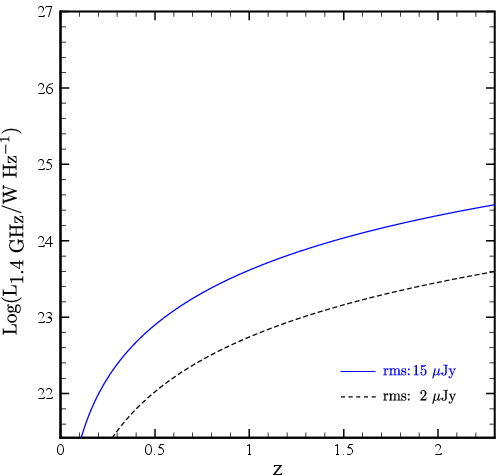
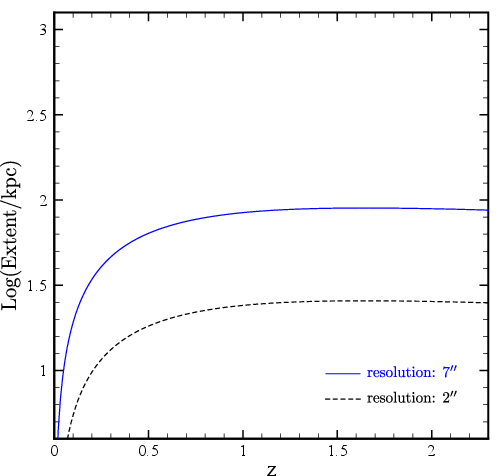
Figure 1: Left—Radio power versus redshift; Right—Physical size versus redshift, illustrating how SKA-level surveys will access lower power, smaller BT galaxies at higher redshifts than is currently possible.
Several mechanisms, such as the relative velocity of a host galaxy with respect to the ICM and gravitational interactions with nearby galaxies, cause the observed bending and shaping of the jets in BTs. Case studies, such as those in the Perseus cluster, Abell 3135, and A3266, have leveraged resolved BT morphologies to infer local ICM dynamics, shock conditions, and merger axes. These inferences are possible through a combination of high-resolution radio imaging and multiwavelength supporting data, but have so far been restricted to individual well-studied cases.
The statistical potential of BTs as cluster environment probes remains largely untapped due to historic sample size limitations. The paper presents a strong claim that SKA-class surveys will extend the detection of BTs by an order of magnitude over current catalogs, vastly expanding the parameter space accessible for population, environmental, and evolutionary studies.
Detection Yield and SKA Survey Projections
By extrapolating from the Australia Telescope Large Area Survey (ATLAS-CDFS) and using survey parameters well-matched to the planned SKA1, the authors estimate that the SKA1 all-sky continuum survey will detect up to a million BT galaxies—an unprecedented leap beyond the ∼100,000 currently catalogued clusters. Moreover, 5–10% of these are projected to be sufficiently polarized for Faraday rotation measurements, yielding 50,000–100,000 BTs suitable for magnetic field studies. This dataset, in combination with X-ray cluster catalogs (e.g., eROSITA), will provide a synergy for multiwavelength environmental characterization up to z∼2.
Physical Models and Morphological Interpretation
The paper discusses physical models illuminating how the observed BT morphological diversity (V, M, S, X-shaped) is a direct function of environmental influence. For instance, cluster winds, orbital/companion galaxy interactions, and AGN precession have been disentangled in studies such as the one on Abell 3135.
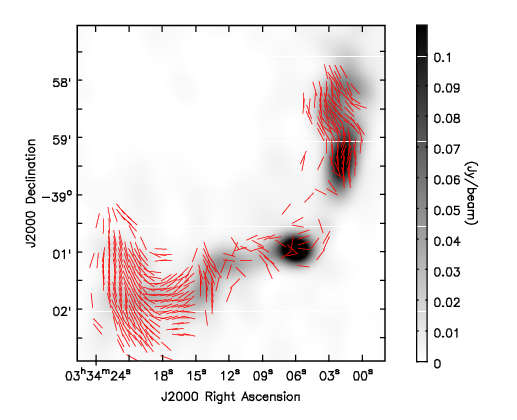
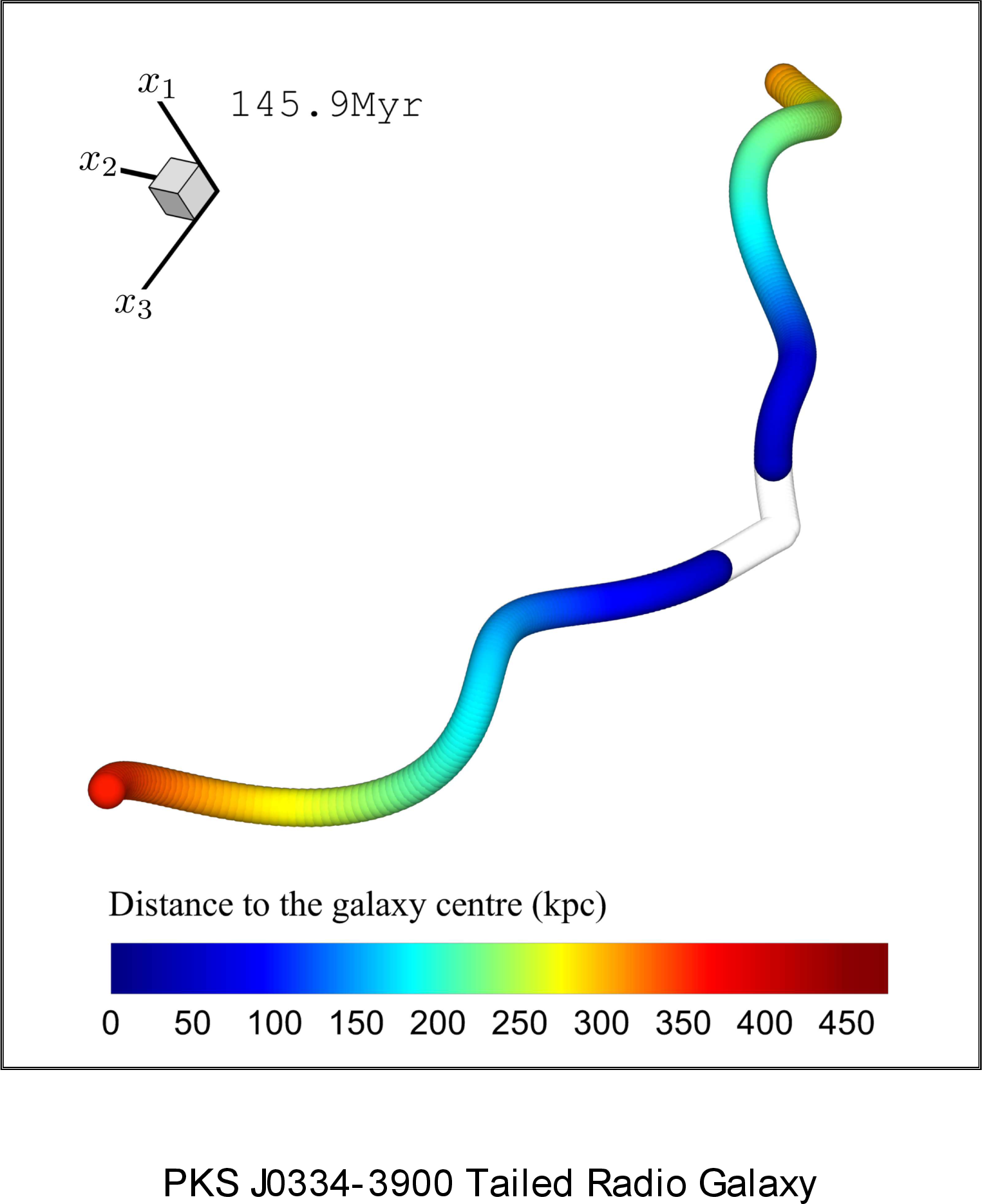
Figure 2: Left—Optical image with overlaid radio contours for the BT in Abell 3135; Right—Kinematic model reproducing observed BT morphology via environmental parameters including cluster wind and jet precession.
Such mechanistic modeling, when combined with SKA-scale statistical samples, will provide new constraints on cluster weather prevalence, the frequency of AGN precession (with implications for X-shaped radio galaxies and gravitational wave event rates), and the necessary dynamical conditions for BT formation.
Probing Cluster Magnetic Fields with BTs
The polarized synchrotron emission from BTs, modulated by Faraday rotation in the ICM, represents a powerful probe of intracluster magnetic field structure and strength. In contrast to diffuse relic or background galaxy RM studies, resolved BTs allow measurement of the coherence scale of μG-level magnetic fields on ∼10–$20$ kpc scales within clusters—scales inaccessible to other methods. Faraday rotation mapping across BT jets, when combined with morphological modeling and X-ray determined electron densities, yields 3D constraints on the magnetic field’s geometry and strength. This method has been validated in clusters such as A400, A2634, Coma, and A2255.
The paper makes an explicit projection: SKA1 will increase the number of polarized BTs by orders of magnitude, enabling the first tomographic and evolutionary study of cluster magnetic fields as a function of cosmic time, thus addressing the open question of magnetogenesis and field amplification in structure formation.
Implications for SKA Design and Survey Configuration
The efficacy of BT science is strongly dependent on survey resolution and sensitivity. Simulations and observational tests show that BT sources can be ∼50 kpc in size, requiring at least $1''$ angular resolution for robust detection at cosmological distances. Significant losses in sensitivity or baseline lengths would reduce the BT yield and the fraction available for high-fidelity RM and morphological studies. Even with 50% of the currently planned SKA sensitivity, the projected yields (200,000 BTs; 10,000–20,000 polarized) would still constitute the largest sample to date but would limit certain evolutionary probes and small-scale environment inference.
Conclusion
The anticipated performance of SKA-class surveys will fundamentally expand the scope of BT-based probes for both environmental and magnetic field characterization of galaxy clusters. The substantial increase in the sample size to the order of one million BTs, with tens of thousands suitable for polarization and Faraday studies, will facilitate statistical analyses across redshift, environment, and dynamical state. This will enable major advancements in understanding the formation and evolution of large-scale structure, the physics of dense environments, and the origin and evolution of cosmic magnetism. The combination of morphological, kinematic, and polarimetric data from SKA and supporting surveys is poised to resolve longstanding questions regarding the interplay of magnetism and baryonic physics in cluster assembly and evolution.
(1501.00761)