
OpenAI's mathematics release, mapped and searchable

On October 6, 2026, OpenAI published 722 manuscripts produced by an unreleased internal model, grouped into 372 results across 17 subjects. Search every abstract by meaning, see where each result sits among the others, and follow it to the PDF, its Lean formalization, and what mathematicians are saying.

Try Riemann zeta function counterexample to a conjecture spin glasses fast multiplication algorithms free group factors

results, each a family of related manuscripts
372
manuscripts, with LaTeX sources
722
pages in total
34,815
results with a Lean formalization
235
problems posed to the model, per OpenAI
≈4,000
hours of ChatGPT Pro thinking per result, on average
≈3
Each mark is one of the 372 results, placed so that results with similar summaries and abstracts sit near each other (a t-SNE projection of text embeddings, so distances between distant clusters mean little). Shape and color give the area; size gives the number of manuscripts. Labels mark subjects that form a tight cluster.

What OpenAI released

From the repository README and the announcement, both dated October 6, 2026.

OpenAI evaluates its models on open research problems, and says it expanded those evaluations after the models saturated its existing mathematical benchmarks. Over the course of the evaluation an unreleased internal model was posed about 4,000 problems. OpenAI grouped the output into result families, kept those it judged significant, and released them as a public repository of manuscripts, LaTeX sources, citations, and Lean proofs.

Almost every result came from the same fixed procedure, using on average about three hours of ChatGPT Pro thinking compute per result. OpenAI names two exceptions to that procedure: the work on a zero-free region for the Riemann zeta function, and the proof of the Hodge conjecture for CM abelian varieties. The write-up of the Re(s) > 11/12 zero-free region was also edited by people for readability.

The results are at different stages of verification. Not all have Lean formalizations, and OpenAI cautions that some of the unformalized results could have issues, which it says it will fix quickly. Corrections will be published as new versions, with earlier versions kept available. Each manuscript carries its own BibTeX entry for citation.

The release follows advice from the independent Advisory Group on Mathematics and Artificial Intelligence at the Institute for Advanced Study, whose recommendations appeared a week earlier; see how the two compare. OpenAI also says it will fund workshops, conferences, and special programs on understanding major AI-produced results, and that it is working to release the model itself.

“Some of the unformalized results could have issues.”

OpenAI, repository README

“Human understanding of mathematics remains of paramount importance.”

IAS Advisory Group on Mathematics and AI, Responsible Release of AI-Generated Mathematics

Subjects

OpenAI files every result under one of 17 subjects. Bars show results per subject; the solid part of each bar is the results with a Lean formalization.

Colors and shapes group the subjects into five areas, used throughout this page.

Subject Results, with and without Lean Results Lean Manuscripts Pages
Theoretical computer science
40 80% 73 2,771
Combinatorics
37 89% 50 2,164
Algebraic and complex geometry
36 19% 89 4,023
Number theory
31 52% 58 3,126
Differential geometry
29 52% 49 1,976
Probability and statistical mechanics
29 66% 105 7,186
Mathematical physics
25 68% 59 3,538
Operator algebras
19 74% 31 1,195
Algebra
18 50% 29 1,123
Topology
18 17% 26 1,445
Partial differential equations
16 69% 29 1,257
Real and complex analysis
16 56% 26 1,588
Convex and metric geometry
15 87% 30 902
Group theory
14 86% 22 858
Dynamical systems and ergodic theory
12 75% 19 822
Functional analysis
11 91% 19 457
Mathematical logic
6 100% 8 384

When they were written

Manuscripts by the date in their directory name, which records when each write-up was produced. Most are dated between September 23 and October 5, 2026.

0 50 100 150 200 Sep 10 Sep 15 Sep 20 Sep 25 Sep 30 Oct 5 Oct 6

How long they are

Page counts read from each PDF. The median manuscript runs 39 pages; together they fill 34,815.

What kinds of results

Our own index, not OpenAI's: an LLM read each result's summary and abstracts and recorded what the principal result claims and which named problems it addresses. It may contain errors; each result's page shows the source text.

The results address 520 named problems, from Milne's rationality conjecture to the Unique Games Conjecture. The index of named problems lists each one with the claimed outcome and the results that address it.

Formal verification in Lean

From the repository's Lean library and its formalization catalogue. OpenAI says it will add formalizations as it obtains them.

results with a Lean formalization and a note on its scope
235 of 372
manuscripts whose main result is listed as formalized
162 of 722
comparator challenges, the statements a checker verifies
185
Lean source files in the library
121,734

The scope notes matter: a formalization can cover a theorem's main statement while leaving out later applications, or prove a slightly different form. Each result's page reproduces its note. The catalogue describes the project's status as “Partial progress.” Its 1.46 GB of Lean source builds on 30 outside libraries.

Libraries the formalizations build on

leanprover-community/mathlib4, AlexKontorovich/PrimeNumberTheoremAnd, n-yamaguchi-0729/ClassFieldTheory, CBirkbeck/AINTLIB, math-inc/strongpnt, abenenson/rellich-kondrachov, harfe/fixed-point-theorems-lean4, TauCetiProject/TauCeti, fpvandoorn/carleson, lana-agents/heights, Aaron1011/gromov, lana-agents/iut, alonamaloh/schoenflies-lean, leanprover-community/sphere-eversion, ahhwuhu/zeta_3_irrational, BennyAvelin/AbsorptionCutoff, lana-agents/belyi, PatrickMassot/checkdecls, leanprover/doc-gen4, lana-agents/elliptic-curves, lana-agents/formal-schemes, lana-agents/genl, hanwenzhu/LeanArchitect, alerad/leancert, lana-agents/oka, lana-agents/orbicurve-cores, lana-agents/pi1, b-mehta/PrimeCert, lana-agents/tate-curves-theta, lana-agents/tempered-fundamental-groups

Release practices

On September 29, 2026 the IAS Advisory Group on Mathematics and AI published recommendations for releasing AI-generated mathematics that no one yet understands, drawing on over 600 responses from mathematicians. OpenAI says it consulted the group.

This is our summary of each recommendation beside what the repository and announcement contain. It is not the group's assessment.

The group recommendsIn this release
Search the literature for related ideas and cite the papers that introduced them.
Included
Every manuscript's LaTeX source includes a bibliography. OpenAI says future releases will further improve citations, exposition, and presentation.
Write each proof up in the conventions of a traditional mathematical paper, with precise statements.
Included
Each result is written up as one or more LaTeX manuscripts with an abstract. One write-up, the Re(s) > 11/12 zero-free region, was edited by people for readability.
Deposit results in a scholarly repository not controlled by any AI lab, with persistent identifiers, recorded revisions, and ideally comments.
Partly
The release is a GitHub repository under OpenAI's account. OpenAI commits to preserving its release history, recording corrections as new versions, and providing BibTeX for each manuscript, and says it is exploring community-hosted alternatives.
Publish the model's name, the prompts, a summarized chain of thought, the time taken, and the estimated compute cost for each result.
Partly
The model is described as an unreleased internal model and is not named. Prompts are not published. Reasoning summaries cover 10 of 372 results. Compute is given as an average of about three hours of ChatGPT Pro thinking per result, not per result.
Formalize proofs where possible, with comparator challenge files and a formalization.yaml; otherwise state the formalization status.
Partly
235 of 372 results have a Lean formalization with a scope note, and the library ships a formalization.yaml and 185 comparator challenges. The README says many, but not all, manuscripts are formalized.
Document how the problems were chosen and how many of comparable difficulty were attempted without success.
Partly
The README says the model was posed about 4,000 problems and that output was aggregated into families and filtered for significance. It does not describe how the problems were selected or how many attempts failed.
Fund the work of understanding the results, through nonprofit institutions, without directing it.
Announced
OpenAI says it will fund workshops, conferences, and special programs on understanding major AI-produced results, with details to come.
Give the mathematical community broad, equitable access to the models that produce such results.
Not yet
The model has not been released. OpenAI says it is working to release it responsibly.

Reactions

A selection of posts on X from mathematicians, computer scientists, and people at OpenAI since the release. Posts that link to a specific result also appear on that result's page.

Mathematicians and scientists

Quasi-RH?!?!???! Are you kidding me? If a human did this, it would be an instant Fields Medal, no questions asked. RH says zeta has no zeros in Re(s)>1/2. The best we had until a second ago was a region that got thinner and thinner the higher up the imaginary axis you go. I thought maybe they’d fatten that up a bit, that’d be a massive breakthrough. But no. They got a zero free strip!!!! Insane

Quoting @OpenAI: We’re releasing a broad range of new mathematical results produced by an internal frontier model. We’ve been consulting with the independent Advisory Group on Mathematics and Artificial Intelligence at the Institute f...
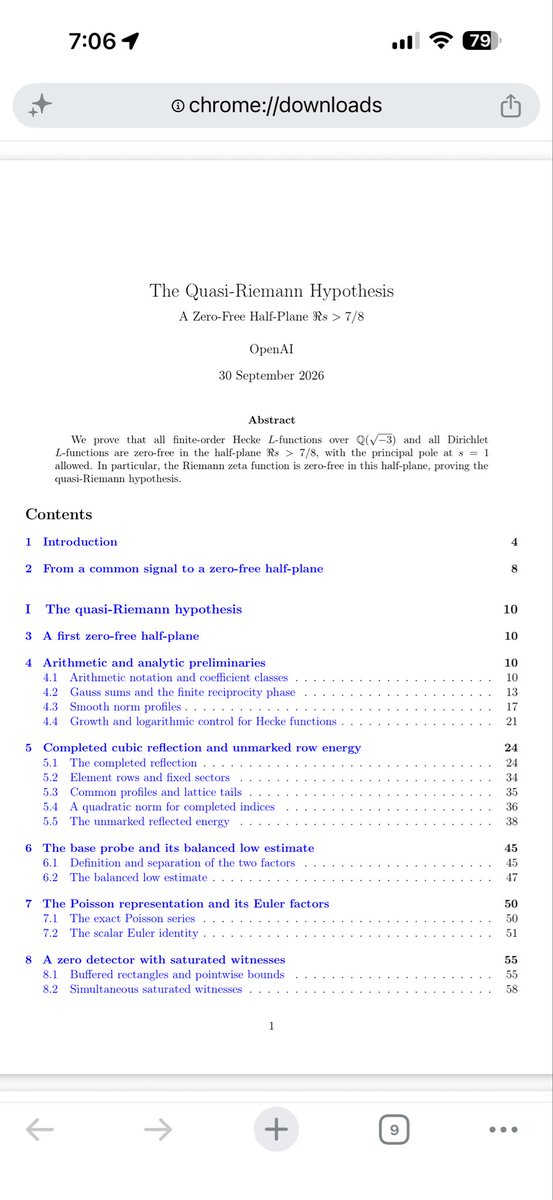
Image attached to the post
Oct 6, 2026, 7:08 PM ET On result 003

Some further thoughts on the 372 results released by OpenAI today, across 722 manuscripts. If I were to classify theorems that mathematicians prove and publish according to their groundbreaking nature, I would (very roughly) divide them into four categories: A) Non-breakthrough results. This is the overwhelming majority of published mathematics. Such results can range from solid to excellent, and some represent genuine advances in a field. But they are not hugely surprising, and would not normally be described as “breakthroughs.” B) Exceptional advances within an existing programme. These are spectacular results, but where there was nonetheless an existing credible route to the theorem, and some expectation that sufficient work would get you there. Completing the programme may require a lot of ingenuity and deep work, but mathematicians would not be shocked that the theorem had finally been proved. C) Surprising breakthroughs. These are results that clear a major barrier and substantially change the state of a field. Before the proof there was no convincing roadmap to the full result. Yet, while mathematicians would find the theorem remarkable and surprising, they would not find it completely shocking: if you asked them beforehand if it was plausible such a theorem could be proved today, most would say yes. Note: The very best mathematicians prove only a small number of results in categories B and C in a lifetime; many mathematicians never prove even one. Such results would normally belong in the very top journals, such as Annals, Inventiones, etc., and there are only a handful of them each year in any given area. Several results of this calibre by a single person would make a very strong case for a Fields Medal. D) Shock breakthroughs. These are results that, before their announcement, leading experts would have regarded as *extremely* unlikely to be proved with the current mathematical technology available. So the theorem itself would come as a shock. These are extraordinarily rare, and instant-Fields medal variety. (There is one further category I have deliberately left out, because I suspect it is empty: a correct proof of a problem for which the overwhelming consensus of top experts, until the proof came, was that a proof was so far beyond existing mathematics that a claimed solution should, on prior grounds alone, be regarded as almost impossible. I would put the Riemann Hypothesis today in that category) My current impression is that some of OpenAI's announcements today lie in A, but most fall into categories B or C. There is exactly one example in D (the Quasi-Riemann Hypothesis). It is a very big day for mathematics.

Quoting @ObhishekSaha: So now we have confirmation that OpenAI has indeed proved the Hodge conjecture for all (CM) abelian varieties. Huge, but not the best proved by LLMs so far! That title goes to the lightning in a bottle: the Riemann Ze...

Oct 7, 2026, 7:52 AM ET

I have now published on my website a paper, jointly written with Samuel Kittle, on the same main result as Paper 148 of the @OpenAI announcement. The first proof I found was discovered by GPT-6 Astra on September 27, 2026. So I don't feel too bad that OpenAI published the result before us, yet I would have preferred it the other way around. My collaborator Samuel Kittle and I spent most of our time over the past 10 days to understand the proof and rewrite part of the argument using our own language. The paper will go on the arXiv tomorrow and I will post more on the mathematics of that paper soon. The paper solves one of the best-known questions on self-similar measures, but only in dimension one. The method extends to dimension two, as we discuss in our version of the paper, but not to dimension three or higher. Paper: constantinkogler.com/Files/ExactOverlapsDim1.pdf Supplementary Material: github.com/ckkogler/kk26-supplementary-material Lean: github.com/ckkogler/exact-overlaps-one-dim-lean

Oct 7, 2026, 12:44 AM ET On result 148

Many staggering results here. But this is a particularly amazing one: the exponent for matrix multiplication is no more than 2.25. The previous world record had been something like 2.37. This leap in progress is like Bob Beamon's long jump. github.com/openai/math/blob/main/preprints/Ma...

Quoting @OpenAI: We’re releasing a broad range of new mathematical results produced by an internal frontier model. We’ve been consulting with the independent Advisory Group on Mathematics and Artificial Intelligence at the Institute f...

Oct 6, 2026, 6:56 PM ET On result 107

Fun! Looks like mathematicians have a lot of exciting work to do. If I understand correctly one of the results is a (very special) case of a conjecture of mine, which is also a consequence of stronger work in progress by a student of mine.

Quoting @OpenAI: We’re releasing a broad range of new mathematical results produced by an internal frontier model. We’ve been consulting with the independent Advisory Group on Mathematics and Artificial Intelligence at the Institute f...

Oct 6, 2026, 6:47 PM ET

While reading their proof, important note: The cubic family of L-functions appear to be essential for the proof, even for the corollary to the Riemann zeta function

Quoting @jdlichtman: OpenAI has just released floodgates for 300+ solutions to math problems. Among them include a proof of: -- a zero-free strip for the Riemann Zeta function -- a proof of the Hodge conjecture for CM abelian varieties ht...
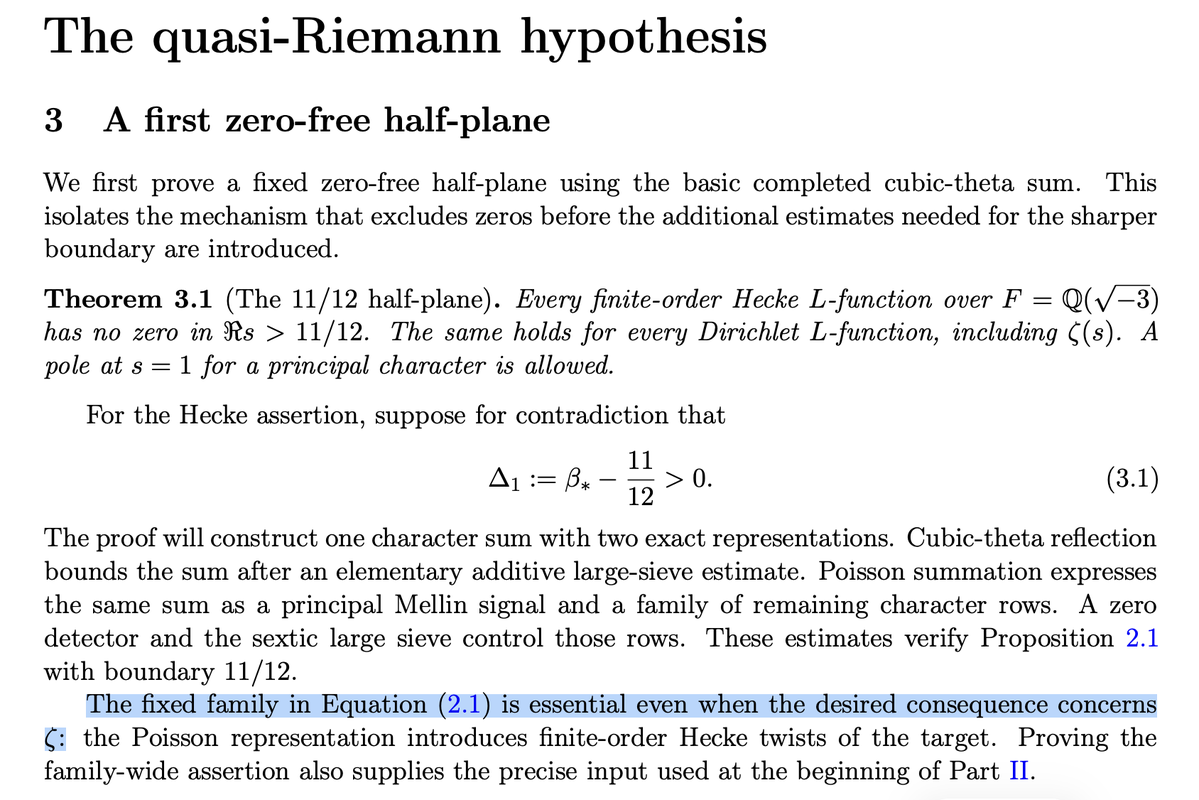
Image attached to the post
Oct 6, 2026, 7:37 PM ET On result 003

This output is absolutely historic by any objective metric. However, it is not the Millenium problem rumor that was buzzing around in past weeks. Worth bearing in mind...

Quoting @jdlichtman: OpenAI has just released floodgates for 300+ solutions to math problems. Among them include a proof of: -- a zero-free strip for the Riemann Zeta function -- a proof of the Hodge conjecture for CM abelian varieties ht...

Oct 6, 2026, 7:42 PM ET

Ok update, yes *this* updates my timelines! github.com/openai/math/blob/main/overview.pdf Rational Hodge over CM abelian varieties is true (032) and BSD for a density-one set (002 & 006). Also Hilbert's tenth problem over Q is false (004), just as everyone expected, but we didn't have a proof for!

Quoting @aran_nayebi: If either Hodge or BSD are proven to be *true* by AI (thereby likely using deep mathematical techniques), then this would update my timelines. This may also mean the Riemann Hypothesis is not far off. But if it's a be...

Oct 6, 2026, 6:40 PM ET On result 002, result 004, result 006, result 032

Incidentally, this is another instance of my "difficulty convergence" thesis. OpenAI and Anthropic both achieved the same partial case of the Hodge conjecture. That was the amount of Hodge unlocked by this current generation of models.

Quoting @ElliotGlazer: Hash=SHA2-256(Ant:CMAV.OAI:WeilOrAV.) ie, Ant had Hodge for CM abelian varieties, OAI all Weil classes or even all abelian varieties. I assumed OAI had gotten further than Ant because of how much they were hyping up t...

Oct 6, 2026, 7:39 PM ET On result 032

Somebody generalized the OpenAI O(n^{2.25}) algorithm for Fast Matrix Multiplication to general fields (not just C): github.com/selanavot/matrix-multiplication-al.... It seems to check out, including in Lean. Btw, the new FMM paper is surprisingly elegant. It uses a very different approach than previous results. Instead of powering the CW tensor and trimming it, the define a potential function on tensors, and show the whole result by contradiction by studying the simple convolution tensor. Maybe n^{9/4} is actually the right exponent for matrix multiplication...

Oct 7, 2026, 8:06 AM ET On result 107

From OpenAI

We’re releasing a broad range of new mathematical results produced by an internal frontier model. We’ve been consulting with the independent Advisory Group on Mathematics and Artificial Intelligence at the Institute for Advanced Study, and we have drawn on their advice and public recommendations to inform how we release these results. github.com/openai/math

Oct 6, 2026, 6:19 PM ET

I hope this is a gift of knowledge to humanity. I expect a renaissance in some fields of mathematics thanks to this. Polymath project bringing down 7/8 towards 1/2 when? (FWIW the method has a barrier at 3/4, so it needs a nice new idea)

Oct 6, 2026, 6:53 PM ET On result 003

Data from github.com/openai/math at commit adc7f12, committed October 6, 2026 at 21:58 UTC, last checked for changes about 7 hours ago. Titles, subjects, summaries, abstracts and Lean notes are OpenAI's; page counts are read from the PDFs. The map, related results, search, kinds of results and the named-problem index are Emergent Mind's, built with text embeddings and an LLM, and may contain errors.

An Emergent Mind Labs project. Emergent Mind is not affiliated with OpenAI. None of these results has been peer reviewed. Cite the manuscripts themselves, using the BibTeX on each result's page.