Result 109, Theoretical computer science

Integer multiplication below nlog⁡nn\log n

Multiplies two n-bit integers exactly at every input length in deterministic worst-case time O(n(log⁡n)1−κ)O(n(\log n)^{1-\kappa}), with κ=2−182\kappa=2^{-182}, on one fixed finite-alphabet Turing machine with finitely many one-dimensional tapes. This disproves the Schönhage–Strassen nlog⁡nn\log n optimality conjecture in the ordinary multitape bit model.

Disproof or counterexample

The bigger picture

Why it matters

How few elementary steps does multiplying two large integers really require? This manuscript claims an algorithm below the long-conjectured n log n speed limit, changing the proposed boundary for a basic arithmetic task.

What changes?

The unreviewed manuscript reports an exact algorithm for multiplying two n-bit integers, where n counts each number's binary digits. Its deterministic worst-case running time is O(n times (log n) to the power (1 - kappa)), with kappa = 2^-182, for every input length. It uses one fixed Turing machine with a finite symbol alphabet and a fixed finite number of one-dimensional tapes. This model counts elementary operations on stored symbols, not operations on arbitrarily large numbers as single units.

What does that help mathematicians do?

If correct, this rules out n log n as a universal lower bound for integer multiplication on ordinary multitape Turing machines, contradicting the Schönhage-Strassen optimality conjecture. Researchers seeking a sharp complexity bound would have to look below that scale. The fixed machine requirement matters: the claimed improvement does not rely on adding tapes or expanding the symbol alphabet as inputs grow.

Are there practical applications?

Its immediate relevance is foundational: it changes the claimed speed limit for exact integer arithmetic in a standard computational model. Because kappa is extraordinarily small and the abstract supplies no constants or benchmarks, the asymptotic bound alone does not establish a faster implementation at usable input sizes.

This section was generated by GPT-6 Astra Medium. This explanation is based on the result summary and manuscript abstracts below. This context is separate from OpenAI's source text.

Manuscript

Integer multiplication below n log n

September 23, 2026 73 pages

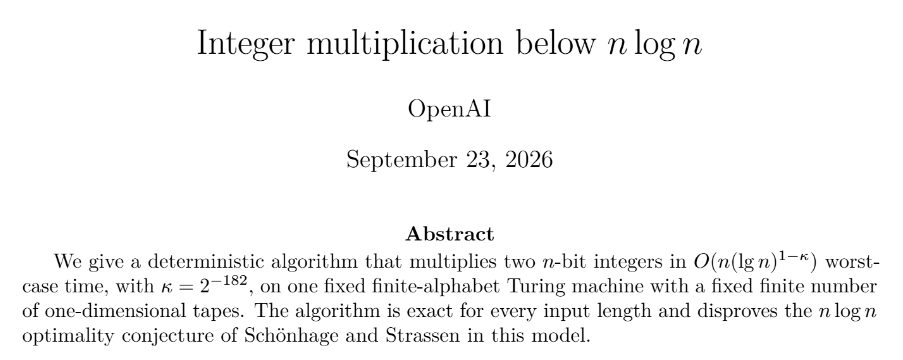
We give a deterministic algorithm that multiplies two n-bit integers in O(n(lg⁡n)1−κ)O(n(\lg n)^{1-\kappa}) worst-case time, with κ=2−182\kappa=2^{-182}, on one fixed finite-alphabet Turing machine with a fixed finite number of one-dimensional tapes. The algorithm is exact for every input length and disproves the nlog⁡nn\log n optimality conjecture of Schönhage and Strassen in this model.

Cite (BibTeX)
@misc{OAI:Integer-multiplication-below-n-log-n-September-23-2026,
  author = {{OpenAI}},
  title = {{Integer multiplication below $n\log n$}},
  howpublished = {OpenAI Math Release preprint
                  \href{https://github.com/openai/math/blob/main/preprints/Integer-multiplication-below-n-log-n-September-23-2026/paper.pdf}{OAI:Integer-multiplication-below-n-log-n-September-23-2026}},
  year = {2026}
}

Posts about this result

Data from github.com/openai/math at commit adc7f12, committed October 6, 2026 at 21:58 UTC, last checked for changes about 7 hours ago. Titles, subjects, summaries, abstracts and Lean notes are OpenAI's; page counts are read from the PDFs. The map, related results, search, kinds of results and the named-problem index are Emergent Mind's, built with text embeddings and an LLM, and may contain errors.

An Emergent Mind Labs project. Emergent Mind is not affiliated with OpenAI. None of these results has been peer reviewed. Cite the manuscripts themselves, using the BibTeX on each result's page.