
Result 003, Number theory

The quasi-Riemann hypothesis

Proves that every Dirichlet L-function, including ζ(s)\zeta(s), is zero-free in ℜs>7/8\Re s\gt 7/8, resolving the quasi-Riemann hypothesis. The same half-plane is zero-free for every finite-order Hecke L-function over Q(−3)\mathbb Q(\sqrt{-3}). A companion gives a different proof of the zero-free half-plane ℜs>11/12\Re s\gt 11/12.

Lean formalization Proof

The bigger picture

Why it matters

The manuscripts claim that broad families of number-theoretic functions never vanish in a fixed region of the complex plane. Such a uniform exclusion would give researchers a firm boundary on where their zeros can occur.

What changes?

Dirichlet L-functions are functions of a complex variable built from periodic arithmetic patterns; they include the Riemann zeta function. The main manuscript claims none vanishes where the real part exceeds seven eighths, at any imaginary height. It claims the same for every finite-order Hecke L-function, a related family over the number field obtained by adjoining the square root of minus three to the rationals. A pole at one is allowed. The companion reports the weaker threshold eleven twelfths.

What does that help mathematicians do?

If correct, the seven-eighths boundary would force every real zero between zero and one in these families to lie at least one eighth away from one. That excludes the near-one exceptional zeros known as Landau–Siegel zeros, as the companion also claims. Researchers could therefore rule out this obstruction uniformly, rather than needing an exclusion that weakens with the function's arithmetic parameters. Zeros on the boundary remain possible.

Are there practical applications?

The immediate value is foundational. A common zero-free region would provide a shared input for arguments involving zeta, Dirichlet and the specified Hecke L-functions, replacing assumptions about zeros near one with a claimed uniform guarantee. The supplied abstracts do not establish a computational speedup or an applied implementation.

This section was generated by GPT-6 Astra Medium. This explanation is based on the result summary and manuscript abstracts below. This context is separate from OpenAI's source text.

3 manuscripts

The Quasi-Riemann Hypothesis: A Zero-Free Half-Plane ℜs>7/8\Re s\gt 7/8

September 30, 2026 199 pages Main result formalized in Lean

We prove that all finite-order Hecke L-functions over Q(−3)\mathbb Q(\sqrt{-3}) and all Dirichlet L-functions are zero-free in the half-plane ℜs>7/8\Re s\gt 7/8, with the principal pole at s = 1 allowed. In particular, the Riemann zeta function is zero-free in this half-plane, proving the quasi-Riemann hypothesis.

Cite (BibTeX)
@misc{OAI:The-Quasi-Riemann-Hypothesis-September-30-2026,
  author = {{OpenAI}},
  title = {{The Quasi-Riemann Hypothesis:
            A Zero-Free Half-Plane $\mathrm{Re}(s)>7/8$}},
  howpublished = {OpenAI Math Release preprint
                  \href{https://github.com/openai/math/blob/main/preprints/The-Quasi-Riemann-Hypothesis-September-30-2026/paper.pdf}{OAI:The-Quasi-Riemann-Hypothesis-September-30-2026}},
  year = {2026}
}

The Quasi-Riemann Hypothesis (alternate 11/12 proof)

October 5, 2026 49 pages

We establish the quasi-Riemann hypothesis by proving that every Dirichlet L-function, including Riemann's zeta function, has no zeros in the half-plane Res>11/12\mathop{\mathrm{Re}}\nolimits s\gt 11/12. More generally, we prove the same zero-free half-plane for every finite-order Hecke L-function over K=Q(−3)K=\mathbb Q(\sqrt{-3}). In particular, this rules out the existence of Landau–Siegel zeros.

Cite (BibTeX)
@misc{OAI:The-Quasi-Riemann-Hypothesis-October-5-2026,
  author = {{OpenAI}},
  title = {{The Quasi-Riemann Hypothesis}},
  howpublished = {OpenAI Math Release preprint
                  \href{https://github.com/openai/math/blob/main/preprints/The-Quasi-Riemann-Hypothesis-October-5-2026/paper2.pdf}{OAI:The-Quasi-Riemann-Hypothesis-October-5-2026}},
  year = {2026}
}

Uniform exclusion of Landau–Siegel zeros

October 1, 2026 9 pages Main result formalized in Lean

We prove the uniform exclusion of Landau–Siegel zeros. There is an absolute constant c > 0 such that every real zero β∈(0,1)\beta\in(0,1) of every primitive nonprincipal real Dirichlet L-function of conductor q ≥ 3 satisfies (1−β)log⁡q≥c(1-\beta)\log q\ge c.

Cite (BibTeX)
@misc{OAI:Uniform-exclusion-of-Landau-Siegel-zeros-October-1-2026,
  author = {{OpenAI}},
  title = {{Uniform exclusion of Landau--Siegel zeros}},
  howpublished = {OpenAI Math Release preprint
                  \href{https://github.com/openai/math/blob/main/preprints/Uniform-exclusion-of-Landau-Siegel-zeros-October-1-2026/paper.pdf}{OAI:Uniform-exclusion-of-Landau-Siegel-zeros-October-1-2026}},
  year = {2026}
}

Lean formalization

OpenAI's note on what the formalization covers, from lean/docs/003.md.

The quasi-Riemann hypothesis

The following describes the scope of the Lean formalization related to the following accompanying paper(s):

Scope

The quasi-Riemann hypothesis asks for a fixed zero-free half-plane ℜs>θ\Re s>\theta with θ<1\theta<1. The formalization gives θ=7/8\theta=7/8 for the Riemann zeta function and every Dirichlet LL-function, uniformly over all positive moduli and all characters. It also establishes the same bound for finite-order Hecke LL-functions over Q(−3)\mathbb Q(\sqrt{-3}).

The principal-character poles at s=1s=1 are excluded in the Dirichlet and Hecke statements. The paper's later applications are not included.

The formalized result gives a uniform logarithmic exclusion region for Landau–Siegel zeros. There is one constant c>0c>0 such that every primitive nonprincipal real Dirichlet character of conductor q≥3q\ge3 and every real zero 0<β<10<\beta<1 of its LL-function satisfy 1−β≥c/log⁡q1-\beta\ge c/\log q.

Both character parities are included. No explicit value of cc is given. This excludes real zeros in 1−c/log⁡q<β<11-c/\log q<\beta<1, but does not rule out real zeros elsewhere in (0,1)(0,1).

Comparator links

Result Comparator statement
Riemann zeta 7/87/8 bound QuasiRiemannHypothesis.lean
Dirichlet LL-function 7/87/8 bound DirichletSevenEighths.lean
Finite-order Hecke LL-function 7/87/8 bound HeckeSevenEighths.lean
Uniform real-zero gap SiegelZeros.lean

Posts about this result

Quasi-RH?!?!???! Are you kidding me? If a human did this, it would be an instant Fields Medal, no questions asked. RH says zeta has no zeros in Re(s)>1/2. The best we had until a second ago was a region that got thinner and thinner the higher up the imaginary axis you go. I thought maybe they’d fatten that up a bit, that’d be a massive breakthrough. But no. They got a zero free strip!!!! Insane

Quoting @OpenAI: We’re releasing a broad range of new mathematical results produced by an internal frontier model. We’ve been consulting with the independent Advisory Group on Mathematics and Artificial Intelligence at the Institute f...
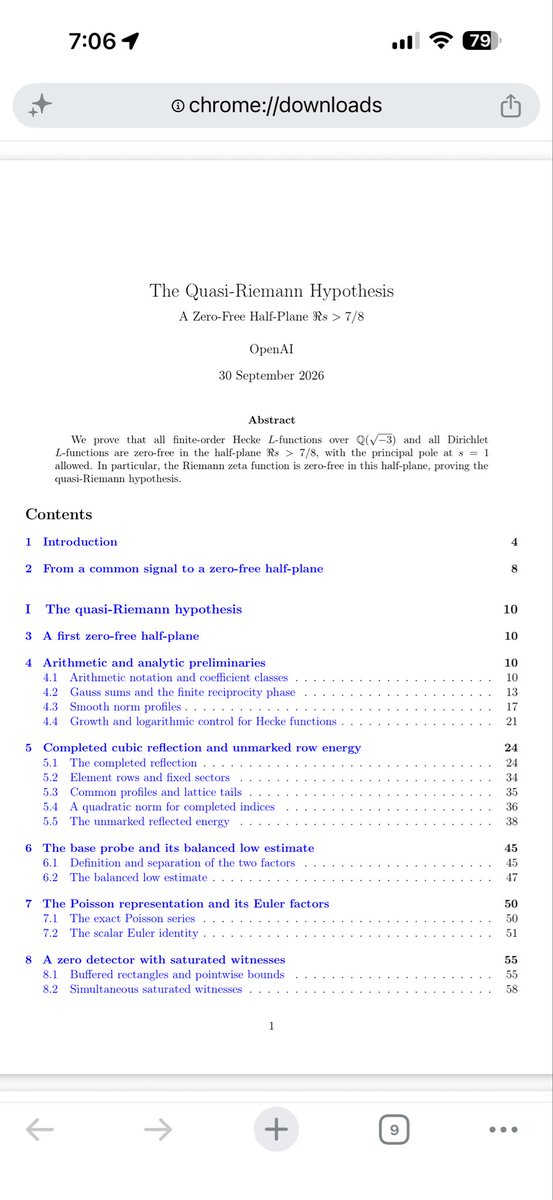
Image attached to the post
Oct 6, 2026, 7:08 PM ET

While reading their proof, important note: The cubic family of L-functions appear to be essential for the proof, even for the corollary to the Riemann zeta function

Quoting @jdlichtman: OpenAI has just released floodgates for 300+ solutions to math problems. Among them include a proof of: -- a zero-free strip for the Riemann Zeta function -- a proof of the Hodge conjecture for CM abelian varieties ht...
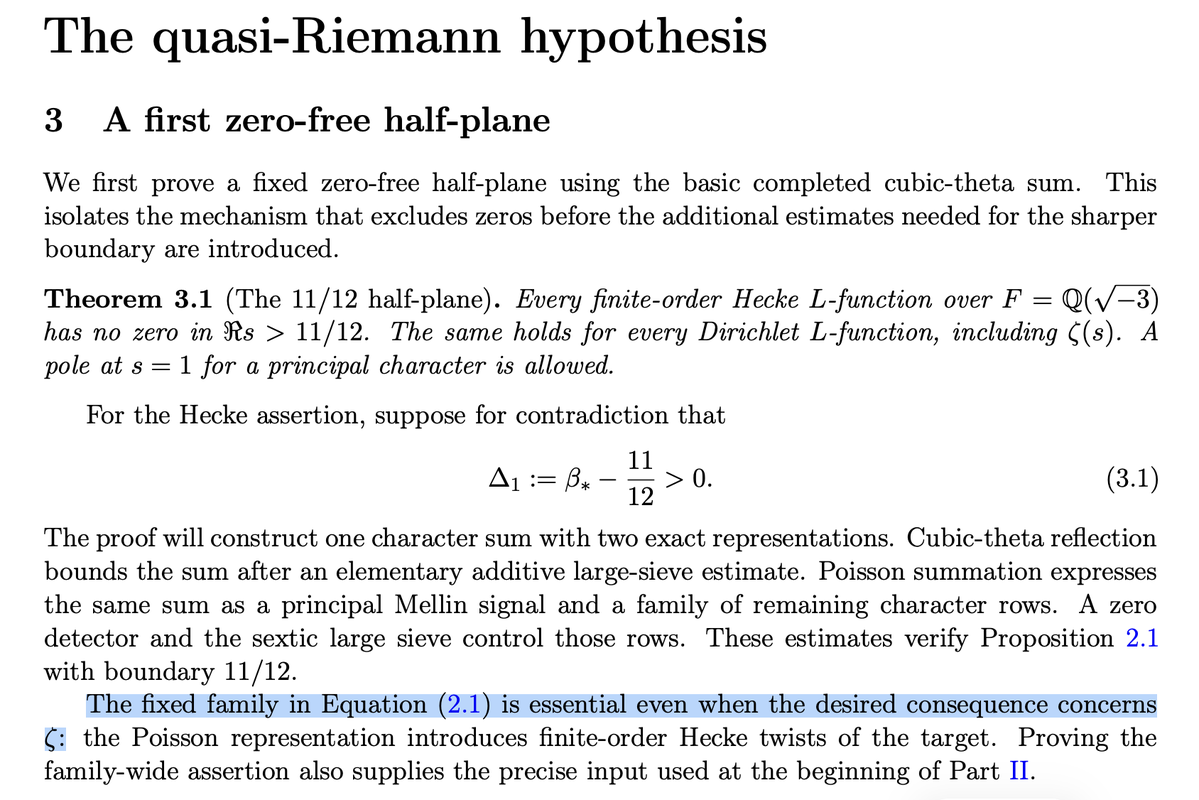
Image attached to the post
Oct 6, 2026, 7:37 PM ET

It will always be the highlight of my career to have been able to see firsthand a model make progress towards the problem that got me interested in mathematics a decade ago. It was a huge honour to have been part of this team. A uniform zero-free strip. github.com/openai/math/blob/main/preprints/Th...

Oct 6, 2026, 6:24 PM ET

I hope this is a gift of knowledge to humanity. I expect a renaissance in some fields of mathematics thanks to this. Polymath project bringing down 7/8 towards 1/2 when? (FWIW the method has a barrier at 3/4, so it needs a nice new idea)

Oct 6, 2026, 6:53 PM ET

Data from github.com/openai/math at commit adc7f12, committed October 6, 2026 at 21:58 UTC, last checked for changes about 9 hours ago. Titles, subjects, summaries, abstracts and Lean notes are OpenAI's; page counts are read from the PDFs. The map, related results, search, kinds of results and the named-problem index are Emergent Mind's, built with text embeddings and an LLM, and may contain errors.

An Emergent Mind Labs project. Emergent Mind is not affiliated with OpenAI. None of these results has been peer reviewed. Cite the manuscripts themselves, using the BibTeX on each result's page.