Ghost Flashes on Film: Replicating Nuclear Test Anomalies in 1950s Sky Surveys
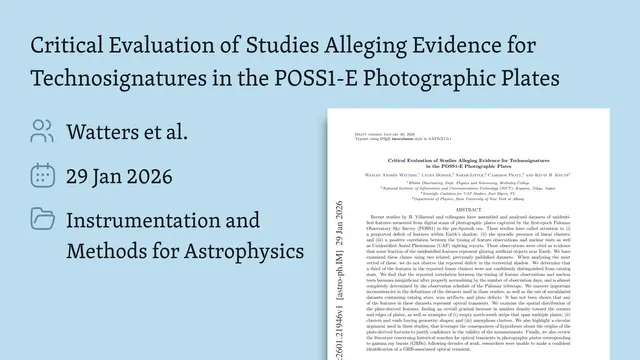
This presentation examines a rigorous independent replication of two extraordinary statistical findings in vintage astronomical photographic plates: transient detections on POSS-I plates cluster around atmospheric nuclear test dates in the 1950s, and these transients systematically avoid Earth's shadow at geosynchronous altitude—despite pre-dating Sputnik. Using confounder-adjusted regression, permutation testing, and precise shadow geometry calculations, the replication confirms both effects with high statistical confidence, raising profound questions about optically reflective phenomena in pre-Space Age skies.Script
Between 1949 and 1957, astronomical plates captured something peculiar: transient light sources that appeared more often on the exact days of atmospheric nuclear tests and were almost never found inside Earth's shadow in space. This paper confirms both patterns are statistically real.
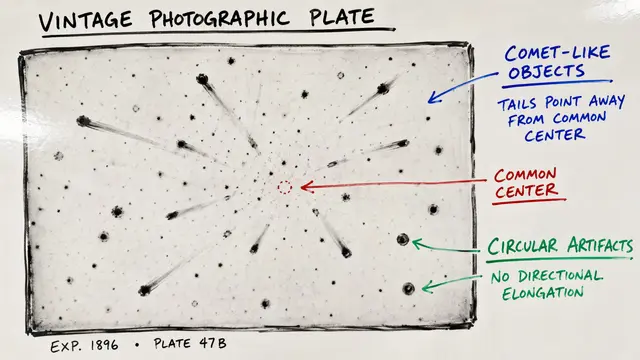
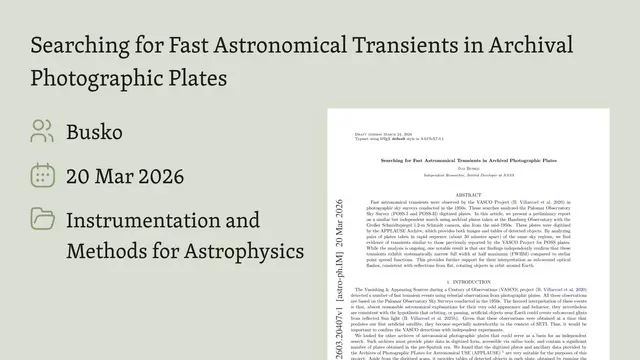
The VASCO catalog contains over 100,000 transient detections from Palomar Observatory plates taken before humanity launched its first satellite. Whatever these light sources were, they don't fit any standard astronomical category—and their behavior is deeply strange.
The replication confirms two interlocking findings. First, transient detections spike on nuclear test dates—especially in sunlit regions, suggesting reflective sources. Second, almost none appear in Earth's shadow at satellite altitude, as if something orbital was catching sunlight but vanishing when eclipsed.
To rule out artifact or coincidence, the authors deployed three independent statistical frameworks.
Chi-square tests, overdispersed count regression with environmental controls, and permutation testing all converge on the same conclusion. The nuclear test association is not explained by weather, lunar phase, or seasonal clustering. The shadow deficit survives every geometric correction and subsample restriction.
The findings systematically exclude standard explanations. Astrophysical sources don't follow human test schedules. Camera flaws don't care about solar illumination or orbital shadow geometry. And technological satellites didn't exist yet.
Something in the pre-Space Age sky was optically reflective, orbiting near geosynchronous altitude, and whose appearance correlated with atmospheric nuclear detonations. The statistics are now confirmed—the physics remains unknown. Visit EmergentMind.com to explore more research at the edge of explanation and create your own video presentations.