When Dots Aren't What They Seem
This presentation examines a critical reanalysis of recent claims that mysterious features in vintage astronomical photographs from the 1950s provide evidence of artificial objects in space. Through careful statistical analysis and dataset validation, researchers reveal how methodological issues, scan artifacts, and improper statistical controls can lead to extraordinary claims that don't hold up under scrutiny.Script
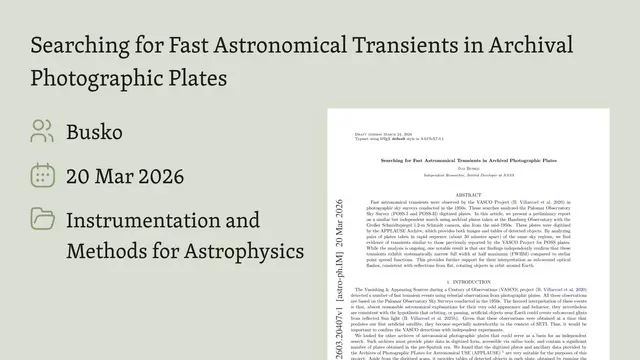
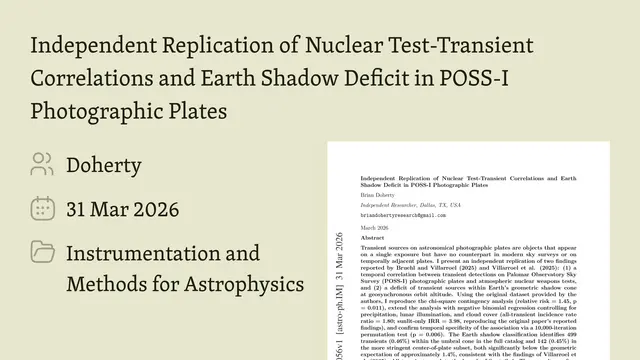
What if someone told you that mysterious spots on 70-year-old astronomical photographs were evidence of artificial objects orbiting Earth before Sputnik? Recent studies have made exactly this claim, suggesting that unidentified features in vintage sky survey plates represent technosignatures from unknown technology.
Let's first examine what these extraordinary claims actually proposed.
The original studies identified three statistically significant patterns in pre-Sputnik photographic plates. These patterns were interpreted as evidence that artificial objects were reflecting sunlight in Earth orbit during the early 1950s.
But extraordinary claims require extraordinary evidence, and this paper asks a fundamental question about that evidence.
Rather than accepting these interpretations at face value, the authors conducted a systematic reanalysis of the datasets and methods. They questioned whether the features represent real astronomical events or something far more ordinary.
Understanding this controversy requires some historical context about astronomical plate analysis.
The Palomar Observatory Sky Survey created these red-band photographic plates decades ago, and identifying real optical transients has always been notoriously difficult. Even sophisticated searches for gamma-ray burst counterparts in the 1970s and 1990s struggled to distinguish genuine astronomical events from plate artifacts.
The authors took a systematic approach to testing these claims using publicly available data.
The key difference lies in dataset quality and transparency. While the original claims relied on privately held data with unclear filtering criteria, this reanalysis used publicly available datasets with documented removal of catalog stars and scan artifacts.
The researchers applied three complementary approaches to test each major claim. They examined how features were distributed in space, simulated Earth's shadow effects, and carefully analyzed timing correlations with proper statistical controls.
The results paint a very different picture from the original technosignature claims.
When the authors applied the Earth shadow test to properly filtered data, the supposed deficit vanished entirely. The analysis revealed that features cluster in non-random patterns, violating the uniform distribution assumption that underpinned the original statistical reasoning.
The geometric alignments that seemed so compelling also crumbled under scrutiny. Many of the features in these supposed linear formations turned out to be catalog stars or scan artifacts that had escaped the original filtering process.
Perhaps most tellingly, the nuclear test correlation disappeared when researchers accounted for the actual observation schedule. Features appeared on nearly every night that Palomar took photographs, making any correlation with external events a statistical artifact of when astronomers happened to be working.
The spatial analysis revealed the most damning evidence against the technosignature interpretation.
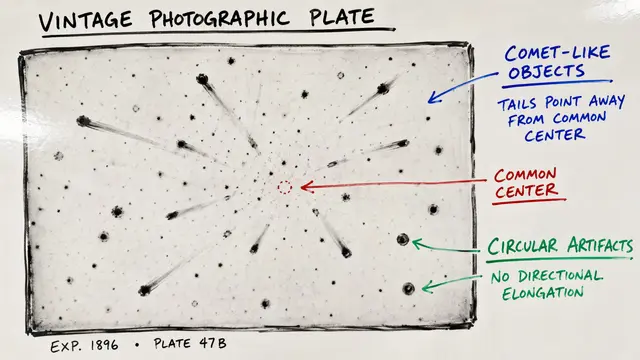
The smoking gun came from comparing spatial distributions. While real astronomical objects show the expected patterns of stellar fields, the mysterious features cluster near plate edges and form geometric patterns that scream plate processing artifacts rather than objects in space.
Beyond the specific findings, this reanalysis exposed deeper problems with the original approach.
The authors identified a fundamental logical problem in the original work. The researchers used the very patterns they claimed as evidence for technosignatures to argue that their feature detections were valid, creating a circular argument that bypassed the crucial step of proving the features were real astronomical events.
This case study offers important lessons that extend far beyond this specific controversy.
This controversy illustrates why the scientific community demands rigorous validation when extraordinary claims are made. Statistical significance becomes meaningless when the underlying assumptions about data quality and distribution are violated.
The fundamental challenge with archival astronomical plates is that numerous mundane processes can create features that look exactly like the extraordinary phenomena researchers hope to find. Without rigorous validation, it's easy to mistake the ordinary for the extraordinary.
So where does this leave the search for genuine anomalies in historical astronomical data?
The authors suggest that future searches for genuine optical transients will require physical validation of the original plates, similar to approaches used in historical gamma-ray burst searches. Modern multi-telescope networks offer much better prospects for confirming extraordinary claims in real time.
This reanalysis provides a masterclass in how rigorous scientific skepticism protects us from false discoveries.
When extraordinary claims emerge from pattern recognition in complex datasets, the most extraordinary step is often the most mundane: carefully validating that the patterns represent what we think they do. This paper demonstrates how proper statistical controls and dataset validation can transform apparent evidence for alien technology into a case study of human pattern-seeking in noisy data. The real discovery here isn't about technosignatures, but about the critical importance of methodological rigor in anomaly research. Visit EmergentMind.com to explore more research at the intersection of extraordinary claims and extraordinary evidence.