Hunting Fast Transients in 1950s Photographic Plates
This presentation examines an independent investigation into ultra-short optical transients detected in archival photographic plates from the mid-1950s Hamburg Observatory. Using pre-satellite era data from the APPLAUSE archive, researchers verify anomalous events previously reported by the VASCO project, employing a novel direct cross-matching methodology that operates on closely spaced plate pairs rather than catalog references. The findings reveal systematically narrower point spread functions consistent with sub-second flashes, raising profound questions about the nature of these transients and their implications for technosignature searches.Script
In the mid-1950s, before any satellite orbited Earth, telescope plates captured something strange: brief optical flashes that left sharp, circular signatures unlike any known star. Researchers have now independently verified these events using Hamburg Observatory archives, and the implications challenge our understanding of what was in the sky before the space age began.
The Hamburg plates come from the APPLAUSE archive, digitized at nearly 1 arcsecond per pixel resolution. Each plate was scanned twice in orthogonal directions, creating independent datasets. What makes this investigation extraordinary is its timing: these observations occurred before humanity launched artificial satellites, yet the transients look exactly like reflections from flat, rotating objects in low Earth orbit.
The question became how to find these fleeting events in century-old data.
Rather than matching against catalog references, the researchers analyzed plate pairs taken within hours of each other on the same night. Sources appearing on one plate but vanishing on its neighbor became transient candidates. The dual orthogonal scans provided a built-in validation layer, allowing rejection of spurious detections from the scanning pipeline itself.
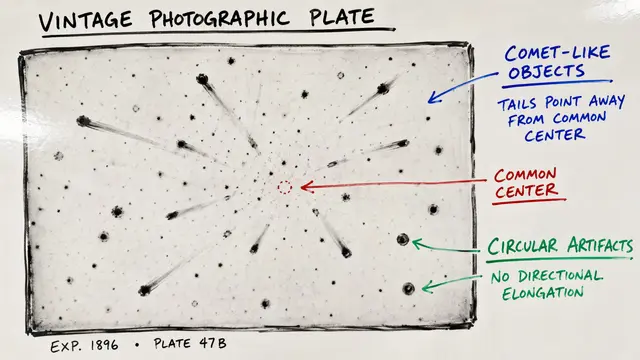
From 41 plates, 70 candidates emerged, reduced to 35 after careful vetting. These events share a distinctive signature: their point spread functions are narrower than stars, consistent with exposure times under one second. Traditional width measurements proved unreliable due to plate position and focus variations, but radial brightness profiles compared against local stellar point spread functions revealed the difference clearly.
The transients replicate exactly what the VASCO project found, strengthening the hypothesis that these are reflections from flat, rotating surfaces. But here is the profound tension: if these are glints from artificial objects, they existed in near-Earth space before humanity launched anything into orbit. The pre-Sputnik timing transforms these from curiosities into potential technosignatures.
A flash of light on a 70-year-old glass plate might be the first evidence of something in our skies before we put anything there ourselves. Visit EmergentMind.com to explore more research and create your own presentation videos.