Hidden in the Archives: Finding 2024 YR4 in 2016 Data
This presentation explores how astronomers identified precovery observations of asteroid 2024 YR4 in archival 2016 IPTF survey data, using advanced statistical methods and image analysis to constrain its orbit and definitively rule out a 2032 lunar impact. The work demonstrates how extending observational baselines through archival searches can transform planetary defense capabilities, reducing uncertainty by over 300-fold and establishing rigorous methodological standards for detecting faint objects in challenging datasets.Script
In early 2025, a 40 to 100 meter asteroid designated 2024 YR4 briefly achieved Torino Scale 3, indicating a credible Earth impact risk exceeding 1%. Although Earth impact was ruled out, the possibility of lunar collision remained troublingly uncertain, with approach distances ranging from just over 1000 kilometers to more than 75,000 kilometers from the Moon's center.
The asteroid's extreme orbit creates a problem. Direct observation is only possible during brief perihelion passages, and no follow-up observations would be feasible until 2028. That leaves years of uncertainty about the 2032 lunar encounter, introducing real operational risk for any planetary defense planning.
The solution lay hidden in old data.
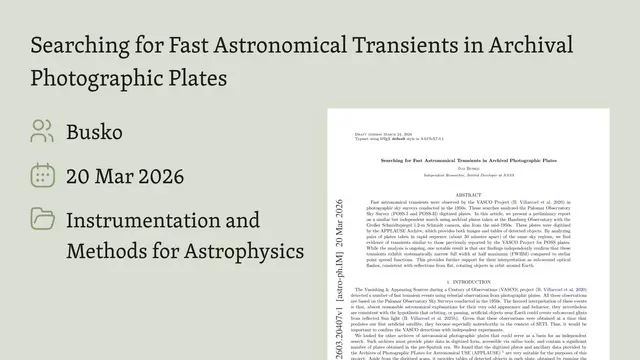
Researchers systematically combed through multiple survey archives. Most candidates were either too faint or geometrically constrained. But nine exposures from the intermediate Palomar Transient Factory in August and September 2016 had just enough depth and sky coverage to potentially capture the asteroid as it passed through.
The detection method itself is elegant in its rigor. The team sampled positions along the predicted line of variation, subtracted reference star fields from deep ZTF data, and correlated the result against synthetic images matching the expected streak length and brightness. Each candidate was then tested against both null distributions from random image locations and true positive distributions from synthetic asteroid injections, building an empirical foundation for statistical significance.
The numbers tell a compelling story. The candidate at position 0.4172 along the line of variation produced a joint probability so extreme that the null hypothesis collapses. When incorporated into the full orbital solution with all published observations, these 2016 measurements shrink the 2032 encounter uncertainty by more than 300-fold. The lunar impact scenario is not just unlikely—it is statistically excluded.
What began as a planetary defense concern ended with archival detective work, proving that sometimes the most powerful telescopes are the ones that already took the picture years ago. To explore more research like this and create your own video presentations, visit EmergentMind.com.