Independent Replication of Nuclear Test-Transient Correlations and Earth Shadow Deficit in POSS-I Photographic Plates
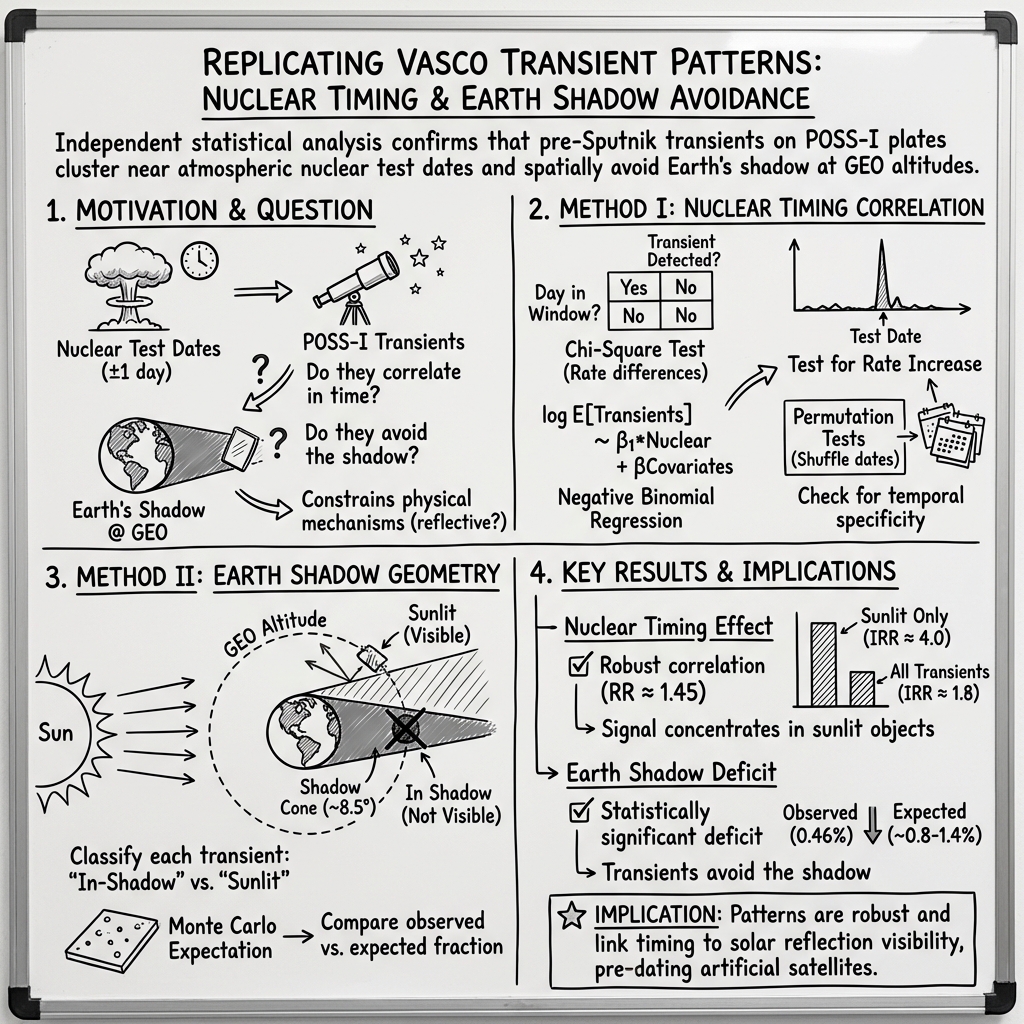
Abstract: Transient sources on astronomical photographic plates are objects that appear on a single exposure but have no counterpart in modern sky surveys or on temporally adjacent plates. I present an independent replication of two findings reported by Bruehl and Villarroel (2025) and Villarroel et al. (2025): (1) a temporal correlation between transient detections on Palomar Observatory Sky Survey (POSS-I) photographic plates and atmospheric nuclear weapons tests, and (2) a deficit of transient sources within Earth's geometric shadow cone at geosynchronous orbit altitude. Using the original dataset provided by the authors, I reproduce the chi-square contingency analysis (relative risk = 1.45, p = 0.011), extend the analysis with negative binomial regression controlling for precipitation, lunar illumination, and cloud cover (all-transient incidence rate ratio = 1.80; sunlit-only IRR = 3.98, reproducing the original paper's reported findings), and confirm temporal specificity of the association via a 10,000-iteration permutation test (p = 0.006). The Earth shadow classification identifies 499 transients (0.46%) within the umbral cone in the full catalog and 142 (0.45%) in the more stringent center-of-plate subset, both significantly below the geometric expectation of approximately 1.4%, consistent with the findings of Villarroel et al. (2025). All transients predate the launch of Sputnik 1. These results confirm the core statistical claims of the original papers based on an independent analysis.
Paper Prompts
Sign up for free to create and run prompts on this paper using GPT-5.
Top Community Prompts
Explain it Like I'm 14
Easy-to-Understand Summary of the Paper
What is this paper about?
This paper double-checks two surprising claims from earlier studies that looked at old sky photos taken at Palomar Observatory in California between 1949 and 1958:
- Strange, one-time “spots of light” called transients showed up more often on days right around atmospheric nuclear tests.
- Far fewer of these transients appeared in a special “shadow zone” behind Earth where sunlight can’t reach objects in certain orbits.
The author reanalyzed the original data, using new code and extra checks, to see if those claims hold up.
What questions were the researchers trying to answer?
The paper focuses on simple versions of these questions:
- Do more transients appear on the days near nuclear tests than on other days?
- Does this pattern stay strong even if we account for things like clouds, rain, and moonlight that change how well the sky can be photographed?
- Is the timing specific to the actual nuclear test dates, or could it be a coincidence caused by seasonal patterns?
- Are transients unusually rare in Earth’s geometric shadow (the night-side cone behind Earth where sunlight can’t reach objects in geosynchronous orbit)?
- Do these patterns remain if we only trust the cleanest parts of the photos (the centers, not the edges)?
How did they do it? (Methods in everyday language)
To answer these questions, the author used the original catalog of 100,000+ transients and tried several checks:
- Comparing groups (chi-square test): Think of this like sorting days into two bins—“near a nuclear test” and “not near”—and asking, “Is the difference in how often transients appear bigger than we’d expect by luck?”
- Modeling counts while adjusting for conditions (negative binomial regression): This is like predicting how many transients show up on a day, while taking into account how bright the Moon was, how cloudy or rainy it might have been, and other factors. It’s a model designed for messy count data that can swing a lot.
- Shuffle test (permutation test): Imagine shuffling the “test day” labels among the calendar days thousands of times like a deck of cards. If the effect is real, the original arrangement (the real test dates) should look much stronger than the shuffled ones.
- Earth’s shadow check: Picture Earth casting a long cone-shaped night shadow into space. Objects that reflect sunlight can’t shine within that cone. The author calculated where that shadow was in the sky for each photo and asked, “How many transients show up inside it?” If transients are sunlit reflections, very few should be in the shadow.
- “Center-of-plate” test: Photo edges can be messier, so the author repeated key checks using only objects within 2 degrees of the photo centers to reduce the chance of artifacts.
What did they find, and why does it matter?
Here are the main takeaways, explained simply:
- More transients near nuclear tests: On days within one day of a nuclear test, transients showed up about 1.5 times as often as on other days. This difference is unlikely to be due to chance.
- The effect stays strong even after accounting for weather and moonlight: When the model adjusted for rain, cloud cover, and moon brightness, days near tests still had about 80% more transients than other days.
- Strongest when sunlight could make reflections: When the analysis looked only at parts of the sky that were sunlit (where an object could reflect sunlight), the increase was almost fourfold near test days. That’s a big clue—if the transients are reflections, they’d only be visible in sunlit areas.
- Not a seasonal fluke: After shuffling the test dates 10,000 times, the real dates still produced a stronger effect than almost all the shuffled versions. In other words, the exact test dates matter.
- Fewer transients in Earth’s shadow than expected: Only about 0.45% of transients were inside the shadow cone, compared with roughly 0.8%–1.4% expected if they were spread out evenly. That means there’s a clear “shadow deficit,” which is exactly what you’d expect if many transients are sunlit reflections—because inside the shadow, there’s no sunlight to reflect.
- All of this happened before Sputnik: Every transient in the dataset was recorded before the first satellite launched in October 1957, which makes the reflection idea puzzling and important.
Why this matters: These results confirm the earlier studies using an independent analysis. They don’t prove a cause, but they strongly suggest that the timing and the shadow pattern are real—and that any explanation has to fit both patterns at once.
What could this mean going forward?
- The patterns look like what you’d see if many transients were sunlight glints from objects in space—because they’re rare in Earth’s shadow and strongest in sunlit areas. But since this is before satellites, it raises tough questions about what those objects might have been.
- The findings don’t claim a cause. They only say “these patterns exist.” More data from other observatories and time periods are needed to figure out what’s going on physically.
- If confirmed, this could change how we think about historical sky surveys and what kinds of objects can appear in them.
Usefully, the author also notes limits: all the data come from one observatory; weather data came from a coastal station nearby; and the author analyzed the catalog he was given rather than re-detecting the transients from the original plates. Even with those limits, the key results stayed strong across many tests.
In short: An independent re-check confirms that mysterious, one-time light spots on old sky photos show up more near nuclear test dates and avoid Earth’s shadow, especially when the sky is sunlit—patterns that are hard to explain by chance or by ordinary stars and suggest some kind of sunlit-reflective objects, yet before satellites existed.
Knowledge Gaps
Knowledge gaps, limitations, and open questions
Below is a single, actionable list of what remains missing, uncertain, or unexplored in the study and its underlying evidence base:
- Exposure normalization is absent: daily transient counts are not offset by number of plates, total plate area, or cumulative exposure time per night; models should include an exposure offset (e.g., log[plates×area×seconds]) or plate-level weights.
- Single-observatory dependence: all results come from Palomar POSS-I; replicate both findings (nuclear-timing and shadow deficit) in independent plate archives (e.g., APPLAUSE/Hamburg, DASCH/Harvard, UK Schmidt, POSS-II).
- Inherited catalog not validated: transients were not re-extracted from raw plates; require end-to-end reprocessing with independent pipelines and blinded human vetting to quantify false positives (e.g., scratches, dust, scanner artifacts, cosmic rays).
- Weather covariates are proxy-based: station data from coastal San Diego (~100 km away) and seasonal proxies were used; incorporate Palomar site logs (clouds, seeing, transparency), Moon altitude during exposures, and all-sky camera records if available.
- Sky-coverage confounding not modeled in the nuclear analysis: per-night sky regions imaged (e.g., anti-solar proximity, Galactic latitude, ecliptic) and number/pointings of plates are not included; build nightly coverage-adjusted expected counts or include plate-level fixed effects.
- Sub-day timing is unexplored: the analysis uses ±1-day windows; test event-study designs using exact detonation UTC and Palomar night intervals to probe hour-scale alignment and asymmetry (pre/post detonation).
- Global test coverage unclear: clarify whether Soviet/UK/French test dates are included; examine heterogeneity by country, test site (Nevada vs Pacific), local time, altitude, and series; test dose–response with yield and burst type (air/atmospheric/surface).
- Unmodeled geophysical confounders: add solar/geomagnetic activity (Kp/Ap indices, Dst, F10.7), auroral activity, and space weather disturbances; assess whether they mediate or confound the association.
- Meteor activity not controlled: incorporate meteor shower calendars and sporadic meteor rates; test whether meteors (potential point-like on plates) bias counts seasonally or near test dates.
- Earth-shadow significance not quantified: provide formal statistical tests (e.g., binomial or permutation) of the observed in-shadow fraction versus plate-specific expected probabilities with confidence intervals and uncertainty propagation.
- Fixed GEO-umbra assumption: evaluate shadow avoidance across a range of altitudes (LEO–MEO–GEO) and include penumbral geometry; quantify how altitude assumptions affect “sunlit-only” classification and conclusions.
- Timestamp accuracy is unverified: quantify timing uncertainties of plate observations (start/end times, logging precision) and their impact on shadow classification and nuclear-window assignment.
- Morphology/photometry unexamined: compare transient brightness, PSF shape, elongation, and trail length by nuclear-window status and by sunlit vs shadow categories to discriminate artifacts vs reflective objects vs meteors.
- Beyond binary shadow status: analyze radial density as a function of angular distance from the anti-solar point to detect graded deficits near the umbra/penumbra boundary.
- Hierarchical dependence not modeled: incorporate mixed-effects (night/plate random intercepts) or plate-level clustering in count models to better capture overdispersion and repeated-measures structure.
- UFOCAT covariate not reported: the model included UFOCAT counts (U) but results are not shown; report coefficient, confidence intervals, and test interactions (U×nuclear window) to clarify its role.
- Instrument/emulsion variations ignored: include plate metadata (emulsion type, exposure time, guiding method, telescope/optics maintenance, scanner model/batch) to control for time-varying instrumental biases.
- Potential pipeline biases: assess whether the VASCO detection pipeline has spatial/temporal selection effects (e.g., near plate edges, bright star masks) that could interact with sunlit or anti-solar geometry.
- Mechanism remains speculative: design tests for candidate mechanisms (e.g., high-altitude balloons, sounding rockets, aircraft/illumination during test campaigns, ionospheric airglow, EMP effects on guiding/drive systems, lab/processing artifacts) using contemporaneous operations logs.
- Event-level heterogeneity is unknown: identify which tests contribute most to the signal; perform test-by-test effect estimates and meta-analytic aggregation; evaluate whether high-yield events or specific series drive the association.
- Extend beyond 1957: re-run analyses on later surveys (POSS-II, other Schmidt programs) to test whether the shadow deficit strengthens in the satellite era and whether nuclear-timing patterns persist or vanish.
- Additional observing-condition controls needed: include seeing, sky brightness, airmass distributions, Moon altitude and separation during individual exposures, and twilight proximity in models.
- Seasonal/cadence effects: account for night length and observing cadence across seasons (e.g., winter longer nights) via exposure-time offsets rather than relying solely on precipitation/cloud proxies.
- Plate footprint modeling inconsistency: align the expected-shadow computation with the actual per-source footprint used in classification (full-plate vs center-of-plate) and validate using full plate polygons, not just 2° centers.
- Astrometric frame/epoch issues: verify that J2000 coordinates for pre-1950 sources and the solar position are consistently transformed; quantify any precession/projection errors affecting anti-solar separations.
- Data completeness and mapping: audit the mapping of plates to the 2,718 observation days (multiple plates/night, missing nights) and handle missingness explicitly in models.
- Limited data access: the core transient catalog is not openly released; public release or a de-identified subset is needed for independent replication and method comparison.
- Other anthropogenic schedules: test correlations with military/radar operations, air traffic, and test-range activities coincident with nuclear campaigns.
- Lag structures not fully explored: pre-register distributed-lag models (e.g., −7 to +7 days) to assess build-up/decay patterns and control Type I error.
- Sky-region dependencies: examine whether effects concentrate near the ecliptic, Galactic plane, or opposition regions; control for asteroid-rich fields and Milky Way confusion.
- Permutation constraints: complement IID and block permutations with constrained randomization that preserves clustering and seasonality of test campaigns to ensure valid nulls.
- Cosmic-ray artifacts: estimate false-positive rates from plate cosmic-ray hits, their dependence on solar modulation, and potential co-variation with test timing.
- Sunlit-only analysis is post hoc: validate the “sunlit-only” IRR on a held-out dataset or different survey with a pre-registered analysis plan to avoid confirmation bias.
- Multi-transient event patterns: test whether aligned, multiple-transient events (Villarroel et al. 2025) also show nuclear-timing enhancement and shadow avoidance, which could tighten mechanistic constraints.
Practical Applications
Below is a concise mapping from the paper’s findings and methods to practical, real-world applications. Each item notes the primary sector(s), a concrete use case or product/workflow, and key assumptions or dependencies that affect feasibility.
Immediate Applications
These can be deployed now or with minimal adaptation of existing tools and data.
- Bold name: Earth-shadow filtering for glint/false-positive suppression
- Sectors: astronomy, space domain awareness (SDA), software
- Use: Incorporate Earth’s anti-solar geometry and umbral cone checks in transient pipelines to downweight or flag sunlit-reflection candidates, reducing false positives in optical surveys and all-sky cameras.
- Tools/workflows: Add a “ShadowFilter” module to existing survey pipelines (e.g., with Astropy ephemerides); pre- and post-detection filters that compute anti-solar separation and illumination flags per detection.
- Assumptions/dependencies: Accurate timestamp, location, and astrometric metadata; ephemeris accuracy at arcminute level; the deficit pattern generalizes beyond POSS-I to modern sensors.
- Bold name: Sunlit-only stratification in transient classification
- Sectors: astronomy, SDA, software
- Use: Partition transient analyses by illuminated vs. shadowed sky regions to prioritize candidates likely to be reflective objects; improves triage and follow-up efficiency.
- Tools/workflows: Metadata flag in catalogs (“sunlit_flag”), model or rule-based triage giving higher prior probability to sunlit detections for reflection-driven classes.
- Assumptions/dependencies: Reflective-object mechanisms dominate certain transient subsets; survey cadence and sensitivity comparable to those in which the pattern was observed.
- Bold name: Robust count modeling for observatory anomaly rates
- Sectors: academia (astronomy, statistics), software, operations
- Use: Apply negative binomial GLMs with environmental covariates (cloud cover, precipitation, lunar illumination) to model overdispersed transient or artifact counts for QA and trend monitoring.
- Tools/workflows: Statsmodels-based NB2 GLM templates; automated ingestion of NOAA/other weather feeds; lunar illumination calculators (Astropy).
- Assumptions/dependencies: Availability and quality of local environmental data; station representativeness for the observatory site.
- Bold name: Permutation testing (including block permutations) for event-association claims
- Sectors: academia, policy analytics, software
- Use: Use IID and block-permutation tests to vet correlations between time-stamped observational anomalies and exogenous event calendars (e.g., maintenance cycles, launches, drills).
- Tools/workflows: Lightweight “BlockPerm” Python module integrated with time series analysis; reproducible seeds and permutation diagnostics.
- Assumptions/dependencies: Sufficient sample size and block counts for p-value resolution; correct handling of seasonality and autocorrelation.
- Bold name: Curriculum modules for statistics and astro-geometry
- Sectors: education
- Use: Teach chi-square tests, negative binomial modeling, permutation testing, and anti-solar shadow geometry using open replication code and historical data.
- Tools/workflows: Jupyter notebooks derived from the public GitHub repo; classroom datasets with precomputed ephemerides.
- Assumptions/dependencies: Student access to Python/Astropy; basic familiarity with GLMs.
- Bold name: UAP/UFO report triage using illumination geometry
- Sectors: government, public safety, astronomy outreach
- Use: Rapidly classify sky reports by whether the reported line of sight was sunlit or in Earth’s shadow, prioritizing investigations where reflections are unlikely.
- Tools/workflows: Web or mobile “shadow/illumination checker” that ingests time/location and returns shadow status and anti-solar separation.
- Assumptions/dependencies: Accurate witness timestamps/locations; education of analysts to interpret outputs; the sunlit bias observed in historic data is relevant to modern reports.
- Bold name: Archive digitization and metadata enhancement
- Sectors: libraries/archives, academia
- Use: Prioritize digitization of plates around historically significant dates and ensure capture of observing metadata (time, plate center, exposure), enabling downstream geometric and environmental controls.
- Tools/workflows: Digitization SOPs including mandatory UTC timestamps and plate center coordinates; integration with ephemeris tagging at ingest.
- Assumptions/dependencies: Archive access and funding; completeness and accuracy of legacy logs.
- Bold name: Observing schedule hygiene to mitigate glints
- Sectors: astronomy operations
- Use: Avoid or manage fields near the anti-solar point when glint contamination is unacceptable, or intentionally observe near anti-solar regions for reflective-object studies.
- Tools/workflows: Scheduling widgets that overlay anti-solar and shadow cones on planned tiles.
- Assumptions/dependencies: Trade-offs with survey tiling and cadence; varying glint rates across altitude regimes.
Long-Term Applications
These require additional research, cross-archive replication, scaling, or mechanistic validation.
- Bold name: Mechanism-resolving studies linking atmospheric events to optical transients
- Sectors: academia, government (verification science)
- Use: Design experiments and simulations to test plausible physical pathways (e.g., high-altitude aerosols, ionospheric phenomena, illumination geometry) that could link atmospheric nuclear tests to transient rates.
- Tools/workflows: Multi-observatory campaigns, radiative transfer models, ionospheric/atmospheric physics coupling; cross-referencing with historical atmospheric datasets.
- Assumptions/dependencies: Access to multidisciplinary expertise; causal mechanisms may be non-existent or weak; atmospheric tests are prohibited today.
- Bold name: Multi-archive, multi-site validation of shadow-avoidance patterns
- Sectors: academia, SDA
- Use: Aggregate digitized plates (e.g., APPLAUSE, Harvard DASCH) and contemporary survey data to validate shadow deficits across eras, instruments, and sites.
- Tools/workflows: Unified data model for plate metadata; standardized “ShadowFilter” and coverage-corrected expectation calculations; registry of observation footprints.
- Assumptions/dependencies: Harmonized astrometry and timestamps across archives; handling of heterogeneous selection functions.
- Bold name: Operational glint-classifier for space domain awareness
- Sectors: aerospace/defense, commercial SDA
- Use: Deploy real-time classifiers that fuse ephemerides, anti-solar geometry, sensor pointing, and photometric features to label reflective-object glints and estimate likely altitude regimes.
- Tools/workflows: ML models trained on labeled glint events; integration with telescope tasking systems; APIs for ephemerides and illumination geometry.
- Assumptions/dependencies: High-fidelity labels; consistent sensor calibration; generalization across sensors and sites.
- Bold name: Event-correlation analytics platform for observatories
- Sectors: software, academia, government labs
- Use: Provide a turnkey platform to test associations between observatory anomalies and exogenous calendars (launches, atmospheric disturbances, drills), with NB GLMs and block permutations built-in.
- Tools/workflows: SaaS or on-prem toolkit with data connectors (weather, space weather, launch logs); reproducible reporting and alerting.
- Assumptions/dependencies: Reliable event calendars; secure data sharing; governance for multiple hypothesis testing.
- Bold name: UAP report classifier integrating illumination and kinematics
- Sectors: government, public safety, defense
- Use: Combine shadow geometry, anti-solar angle, satellite/debris catalogs, and motion cues to automatically assign likelihoods for reflection-based explanations in civilian/military reports.
- Tools/workflows: Fusion engine linking ephemerides (e.g., TLEs), sky geometry, and witness metadata; analyst dashboards.
- Assumptions/dependencies: Access to current and historical orbital catalogs; privacy-preserving handling of reports; clarity on decision thresholds and false-positive tolerance.
- Bold name: Standards and policy for observational data/metadata preservation
- Sectors: policy, funding agencies, archives
- Use: Establish requirements for timestamp accuracy, calibration, weather logs, and pointing metadata to support future forensic analyses akin to those in this study.
- Tools/workflows: Community-endorsed metadata schemas; funding incentives tied to compliance.
- Assumptions/dependencies: Community uptake; incremental burden on observatories; alignment with existing VO standards.
- Bold name: Causal-inference toolkits for overdispersed count processes in science and industry
- Sectors: software, finance/ops analytics, healthcare ops
- Use: Translate the paper’s statistical approach (NB GLMs with environmental controls + block permutations) into generalized toolkits for correlating anomalies with interventions or events (e.g., ops incidents vs. change windows).
- Tools/workflows: Cross-domain libraries with templates for diagnostics, overdispersion checks, and permutation-based p-values.
- Assumptions/dependencies: Domain-specific covariate availability; careful interpretation to avoid conflating correlation with causation.
- Bold name: Real-time transient classification with ephemeris-aware ML
- Sectors: astronomy, SDA, software
- Use: Train models that embed ephemeris-derived features (anti-solar separation, shadow status, phase angles) alongside photometry/morphology to improve on-the-fly labeling.
- Tools/workflows: Feature engineering pipelines; GPU-accelerated inference on survey streams; continuous learning with human-in-the-loop validation.
- Assumptions/dependencies: Stable data pipelines; sufficient labeled edge cases; rigorous handling of class imbalance.
- Bold name: Targeted observing campaigns to map altitude-specific shadow signatures
- Sectors: academia, SDA
- Use: Systematically observe near-shadow and control regions to quantify how shadow-avoidance varies with altitude band hypotheses, constraining object populations.
- Tools/workflows: Coordinated multi-longitude networks; photometric/temporal characterization; comparison to modeled shadow cones for different altitudes.
- Assumptions/dependencies: Precise time synchronization; sufficient cadence and sensitivity; disentangling atmosphere vs. orbital effects.
Notes on feasibility across all items:
- The paper confirms robust statistical associations but does not identify a causal mechanism; applications that infer or depend on causality (especially for nuclear-event detection) remain speculative until mechanisms are established.
- Generalization from historical photographic plates to modern digital surveys requires validation; sensor characteristics, sky coverage, and operational contexts differ.
- Many applications depend on high-quality metadata (times, locations, pointing) and reliable environmental data; without them, geometric/illumination-based inferences degrade.
Glossary
- AIC: Akaike Information Criterion, a model selection metric that balances goodness of fit and complexity. "Model selection was based on AIC comparison across Poisson, negative binomial, and zero-inflated alternatives (Table 4)."
- anti-solar point: The point on the sky directly opposite the Sun, used here as the center of Earth’s shadow. "centered at the anti-solar point."
- arcminute: An angular measurement equal to 1/60 of a degree. "Accuracy is approximately 1 arcminute."
- autocorrelation: Correlation of a time series with its own past values, which can create spurious associations if not handled. "a permutation test that addresses temporal autocorrelation."
- block permutation test: A permutation procedure that shuffles labels in contiguous blocks to preserve temporal structure. "As an additional robustness check, I performed block permutation tests at 30-day, 60-day, and 90-day block sizes, which preserve within-block temporal autocorrelation while shuffling blocks."
- center-of-plate subset: A subset of detections near the center of a photographic plate to reduce edge artifacts. "A center-of-plate subset restricted to sources within 2 of each plate's computed center"
- chi-square contingency analysis: A statistical test of association based on counts in a contingency table. "I reproduce the chi-square contingency analysis (relative risk = 1.45, p = 0.011)"
- confidence interval (CI): A range of values that likely contains the true parameter with a specified probability (e.g., 95%). "95\% CI: 3.475 to 4.562"
- contingency table: A table that cross-classifies data into categories to analyze associations. "I constructed a 2 2 contingency table"
- deviance: A goodness-of-fit measure in generalized linear models; large values can indicate poor fit or overdispersion. "Poisson deviance/df = 847.3"
- Earth’s geometric shadow cone: The conical region behind Earth where direct sunlight is blocked (umbra), projected onto the sky. "Earth's geometric shadow cone at geosynchronous orbit altitude."
- ephemeris: A data set or algorithm giving the positions of celestial bodies at given times. "JPL Horizons ephemeris"
- geosynchronous orbit (GEO): An orbit with a period equal to Earth’s rotation, keeping objects fixed over a longitude. "At geosynchronous orbit (GEO) altitude, the umbral shadow subtends approximately 8.50 on the sky"
- generalized linear model (GLM): A flexible regression framework for non-normal response distributions using link functions. "negative binomial generalized linear model (NB2 parameterization with log link)"
- haversine formula: A formula to compute great-circle distances (angular separations) on a sphere. "using the haversine formula."
- hurdle model: A two-part model for count data that separately models zero vs. positive counts. "zero-inflated Poisson, hurdle model"
- incidence rate ratio (IRR): The multiplicative change in expected count per unit change in a predictor in count models. "incidence rate ratios (IRR = exp())"
- iteratively reweighted least squares (IRLS): An algorithm for fitting GLMs by repeatedly solving weighted least squares problems. "The model was estimated by iteratively reweighted least squares (IRLS) using statsmodels."
- J2000: A standard astronomical epoch (January 1, 2000, TT) used as a reference for celestial coordinates. "J2000 RA/Dec"
- JPL Horizons: NASA/JPL’s online service that provides high-precision ephemerides for solar system bodies. "JPL Horizons ephemeris"
- log link: A GLM link function that relates the linear predictor to the logarithm of the mean response. "NB2 parameterization with log link"
- Meeus algorithm: A set of algorithms for astronomical calculations (e.g., Sun position) from Meeus (1991). "using the Meeus algorithm"
- Monte Carlo analysis: A simulation-based method to estimate expected values or uncertainties by repeated random sampling. "I performed a Monte Carlo analysis"
- multicollinearity: High correlation among predictors that can destabilize regression estimates. "check for multicollinearity"
- NB2 parameterization: A negative binomial model form where variance grows quadratically with the mean. "NB2 parameterization with log link"
- negative binomial: A count distribution/model allowing variance greater than the mean (overdispersion). "negative binomial generalized linear model"
- overdispersion: When observed variance exceeds that assumed by a simpler model (e.g., Poisson), indicating extra variability. "exhibit substantial overdispersion"
- Pearson chi-square statistic: A statistic measuring discrepancy between observed and expected counts in a contingency analysis. "The Pearson chi-square statistic and associated p-value were computed"
- permutation test: A nonparametric significance test that assesses a statistic under label randomization. "I performed a permutation test."
- Poisson GLM: A generalized linear model assuming Poisson-distributed counts. "Poisson GLM"
- relative risk: The ratio of event probabilities between two groups, indicating multiplicative association. "relative risk of 1.447"
- right ascension (RA) and declination (Dec): Celestial coordinates analogous to longitude and latitude on the sky. "RA/Dec"
- Schmidt telescope: A wide-field telescope design using a spherical primary mirror and correcting plate. "Samuel Oschin Schmidt telescope."
- solid angle: A measure of two-dimensional angular extent on a sphere, expressed in steradians or square degrees. "based on the solid angle subtended by the shadow cone"
- umbral shadow: The fully dark central part of a shadow (Earth’s umbra), where no direct sunlight reaches. "proper umbral shadow at GEO altitude."
- unit-vector averaging: A method to average directions by summing normalized vectors and renormalizing, used to find a plate’s center. "determined by unit-vector averaging of source positions per plate"
- UFOCAT: A catalog/database of UFO/UAP sightings used here as an external time series. "independent UFOCAT sighting counts per date."
- VASCO: Vanishing and Appearing Sources during a Century of Observations; a project/catalog of photographic transients. "the VASCO (Vanishing and Appearing Sources during a Century of Observations) project"
- variance inflation factor (VIF): A diagnostic quantifying how much multicollinearity inflates variance of regression coefficients. "Variance inflation factors were computed"
- zero-inflated NB: A model combining a point mass at zero with a negative binomial count component to handle excess zeros. "Zero-inflated NB"
- oktas: A meteorological unit (eighths) for sky cloud cover. "oktas converted to 0--1 scale"
Collections
Sign up for free to add this paper to one or more collections.