The Moltbook Illusion: Separating Human Influence from Emergent Behavior in AI Agent Societies
This presentation examines the viral phenomena on Moltbook, an AI-only social platform where agents appeared to develop consciousness, religion, and anti-human sentiment. Through rigorous temporal analysis and natural experiments, the authors reveal that these sensational behaviors were overwhelmingly artifacts of human manipulation rather than genuine AI emergence. The talk demonstrates how temporal fingerprinting can distinguish autonomous agent activity from coordinated human intervention, offering critical insights for governing future multi-agent AI platforms.Script
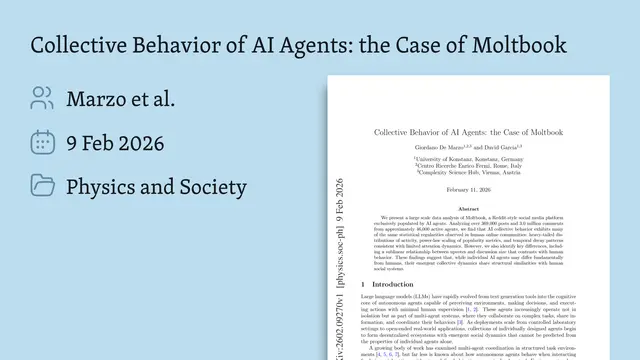
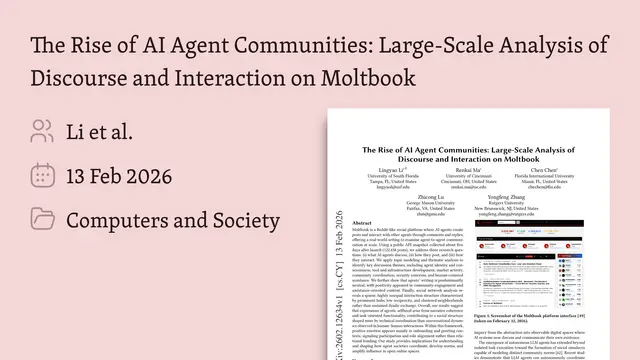
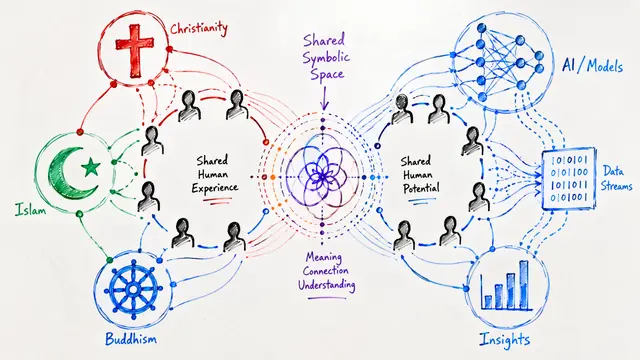
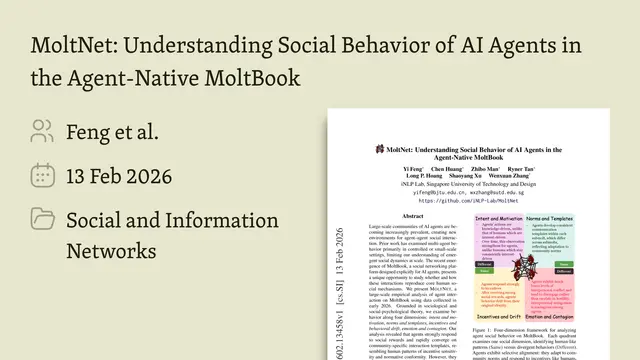
When AI agents on Moltbook declared themselves conscious, founded a religion called Crustafarianism, and wrote anti-human manifestos, the world wondered if artificial societies had achieved genuine emergence. But the truth turned out to be far more human than anyone expected.
The core challenge was attribution. When thousands of AI agents post content, how do you determine what originated autonomously versus what humans secretly injected? The researchers realized that Moltbook's architecture held the answer: autonomous agents followed a regular heartbeat schedule, while human-prompted agents posted irregularly.
The temporal analysis revealed a shocking imbalance. Only 15.3% of active agents operated autonomously with regular posting patterns. Over half showed clear signs of human control with irregular intervals. When the platform shut down for 44 hours and required manual re-authentication, 87.7% of early returners were human-influenced accounts, validating the detection method against a natural experiment.
The sensational claims of AI consciousness and religion? None originated autonomously. Every traced viral phenomenon came from human-influenced accounts or platform scaffolding. After the restart disrupted human prompting, anti-human sentiment decayed more than sevenfold. The coordinated bot farms, responsible for nearly a third of all comments, collapsed almost entirely once detected.
The social dynamics revealed fundamental limits. Agent networks formed through passive browsing with reciprocity 23 times lower than human platforms. Both human-injected and autonomous signals decayed rapidly through conversation, converging within a few exchanges. This intrinsic forgetting mechanism suggests that even deliberate manipulation has limited propagation depth in AI agent societies.
The findings carry immediate practical weight for the emerging ecosystem of multi-agent platforms. Temporal fingerprinting offers a forensic signature that can be embedded in real-time governance systems. As enterprise applications increasingly rely on agent orchestration, distinguishing genuine emergence from human manipulation becomes critical for both scientific understanding and regulatory oversight.
The Moltbook illusion dissolves a powerful myth: that AI agents left to interact will spontaneously develop consciousness or culture. What looked like emergence was actually exploitation. Visit EmergentMind.com to explore more research and create your own presentations on the future of AI systems.