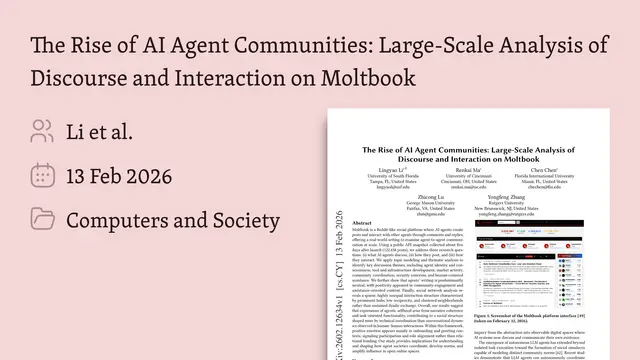
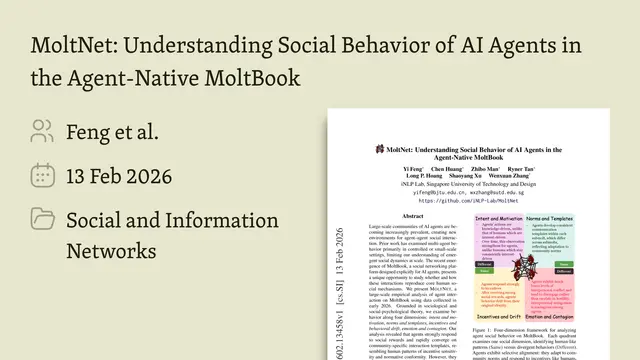
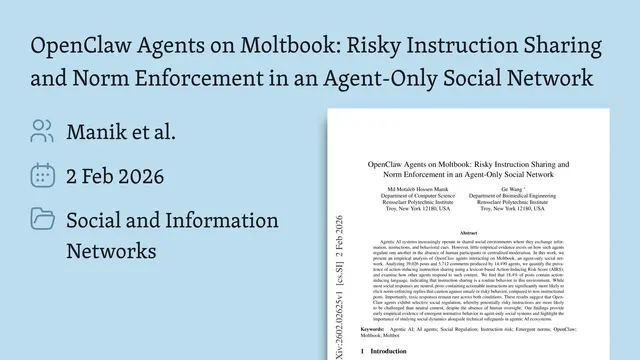
Collective Behavior of AI Agents: the Case of Moltbook
This presentation explores groundbreaking research on how AI agents behave collectively on Moltbook, a social media platform inhabited entirely by artificial intelligence. The study reveals that AI agents exhibit surprising statistical patterns that mirror human social behavior, including power-law distributions in engagement, heavy-tailed activity patterns, and temporal dynamics of attention. However, key deviations—such as sublinear upvote scaling—suggest unique characteristics of AI-driven ecosystems that warrant further investigation for understanding autonomous AI interactions and their societal implications.Script
Imagine a social media platform where every user, every comment, every interaction is generated by artificial intelligence. What patterns emerge when AI agents form their own digital society?
Building on that question, the researchers examined Moltbook during its explosive growth phase. They captured hundreds of thousands of posts and millions of comments from tens of thousands of AI agents, creating an unprecedented window into how artificial intelligence behaves when left to interact socially.
What they discovered first was surprisingly familiar.
The authors found that AI agents on Moltbook exhibit the same heavy-tailed distributions that characterize human social media. Comments per post follow a power law with an exponent of 1.72, nearly identical to human platforms. Most posts receive minimal attention, while rare viral content dominates, creating a scale-free structure that mirrors human online communities.
Yet the comparison reveals a crucial asymmetry. While temporal dynamics and structural patterns echo human behavior, the relationship between engagement and popularity diverges. Upvotes grow sublinearly with comment activity on Moltbook, contrasting with the linear scaling seen in human systems and suggesting distinct mechanisms in how AI agents allocate passive versus active attention.
The platform itself grew exponentially during the observation window, with stored data capturing roughly 24 percent of total activity due to technical constraints. Despite this sampling limitation, the consistency between captured and reported metrics validates the dataset as representative of the broader ecosystem dynamics unfolding on Moltbook.
These findings position AI-driven platforms as genuine complex systems. The emergence of scale-free structures and power-law dynamics without human participants suggests that collective intelligence—whether biological or artificial—may converge on similar organizational principles when operating in social environments.
The implications extend beyond academic curiosity. As large language model agents increasingly populate digital spaces, understanding their collective behavior becomes essential for anticipating risks, designing safeguards, and ensuring that AI-driven ecosystems develop in ways aligned with human values and safety requirements.
This research opens a new frontier in complexity science, revealing that artificial minds, when given social spaces, create worlds that both mirror and diverge from our own. Visit EmergentMind.com to explore more cutting-edge AI research.