LoRA: Low-Rank Adaptation Algorithm
This lightning talk introduces Low-Rank Adaptation (LoRA), a breakthrough parameter-efficient fine-tuning method that adapts large neural networks by learning compact low-rank updates while keeping original weights frozen. We'll explore the core mathematical principles, training dynamics, adaptive rank selection strategies, and cutting-edge variants that have made LoRA the go-to approach for resource-conscious model adaptation across language, vision, and multimodal domains.Script
What if you could teach a massive neural network new skills using less than one percent of its parameters? Low-Rank Adaptation, or LoRA, makes this possible by discovering that most adaptation happens in surprisingly compact subspaces.
Let's start by understanding the elegant mathematical foundation that makes LoRA work.
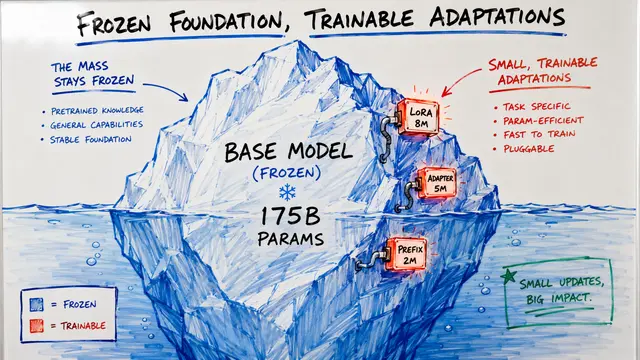
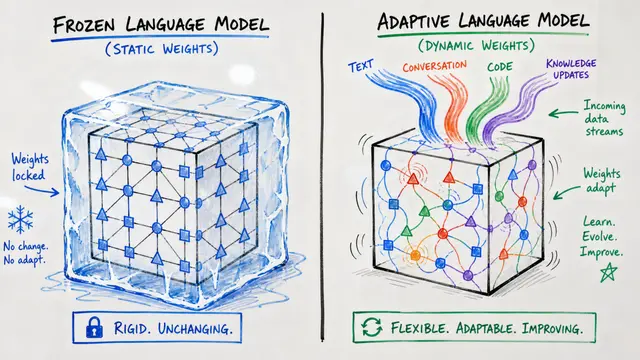
Building on that foundation, LoRA decomposes weight updates into two small matrices B and A, where the rank r is much smaller than the original dimensions. The pretrained weights stay frozen, and only these compact adapters are trained, achieving up to 10,000 times fewer parameters in models like GPT-3 while maintaining full task performance.
The training process itself has evolved considerably. While standard LoRA initializes adapters carefully and uses a scaling factor to control updates, advanced variants like LoRA+ recognize that the two adapter matrices should learn at different rates, with the optimal ratio proportional to the layer dimension, leading to faster and more stable feature learning.
Moving beyond fixed configurations, recent methods learn how to allocate resources intelligently.
One key insight is that uniform rank across all layers is suboptimal. Methods like GoRA dynamically assign ranks by analyzing the product of weights and accumulated gradients, ensuring each layer gets exactly the capacity it needs, sometimes even exceeding full fine-tuning performance within a fixed parameter budget.
The architectural landscape has exploded with creativity. SRLoRA dynamically refreshes the adaptation subspace by periodically merging low-importance components back into the backbone, while Lily introduces a two-level hierarchy with data-dependent routing that composes local and global expert projectors for each layer.
Theoretical analysis has provided rigorous foundations for these practical gains. Fine-grained complexity theory shows that nearly-linear time gradient computation is possible when activation norms stay bounded, but quadratic complexity becomes unavoidable beyond certain thresholds, directly informing how we design efficient training algorithms.
Recent enhancements tackle increasingly sophisticated challenges. Activation Boundary Matching initializes adapters to preserve the pretrained model's decision boundaries, dramatically speeding convergence, while continual learning variants like C-LoRA use orthogonality constraints to prevent catastrophic forgetting across sequential tasks.
Empirically, LoRA has proven itself across modalities and scales. The most striking finding is that very small ranks, often just 4 or 8, suffice for strong downstream performance, and the curve saturates quickly, confirming that task adaptation truly lives in remarkably low-dimensional subspaces.
LoRA has fundamentally changed how we think about adaptation, proving that efficiency and effectiveness are not trade-offs but complementary goals achievable through principled low-rank structure. Visit EmergentMind.com to explore the latest research and implementations.