Free-Range Gaussians: Non-Grid-Aligned Generative 3D Gaussian Reconstruction
This presentation explores a breakthrough in 3D object reconstruction from sparse views. By abandoning traditional grid-aligned approaches and instead using flow matching on non-grid-aligned 3D Gaussians, the method achieves high-fidelity reconstructions with 10 times fewer Gaussians. Through hierarchical patchification and reconstruction-guided generative modeling, the system produces sharp, complete 3D objects even when large portions are unobserved—addressing a fundamental limitation of regression-based methods that produce blurry holes in missing regions.Script
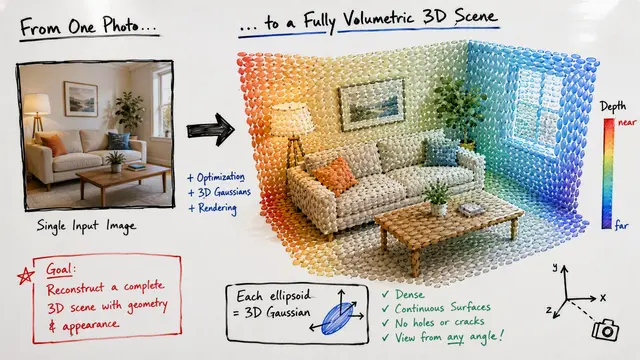
Typical 3D reconstruction methods anchor their predictions to pixel or voxel grids, creating dense, redundant representations that struggle when parts of an object are hidden. This paper breaks free from that constraint entirely, letting Gaussians roam anywhere in space to build complete 3D objects from just four views.
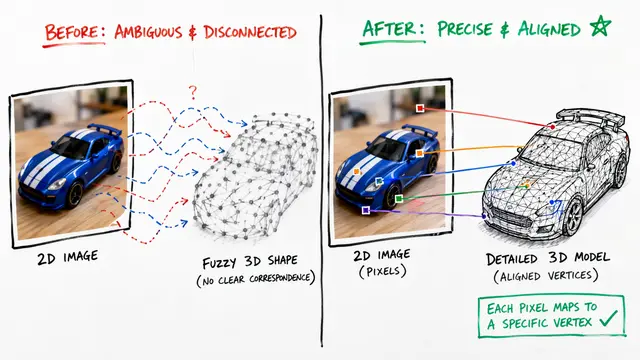
Why does grid alignment matter? When you force 3D representations onto 2D pixel grids or 3D voxel grids, you inherit their structure and their waste. More critically, when a region is never seen in your sparse input views, regression models can only average over possibilities, yielding blurred, incomplete geometry. The authors reframe this as a generative problem, sampling from conditional distributions to synthesize sharp, plausible content where none was observed.
The technical machinery behind this involves three interlocking innovations.
Standard transformers choke on tens of thousands of Gaussians. The authors build a hierarchical binary tree over the Gaussian parameters, where spatially nearby Gaussians become siblings. At any chosen depth, sibling pairs merge into single tokens, cutting sequence length in half while preserving local structure. A coarse-to-fine curriculum starts training with just 2,000 Gaussians and scales up, making the entire pipeline tractable without sacrificing detail.
Generative models risk losing fidelity to the input views. To counter this, the system employs three guidance mechanisms. A timestep-weighted photometric loss increases supervision weight as denoising progresses. Gradients from the rendering loss are concatenated to the input at every step, directly steering parameter updates. Finally, classifier-free guidance blends conditional and unconditional predictions at test time, pulling the output toward consistency with observed views. Ablations confirm that each mechanism contributes meaningfully to both metrics and visual quality.
This figure encapsulates the core result. Given just four sparse input views, the method produces a complete, high-fidelity 3D Gaussian set. The reconstruction matches or exceeds the perceptual quality and numerical fidelity of grid-aligned baselines, yet uses an order of magnitude fewer Gaussians. Unobserved regions are filled with sharp, plausible geometry rather than the blurry averaging artifacts typical of regression approaches. The combination of generative modeling and spatial freedom yields both compactness and completeness.
Free-Range Gaussians demonstrates that liberating 3D representations from grids unlocks generative power and spatial efficiency simultaneously. To explore more cutting-edge research and create your own video presentations, visit EmergentMind.com.