Neural Implicit Flow: Mesh-Agnostic Dimensionality Reduction
This presentation explores Neural Implicit Flow (NIF), a breakthrough framework that revolutionizes how we compress and represent complex spatio-temporal data. Unlike traditional methods that struggle with variable geometries and adaptive meshes, NIF uses two specialized neural networks to achieve mesh-agnostic dimensionality reduction. We examine its architecture, validation across turbulent flows and dynamic systems, and remarkable performance gains including 40% improved generalization and 34% error reduction compared to state-of-the-art methods.Script
Traditional dimensionality reduction breaks down when your mesh changes, your geometry varies, or your grid adapts. The authors of this paper introduce Neural Implicit Flow, a framework that finally makes dimensionality reduction mesh-agnostic.
Engineering simulations generate data on meshes that morph, adapt, and vary across cases. A turbulent flow might use 2 million cells in one configuration and half a million in another. Standard compression techniques assume a fixed spatial structure, making them useless when that structure is fluid.
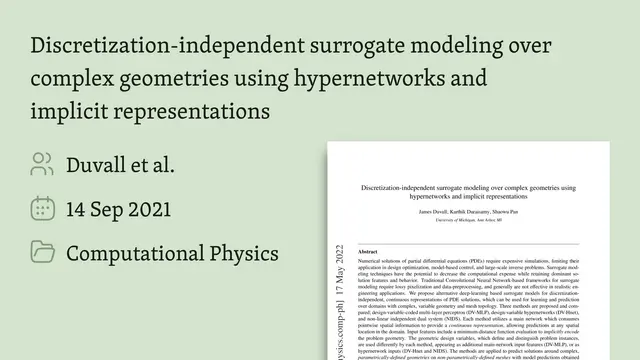
Neural Implicit Flow solves this with a clever architectural split.
The framework uses two modified multilayer perceptrons. ShapeNet treats space as a continuous implicit function, borrowing ideas from computer graphics. ParameterNet disentangles everything else: time, parameters, sensor data. Together, they create a hypernetwork that separates what the field looks like from where and when it exists.
The researchers validated NIF on 3 dimensional turbulent flow with over 2 million cells. Where autoencoders choke on mesh variability, NIF scales smoothly. It even performs dynamic mode decomposition on adaptive meshes, capturing flow features that shift as the grid refines.
The numbers are striking. On the Kuramoto-Sivashinsky equation, NIF cuts generalization error by 40 percent compared to state-of-the-art baselines. For sparse sensing tasks reconstructing ocean temperature from limited measurements, error drops by 34 percent. It beats both linear and deep learning competitors.
NIF's mesh-agnostic design means you can throw particle image velocimetry data and computational fluid dynamics results at the same model, no alignment needed. You skip the preprocessing headaches that plague autoencoders. The cost is training time and model size, and the researchers acknowledge that robustness across wildly different parameter regimes remains an open question.
Neural Implicit Flow represents a shift in how we think about compressing physical data. By decoupling spatial structure from dynamics, it aligns nonlinear dimensionality reduction with the implicit representations now standard in graphics and physics-informed learning. That architectural choice makes previously impossible tasks, like fusing data across mismatched meshes, suddenly tractable.
The researchers outline three directions: pushing scalability further, tightening interoperability with existing simulation tools, and hardening the framework's ability to generalize beyond its training distribution. Each step will determine whether NIF becomes a niche tool or a standard component of the computational scientist's toolkit.
When the grid itself is part of the data, compression becomes a spatial reasoning problem, and Neural Implicit Flow shows us how to solve it without throwing away the mesh. Visit EmergentMind.com to explore more research and create your own videos.