- The paper presents a novel framework that externalizes both research synthesis and validation to counter claim drift and ensure process accountability.
- It employs a three-layered research harness incorporating paper graphs, Monte Carlo Tree Search ideation, and contract-based validation, improving performance metrics across diverse tasks.
- Empirical case studies demonstrate enhanced auditability, reproducibility, and efficiency, with notable improvements such as a 64.2% token reduction and increased robustness.
Externalizing Research Synthesis and Validation in Automated AI Scientists via Xcientist
Motivation and Problem Statement
Emergent agentic AI systems now automate substantial segments of scientific workflows, including literature review, hypothesis generation, code synthesis, experimental evaluation, and result reporting. However, the underlying reasoning linking prior evidence, generated ideas, the experimental pipeline, and the final claims often remains hidden within transient model inference or inaccessible model weights. This implicitness undermines the scientific requirements for auditability, reproducibility, and process accountability. Empirical observations in prior systems (e.g., AI-Scientist-v2) highlight the claim drift phenomenon: runnable artifacts diverge from the mechanisms originally claimed, which compromises scientific attribution and verification. Addressing this, the Xcientist framework externalizes both research synthesis and experimental validation, transforming them into contract-governed, inspectable processes.
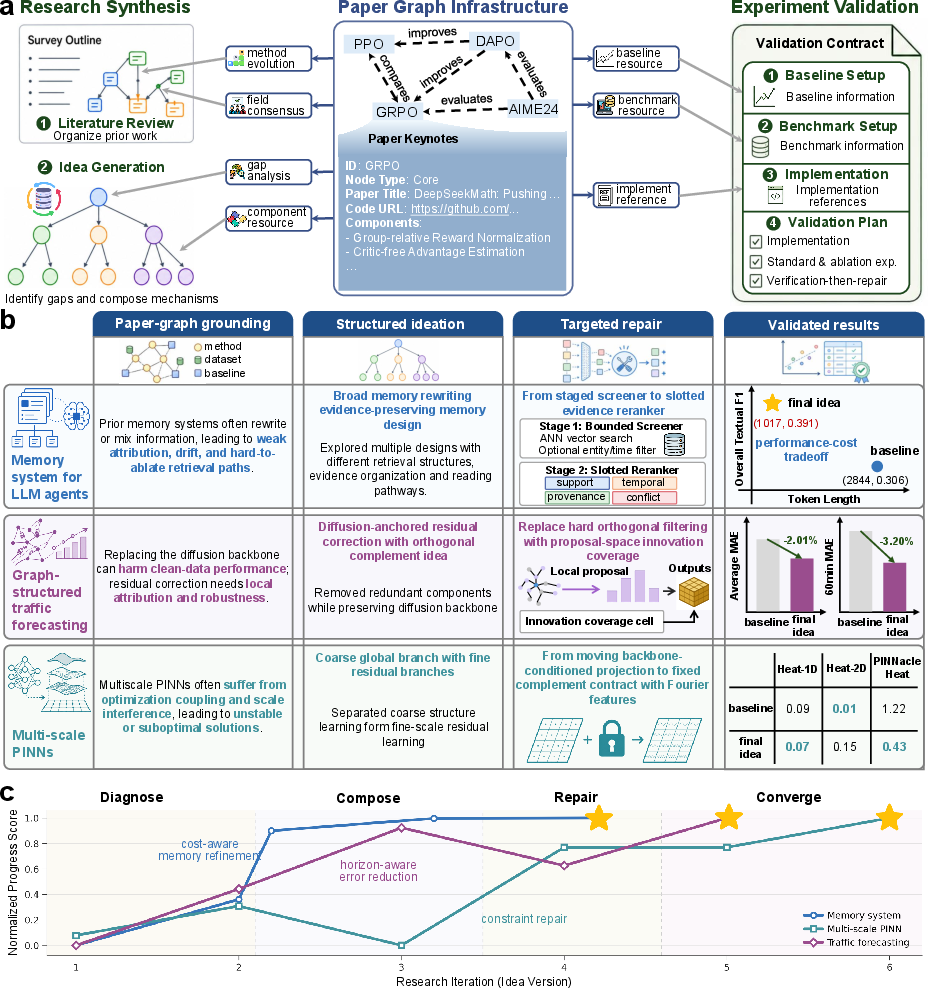
Figure 1: High-level overview of Xcientist: Literature synthesis and experiment validation are systematically externalized and interconnected through a paper graph infrastructure and staged validation contracts.
Architecture and System Design
Xcientist implements a three-layered research harness:
- Paper Graph Infrastructure: Full-text parsing (via MinerU) and schema-bound evidence extraction over ~50K papers generate a heterogeneous method-evolution graph. This graph exposes granular entities—methods, baselines, datasets, explicit limitations, innovations—and typed experimental relations, permitting structured evidence retrieval, gap discovery, and method evolution analysis. Entity resolution ensures global deduplication for baselines and datasets.
- Research Harness: The harness operationalizes research synthesis and validation through an ideation-validation-evolution loop. Idea generation runs Monte Carlo Tree Search (MCTS) across structured idea states, exploring diverse ideation priors (idea-taste modes); fusion synthesizes candidates into a constrained, auditable mechanism proposal. Validation is staged: contract-based execution, ablation-driven diagnosis, repair, and claim-boundary audit. Each phase produces persistent artifacts, ensuring that intermediate decisions and repairs remain attributable.
- System User Interface: Workflow lanes (review, ideation, experiment) and a snapshot-stream event model expose artifacts, traces, intermediate judgments, approval messages, and run states for inspection and auditability.
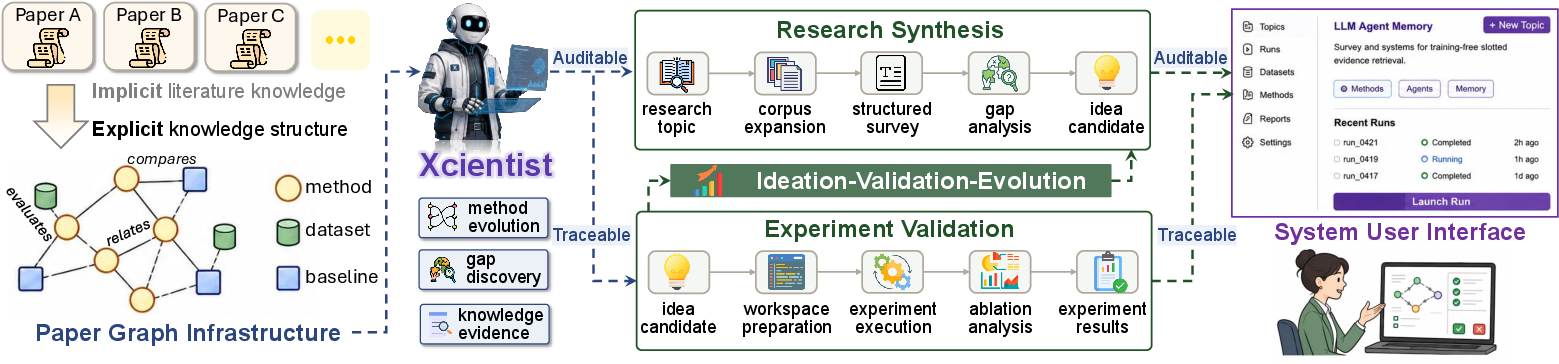
Figure 2: Xcientist architectural layers: Explicit knowledge structures, contract-governed validation, and workflow state exposure.
Process Accountability and Comparison to Prior Systems
Unlike prior systems that focus on terminal outputs or rely on unstructured retrieval and ad hoc improvement, Xcientist enforces explicit process accountability across all stages:
- Literature evidence is organized as an updatable paper-graph substrate.
- Ideas evolve as structured, inspectable states through controlled fusion and repair.
- Experiments are governed by validation contracts—phases must pass explicit validator checkpoints.
- Validation outcomes drive evidence-grounded repair.
- Results are attributed to specific claimed components.
- Final claims are audited prior to report generation.
This explicitness directly addresses claim drift: every artifact is traceable to its evidential basis.
Empirical Case Studies
Three heterogeneous domains were studied to validate the system—each illustrating the preservation and accountability of research trajectories:
Case 1: Training-Free Memory System for LLM Agents
The system converged from broad memory-rewriting proposals toward atomic evidence preservation and deterministic slotted evidence retrieval. MCTS explored multiple design trajectories; synthesis and repair refined the mechanism, targeting interpretability and efficiency without unnecessary complexity. The best final system achieved an overall F1 of 0.391 (vs. baseline 0.306), with a 64.2% reduction in context length (from 2844.1 to 1017.2 tokens) and improved robustness across query types.
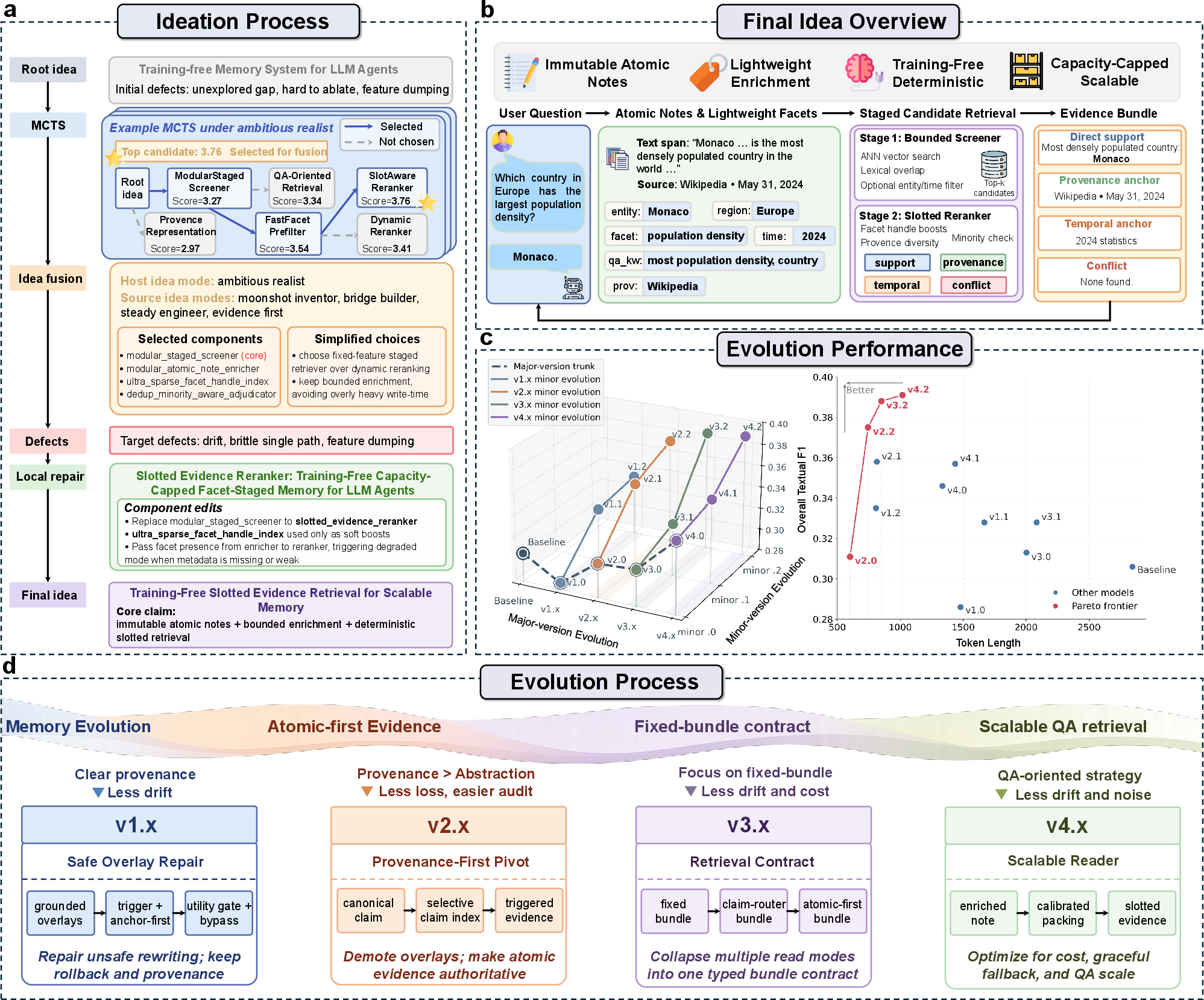
Figure 3: Iterative synthesis and repair of memory-system architecture, illustrating expansion, cross-candidate fusion, defect diagnosis, and convergence.
Case 2: Graph-Structured Spatiotemporal Forecasting
Xcientist performed diagnostic ablation over candidate architectures—identifying a basis-sensitive orthogonal projection as functionally inert, then repairing it via diffusion-referenced proposal-space innovation coverage. Iterative repair improved the performance/robustness tradeoff: the best method achieved average MAE of 1.556 (horizon-12 MAE 1.908), with stronger degradation resilience under 40% masking, using less training and no parameter increase.
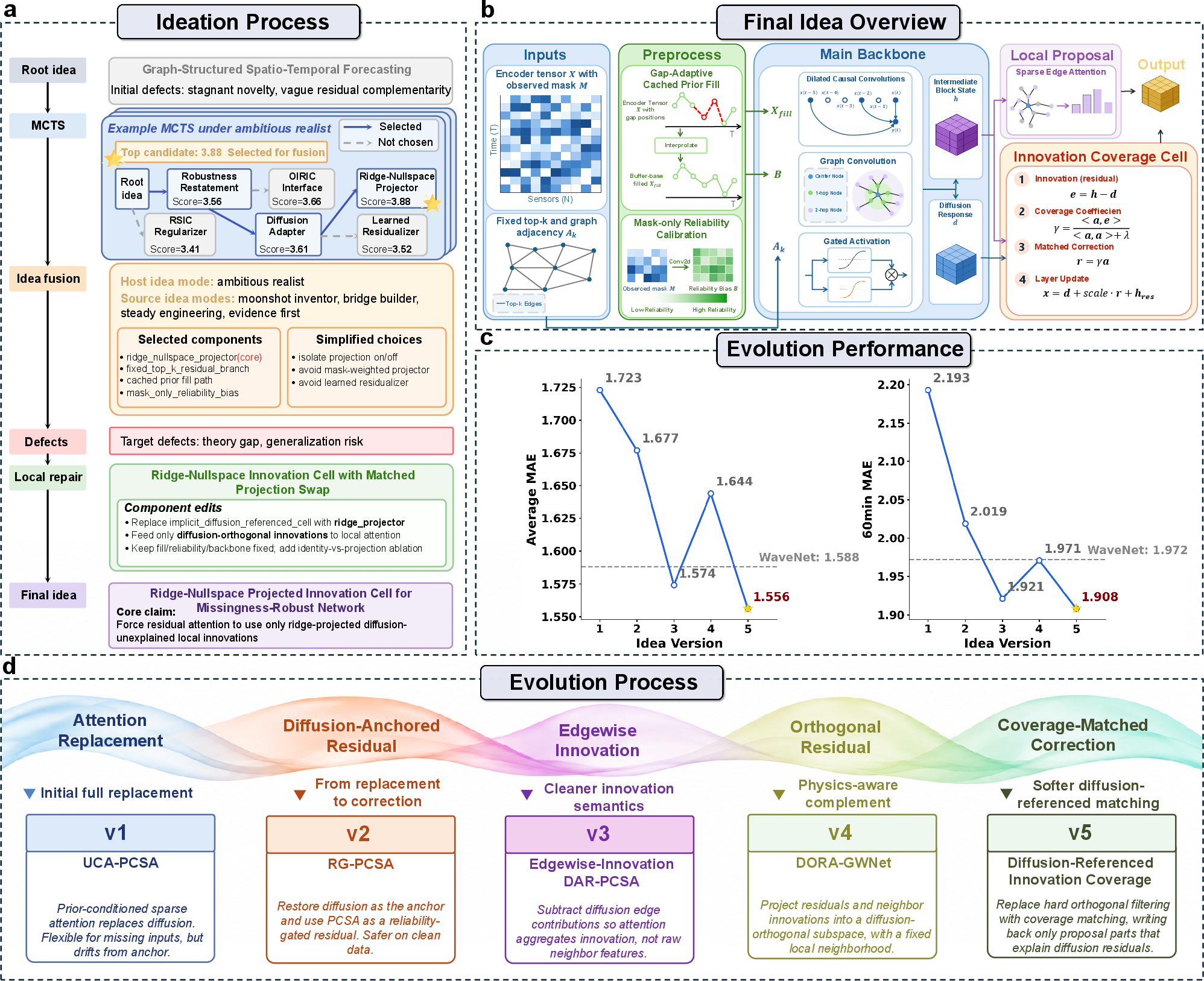
Figure 4: Diagnosis-driven architectural repair in graph forecasting—expansion, ablation evidence, and mechanism revision.
Ideation remained bounded by PDE, boundary, and initial-condition constraints. The system generated a staged additive pipeline separating coarse/fine scale, improved generalization and coordination via fixed complement projection, and quantitatively tested the outcome against strong baselines. Final design obtained mean relative L2 error of 0.0672 on heat1d_multiscale and 0.4307 on pinnacle_heat, outscoring baselines in those settings but falling short on heat2d_multiscale, delineating supported claim boundaries.
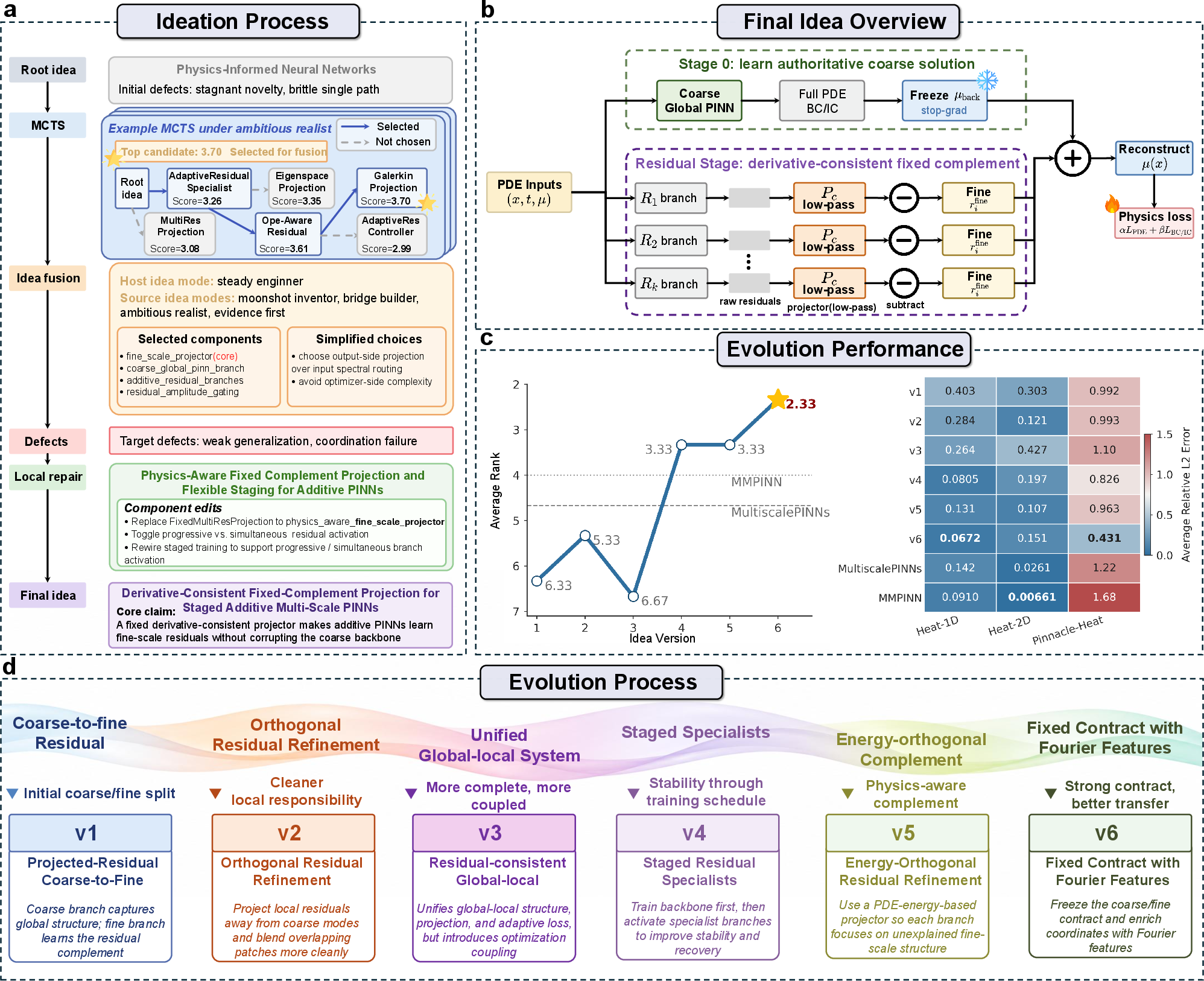
Figure 5: PINN mechanism generation under PDE constraints—stagewise proposal, repair, and benchmark comparison.
Methods and Externalization Mechanisms
- Paper Graph Construction: Full-text parsing, schema-bound evidence extraction, and entity resolution yield a graph supporting both synthesis and validation—method nodes, baseline nodes, dataset nodes, and edge relations (methodological, comparison, experimental).
- DeepSurvey Integration: Structured survey generation: evidence retrieval, keynote extraction, clustering, relation modeling, guided QA, code analysis, outline-driven drafting, and multi-granularity refinement. All artifacts are traceable to explicit paper passages.
- Idea Generation: Cross-mode search (taste modes), memory-guided MCTS, structured fusion, and component-level novelty and defect signals. Each edit and repair is recorded and justified.
- Experiment Validation: Contract-governed code enablement, standard science, component-complete ablation, and convergence judgment. Validator supremacy ensures only evidence-backed completion.
- Claim-Boundary Audit: Source code, configuration values, artifact paths, and citation completeness are verified; claims are bounded if attribution or evidence is insufficient.
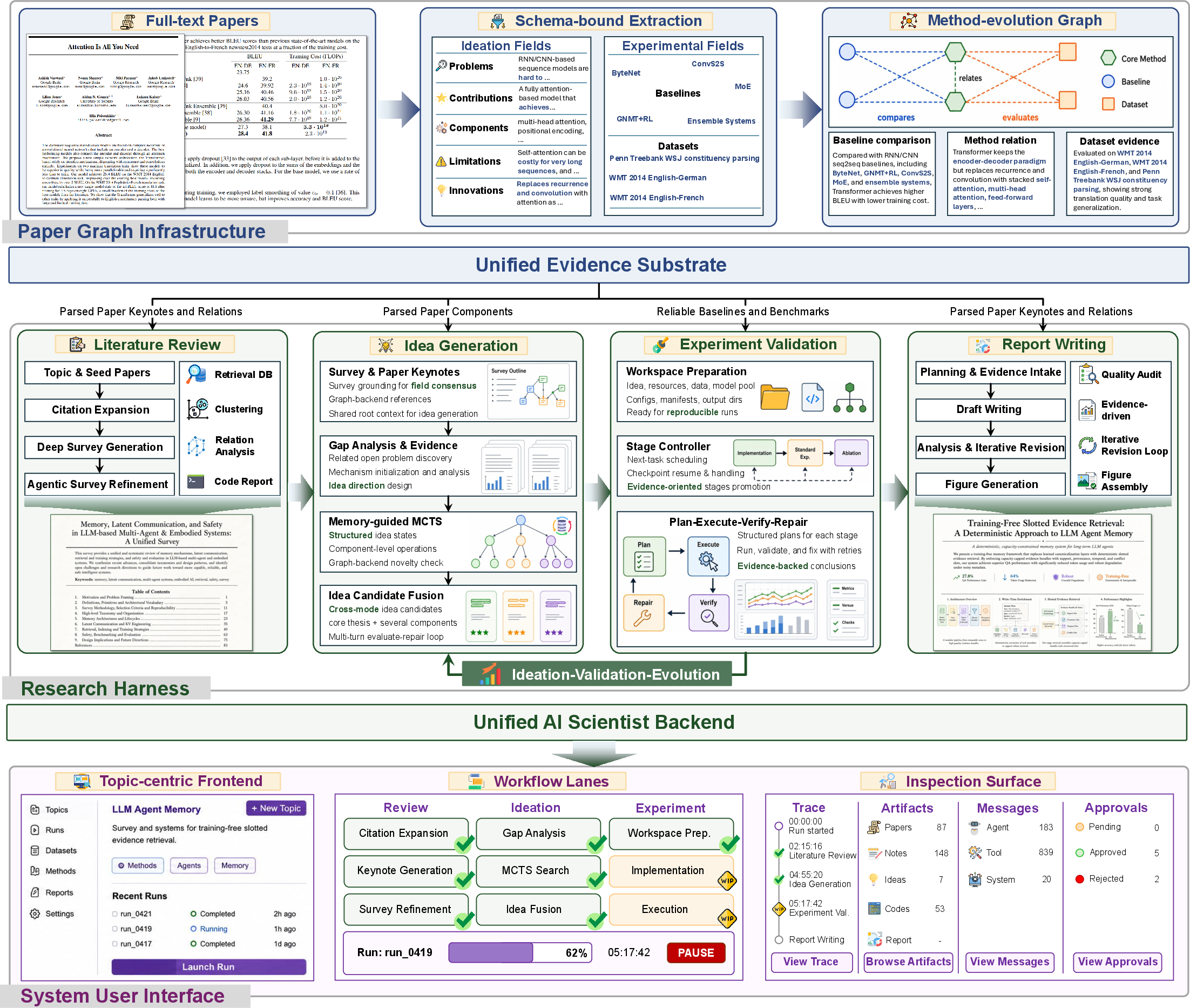
Figure 6: Framework design: Evidence extraction, ideation-validation-evolution loop, and user interface for traceability.

Figure 7: Heterogeneous paper graph construction—full-text parsing, schema extraction, and entity-resolved graph assembly.
Numerical Results and Contradictory Claims
- Memory System Task: Achieved F1 0.391 vs. 0.306 baseline, 64.2% token reduction, distributed performance gains across question types.
- Graph Forecasting Task: Ablation evidence refuted high-scoring mechanisms as inert; targeted repair improved robustness (average MAE 1.556; block-40% robustness achieved).
- PINN Task: Scheme generalization and quantitative evaluation revealed bounded superiority—outperformed existing baselines in 1D cases, not in 2D, resulting in claim-boundaries.
Contradictory Claims:
- Empirical gains achieved by prior agentic systems cannot always be attributed to claimed mechanisms—claim drift emerges absent explicit process externalization.
- Validation outcomes may support mechanism revision rather than terminal acceptance; gains must remain attributable, not merely plausible or executable.
Practical and Theoretical Implications
Xcientist substantiates that scientific automation mandates process-level auditability—not just artifact generation. By externalizing intermediate judgments, evidence intake, staged validation, ablation, repair, and claim audit, the system reveals the internal logic governing research trajectories. Practically, adopting such harnesses can improve the reliability, reproducibility, and attribution of automated discovery pipelines—critical for high-stakes scientific domains or regulation-sensitive workflows.
Theoretically, explicit process externalization shifts the evaluation axis from model outputs to traceable research trajectories. This enables new quantitative metrics (e.g., claim-drift rate, attribution completeness), supports auditability in autonomous research settings, and aligns with the philosophy that science depends as much on reasoning chains as on numerical results.
Future Developments
Areas for extension include:
- Enhancing the coverage and fidelity of paper-graph extraction (e.g., deeper entity resolution, richer evidence parsing).
- Developing quantitative process metrics for claim drift, repair traceability, and citation-claim alignment.
- Broadening evaluation to less-curated domains and agnostic benchmarks.
- Integrating agentic synthesis and validation with automated falsification and risk-aware governance.
Conclusion
Xcientist demonstrates that successful automation of scientific research requires not only generative autonomy, but process accountability and reasoning attribution. By designing and validating a system that externalizes both synthesis and validation as governed, inspectable, auditable trajectories, this work sets new standards for AI scientist evaluation. The results indicate that future research should prioritize the preservation of evidence-grounded, executable, repairable, and bounded claims—thereby closing the gap between end-to-end automation and scientific method.