RoboJEPA: Scaling Robotic Latent World Models
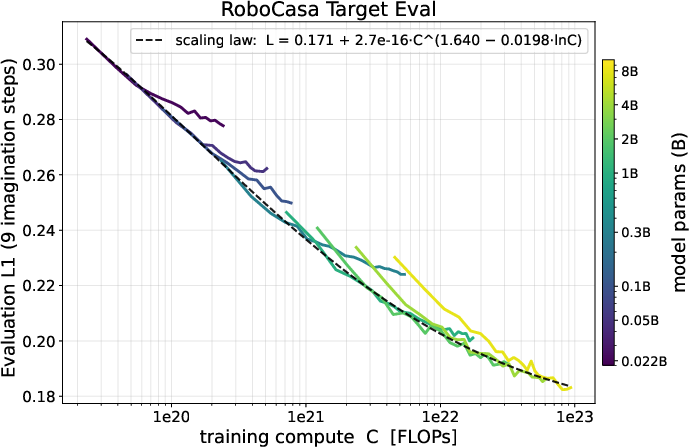
Abstract: Latent world models have shown a remarkable ability to predict future states and to plan in the real world. In practice, however, we lack a principled way to estimate how their capabilities scale with model size, data, and compute, an open problem that slows progress in the field. In this work we present RoboJEPA, a world model based on the Joint Embedding Predictive Architecture (JEPA) and trained on a large-scale dataset spanning 12 robotic embodiments. We show that RoboJEPA's imagination error, the error of its latent rollouts, follows a second-order power law in compute, allowing us to predict model quality well beyond the scale at which the law is fit. We further show that downstream robotic planning performance improves predictably with compute, and that imagination error is strongly correlated with it, making it a reliable proxy for real-robot evaluation. Finally, we demonstrate that latent world models can be deployed zero-shot as robotic agents, planning toward a single goal image to solve tasks requiring long-horizon planning on real hardware. We release all model checkpoints together with our training and robot deployment code. To our knowledge, this is the first work to establish scaling laws for multi-embodiment robotic world models trained on real robot data, and RoboJEPA, at 8B parameters, is the largest JEPA predictor model trained to date.
Paper Prompts
Sign up for free to create and run prompts on this paper.
Top Community Prompts
Explain it Like I'm 14
1. What is this paper about?
This paper introduces RoboJEPA, an artificial intelligence system that helps robots understand how the world changes when they move.
For example, if a robot sees a cup and moves its arm toward it, RoboJEPA tries to predict what the scene will look like next. It can then imagine many possible movements and choose the one most likely to reach a goal.
The main focus of the paper is scaling: finding out how a robot’s abilities improve when researchers use:
- a larger AI model,
- more training data, or
- more computer power.
The researchers want to know whether robot learning improves in a predictable way, similar to what has happened with LLMs such as ChatGPT.
2. What questions did the researchers ask?
The paper mainly asks four questions:
- Can a robot world model become better in a predictable way as it gets more computing power?
- Does being better at predicting the future also make the robot better at planning and completing tasks?
- Can one model learn from many different types of robots, cameras, and action systems?
- Can RoboJEPA control real robots without being specially trained for every task?
A world model is like an internal simulator. Instead of trying an action immediately in the real world, the robot can first imagine what might happen.
For example, it can compare these possibilities:
- move the arm left,
- move the arm right,
- close the gripper,
- push the object forward.
It then chooses the imagined action sequence that seems most likely to reach the desired final scene.
3. How was the research carried out?
Training on many robot experiences
The researchers trained RoboJEPA using 23 public datasets. These datasets contained information from:
- 12 different robot platforms,
- 26 different action systems,
- more than 2.8 million recorded episodes,
- about 15,000 hours of video.
The data included single-arm robots, two-arm robots, and humanoid robots. Some data came from real robots, while some came from simulated robots inside computer-generated environments.
This variety is important because robots do not all move in the same way. A command that moves one robot’s arm may not make sense for another robot.
Predicting hidden visual information
RoboJEPA does not directly predict every future pixel in a video. Instead, it changes images into a smaller set of numbers called latent features.
A useful analogy is making a summary of a picture. Rather than remembering every single pixel, the summary might record:
- where the robot’s arm is,
- where the objects are,
- which way they are moving,
- what the scene generally looks like.
RoboJEPA predicts how these summaries will change after the robot takes an action.
A separate vision system, called V-JEPA, first creates these summaries. RoboJEPA then predicts the next summaries.
Learning from mistakes
The system was trained in two ways:
- It learned to predict the next moment when it was given the correct previous images.
- It also learned to continue predicting using its own earlier predictions.
The second method is important because, during real planning, the model must rely on its own imagined future. If its first prediction is slightly wrong, it must still avoid making the error grow rapidly.
This is similar to practicing a chain of steps rather than only practicing one step at a time.
Testing different model sizes
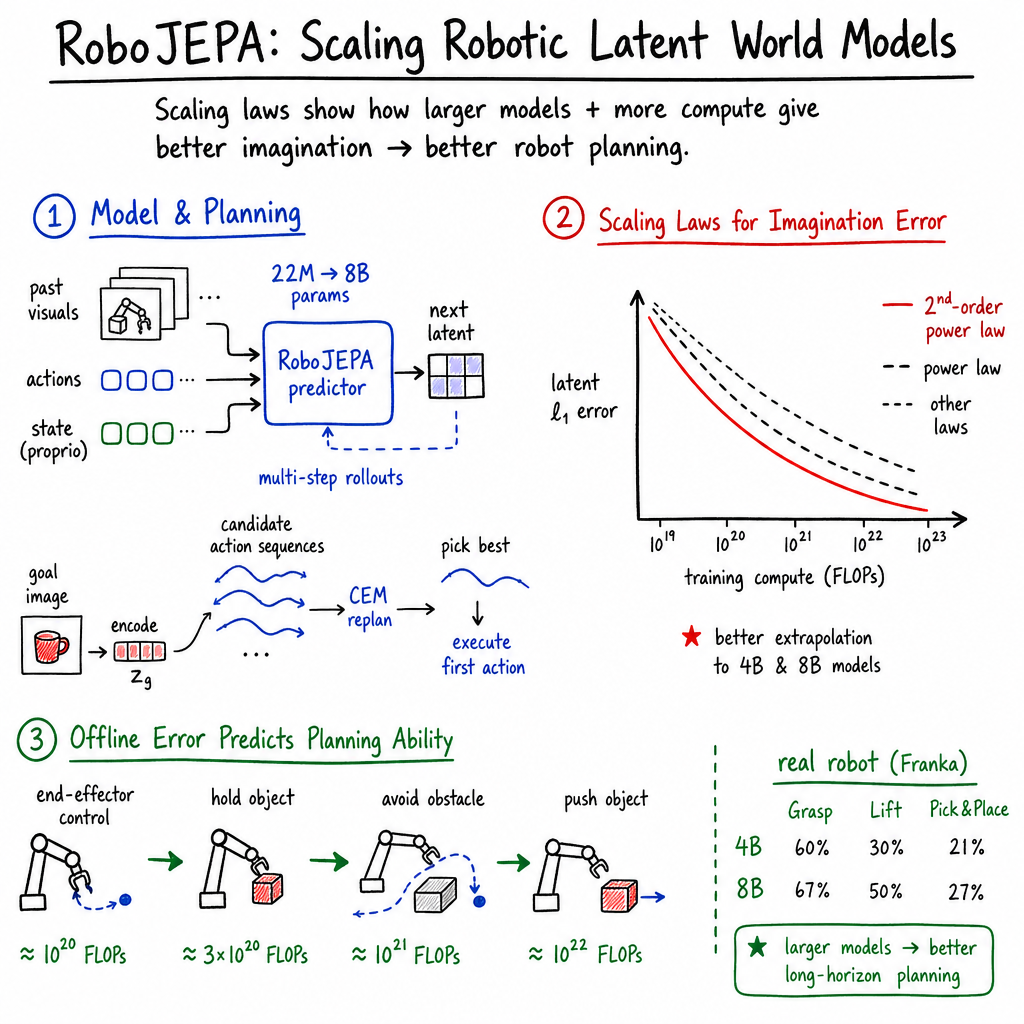
The researchers trained RoboJEPA models ranging from 22 million to 8 billion parameters.
Parameters are the adjustable values inside an AI model. More parameters usually give a model more ability to learn complicated patterns, although they also require more data and computing power.
The researchers measured:
- how accurately the models predicted future scenes,
- how well they planned in simulated robots,
- how well they performed tasks on real robots.
Planning toward a goal image
Instead of giving the robot a long written instruction, the researchers often gave it one goal image showing what the final scene should look like.
For example, the goal image might show:
- an object inside the robot’s gripper,
- an object lifted above a table,
- an object placed in a new location.
The robot then tested many possible action sequences in its internal world model. It selected the sequence whose imagined result looked most like the goal image.
This is similar to trying many routes on a map before choosing which road to take.
4. What did the researchers find?
Larger models made better predictions
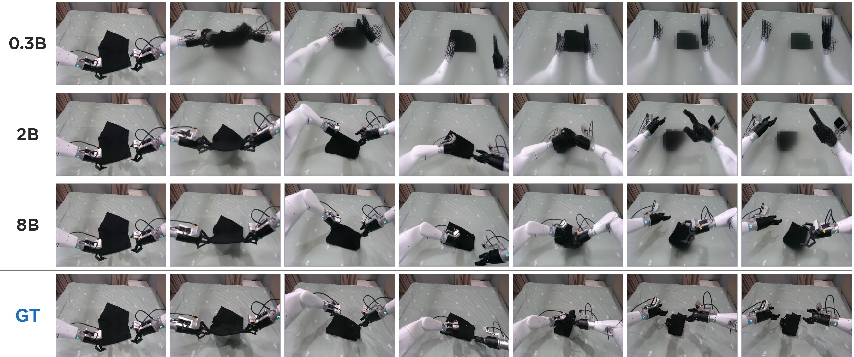
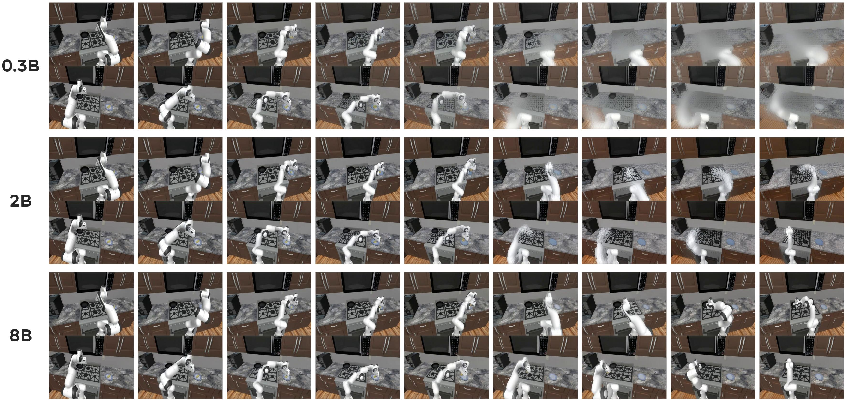
The larger RoboJEPA models generally imagined future scenes more accurately. Their predictions kept track of details such as:
- the position of objects,
- contact between the robot and objects,
- the robot’s movements,
- relationships between different camera views.
Small models often lost important details during longer imagined sequences. Larger models were better at preserving them.
Performance followed a predictable scaling pattern
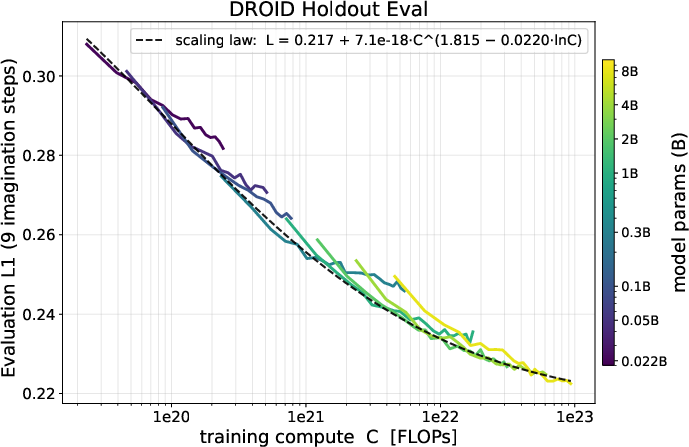
The main result was that the model’s prediction error decreased in a predictable way as training compute increased.
The researchers describe this relationship using a scaling law. A scaling law is a mathematical pattern that helps estimate how much improvement can be expected from using more computing power.
This means researchers may be able to predict how good a larger RoboJEPA model will be without training every possible model first.
The paper reports that a special curve called a second-order power law predicted the performance of larger 4-billion- and 8-billion-parameter models better than several other mathematical curves.
Better predictions usually led to better planning
The researchers found a strong connection between offline prediction accuracy and real planning ability.
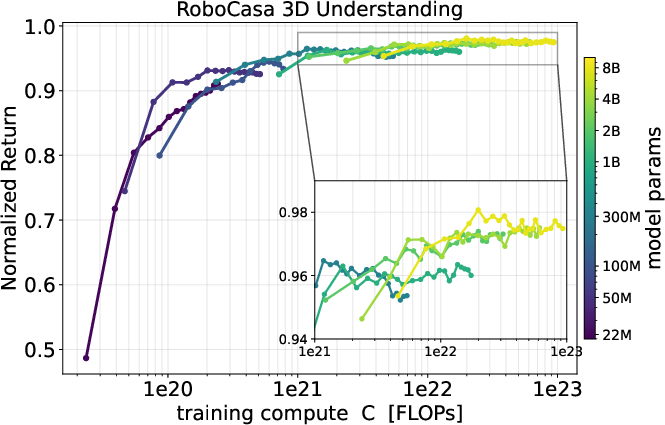
In simpler simulated tasks, more compute helped the robot:
- move its arm to a target position,
- move while holding an object,
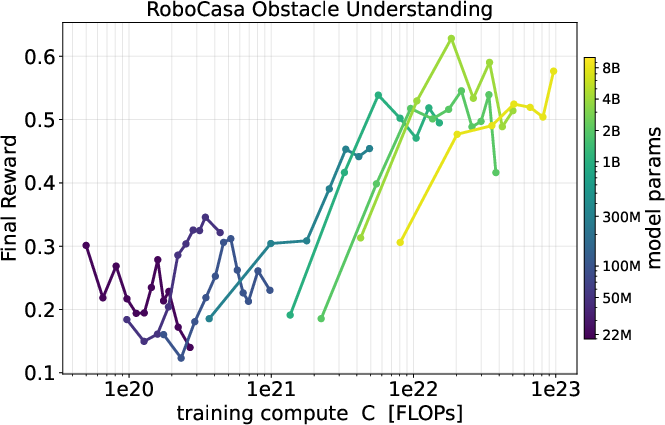
- avoid obstacles,
- push objects toward a target.
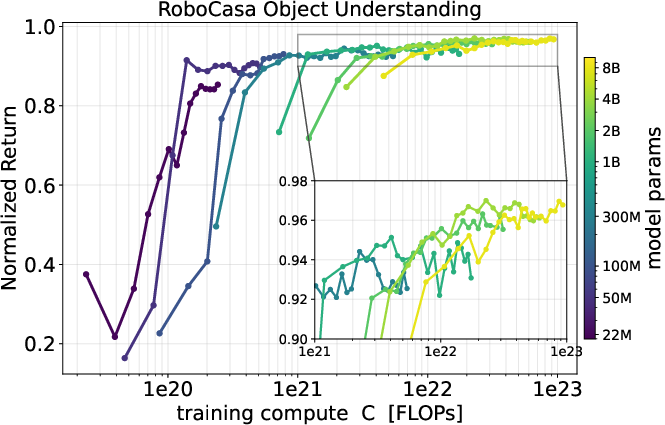
The robot’s abilities appeared in stages:
- basic control of the robot’s arm,
- moving while holding an object,
- understanding the shape of the surrounding scene,
- understanding how objects move when pushed or manipulated.
The harder tasks required much more training compute. For example, object-pushing tasks only began to succeed after roughly floating-point operations, or FLOPs, a measure of computer work.
Long-term planning required special training
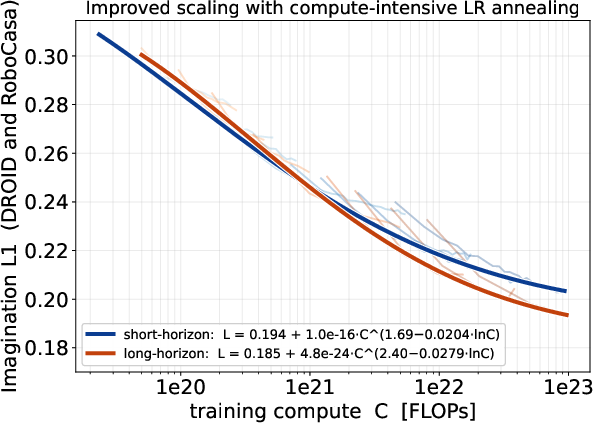
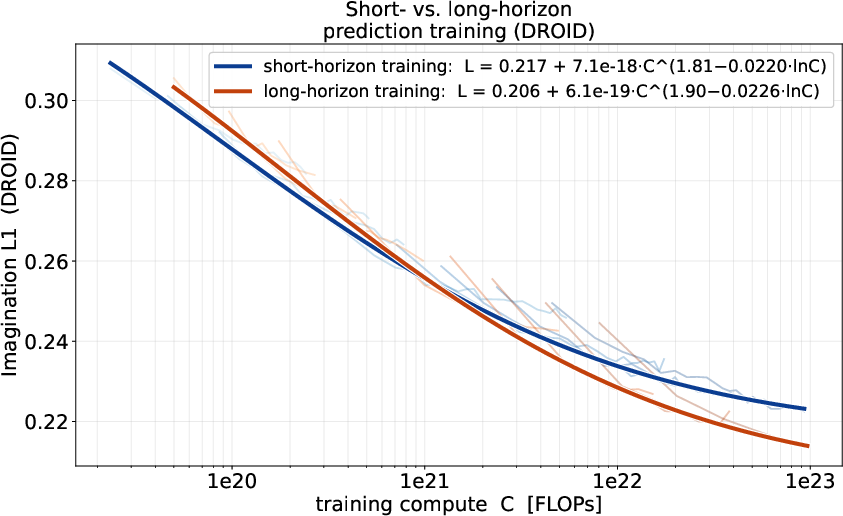
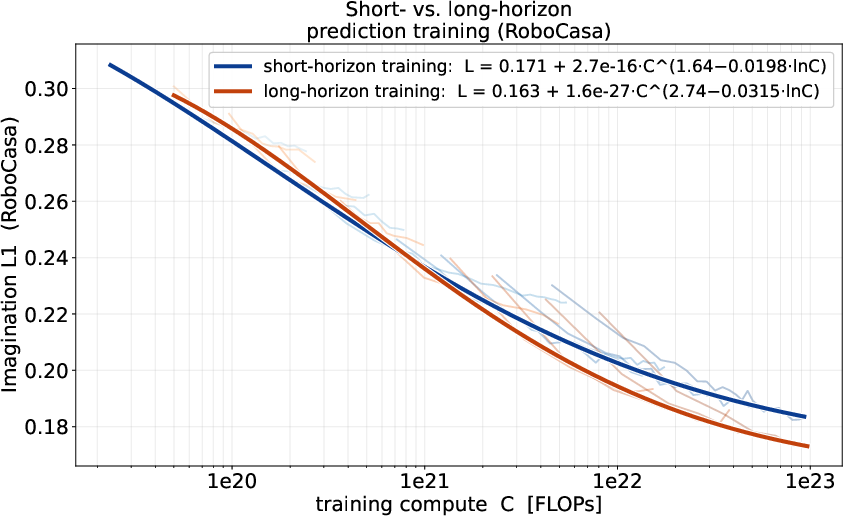
The first training setup mainly taught the model to predict a short distance into the future. This worked well for simple tasks but was less reliable for tasks requiring many steps, such as moving around an obstacle.
The researchers improved this by training the model to predict farther into the future and by using higher-resolution images.
After this change, performance on long-term tasks became more predictable. This suggests that a model should be trained in a way that matches how it will be used.
RoboJEPA worked on real robots
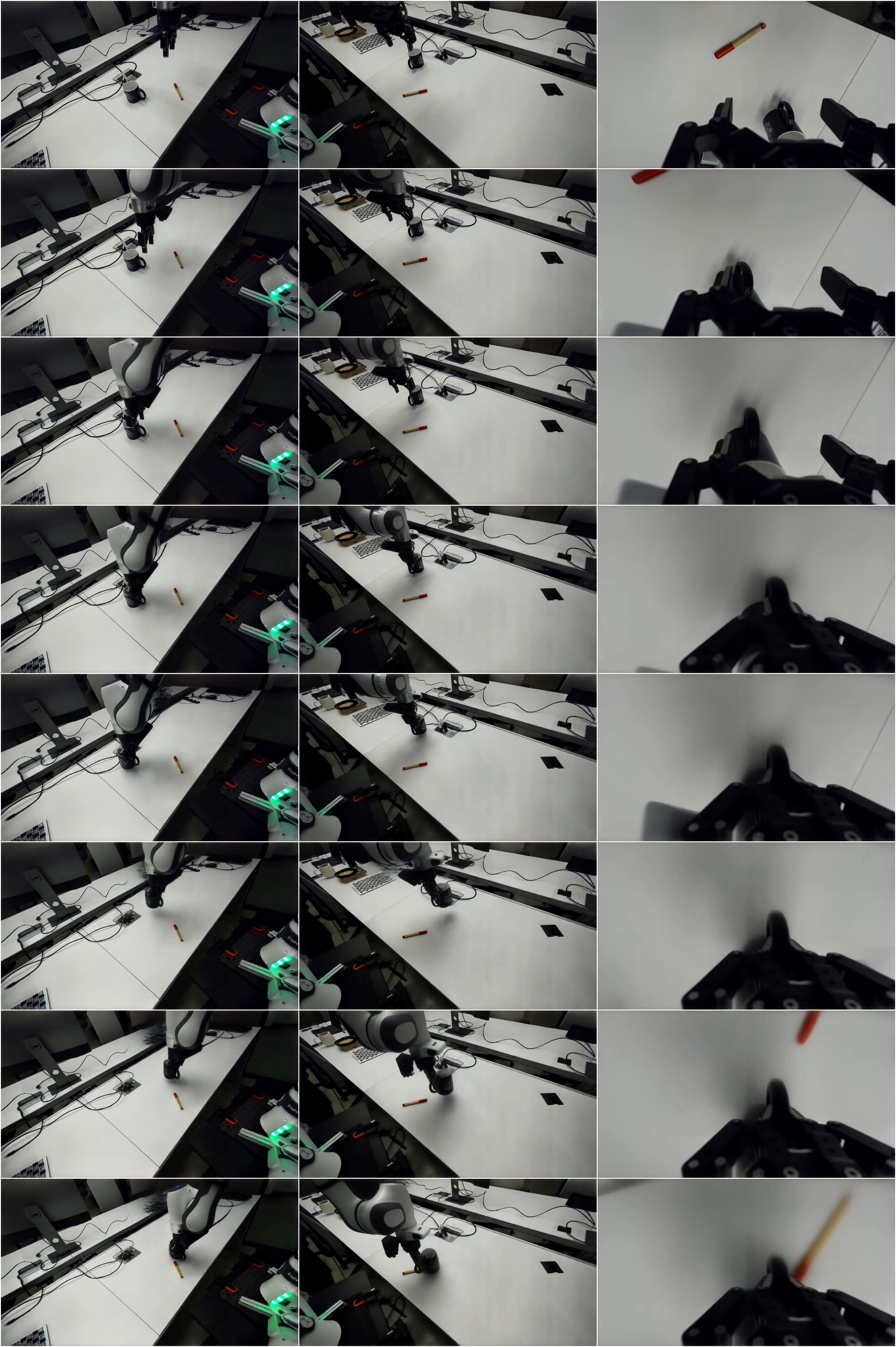
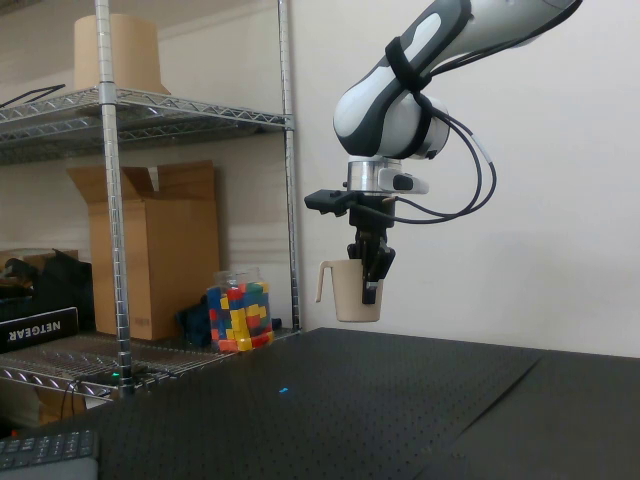
The researchers tested RoboJEPA on a real Franka robot. The tasks included:
- grasping an object,
- lifting an object,
- picking an object up and placing it somewhere else.
The robot was given only a final goal image. It was not given a detailed list of steps.
All model sizes achieved some success, but larger models generally performed better. The paper also reports that models with at least about 2 billion parameters were more likely to keep the gripper closed after grasping an object, instead of accidentally dropping it.
The model could work across many robot types
RoboJEPA was trained on data from many different robots and camera setups. This is important because a robot system that only works on one machine would have limited usefulness.
The researchers also released the model checkpoints, training code, and robot deployment code so other scientists can study and test the system.
5. Why are these findings important?
Robots are expensive and difficult to test. Training a large model or collecting more robot data can require a lot of time, money, and computing power.
RoboJEPA’s scaling results could help researchers answer questions such as:
- Should they build a larger model?
- Should they collect more robot demonstrations?
- How much computing power is needed for a certain ability?
- Is a model ready for real-robot testing?
The prediction error of the world model may also act as a useful proxy. A proxy is an easier measurement that gives information about a harder measurement. Instead of testing every model repeatedly on expensive real robots, researchers might first measure how accurately it predicts future scenes.
However, the results do not mean that simply making a model bigger will solve every problem. The paper shows that:
- more compute is especially useful for difficult tasks,
- the model must be trained for long-term prediction if it will plan far ahead,
- better offline predictions do not always immediately produce better real-world behavior,
- the model still has limits and can make mistakes.
Simple conclusion
RoboJEPA is an AI “imagination engine” for robots. It watches examples of robots acting, learns how actions change the world, and uses that knowledge to plan future movements.
The paper’s biggest contribution is showing that robot world models can improve in a fairly predictable way as their size and training compute increase. Larger models usually imagine the future more accurately and perform better at planning, including on real robots.
In the future, this kind of research could make it easier to design capable robots for tasks such as picking up objects, moving items around homes, or working in changing environments. It may also help scientists plan robot development more efficiently instead of guessing how much data and computing power they need.
Knowledge Gaps
Knowledge gaps, limitations, and open questions
- The scaling laws are established for a single frozen
V-JEPA 2.1-Grepresentation; it remains unknown whether the same compute-quality relationship holds when the encoder is jointly trained, replaced, or scaled. - The reported second-order power law is fitted over a limited compute range and extrapolated mainly from
22M–2Bmodels to4B–8B; its validity at substantially larger model, data, or compute scales is unresolved. - The study does not establish whether the apparent irreducible error reflects true environment stochasticity, partial observability, limitations of the frozen representation, action-label noise, dataset noise, or model underfitting.
- The compute-optimal frontier is constructed by selecting the best checkpoint at each compute budget, but the effects of independently scaling dataset size, model size, training duration, and data mixture are not disentangled.
- The experiments do not provide a complete parameter–data–compute allocation law comparable to established language-model scaling analyses; it remains unclear how much performance would improve from more data versus larger predictors.
- Dataset sampling weights, duplication, and mixture composition may strongly influence the scaling results, but the paper does not systematically test whether the laws are robust to alternative mixture weights or removal of dominant datasets such as Open-X Embodiment and AgiBot World.
- The public datasets differ substantially in camera configuration, action semantics, control frequency, embodiment, and data quality; the contribution of each heterogeneity factor to generalization and scaling remains unquantified.
- The model conditions on finite robot and camera identifiers, so its ability to generalize to unseen embodiments, novel camera placements, unseen action spaces, or new sensor modalities is not demonstrated.
- The treatment of absolute commands, state deltas, and proprioceptive inputs is simplified and heterogeneous; the paper does not isolate how action representation choices affect world-model accuracy or planning success.
- Proprioceptive states are not learned or predicted by the model; future work is needed to determine whether explicitly modeling robot state, contacts, velocities, and actuator dynamics improves long-horizon planning.
- The deterministic predictor cannot represent multimodal or stochastic futures, leaving unresolved how RoboJEPA handles ambiguous actions, contact uncertainty, slips, collisions, failures, or environments with genuinely stochastic dynamics.
- The training objective uses per-token latent error, but the paper does not establish whether this metric reliably captures task-relevant physical correctness, especially when visually small latent errors correspond to major control failures.
- The strong correlation between offline imagination error and planning performance is demonstrated primarily on selected DROID and RoboCasa settings; its reliability across tasks, embodiments, environments, horizons, and planners is not fully validated.
- Offline evaluation predicts nine future steps, whereas real deployment and some simulated tasks require substantially longer horizons; the relationship between nine-step error and very long-horizon success remains insufficiently characterized.
- The study shows that short-horizon training fails on obstacle-reach tasks and that a
K=10cooldown helps, but it does not determine the optimal rollout length, rollout schedule, or training-compute allocation for different deployment horizons. - Long-horizon prediction training is introduced together with higher-resolution inputs and a modified cooldown procedure, so the separate effects of rollout length, resolution, and fine-tuning schedule are not isolated.
- The paper does not compare RoboJEPA systematically with alternative world-model objectives or architectures, such as stochastic latent models, diffusion predictors, recurrent state-space models, action-conditioned video models, or hierarchical planners.
- The role of the architectural choices—flat tokenization, joint attention, local eight-step attention, factorized RoPE, view bias, QK normalization, and KV caching—is not established through comprehensive ablations at comparable compute budgets.
- The claim that V-JEPA 2.1 enables predictable scaling while V-JEPA 2 does not is only hypothesized; the underlying representational properties responsible for this difference remain unexplained.
- The effect of multi-view supervision is unclear because most scaling-law evaluation uses two views, while training mixes single-view and multi-view data; performance with missing, corrupted, reordered, or novel camera views is not systematically tested.
- The diffusion decoder is used for qualitative visualization but may generate plausible frames that are inconsistent with the underlying latent prediction; its visualizations are not validated as a faithful measure of world-model accuracy.
- Planning relies on CEM, thousands of model evaluations, multiple GPUs, compilation, and a precompiled inference engine; the robustness of the conclusions to other planners, inference budgets, hardware constraints, and real-time requirements is unknown.
- The computational and latency costs of deploying the largest models are not analyzed against task performance, making the practical trade-off between model scale, planning speed, energy use, and success rate unresolved.
- The goal-conditioned planner uses a single final image and latent distance, but the limitations of this goal representation for occlusions, viewpoint changes, multiple valid outcomes, temporal constraints, and semantic task requirements are not explored.
- The planner’s latent objective may reward visually similar but physically invalid states; systematic analysis of reward hacking, goal ambiguity, collision avoidance, and safety constraints is absent.
- Real-robot experiments use a narrow set of tasks—grasping, lifting, and pick-and-place—on a single Franka/DROID setup; generalization to clutter, deformable objects, articulated objects, human interaction, failure recovery, and diverse real environments remains untested.
- Real-world success rates are reported for selected tasks and model sizes, but confidence intervals, statistical significance, random-seed variability, and sensitivity to initial object placement and camera calibration are not fully established in the presented results.
- The real-robot evaluation uses manually prepared goal images and object placement, leaving open whether the method can robustly operate with naturally occurring goals, imperfect demonstrations, or automatically specified task objectives.
- The comparison with -FAST and is explicitly not controlled for goal modality, pretraining data, or fine-tuning, so the relative effectiveness of RoboJEPA versus VLA policies cannot be inferred.
- The paper does not test continual adaptation or fine-tuning after deployment, leaving unresolved whether scaling reduces the amount of real-robot data required for adaptation to new robots, environments, or tasks.
- The model’s safety properties are not evaluated, including behavior under distribution shift, sensor corruption, unexpected obstacles, actuator faults, invalid action sequences, or human presence.
- The relationship between model size and emergent capabilities is described using threshold-like observations, but the mechanisms behind these thresholds and their reproducibility across seeds and task variants remain unknown.
- The study does not determine whether the observed capability ordering—end-effector control, grasped-object manipulation, obstacle avoidance, and object dynamics—is universal or specific to the selected datasets, representations, and task designs.
- Generalization is evaluated mainly on unseen scenes within related simulated or dataset distributions; performance under genuinely novel objects, textures, layouts, lighting, robot morphologies, and physical dynamics remains unresolved.
- The paper does not investigate whether language, proprioceptive state, tactile sensing, force/torque feedback, or object-centric representations could improve scaling efficiency and long-horizon physical reasoning.
- The released checkpoints and code support reproducibility, but the paper does not report the full statistical variability of training runs, leaving uncertainty about how reliably the scaling laws can be reproduced across seeds, hardware configurations, and data-order permutations.
- It remains unclear whether scaling the predictor beyond
8Bparameters will continue to improve planning, or whether representation quality, data coverage, planning search, and embodiment mismatch will become the dominant bottlenecks.
Practical Applications
Immediate Applications
- Robotic manipulation through image-goal planning — robotics and manufacturing. RoboJEPA can be deployed now for relatively constrained tasks such as grasping, lifting, pick-and-place, reaching, and basic object manipulation. A workflow could provide the robot with its current camera observations and a single image showing the desired final state; the model then uses latent rollouts and cross-entropy-method planning to select actions. This could support laboratory automation, warehouse handling, kitting, bin picking, and light assembly.
- Dependencies: The target robot must be represented by a supported embodiment/action-space configuration, and the deployment environment should resemble the training distribution. The current planner takes several seconds and is not generally real-time, so it is better suited to low-speed or batch operations than safety-critical industrial control.
- Zero-shot or low-supervision task execution — industrial robotics and research laboratories. The single-goal-image interface can reduce the need to write a separate policy for every task. Operators could demonstrate or photograph a desired end state rather than collecting task-specific demonstrations or engineering a reward function.
- Dependencies: “Zero-shot” does not imply universal generalization. Reliable operation depends on adequate visual coverage, accurate proprioception, compatible camera placement, calibrated action commands, and safe handling of failures. Human supervision and conventional safety controllers remain necessary.
- Offline world-model evaluation before robot deployment — robotics engineering. The reported relationship between latent imagination error and online planning success provides a practical screening workflow: train or select candidate checkpoints, evaluate their multi-step latent prediction error on held-out real-robot or simulated data, and use that metric to identify promising models before expensive physical-robot trials.
- Dependencies: The correlation is established for the studied embodiments, tasks, datasets, and planning setup. It should not be assumed to predict performance on substantially different robots, environments, horizons, or sensor configurations without local validation.
- Compute and model-size budgeting — AI infrastructure and robotics companies. The second-order scaling law can be used to estimate the expected reduction in forward-prediction error for a proposed training budget. Organizations can compare adding parameters, extending training, or acquiring more data before committing to a large training run.
- Dependencies: The fitted law is empirical and is tied to RoboJEPA’s encoder, data mixture, training recipe, and compute regime. Extrapolation beyond the tested range may fail, particularly after saturation or when data quality becomes the limiting factor.
- Capability-based model selection — robotics product development. The paper suggests a staged evaluation strategy: smaller models may be sufficient for end-effector reaching, while obstacle avoidance, grasp retention, and object pushing require substantially more computation. Companies can select the least expensive checkpoint that meets a specific capability threshold instead of deploying the largest model for every task.
- Dependencies: Capability thresholds must be re-estimated for each robot, camera arrangement, control frequency, and safety requirement. Simulation performance should be confirmed on the physical platform.
- Simulation-based testing and regression evaluation — software engineering and robot simulation. RoboCasa-style environments can be used to test planning behavior on increasingly difficult tasks, including reaching, obstacle avoidance, and pushing. The released checkpoints and deployment code can support reproducible benchmark suites and automated regression tests for robotic software.
- Dependencies: Simulation must accurately model contacts, friction, actuator limits, and sensing. Sim-to-real transfer remains a major uncertainty, especially for fine-grained object interaction.
- World-model training infrastructure for heterogeneous datasets — robotics academia and industry. The architecture’s handling of variable camera views, resolutions, robot identifiers, action spaces, and proprioceptive inputs can be reused to combine datasets from multiple robot platforms. This supports centralized pretraining followed by platform-specific evaluation or limited adaptation.
- Dependencies: Dataset synchronization, action-space normalization, camera metadata, embodiment identifiers, licensing, and privacy permissions are required. Performance may be dominated by the quality and balance of the heterogeneous data mixture.
- Visualization and debugging of predicted behavior — research and robot operations. The diffusion decoder can turn latent predictions into approximate video rollouts. Engineers can inspect whether a model preserves object identity, contact relationships, gripper state, and multi-view consistency before testing an action sequence on hardware.
- Dependencies: Decoded videos are interpretive visualizations rather than guaranteed pixel-accurate forecasts. They should not be used as the sole basis for safety decisions or physical execution.
- Open-source academic experimentation — academia and education. The released model checkpoints, training code, and deployment code can be used to reproduce scaling-law analyses, study latent dynamics, compare planning algorithms, and build courses or laboratory assignments on world models, robot learning, and model-based control.
- Dependencies: Reproduction requires substantial GPU capacity, compatible hardware, access to the relevant datasets, and careful handling of dataset licenses. Smaller-scale educational experiments may need reduced models or subsets of the data.
- Human-in-the-loop household or assistive robotics prototypes — daily life and healthcare support. In controlled settings, a robot could use a goal image to perform simple assistance tasks such as moving an object, placing an item in a target location, or retrieving an object from a known workspace.
- Dependencies: Domestic and healthcare environments are more variable than the reported benchmarks. Physical safety, occlusion, fragile objects, human motion, accessibility requirements, and fail-safe intervention mechanisms must be addressed before deployment around people.
Long-Term Applications
- General-purpose multi-embodiment robot foundation models — robotics and automation. Scaling RoboJEPA-style predictors across more robot morphologies, sensors, tasks, and environments could yield a reusable dynamics model for arms, mobile manipulators, quadrupeds, and humanoids. Such a model might support transfer from one platform to another through embodiment and camera conditioning.
- Dependencies: The current evidence covers 12 embodiments but does not establish broad physical transfer. Additional research is needed on unseen embodiments, continuous adaptation, action-space alignment, embodiment-specific dynamics, and robustness to sensor changes.
- Long-horizon autonomous manipulation — manufacturing, logistics, and service robotics. Longer autoregressive training, higher-resolution inputs, and more accurate object dynamics could enable multi-stage operations such as opening containers, routing around obstacles, pushing objects into place, and assembling components from a single high-level goal.
- Dependencies: Long-horizon errors accumulate, and the paper shows that short-horizon training does not reliably scale to non-greedy tasks. Progress requires stronger uncertainty modeling, adaptive replanning, contact-aware prediction, recovery behaviors, and extensive physical validation.
- Safety-aware model-based control — healthcare, collaborative robotics, and public environments. A future RoboJEPA-like system could evaluate candidate action sequences in latent space while incorporating constraints for collision avoidance, force limits, human proximity, uncertainty, and equipment protection. This could support cobots, rehabilitation devices, elder-care assistance, and hospital logistics.
- Dependencies: The current deterministic predictor and goal-distance objective do not provide calibrated uncertainty or formal safety guarantees. Safety applications require conservative uncertainty estimates, verified controllers, redundant sensing, emergency stops, and certification under applicable regulations.
- Active data collection and robotics experimentation — academia and industry. Scaling laws could guide which demonstrations to collect next. If prediction error has plateaued on common scenes but remains high for object contacts or obstacle interactions, data-collection systems could prioritize those rare behaviors rather than uniformly adding more demonstrations.
- Dependencies: The scaling law currently describes compute-optimal performance under a particular data mixture. It does not by itself identify which examples have the highest marginal value. Active-learning criteria and causal analysis of data composition remain necessary.
- Automated robot curriculum generation — education, simulation, and training platforms. The observed progression—from end-effector control to grasp retention, obstacle avoidance, and object dynamics—could support curricula that introduce capabilities in increasing order of difficulty. Simulators could generate targeted tasks when a model reaches a particular capability threshold.
- Dependencies: Capability emergence may differ across robots and datasets. Curriculum design must prevent overfitting to simulator artifacts and ensure that progress transfers to real hardware.
- Predictive digital twins for industrial cells — manufacturing and energy infrastructure. A sufficiently accurate multimodal world model could simulate the likely outcome of proposed interventions in a physical workspace before they are executed. It might be used to test robot trajectories, inspect fixture changes, or plan maintenance operations.
- Dependencies: The present model predicts visual latent states for manipulation rather than a complete, high-fidelity digital twin. Industrial deployment would require persistent object identity, precise geometry, force and torque modeling, uncertainty quantification, and integration with plant-control systems.
- Natural-language and multimodal task interfaces — software and human–robot interaction. A future system could combine image goals with language, sketches, demonstrations, or spatial instructions. For example, an operator might say “place the blue component in the tray shown in this image,” with the world model translating the instruction into a visual target and planning actions.
- Dependencies: The paper evaluates image goals, not language grounding or semantic instruction following. Additional language–vision–action alignment, ambiguity handling, and verification mechanisms would be required.
- Robot fleet learning and continual adaptation — logistics and field robotics. Robots deployed across facilities could contribute anonymized trajectories and failure cases to periodically update a shared world model. Scaling-law measurements could determine whether additional fleet data, larger models, or longer-horizon training offers the best improvement.
- Dependencies: Fleet data may be non-independent and biased toward successful behavior. Privacy, cybersecurity, dataset governance, catastrophic forgetting, distribution shift, and safe model-update procedures must be addressed.
- Robotic planning under uncertainty and partial observability — autonomous systems. Extending RoboJEPA from deterministic latent prediction to probabilistic or ensemble-based rollouts could allow planners to account for ambiguous object states, hidden obstacles, uncertain contacts, and multiple plausible futures.
- Dependencies: The current latent objective and deterministic forward model do not quantify uncertainty. Research is needed to ensure that latent uncertainty corresponds to meaningful physical risk rather than merely representation error.
- Policy and funding decisions for robotics infrastructure — public policy and research management. Scaling curves and offline-to-online correlations could inform grants, shared GPU facilities, and national robotics programs by estimating the compute, data, and hardware required for specific capability targets.
- Dependencies: The curves should not be treated as universal economic forecasts. They omit energy consumption, hardware availability, data-collection costs, labor, safety certification, and the possibility that architectural or algorithmic improvements change the scaling regime.
- Energy-efficient edge deployment — consumer, mobile, and field robotics. Distillation, quantization, caching, and smaller specialized world models could eventually bring image-goal planning onto local robot computers, reducing dependence on multi-GPU clusters and improving latency and privacy.
- Dependencies: The largest reported models require substantial compute, while the current real-robot planner is connected to a GPU cluster. Edge deployment requires compression with minimal loss of long-horizon accuracy, hardware-specific optimization, and real-time safety validation.
- Everyday personal robotics — domestic assistance and accessibility. In the longer term, a household robot could learn or receive a visual target for tasks such as organizing objects, loading a dishwasher, or placing items in accessible locations, adapting its plan as people or objects move.
- Dependencies: These environments contain far greater variation, clutter, occlusion, and human interaction than the tested settings. Reliable household use would require robust semantic perception, social-aware planning, failure recovery, low-cost hardware, privacy protections, and extensive validation with real users.
Glossary
- Action-conditioned latent world model: A learned dynamics model that predicts future latent states based on the robot’s actions. “a family of action-conditioned latent joint-embedding predictive world models”
- Autoregressive rollout: Sequential prediction in which each predicted output is fed back as the next input. “Feeding predictions back as inputs lets us roll the model out autoregressively over future actions”
- Causal attention mask: An attention restriction preventing a token from accessing information from future timesteps. “We use the frame-level causal attention mask”
- Closed-loop planning: Planning that repeatedly recomputes a plan after observing the result of each executed action. “where the model re-plans toward the goal image after every executed action”
- Compute-optimal frontier: The lowest achievable evaluation loss for each available training-compute budget. “The compute-optimal frontier (lower envelope) follows the second-order power law”
- Cross-entropy method (CEM): A sampling-based optimization algorithm that iteratively concentrates a probability distribution around high-performing candidate solutions. “We optimize \Cref{eq:plan} with the cross-entropy method”
- Diffusion decoder: A generative model that reconstructs or synthesizes visual outputs by progressively denoising noisy representations. “we train a diffusion decoder that produces pixel outputs from the predicted features”
- Embodiment: A particular robot platform or physical robot configuration. “a large-scale dataset spanning 12 robotic embodiments”
- Exposure bias: The discrepancy caused when a sequential model is trained on true previous outputs but must use its own predictions during inference. “to minimize exposure bias, we additionally train it on its own outputs”
- Factorized RoPE: A rotary positional-encoding scheme that separately represents multiple axes, such as time, height, width, and camera view. “Factorized RoPE and view conditioning.”
- Feed-forward transformer: A transformer model that produces an output through a forward computation without iterative latent-state optimization. “RoboJEPA is a feed-forward transformer that predicts the next latent state deterministically in a single forward pass.”
- Frozen encoder: An encoder whose parameters are kept fixed while another model is trained on its representations. “RoboJEPA operates in the representation space of a frozen V-JEPA~2.1 encoder”
- GELU: The Gaussian Error Linear Unit, a smooth neural-network activation function. “GELU feed-forward block”
- Global gradient-norm clipping: A training technique that limits the overall magnitude of gradients to stabilize optimization. “global gradient-norm clipping at $1.0$”
- Held-out data: Data excluded from model fitting and used to evaluate generalization. “evaluated on a real-robot DROID holdout and simulated RoboCasa scenes”
- Irreducible loss: The residual error that cannot be eliminated by increasing model size or training compute under a given setup. “ is the irreducible loss”
- Joint embedding predictive architecture (JEPA): A representation-learning architecture that predicts the embedding of a target observation from contextual information rather than directly reconstructing pixels. “a world model based on the Joint Embedding Predictive Architecture (JEPA)”
- Key-value cache (KV-cache): A memory of previously computed attention keys and values used to avoid recomputing earlier sequence elements. “We use a key-value cache to speed up this autoregressive prediction”
- Latent representation: A learned internal vector space encoding information about observations in a form used for prediction or planning. “We focus on latent world models that predict and plan in a latent representation space”
- Long-horizon planning: Planning over a sequence of many future actions rather than selecting only an immediate action. “tasks requiring long-horizon planning on real hardware”
- Multiview: Involving visual inputs captured simultaneously from multiple camera viewpoints. “The frozen V-JEPA~2.1 encoder maps the input multiview frames”
- Non-greedy planning: Planning that selects actions for their longer-term consequences rather than always choosing the action with the best immediate result. “only models trained with more than FLOPs of training compute ... can solve object-interaction tasks in RoboCasa via non-greedy planning”
- Out-of-distribution data: Data whose distribution differs from that of the data used during training. “the latent forward-prediction loss on out-of-distribution data follows a scaling law”
- Power law: A mathematical relationship in which one quantity varies as a power of another. “We therefore adopt it as our scaling law.”
- Pre-normalization: Applying normalization to a transformer sublayer’s input before the sublayer operation. “we use pre-normalization”
- Proprioceptive state: Measurements of a robot’s internal configuration, such as joint positions or velocities. “proprioceptive states ”
- QK-normalization: Normalization applied to attention queries and keys to improve numerical or training stability. “We found QK-normalization to be of particular importance for training stability”
- Receding-horizon planning: A strategy that plans several steps ahead but executes only the first action before replanning. “We employ receding-horizon CEM”
- Representation space: The vector space in which an encoder expresses observations as learned features. “the representation space of a frozen V-JEPA~2.1 encoder”
- Residual stream: The sequence of intermediate representations passed through transformer blocks via residual connections. “The model stacks blocks that form a standard residual stream of ViT.”
- Rollout loss: A training loss computed on predictions generated recursively from the model’s own earlier outputs. “the rollout loss, which attempts to predict the same target sequence as the teacher-forcing loss”
- Rotary Position Encoding (RoPE): A positional-encoding method that incorporates token positions by rotating query and key representations. “Rotary Position Encoding”
- Scaling law: An empirically fitted relationship describing how model performance changes with data, model size, or compute. “We build scaling laws estimating the compute-efficient frontier”
- Second-order power law: A power-law scaling relation whose exponent changes with the logarithm of compute. “we refer to the former as a first-order and to the latter as a second-order power law”
- Self-attention: A mechanism allowing each sequence element to weight and aggregate information from other elements in the same sequence. “token activations of will have access to tokens of in self-attention”
- Teacher forcing: Training a sequential model using the ground-truth previous values rather than its own generated values. “the teacher-forcing loss, the per-token distance between predicted features and the next-step features”
- Tokenization: Converting inputs or their representations into a sequence of vectors processed as tokens by a model. “We encode each modality separately and interleave the results into a single flat sequence.”
- Vision Transformer (ViT): A transformer architecture that processes images as sequences of patch embeddings. “RoboJEPA uses the vision transformer as the backbone”
- Vision-Language-Action (VLA) model: A model that maps visual observations and language instructions to robot actions. “the Vision-Language-Action (VLA) models -FAST”
- World model: A learned model of an environment’s dynamics that predicts future states for simulation or planning. “A world model is a learned model of environment dynamics that an agent can roll out to imagine future states and plan”
- Zero-shot deployment: Using a model on a task or setting without task-specific training or fine-tuning. “latent world models can be deployed zero-shot as robotic agents”