ARROW: Arbitrary Reconstruction and Tracking of 4D Observations in the Wild
Abstract: Dynamic scenes may be captured by a moving camera, multiple video streams, or images taken at different times. These observations reveal complementary aspects of scene geometry and motion, yet bringing them together requires establishing correspondence across viewpoints, capture times, and visibility changes. We introduce ARROW, a feed-forward model that unifies 3D reconstruction and 3D point tracking from arbitrary image sets. At its core is a novel order-invariant querying approach, which allows the association of queries with observations across arbitrary inputs. We show that exposing the model to more diverse sets of inputs during training results in improved task performance. Moreover, the resulting model is capable of generalization to a wider range of tasks including multi-view tracking. Trained with this strategy, ARROW establishes a new state of the art in 3D tracking on WorldTrack and TAPVid-3D and outperforms dedicated multi-view trackers on an adapted RGB-only MVTracker benchmark, while remaining competitive across 3D reconstruction tasks. Code and weights are publicly available.


Paper Prompts
Sign up for free to create and run prompts on this paper.
Top Community Prompts
Explain it Like I'm 14
1. What is this paper about?
This paper introduces ARROW, an artificial intelligence system that can understand how objects and points are arranged and move in the real world using images.
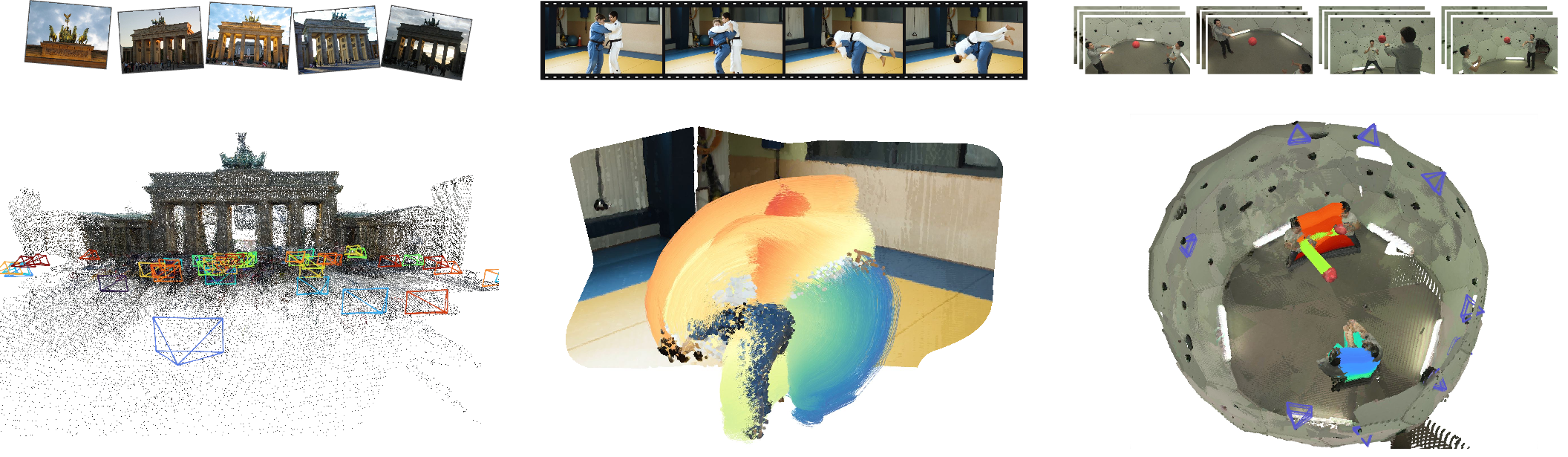
The system works with many kinds of image input:
- Several pictures taken from different camera angles
- Frames from a video
- Pictures taken at different times
- Multiple camera videos showing the same scene
ARROW tries to solve two related problems at once:
- 3D reconstruction: Building a three-dimensional understanding of a scene from images.
- 3D point tracking: Following the same physical point, such as a person’s hand or a corner of a box, as it moves through different images and times.
The name “4D” means that the system understands both 3D space and time.
2. What questions are the researchers asking?
The researchers want to know whether one computer model can successfully understand scenes when the input images do not have a neat order.
For example, a video normally has a clear order: frame 1, frame 2, frame 3, and so on. But a collection of photographs may have no natural order. Some pictures may come from different cameras, and some may have been taken at very different times.
The main questions are:
- Can a model match the same physical point across pictures from different cameras and times?
- Can it track points even when the images are not consecutive video frames?
- Can one model handle both static scenes and moving scenes?
- Does training on more varied image combinations improve tracking?
- Can the same system perform 3D reconstruction, camera estimation, and tracking?
3. How does ARROW work?
Understanding a scene from a set of images
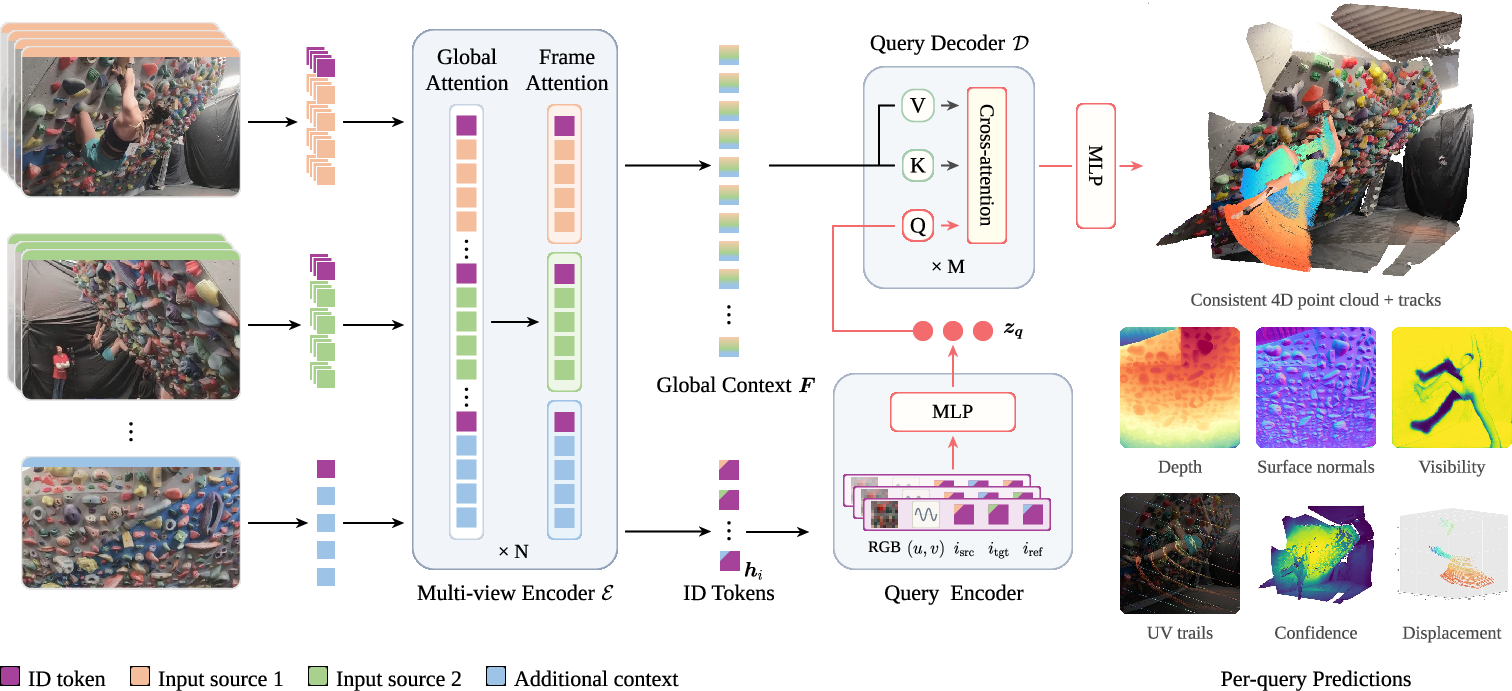
First, ARROW looks at all the input images together. It creates a shared description of the scene, similar to making a large mental map from several photographs.
The images might show:
- A room from different sides
- A moving person
- A car scene recorded by several cameras
- A collection of photographs taken at different moments
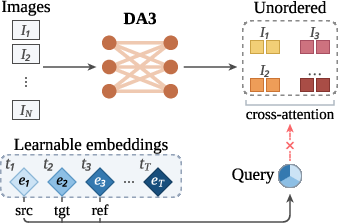
Unlike many older systems, ARROW does not assume that the images are arranged in time order.
Using identity tokens
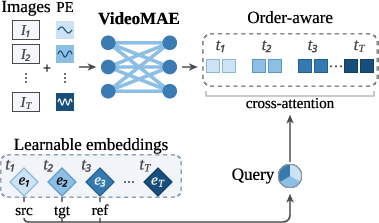
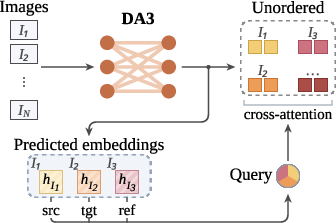
A major problem is telling the system which image a question refers to. The researchers solve this using identity tokens.
An identity token is like a name tag attached to each image. Instead of saying “the third frame,” ARROW uses information from the image itself to identify it.
This is useful because:
- The images do not need to be in a fixed order.
- Several images can come from the same moment.
- The system can work with images from different cameras.
- The system can handle ordinary unordered photo collections.
These tokens are created from the image content, so they are called content-derived identities.
Asking questions about individual points
ARROW works with queries, which are questions about particular points in an image.
A query might ask:
“This point in image A: where is the same physical point at the time shown in image B, using the viewpoint of image C?”
This lets the system predict many things, including:
- The point’s 3D position
- Where the point appears in another image
- Whether the point is visible
- The direction of the surface near the point
- How far the point moved
- How confident the system is in its answer
This is similar to asking a map application very specific questions instead of rebuilding the entire map every time.
Training the model
The researchers train ARROW using several types of data:
- Static scenes, where objects stay in the same place
- Videos containing moving objects
- Multiple synchronized cameras
- Scenes with known 3D points and tracked movements
During training, the model compares its predictions with the correct answers. It receives feedback about several things, such as whether its 3D location, movement, visibility, and image position are correct.
This is called multi-task learning because the model learns several related tasks at the same time.
4. What did the researchers find?
Stronger 3D point tracking
ARROW performed extremely well on the WorldTrack benchmark. It achieved the best results on all four tested datasets:
- Aria Digital Twin
- Dynamic Replica
- PointOdyssey
- Panoptic Studio
It was especially effective at tracking points on moving objects.
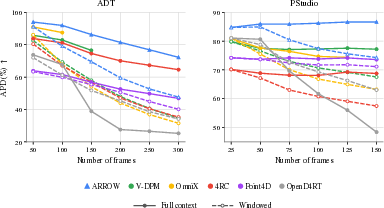
The model also achieved the best average results on much of the TAPVid-3D benchmark, which tests whether points can be tracked across long video sequences.
In simple terms, ARROW was usually better at answering:
“Where did this exact physical point go?”
Effective multi-camera tracking
The researchers also tested ARROW with multiple camera views using only RGB images, without giving it extra depth information or camera calibration.
ARROW achieved the best overall results on most of the tested measures. It outperformed specialized multi-view tracking systems on this adapted benchmark.
This is important because multiple cameras can help reveal parts of an object that are hidden from one camera. ARROW can combine these views without needing a separate system to first calculate all the camera positions.
Competitive 3D reconstruction
Although ARROW was mainly designed for tracking, it also performed competitively at reconstructing 3D scenes and estimating camera poses.
It was not always the best system for these tasks, but it produced results similar to specialized reconstruction systems. This shows that tracking and reconstruction can help each other:
- Understanding 3D structure helps the model track points.
- Tracking points helps the model understand how the scene changes.
Training with varied examples helped
The researchers performed additional tests called ablations. In an ablation, parts of a system are removed or changed to see which parts matter.
These tests showed that performance improved when:
- ARROW used image-based identity tokens instead of fixed position labels.
- The training data included images from different viewpoints and distant times.
- The model learned from static images, videos, and multi-camera scenes together.
This suggests that exposing an AI system to more varied examples can help it solve familiar problems better, not just new problems.
5. Why is this research important?
Many computer vision systems are built for one specific situation. For example, one system might track objects in a video, while another reconstructs a scene from photographs. These systems may also require the images to be in a particular order or require extra information about the cameras.
ARROW offers a more flexible approach. It can use different kinds of image collections without needing a fixed order. It can also answer specific questions about selected points instead of producing unnecessary information for the entire scene.
Possible future uses include:
- Helping robots understand and move through changing environments
- Improving augmented and virtual reality
- Allowing self-driving vehicles to combine views from several cameras
- Tracking people, tools, or objects in sports and medical applications
- Creating 3D models of places from ordinary photographs
- Studying how objects move in complicated scenes
Simple conclusion
ARROW is a single AI model that combines 3D scene building and 3D movement tracking. Its most important idea is to identify each image using information from the image itself rather than assuming that all images have a fixed order.
The experiments show that this approach makes ARROW very good at tracking points across time, viewpoints, and cameras. It also remains useful for reconstructing 3D scenes. The broader lesson is that AI systems may become more powerful and flexible when they learn from many different kinds of observations instead of only from neatly ordered videos.
Knowledge Gaps
The paper leaves the following knowledge gaps, limitations, and open questions unresolved:
- Scalability to large image sets is not established. Because global attention operates over all patch tokens and each query attends to the full context, the computational and memory costs for hundreds or thousands of observations remain unclear.
- The practical limits of arbitrary observation selection are unknown. The experiments do not systematically vary viewpoint baselines, temporal gaps, camera counts, or the proportion of cross-camera versus cross-time observations.
- Order invariance is not fully validated under permutation tests. The paper motivates an order-free architecture but does not report explicit experiments measuring whether predictions remain unchanged when input images are randomly permuted.
- The uniqueness and reliability of content-derived ID tokens are uncertain. Images with similar appearance, repeated viewpoints, severe occlusion, or low texture may produce ambiguous identity tokens, but these failure cases are not analyzed.
- The model’s behavior when observations are visually similar or duplicated is unexplored. It is unclear whether ARROW can consistently distinguish multiple cameras or frames that have nearly identical RGB content.
- Dependence on the DA3 pretrained representation is not isolated sufficiently. The results suggest that the choice of geometry prior strongly affects performance, but the paper does not establish whether the proposed querying mechanism remains effective with substantially different encoders or with a trained-from-scratch encoder.
- The contribution of ID tokens versus other identity mechanisms is incompletely characterized. Comparisons against explicit set-aware indexing, learned permutation-equivariant identifiers, camera metadata, or pairwise matching features are missing.
- The model does not explicitly enforce cross-query consistency. Since queries are decoded independently without query self-attention or a global consistency objective, predictions for the same physical point across different queries may disagree; this inconsistency is not measured.
- Geometric and motion consistency constraints are absent. The training objective does not explicitly enforce multiview reprojection consistency, rigid-background consistency, cycle consistency, or physically plausible trajectories.
- Performance under severe occlusion and disocclusion is insufficiently investigated. Although visibility is predicted, the paper does not provide detailed breakdowns by occlusion duration, disocclusion type, object size, or visibility transition.
- Appearance changes beyond ordinary viewpoint and time variation remain underexplored. Robustness to lighting changes, shadows, reflections, weather, motion blur, sensor exposure differences, and nonrigid appearance changes is not systematically evaluated.
- Long-term tracking beyond the benchmark horizons is unresolved. TAPVid-3D includes sequences of up to 300 frames, but robustness over substantially longer temporal gaps and repeated appearances is not demonstrated.
- Fast or highly nonrigid motion is not separately evaluated. The training strategy samples broader temporal windows, but the paper does not quantify performance as a function of motion magnitude, acceleration, or deformation rate.
- Dynamic-scene training remains limited when ground-truth tracks are unavailable. For datasets such as nuScenes, motion queries are restricted to identical source and target times, leaving the model without direct cross-time motion supervision in those data.
- The ability to separate camera motion from scene motion is not fully analyzed. The paper reports aggregate tracking metrics but does not provide controlled experiments isolating errors caused by camera motion, object motion, or simultaneous motion.
- Generalization to unseen domains and sensors is uncertain. Evaluation is concentrated on established benchmarks and mostly RGB imagery; robustness to handheld consumer cameras, surveillance footage, fisheye cameras, different resolutions, infrared, or adverse-weather imagery is not established.
- Calibration and camera-model assumptions remain unclear. The model is evaluated without ground-truth intrinsics in some settings, but its sensitivity to unknown focal length, principal point, rolling shutter, lens distortion, and synchronization errors is not quantified.
- Asynchronous and imperfectly synchronized multi-camera inputs are not evaluated. The formulation permits observations with different capture times, but experiments primarily use synchronized multi-view data or timestamp information implicit in the datasets.
- Absolute metric scale is not recovered. Several evaluations use per-scene median-scale alignment, so the results do not establish whether ARROW can estimate metrically accurate geometry without scene-level scale correction.
- The impact of scale alignment on comparative conclusions is not fully examined. Per-scene alignment may reduce differences between methods, but no evaluation without alignment or with a shared calibration protocol is reported.
- Camera pose recovery is only indirectly assessed. Poses are recovered from predicted points, yet the paper does not clearly separate errors originating from point reconstruction from errors caused by the pose-recovery procedure.
- The model’s weaker reconstruction and pose performance is not explained. ARROW is competitive rather than dominant on several reconstruction benchmarks, but there is no detailed analysis of whether the gap comes from the decoder, training mixture, loss weighting, or DA3 initialization.
- The effect of each training dataset and sampling policy is not fully disentangled. The ablations show cumulative benefits, but a comprehensive leave-one-dataset-out study and controlled comparisons of temporal-window, camera-selection, and point-sampling policies are not provided.
- Loss-weight sensitivity is not reported. The relative contributions and robustness of the 3D, confidence, UV, visibility, normal, and displacement losses remain unclear.
- Confidence calibration is unexplored. The model predicts confidence values, but their calibration, correlation with geometric error, and usefulness for filtering or downstream decision-making are not evaluated.
- Failure cases are not systematically documented. Qualitative examples emphasize successful reconstructions and tracks, while failure modes involving ambiguous correspondences, thin structures, reflections, textureless surfaces, and large errors receive limited analysis.
- The effectiveness of sparse decoding for dense reconstruction is not quantified. Although the same decoder is claimed to support dense outputs, the paper does not report throughput, memory usage, accuracy degradation, or query-count scaling for dense prediction.
- Real-time applicability is uncertain. Runtime, latency, peak memory, and throughput for encoding long sequences and answering large numbers of queries are not reported.
- The relationship between input diversity and transfer to tracking is not fully causal. Improved results may reflect additional data volume, stronger pretraining, or altered sampling rather than diversity itself; matched-data experiments controlling for quantity are needed.
- Robustness to missing or corrupted observations is not tested. The paper does not evaluate random frame removal, incomplete camera views, noisy images, compression artifacts, or partial image sets.
- The handling of multiple observations at the same capture time is not deeply examined. Although the formulation allows shared timestamps, it remains unclear how the model distinguishes observation identity from temporal identity when cameras view the same scene simultaneously.
- The query interface does not explicitly represent uncertainty or multimodality. Ambiguous points may have multiple plausible 3D correspondences, but the deterministic output formulation does not model alternative hypotheses.
- The training and evaluation protocols may not fully reflect downstream deployment conditions. Queries are generally sampled from annotated or visible points, whereas practical systems may receive arbitrary pixels, including background, occluded regions, and points outside the training distribution.
- The extent of data leakage or overlap between pretraining and evaluation domains is not clarified. Since ARROW initializes from DA3 and uses datasets related to the evaluated benchmarks, the independence of pretraining, training, and test scenes warrants explicit verification.
- Comparisons with concurrent methods are not uniformly controlled. Differences in checkpoints, input modalities, external reconstruction components, training data, and evaluation protocols make it difficult to attribute gains solely to ARROW’s architecture.
- The adapted RGB-only MVTracker benchmark lacks broader validation. Because the benchmark is modified from its original protocol, the representativeness of the adaptation and the comparability to methods designed for the original setting remain open questions.
- Object-level and semantic tracking capabilities are not investigated. The paper focuses on point correspondence and geometry, leaving unresolved whether the representation supports object identity, part tracking, category-level transfer, or interaction tasks.
- The role of explicit temporal information is not fully resolved. Removing temporal encodings supports arbitrary sets, but the paper does not test whether selectively providing timestamps or relative time differences could improve dynamic-scene performance without sacrificing permutation invariance.
Practical Applications
Immediate Applications
- Markerless 3D motion capture for media, sports, and human–computer interaction
- Use ARROW to track selected body, object, or scene points in 3D from RGB video without requiring calibrated multi-camera rigs, depth sensors, or motion-capture markers.
- Potential workflow: select image points or object landmarks in one frame, issue source–target–reference queries, and obtain 3D trajectories, visibility estimates, and confidence scores.
- Sectors: film and animation previsualization, sports biomechanics, virtual production, interactive systems, and gesture-based interfaces.
- Dependencies: accuracy may degrade under severe occlusion, unusual camera motion, domain shift, poor image quality, or objects with limited visual texture. Safety-critical biomechanical conclusions would require calibrated validation.
- RGB-only multi-camera tracking in robotics and industrial automation
- Deploy ARROW as a perception module for tracking tools, parts, hands, or workpieces across several unsynchronized or weakly calibrated camera streams.
- Its arbitrary observation-set formulation can combine views taken at the same time with observations captured at different times, while its sparse decoder can process only the points needed by a downstream controller.
- Potential products: camera-based workcell monitoring, object handoff tracking, robotic manipulation assistance, and calibration-light inspection systems.
- Dependencies: the paper demonstrates strong benchmark performance but does not establish real-time latency, robustness to industrial lighting, or closed-loop control stability. Coordinate-scale ambiguity and uncertainty calibration must be handled before precise manipulation.
- 3D reconstruction and tracking for autonomous vehicles and mobile robots
- Use RGB observations from vehicle cameras or robot-mounted cameras to estimate scene geometry, track road users and objects, and distinguish camera motion from object motion.
- The model’s query interface supports tracking points from arbitrary source frames to target observations and expressing outputs in a selected reference coordinate system.
- Potential workflow: generate sparse 3D tracks for planning while requesting dense point maps only for regions requiring reconstruction.
- Sectors: autonomous driving, delivery robots, drones, and mobile mapping.
- Dependencies: the reported results include driving-related benchmark data, but deployment requires evaluation under weather, night-time conditions, sensor exposure changes, long-term scene changes, and safety-critical failure modes. Metric scale, camera intrinsics, temporal synchronization, and latency may require additional processing.
- Video editing, visual effects, and augmented reality
- Track sparse points or surfaces across changing viewpoints and time to support object insertion, image stabilization, camera-aware compositing, rotoscoping, and attachment of virtual content to moving objects.
- Surface normals, image coordinates, visibility predictions, and 3D positions can provide useful intermediate signals for graphics pipelines.
- Potential tools: point-based AR anchoring, automatic effects masks, viewpoint-consistent retargeting, and semi-automatic rotoscoping assistants.
- Dependencies: photorealistic AR requires more than point tracking; dense surface completion, accurate camera calibration, lighting estimation, and robust handling of reflections and transparent objects remain necessary.
- Digital-twin creation and 4D scene annotation
- Apply ARROW to convert collections of RGB images and videos into approximate 3D/4D scene representations with point correspondences and motion tracks.
- This can accelerate annotation of dynamic objects, construction-site progress, indoor environments, and laboratory experiments.
- Sectors: architecture, construction, manufacturing, smart buildings, and cultural heritage.
- Dependencies: the model is competitive with dedicated reconstruction systems rather than universally superior for reconstruction. Long-term digital twins need persistent object identities, global coordinate alignment, scale consistency, and quality-control procedures.
- Dataset generation and annotation for computer vision research
- Use ARROW’s predictions to produce candidate 3D tracks, visibility labels, point correspondences, and camera-relative geometry for otherwise unlabeled RGB datasets.
- Researchers can use these outputs for pre-annotation followed by human verification, reducing the cost of constructing multi-view and 4D datasets.
- Sectors: academia, robotics research, autonomous-systems development, and simulation.
- Dependencies: pseudo-labels will contain systematic errors, especially for occluded or highly deformable objects. Human review and confidence-based filtering are required; ARROW outputs should not be treated as ground truth without validation.
- Interactive 3D measurement and scene inspection
- A user could click a point in an image and query its estimated position in another observation, enabling approximate measurements of object movement, distances, and spatial relationships.
- Potential applications: remote inspection, laboratory analysis, facility management, and consumer mobile scanning.
- Dependencies: the method uses scale alignment in several evaluations, so absolute metric measurement may require known scale references, camera metadata, or additional calibration. Accuracy should be presented with confidence and uncertainty rather than as exact measurement.
- Academic baselines and reusable open-source research infrastructure
- The publicly available code and weights can serve as a unified baseline for studies of 3D reconstruction, point tracking, multi-view learning, query-based vision, and order-invariant architectures.
- Researchers can compare sparse versus dense decoding, investigate arbitrary image-set sampling, and fine-tune the model for domain-specific datasets.
- Dependencies: reproducibility depends on access to the specified pretrained encoder, computational resources, licensing conditions, and consistent benchmark protocols. The paper’s results should not be generalized beyond the evaluated datasets without additional testing.
- Policy and standards development for camera-based spatial AI
- Public agencies and standards bodies can use ARROW-like systems as reference implementations when evaluating privacy-preserving, calibration-light 3D monitoring technologies.
- For example, urban planning or transport authorities could prototype anonymous scene-flow statistics without storing identifiable video, provided that only derived tracks are retained.
- Dependencies: 3D trajectories may still enable re-identification or behavioral profiling. Deployment requires privacy impact assessments, data minimization, secure processing, retention limits, and legal review.
Long-Term Applications
- Safety-certified perception for autonomous driving and robotics
- ARROW could evolve into a unified perception component that supplies geometry, object motion, visibility, and camera-relative coordinates to planning and control systems.
- Its ability to use arbitrary views could improve perception when some cameras are occluded, temporarily unavailable, or captured at different times.
- Dependencies: substantial research is needed on calibrated uncertainty, out-of-distribution detection, metric-scale recovery, real-time inference, sensor fusion, temporal consistency, and formal safety validation. Benchmark gains alone are insufficient for autonomous deployment.
- General-purpose 4D world models
- The architecture could become a building block for world models that accept unordered image collections, video, multi-camera observations, and user-defined spatial queries through one interface.
- Such systems could answer queries such as where an object was, where it moved, what was occluded, and how the scene changed between observations.
- Potential products: searchable 4D video archives, spatial memory for robots, interactive digital twins, and multimodal simulation environments.
- Dependencies: current outputs are primarily point-level and coordinate-relative. Long-term systems need persistent object identity, semantic understanding, physical reasoning, globally consistent maps, uncertainty modeling, and efficient handling of very large observation sets.
- Robotic manipulation and embodied agents
- A robot could query the future 3D position of selected grasp points, estimate object motion from multiple cameras, and use visibility predictions to replan when an object becomes occluded.
- The sparse query mechanism is potentially well matched to control systems that need only a small number of task-relevant points.
- Dependencies: closed-loop manipulation requires millimeter-level reliability in many settings, fast inference, temporal stability, contact and deformable-object modeling, and robust recovery from incorrect correspondences. ARROW’s benchmark-level tracking accuracy does not by itself guarantee control performance.
- Medical and rehabilitation motion analysis
- With appropriate clinical validation, markerless 3D tracking could support rehabilitation assessment, gait analysis, physical-therapy feedback, and monitoring of movement over time using ordinary cameras.
- Dependencies: medical use requires demographic and environmental fairness studies, privacy safeguards, clinically meaningful error bounds, calibrated scale, occlusion robustness, and regulatory approval. The paper does not evaluate clinical populations or medical tasks.
- Large-scale infrastructure and disaster-response mapping
- Collections of images from drones, phones, body cameras, and fixed cameras could be fused to reconstruct changing environments and track structural or environmental changes.
- Potential applications: post-disaster assessment, bridge and building inspection, landslide monitoring, and emergency-response mapping.
- Dependencies: observations may not share sufficient visual overlap; weather, dust, smoke, lighting changes, and scene destruction can violate the model’s assumptions. Reliable global georegistration, uncertainty estimates, and robust operation under severe domain shift are required.
- Persistent augmented reality and spatial computing
- ARROW could contribute to AR systems that maintain point and object correspondence across devices, viewpoints, and later visits, even when observations are not captured as a continuous video.
- This may enable persistent virtual annotations, collaborative spatial workspaces, and cross-device reconstruction.
- Dependencies: persistent AR needs globally stable maps, identity-level object recognition, metric-scale accuracy, low latency, privacy-preserving cloud or edge processing, and resistance to scene rearrangement. The current model’s relative reference-coordinate formulation would need extension.
- Energy and industrial asset monitoring
- Long-term development could apply arbitrary-view 4D reconstruction to detect deformation, motion, wear, or damage in wind turbines, power infrastructure, factories, and pipelines.
- RGB cameras distributed across a facility could provide complementary views without requiring every camera to be precisely calibrated.
- Dependencies: industrial deployment requires reliable metric estimates, domain-specific training, operation under harsh lighting and weather, explainable alarms, and integration with maintenance databases. False positives and missed detections have significant operational costs.
- Policy-grade mobility and urban analytics
- Aggregated 3D tracks could support traffic-flow analysis, pedestrian-safety studies, accessibility planning, and evaluation of road or public-space redesigns.
- Dependencies: the system must provide population-level fairness, robust anonymization, transparent error reporting, and safeguards against surveillance misuse. Regulatory acceptance would depend on whether raw imagery is retained and whether trajectories can be linked to individuals.
- Order-invariant learning for other multimodal and temporal systems
- The paper’s central innovation—content-derived identities instead of fixed positional or temporal embeddings—could transfer to medical imaging, satellite imagery, scientific experiments, and multimodal sensor fusion where observations have no natural order.
- Potential research directions: unordered laboratory measurements, irregularly sampled climate observations, multi-sensor industrial logs, and event-based video analysis.
- Dependencies: content-derived identities must remain distinguishable when observations are visually similar, repeated, or ambiguous. Additional mechanisms may be needed for explicit timestamps, sensor type, calibration metadata, and identity consistency across sessions.
Glossary
- 4D reconstruction: Reconstruction of scene geometry and motion across three spatial dimensions and time. “ARROW reconstructs 4D scenes over arbitrary sets of input images.”
- Attention: A neural-network mechanism that selectively weights relationships among feature representations. “Each query independently attends to the full encoded context”
- Camera calibration: Estimation or provision of the camera’s intrinsic and extrinsic parameters. “but assume supplied camera calibration and synchronized videos”
- Camera pose: The position and orientation of a camera relative to a scene or coordinate system. “We recover camera poses from the predicted 3D points”
- Chamfer distance: A metric measuring the average nearest-neighbor distance between two point sets. “Chamfer”
- Confidence-weighted loss: A loss function whose contribution is adjusted according to the model’s predicted confidence. “The primary term $L_{\mathrm{3D}$ is a scale-invariant, confidence-weighted loss”
- Cross-attention: An attention operation in which one representation attends to another distinct representation. “The query decoder then predicts the per-query outputs via cross-attention between the query token and the global scene representation.”
- Depth ambiguity: Uncertainty in recovering a point’s distance from a camera using image evidence. “Multi-view trackers instead combine simultaneous views to reduce depth ambiguity”
- End-point error (EPE): The distance between a predicted endpoint and its ground-truth endpoint, commonly used for motion or tracking evaluation. “mean 3D end-point error (EPE, meters)”
- Feed-forward model: A model that produces predictions through a forward pass without iterative optimization at inference time. “We introduce ARROW, a feed-forward model that unifies 3D reconstruction and 3D point tracking from arbitrary image sets.”
- Fourier encoding: A representation that maps coordinates to sinusoidal features at multiple frequencies. “$\phi_{\mathrm{uv}$ embeds the Fourier-encoded normalized coordinates”
- Global attention: Attention computed over all relevant tokens or observations rather than within a local neighborhood. “alternates frame-wise and global self-attention”
- Global context: A shared feature representation containing information from the complete input image set. “The multi-view encoder receives an image set and outputs a global scene representation and a set of ID~tokens.”
- Global median scale alignment: Scaling predictions using a single scene-level factor based on the median predicted and reference distances. “We express trajectories in the first camera's coordinate system and apply global median scale alignment per scene.”
- Inductive bias: A preference or assumption introduced by a model architecture or training procedure that influences generalization. “Training primarily on temporally local video introduces an inductive bias toward motion and appearance continuity.”
- Image-set representation: A feature representation formed from a collection of images treated as an unordered set. “Replacing the encoder with an order-free image-set representation”
- Image-plane tracking: Tracking points by their two-dimensional image coordinates without directly estimating their three-dimensional positions. “Image-plane trackers follow point identities through video”
- Intrinsic parameters: Camera parameters describing internal projection properties, such as focal length and principal point. “Without ground-truth intrinsics.”
- Latent query token: A learned feature vector representing a query before it is decoded into an output. “The query encoder combines local appearance, coordinates, and the ID~tokens of the queried observations into a latent query token”
- L1 loss: A loss based on the absolute difference between predicted and target values. “$L_{\mathrm{uv}$ and $L_{\mathrm{disp}$ are losses”
- Median-scale alignment: Rescaling predictions according to the ratio of median predicted and ground-truth distances. “Both settings use the same per-sequence median-scale alignment formula as WorldTrack.”
- Multi-view stereo: Recovery of three-dimensional scene structure from multiple images captured from different viewpoints. “Classical structure-from-motion and multi-view stereo recover cameras and the geometry of a fixed world”
- Occlusion accuracy (OA): A metric evaluating whether a model correctly predicts point visibility or occlusion. “We report APD, average Jaccard~(AJ) and occlusion accuracy~(OA)”
- Order-invariant querying: Query processing that does not depend on the ordering of input observations. “At its core is a novel order-invariant querying approach”
- Order-agnostic: Independent of the order in which inputs are presented. “since the input is treated as an order-agnostic set.”
- Per-pixel trajectory: A motion path predicted separately for each image pixel across time. “directly predict per-pixel B-spline trajectories”
- Point map: A dense image-aligned representation in which each pixel is associated with a three-dimensional point. “to predict per-frame point maps and camera poses.”
- Pointwise decoder: A decoder that independently processes individual point queries. “ARROW realizes all three with one shared encoder and a pointwise decoder.”
- Positional encoding: A feature added to a representation to communicate the position or index of an element. “D4RT enables this association by explicitly imposing order on the global context via positional encodings”
- Reference coordinate system: The coordinate frame in which a predicted geometric quantity is expressed. “The 3D position, surface normals, and displacement are predicted in the coordinate system of the reference observation.”
- Scale-invariant loss: A loss whose value is unaffected by a common multiplicative change in scale. “The primary term $L_{\mathrm{3D}$ is a scale-invariant, confidence-weighted loss”
- Self-attention: An attention mechanism in which tokens attend to other tokens within the same representation. “alternates frame-wise and global self-attention”
- Sparse decoding: Producing outputs only for explicitly requested queries rather than for every possible point. “Sparse decoding offers finer control by predicting only the requested point states”
- Structure-from-motion: The recovery of camera motion and three-dimensional structure from multiple images. “Classical structure-from-motion and multi-view stereo recover cameras and the geometry of a fixed world”
- Surface normal: A vector perpendicular to a surface at a particular point. “a unit surface normal”
- Temporal continuity: The assumption that observations close in time have smoothly related appearance or motion. “without requiring temporal continuity”
- Temporal embedding: A learned feature representing a time index or temporal position. “replacing the role of the learned temporal embedding.”
- Triangulation: Estimating a three-dimensional point from its projections in multiple calibrated images. “through feature matching, triangulation, and optimization”
- Unposed image: An image for which the camera’s pose relative to the scene is not provided. “geometry transformers such as DUSt3R, VGGT, and Depth Anything~3 (DA3) recover geometry from unposed image sets”
- Visibility logit: An unconstrained scalar whose transformed value represents the predicted probability that a point is visible. “a visibility logit $\hat o\inR$”
- Windowed method: A method that processes a long sequence in overlapping or separate temporal segments. “Long sequences and arbitrary source frames require windowed methods to propagate tracks bidirectionally”
- World coordinate system: A shared coordinate frame used to express points across different cameras or observations. “a shared world frame (the first input camera).”