Rho: A Foundation for Efficiently Adaptable VLA Models
Abstract: General-purpose physical AI models must combine broad visual and linguistic capabilities with precise control across robot embodiments and efficient adaptation to downstream tasks. We introduce Rho, a family of open-weights VLA models for bimanual manipulation designed for data-light task adaptation on 3 embodiments representative of dual-arm robots across research labs and the industry -- YAM Box, UR AI Trainer, and FR3 Duo. We systematically ablate Rho's action-expert architecture and training recipe, and show in controlled simulation and physical-robot experiments that embodiment midtraining improves downstream adaptation. The resulting Rho variants for YAM Box, UR AI Trainer, and FR3 Duo match or outperform existing open-weights VLAs and achieve the strongest overall performance across the tasks, embodiments, and baselines evaluated in this report. We further demonstrate the Rho model family's built-in capacity for online adaptation: an internal latent policy learns from corrective feedback to select observation-conditioned noise inputs for the frozen flow-matching action expert. With as few as 15 corrected episodes, adapting this lightweight module enables Rho to handle task situations at the fringe of its offline finetuning distribution. Together, these results position Rho as both a strong general-purpose robotic manipulation model and a practical foundation for adaptation. We release the base Rho model and the embodiment-specific checkpoints to facilitate Rho's deployment in research experiments and practical industrial use cases.
Paper Prompts
Sign up for free to create and run prompts on this paper.
Explain it Like I'm 14
1. ¿De qué trata el artículo?
El artículo presenta Rho, una familia de modelos de inteligencia artificial diseñados para controlar robots con dos brazos.
Rho combina tres habilidades:
- Ver lo que ocurre mediante cámaras.
- Entender instrucciones escritas o habladas.
- Mover los brazos del robot para realizar tareas.
Por ejemplo, una persona podría decirle al robot: “Recoge la taza y colócala junto al plato”. El modelo intentaría mirar la escena, entender la orden y producir los movimientos necesarios.
El objetivo principal de Rho es que los robots puedan aprender tareas nuevas usando menos ejemplos y menos tiempo de entrenamiento que otros sistemas.
El texto proporcionado parece ser un fragmento del artículo y termina durante una tabla de resultados. Por eso, algunos detalles numéricos de los experimentos finales no aparecen completos.
2. ¿Qué preguntas intenta responder el estudio?
Los investigadores quieren saber principalmente:
- ¿Qué tipo de diseño hace que Rho controle mejor un robot?
- ¿Ayuda entrenar primero al modelo para un tipo específico de robot?
- ¿Puede Rho aprender una tarea nueva con pocos ejemplos?
- ¿Puede mejorar después de empezar a trabajar, usando correcciones de una persona?
- ¿Funciona Rho en distintos robots, simuladores y situaciones reales?
La idea central es separar el aprendizaje en etapas. Primero, el modelo aprende a controlar un tipo de robot en general. Después, aprende una tarea concreta, como ordenar objetos o insertar un cable.
Es parecido a enseñar a una persona a conducir un automóvil antes de pedirle que aprenda una ruta específica. Si ya sabe conducir, necesitará menos práctica para aprender la ruta.
3. ¿Cómo realizaron la investigación?
El modelo Rho
Rho tiene aproximadamente 5.000 millones de parámetros. Los parámetros son valores internos que el modelo ajusta durante el entrenamiento, como si fueran miles de millones de pequeños controles que le ayudan a reconocer patrones.
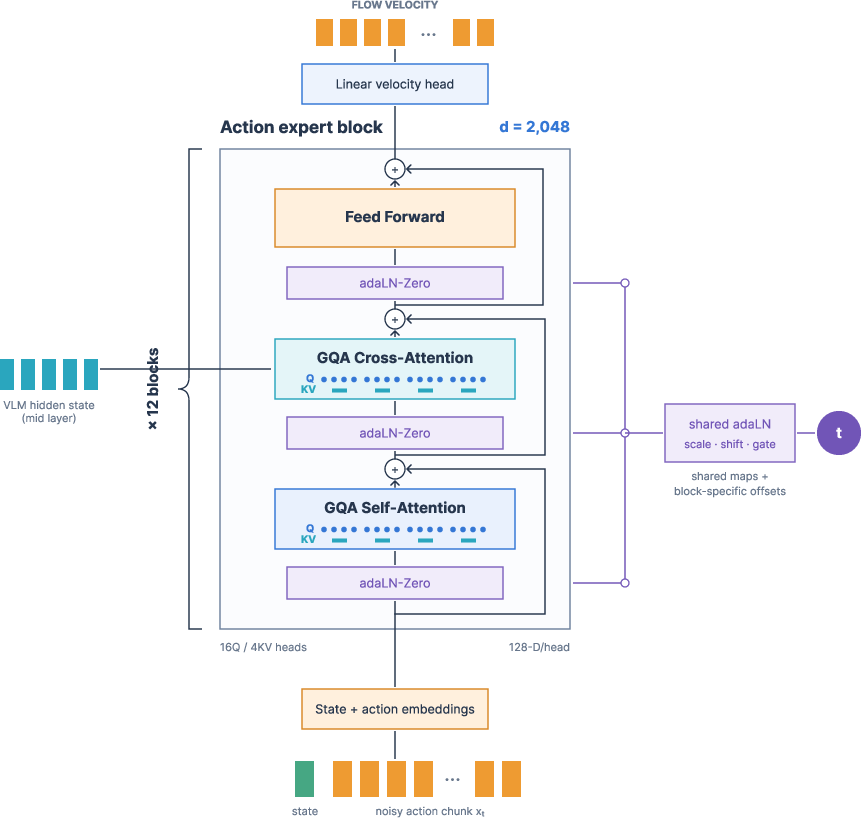
El modelo comienza con una parte llamada modelo visión-lenguaje. Esta parte aprende a relacionar imágenes y palabras. Después se le añade una parte especial para producir movimientos del robot, llamada experto de acciones.
Información que recibe el robot
En cada momento, Rho puede recibir:
- Imágenes de una o varias cámaras.
- Una instrucción, como “mete el bloque azul en la caja”.
- Información sobre el estado del robot, como la posición de sus brazos.
- Datos sobre el movimiento que debería realizar.
El modelo no predice solamente un movimiento. Predice un grupo de movimientos futuros, llamado action chunk. Esto es parecido a planear varios pasos de una coreografía en vez de decidir cada paso justo cuando llega el momento.
Generación de movimientos
Rho utiliza una técnica llamada flow matching. En términos sencillos, el modelo comienza con una especie de movimiento aleatorio y lo va corrigiendo poco a poco hasta convertirlo en una secuencia útil para el robot.
Una analogía sería empezar con un dibujo borroso y mejorarlo gradualmente hasta obtener una imagen clara. En Rho, el resultado final no es una imagen, sino una serie de movimientos para los brazos.
Entrenamiento con muchos robots
Durante el entrenamiento inicial, Rho observa datos de más de una docena de tipos de robots y muchas tareas diferentes. Estos datos incluyen:
- Robots de uno o dos brazos.
- Tareas en laboratorios y entornos cotidianos.
- Ejemplos reales y simulados.
- Información visual y preguntas sobre imágenes.
Los investigadores llaman a esta mezcla de datos Rho-Tomyum.
También usan datos de robots específicos para crear versiones adaptadas a tres plataformas:
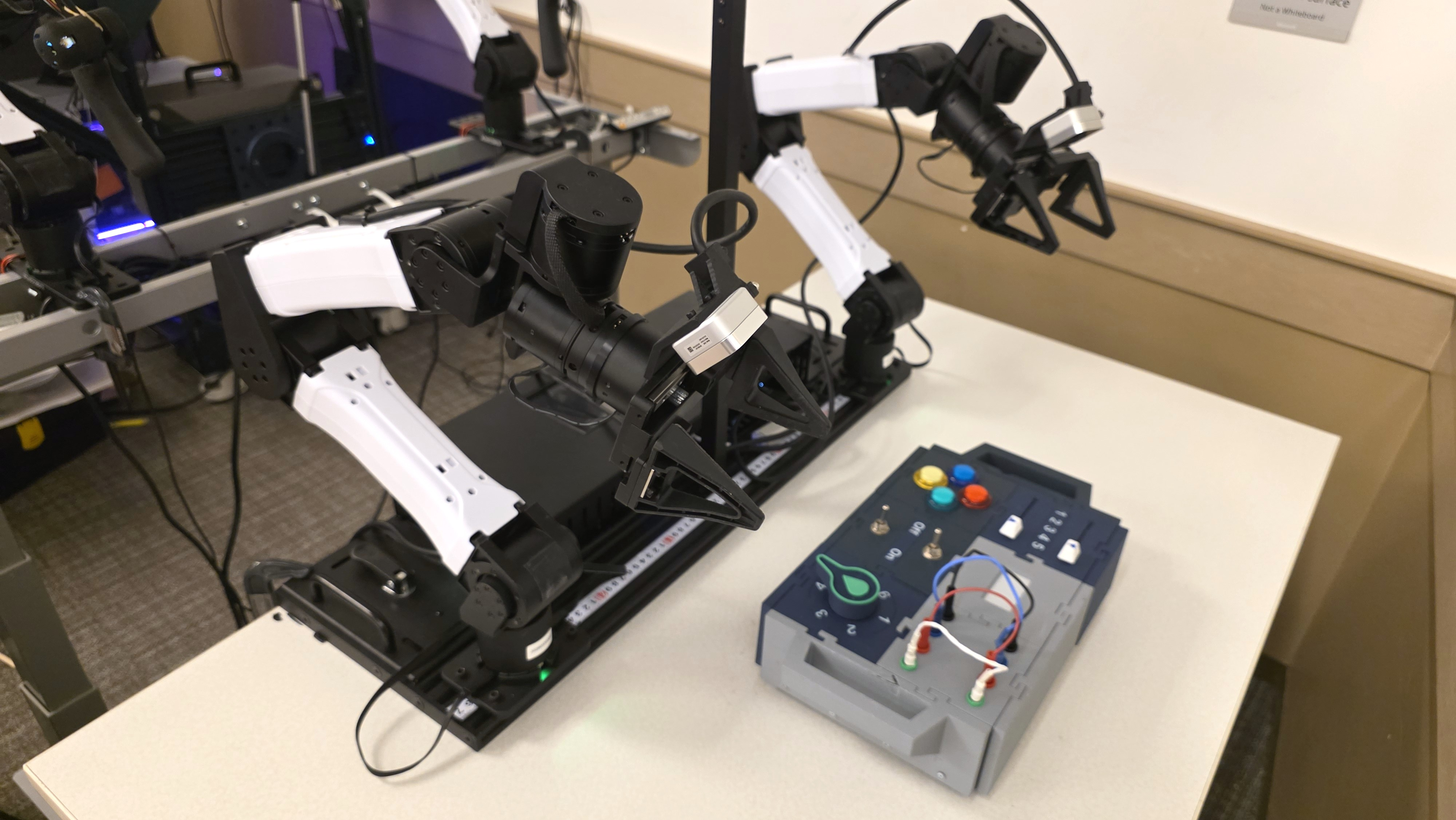
- YAM Box
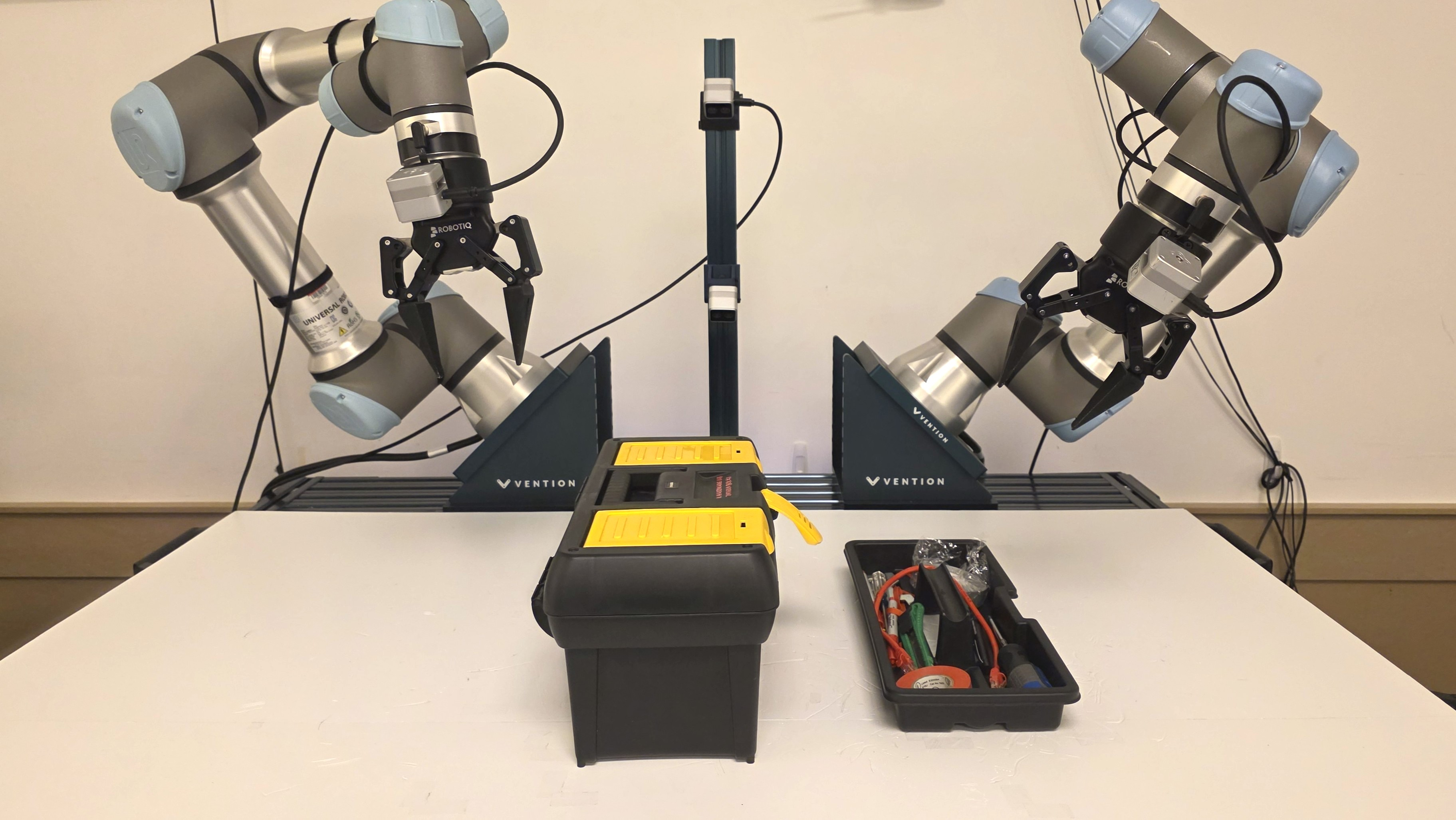
- UR AI Trainer
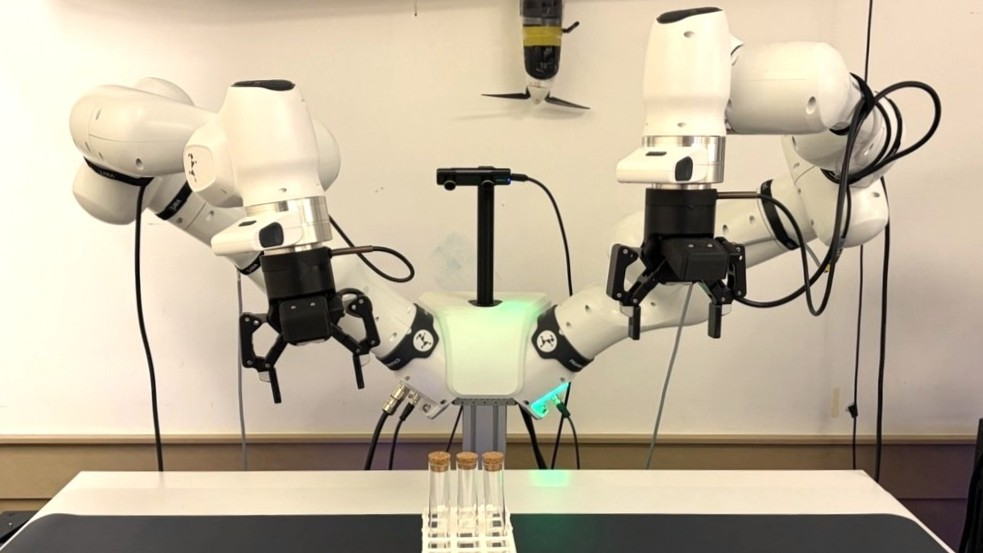
- Franka FR3 Duo
Estos robots tienen dos brazos y cámaras, pero no son exactamente iguales. Cada uno tiene distintas posiciones, sensores y formas de moverse.
Adaptación en dos etapas
Rho sigue una estrategia llamada adaptación progresiva regularizada. Sus etapas principales son:
- Preentrenamiento general: aprende visión, lenguaje y movimientos de muchos robots.
- Entrenamiento del tipo de robot: aprende las cámaras, los controles y la forma de moverse de un robot específico.
- Adaptación a una tarea: aprende una tarea concreta con demostraciones adicionales.
- Adaptación en línea: después de comenzar a trabajar, puede aprender de correcciones humanas.
Correcciones durante el uso
Rho también tiene una pequeña parte interna llamada política latente. Si el robot se equivoca y una persona corrige su movimiento, esta parte aprende cómo elegir mejor sus movimientos iniciales la próxima vez.
Lo importante es que no se cambia todo el modelo. Se mantiene congelada la mayor parte de Rho y solo se ajusta este pequeño componente. Según el artículo, puede ser útil con tan solo 15 episodios corregidos, es decir, unas 15 demostraciones o intentos guiados.
4. ¿Cuáles son los principales resultados?
El entrenamiento específico para cada robot ayuda
El resultado más importante es que el entrenamiento de adaptación al tipo de robot mejora el aprendizaje de tareas nuevas.
Los modelos que recibieron este entrenamiento específico necesitaron aproximadamente la mitad de los datos para alcanzar un nivel de éxito similar al de los modelos que solo recibieron el entrenamiento general.
Esto significa que, antes de enseñar al robot una tarea concreta, conviene enseñarle cómo funciona su propio cuerpo:
- Cómo ven sus cámaras.
- Hasta dónde pueden llegar sus brazos.
- Cómo funcionan sus pinzas.
- Qué significan sus controles.
Rho obtuvo buenos resultados frente a otros modelos abiertos
En las pruebas mencionadas, las versiones de Rho alcanzaron o superaron a otros modelos de visión-lenguaje-acción cuyos parámetros están disponibles públicamente.
Los experimentos se realizaron en:
- Simuladores de robots.
- Pruebas con el robot YAM Box.
- Pruebas con el UR AI Trainer.
- Pruebas con el FR3 Duo.
El artículo afirma que Rho obtuvo el mejor rendimiento general entre los modelos comparados en los conjuntos de tareas, robots y pruebas evaluados.
La arquitectura de las acciones es importante
Los investigadores probaron diferentes tamaños y diseños para el experto de acciones. Descubrieron que no basta con tener un modelo grande: también importa cómo se organiza.
En una tabla de pruebas de RoboEval, algunas configuraciones obtuvieron tasas de éxito distintas. Por ejemplo:
| Configuración | Tasa media de éxito |
|---|---|
| 1.024 de ancho, 16 cabezas, 16 bloques | 61,7 % |
| 1.024 de ancho, 8 cabezas, 16 bloques | 64,0 % |
| 1.024 de ancho, 8 cabezas, 32 bloques | 64,2 % |
| 2.048 de ancho, 8 cabezas, 16 bloques | 62,3 % |
| 2.048 de ancho, 16 cabezas, 16 bloques | 67,3 % |
En este contexto, la tasa de éxito indica cuántas veces el robot completó correctamente las tareas. La mejor configuración de esa tabla consiguió un éxito medio del 67,3 %.
El robot puede seguir mejorando con correcciones
Después del entrenamiento normal, Rho puede aprender de correcciones humanas. Si el robot encuentra una situación poco común que no aparecía en sus ejemplos iniciales, una persona puede ayudarlo y el modelo puede usar esa información para mejorar.
Este método es importante porque los robots reales suelen encontrarse con problemas inesperados, por ejemplo:
- Un objeto está ligeramente fuera de lugar.
- Una cámara ve la escena desde un ángulo diferente.
- Un objeto se mueve o se dobla.
- El robot necesita aplicar más o menos fuerza.
5. ¿Por qué son importantes estos resultados?
Entrenar robots suele ser difícil y caro. Se necesitan muchas demostraciones, equipos especiales y bastante tiempo.
Si Rho puede aprender una tarea nueva usando menos datos, entonces podría ser más práctico para:
- Fábricas.
- Laboratorios de investigación.
- Almacenes.
- Ayuda en tareas domésticas.
- Manipulación de objetos delicados.
- Trabajos que requieren dos brazos coordinados.
La adaptación por etapas también podría facilitar el uso del mismo modelo en robots diferentes. En vez de construir un modelo completamente nuevo para cada robot, se podría comenzar con Rho y adaptarlo.
Además, la posibilidad de aprender de correcciones humanas puede ser más sencilla que recopilar miles de demostraciones perfectas. Una persona solo tendría que intervenir cuando el robot comete un error.
6. Posibles limitaciones
Aunque los resultados son prometedores, el artículo no demuestra que Rho pueda realizar cualquier tarea.
Hay varias limitaciones importantes:
- El robot todavía necesita entrenamiento específico para cada plataforma.
- Las tareas largas y precisas siguen siendo difíciles.
- Un buen resultado en un simulador no siempre se repite exactamente en el mundo real.
- Las pruebas cubren ciertos robots y tareas, pero no todos los posibles escenarios.
- El fragmento proporcionado no incluye todos los resultados numéricos ni la discusión final completa.
- El modelo necesita cámaras, datos de entrenamiento y suficiente capacidad informática.
También es importante recordar que una tasa de éxito del 67,3 % significa que el robot todavía falla en una parte considerable de los intentos.
Conclusión
El artículo presenta Rho como un sistema general para enseñar a robots de dos brazos a ver, entender instrucciones y mover objetos.
La idea principal es que el aprendizaje debe dividirse en partes: primero el robot aprende a controlar su cuerpo, después aprende tareas concretas y finalmente puede mejorar con correcciones durante el uso.
Los experimentos indican que este método hace que la adaptación sea más rápida y necesite menos datos. Si estos resultados se confirman en más robots y tareas, Rho podría ayudar a crear robots más flexibles, capaces de aprender nuevas habilidades sin tener que ser programados desde cero cada vez.
Practical Applications
Immediate Applications
- Data-efficient adaptation of dual-arm industrial robots — Industry / manufacturing Companies can use the released embodiment-specific Rho checkpoints for tasks such as cable routing, component insertion, packing, sorting, tool handling, garment manipulation, and surface preparation. A practical workflow is: collect a small set of demonstrations on the target robot, fine-tune the relevant checkpoint offline, validate it in simulation and controlled cells, and deploy with conservative replanning and safety limits. Potential products/tools: robot-cell programming assistants, reusable VLA controller libraries, and task-specific deployment packages for YAM Box, UR AI Trainer, and FR3 Duo systems. Dependencies: The target platform must have compatible sensors, camera placement, robot-state interfaces, action conventions, and sufficient demonstrations. The reported results do not establish unattended operation in safety-critical production environments.
- Rapid robot commissioning and reprogramming — Industrial automation / robotics integrators Embodiment midtraining can be used as a reusable intermediate layer between a general robot model and a specific production task. Integrators could maintain a platform-specific checkpoint and adapt it repeatedly for new workstations instead of training each task from a generic model. The paper reports that embodiment midtraining can halve the task-finetuning data needed to reach a given success-rate threshold relative to finetuning the pretrained model alone. Potential workflow: platform calibration → embodiment-specific midtraining → task demonstration collection → offline task adaptation → physical validation. Dependencies: The reported data-efficiency advantage depends on having broad, representative multi-task data for the embodiment and on maintaining compatible normalization and action representations.
- Human-in-the-loop recovery from robot failures — Manufacturing, logistics, laboratory automation Operators can take over when a robot encounters an unfamiliar configuration and provide corrective action chunks. Rho’s FlowDAgger-style latent policy can then learn from these corrections while keeping the main vision-language backbone and action generator frozen. This supports a “correct once, improve later” workflow for edge cases such as misaligned objects, occlusions, unusual object poses, or partial task failures. Potential products/tools: teleoperation consoles, intervention-recording systems, automatic correction datasets, and deployment dashboards that identify states requiring human takeover. Dependencies: Human corrections must be accurately captured and mapped into the model’s latent action space. Safety supervisors, intervention latency limits, and reliable flow inversion are required.
- Small-batch and high-mix manufacturing — Manufacturing / electronics / consumer products The combination of reusable embodiment checkpoints and low-data offline adaptation is suitable for production environments in which tasks change frequently or product variants are manufactured in small quantities. Example applications include inserting storage devices, connecting cables, wrapping products, assembling small components, and packing variable objects. Dependencies: Task variation must remain within the model’s visual and kinematic coverage. Performance may degrade for novel materials, reflective objects, severe occlusion, contact dynamics, or tasks requiring force sensing not represented in the training data.
- Research platforms for bimanual manipulation — Academic and corporate robotics research Researchers can use the open-weight foundation and the three embodiment-specific checkpoints as standardized starting points for studying robot learning, imitation learning, flow-matching control, multimodal perception, online adaptation, and cross-embodiment transfer. The common interface supports up to 32 state/action dimensions and multiple control parameterizations, facilitating controlled comparisons across robot platforms. Potential tools: benchmark implementations, adaptation baselines, reproducible robot-learning pipelines, and shared datasets of corrective interventions. Dependencies: The released code, models, datasets, licenses, hardware interfaces, and computational requirements must be sufficient for independent reproduction. The paper’s evaluation is limited to the reported embodiments, tasks, and baselines.
- Simulation-based robot training and pre-deployment testing — Robotics software / digital twins Rho can be integrated with simulators such as NVIDIA Isaac Sim for synthetic demonstrations, domain randomization, policy testing, and failure analysis before physical deployment. The paper specifically uses simulated UR AI Trainer trajectories and randomizes object appearance, camera position, and focal length. Potential workflow: generate synthetic trajectories → adapt or validate the policy in simulation → test perturbations and recovery behavior → transfer to the physical robot. Dependencies: Sim-to-real transfer requires sufficiently accurate robot kinematics, camera models, object physics, grasp properties, and workspace layouts. Simulation success should not be treated as evidence of physical safety.
- Robot-learning curriculum and dataset design — Academia / industrial R&D The paper provides an actionable training recipe: first ground the vision-language backbone in spatial and physical reasoning, then perform multi-embodiment action pretraining, followed by horizontal embodiment midtraining and vertical task adaptation. Organizations can use this structure to organize heterogeneous robot demonstrations rather than directly mixing all data or training each task independently. Dependencies: The effectiveness of the recipe depends on data quality, source balancing, action normalization, clean demonstrations, and the availability of sufficiently broad multi-task data.
- Standardized evaluation of general-purpose manipulation models — Academia / benchmarking Rho’s architecture and released checkpoints can serve as baselines for experiments in RoboTwin, LIBERO, RoboEval, and physical dual-arm settings. Researchers can compare zero-shot performance, offline adaptation efficiency, correction efficiency, embodiment transfer, and robustness to visual or geometric perturbations. Dependencies: Comparisons should control for model size, training data, compute, task demonstrations, hardware configuration, and evaluation protocols. Reported “strongest overall” performance applies only to the baselines and settings evaluated in the paper.
- Operator-assistance systems for laboratories and workshops — Laboratory automation / technical education A dual-arm robot equipped with Rho could assist with repetitive handling tasks such as sorting equipment, organizing objects, preparing materials, connecting cables, packing items, or manipulating tools. An operator could specify tasks in natural language and intervene when the robot encounters an unfamiliar state. Dependencies: Natural-language instructions must be unambiguous, workspaces must be constrained, and safeguards must prevent collisions, contamination, tool damage, or handling of hazardous materials.
Long-Term Applications
- General-purpose warehouse and fulfillment manipulation — Logistics / warehousing A scaled version of Rho could support mixed-item picking, packing, unpacking, cable or strap handling, and coordinated two-arm manipulation of deformable goods. The action-chunking design and online correction mechanism are potentially useful for long-horizon operations in changing warehouse environments. Dependencies: Large-scale deployment requires much broader data coverage, reliable object identification, grasp-force and tactile feedback, robust handling of deformable or fragile items, high uptime, and formal safety validation. The current evidence does not demonstrate warehouse-scale reliability.
- Adaptive home-assistance robots — Daily life / domestic robotics Future systems could use Rho-like models for folding clothes, organizing household objects, loading appliances, handling packaging, cleaning surfaces, or preparing simple workspaces. Online corrections could allow a household member to guide the robot when object layouts or preferences change. Dependencies: Homes are less structured than the evaluated workspaces. Safe interaction with people, children, pets, fragile objects, liquids, sharp tools, and unknown household layouts requires substantial research in perception, force control, uncertainty estimation, and human-robot interaction.
- Assistive robotics for older adults and people with disabilities — Healthcare / rehabilitation / accessibility A bimanual robot could perform object retrieval, placement, packaging, dressing-related assistance, or manipulation of daily-use items. Natural-language instructions combined with a corrective-feedback interface could enable personalization to an individual’s environment and motor needs. Dependencies: Medical and assistive applications require clinically validated reliability, fail-safe behavior, privacy protection, explainable intervention policies, and compliance with applicable medical-device and accessibility regulations. The paper does not evaluate physical human assistance or close-contact operation.
- Flexible industrial “robot-as-a-service” platforms — Manufacturing / robotics services Rho-like embodiment checkpoints could support subscription-based robot cells that are configured for new tasks using customer demonstrations rather than extensive custom engineering. A service provider could maintain a model registry for different robot embodiments and offer task adaptation, simulation validation, monitoring, and periodic online improvement. Dependencies: This requires standardized robot interfaces, fleet-wide calibration, monitoring for distribution shift, versioned safety policies, secure model updates, and reliable performance across factories with different lighting, tooling, layouts, and object distributions.
- Cross-embodiment transfer to new robot platforms — Robotics research and industry The 32-dimensional padded interface and embodiment-midtraining concept could be extended to new dual-arm robots, mobile manipulators, humanoids, or robots with different joint configurations and sensor suites. A general embodiment adaptation stage could reduce the amount of task-specific data required on each new platform. Dependencies: New embodiments may have substantially different kinematics, reachability, dynamics, end-effectors, latency, or sensing modalities. Transfer will require new data adapters, calibration procedures, action representations, and likely additional architectural or training changes.
- Closed-loop learning from continuous deployment — Industrial AI / autonomous systems Organizations could build systems that collect successful rollouts, operator corrections, intervention events, and failure cases, then periodically update a lightweight latent policy or task adapter. This could produce a continuously improving robot controller without repeatedly retraining the entire foundation model. Dependencies: Continuous learning introduces risks of catastrophic forgetting, feedback-loop amplification, unsafe exploration, and model drift. It requires rigorous data filtering, rollback mechanisms, validation gates, uncertainty estimation, and human approval of updates.
- Multimodal robot policies with richer sensing — Robotics / healthcare / hazardous environments Rho’s vision-language-action structure could be extended with depth, tactile, force/torque, audio, or event-camera inputs. Such extensions could improve contact-rich manipulation, insertion, fragile-object handling, and operation under poor lighting or occlusion. Dependencies: The current paper primarily describes RGB observations and proprioceptive state. Additional modalities require new datasets, synchronization, sensor calibration, fusion architectures, and evaluation protocols.
- Policy-driven quality inspection and rework — Electronics, automotive, and precision manufacturing A future system could combine visual inspection with bimanual corrective manipulation: identify a misplaced component, retrieve the appropriate tool, reposition or reconnect it, and verify the result. Rho’s spatial reasoning and continuous action generation provide a possible foundation for this perception-to-action loop. Dependencies: Inspection and rework require very low defect rates, traceability, force control, precise metrology, and integration with manufacturing execution systems. The current results do not establish the accuracy or certification needed for such workflows.
- Public-policy and workforce training programs for physical AI — Education, labor policy, and government research Open-weight models and standardized embodiment checkpoints could support shared academic–industry curricula on robot adaptation, teleoperation, dataset collection, safety engineering, and human oversight. Policymakers and funding agencies could use the results to encourage reproducible benchmarks and responsible evaluation of adaptive physical AI systems. Dependencies: Broader adoption depends on licensing, hardware access, compute costs, data governance, worker consultation, cybersecurity, and clear standards for accountability when a continuously adapting robot causes damage or injury.
Glossary
- AdaLN-Zero: An adaptive layer-normalization method whose modulation and residual gates are initialized to zero for stable conditioning. “The flow timestep conditions the expert through DiT-style adaLN-Zero”
- Action chunking: Predicting a sequence of future control actions together rather than one action at a time. “The model predicts chunks of future actions rather than individual actions”
- Action expert: A neural module specialized in generating continuous robot actions from multimodal representations. “The action expert is trained to transform Gaussian noise into continuous robot action chunks”
- Autoregressive cross-entropy: A loss that trains a model to predict each output token conditioned on preceding tokens. “train the backbone with autoregressive cross-entropy on visual-question-answering or pointing targets”
- Bimanual manipulation: Robot manipulation that coordinates two arms or end effectors. “Rho's physical dual-arm robot embodiments”
- Bfloat16: A reduced-precision floating-point format commonly used to accelerate neural-network training. “We train with AdamW in bfloat16”
- Causal language decoder: A language-model decoder that predicts tokens using only preceding context. “a Phi-family causal language decoder”
- Chunk-relative delta end-effector representation: An action representation encoding future end-effector displacement relative to the current pose. “a common chunk-relative delta end-effector (EEF) representation”
- Compounding error: The accumulation of small prediction errors over a sequence of sequential decisions. “which can reduce compounding error”
- Conditional velocity field: A function that specifies how a generated sample should move over time given conditioning information. “the wide action stream gives the flow-matching expert capacity to represent high-fidelity conditional velocity fields”
- Continuous 6D rotation representation: A six-dimensional numerical encoding of 3D orientation designed to avoid discontinuities. “a relative orientation in the continuous 6D rotation representation”
- Cross-attention: An attention mechanism in which one sequence attends to representations from another sequence. “cross-attention to the VLM context”
- Cross-modal projector: A learned transformation that maps representations from one modality into the representation space of another. “it has a two-layer cross-modal projector maps visual features into the language embedding space”
- Delta end-effector control: Robot control that specifies changes in an end effector’s position or orientation rather than absolute poses. “a common chunk-relative delta end-effector (EEF) representation”
- DiT: A diffusion-transformer architecture that uses transformer blocks for generative modeling. “DiT-style adaLN-Zero”
- Domain randomization: Training with randomized environmental or visual parameters to improve robustness to variation. “all simulated data incorporates domain randomization across object color, camera positions, and focal lengths”
- Embodiment: A particular physical robot configuration, including its sensors, morphology, and control interface. “embodiment midtraining improves downstream adaptation”
- Embodiment midtraining: Intermediate training that adapts a general model to a specific robot platform before task-specific fine-tuning. “The embodiment-midtraining stage is key”
- End effector: The tool, gripper, or terminal component at the end of a robot arm. “The target contains a three-dimensional translation delta”
- Explicit Euler steps: Numerical integration steps using the current derivative to approximate the next point in a dynamical system. “the default configuration uses 10 explicit Euler steps”
- Flow inversion: Recovering the initial latent condition that produces a desired output under a learned flow. “we invert the frozen flow to recover a latent target”
- Flow matching: A generative-model training method that learns a vector field transporting noise toward target data. “we train the model to predict the velocity with a mean-squared flow-matching loss”
- Flow-matching action generator: A model that converts an initial noise or latent state into a robot action trajectory using flow matching. “Let denote its flow-matching action generator”
- Foundation model: A broadly pretrained model intended to support adaptation to many downstream tasks. “The Rho family derives from a single foundation”
- Grouped-query attention: An attention variant in which multiple query heads share key and value heads. “With 12 blocks, shared modulation, and grouped-query attention”
- Grounding: Connecting language or visual descriptions to specific objects, locations, or regions in perceptual input. “Multi-image grounding, pointing, OCR, and counting data”
- Latent action space: An internal representation in which actions are encoded as latent variables before being generated. “Online adaptation in latent action space”
- Latent policy: A policy that predicts internal latent variables used by another model to generate actions. “an optional internal latent policy”
- Long-horizon task: A task requiring a sequence of actions over an extended duration. “high-dexterity long-horizon tasks”
- Mean-squared error (MSE): The average squared difference between predicted and target values. “velocity-prediction MSE”
- Mid-fusion: A multimodal architecture that integrates visual features into language processing at an intermediate stage. “Following the mid-fusion design studied in Phi-4-reasoning-vision-15B”
- Multimodal: Involving and integrating multiple data modalities, such as images, language, and robot state. “The observation sequence combines one or more camera views with the task instruction and proprioceptive state”
- NaFlex: A vision-encoder design that preserves image aspect ratio while varying the number of visual tokens. “The NaFlex encoder preserves image aspect ratio”
- Offline adaptation: Model adaptation performed using a fixed dataset rather than live interaction. “Offline adaptation fine-tunes either pretrained Rho”
- Online adaptation: Model adaptation performed during deployment through interaction and feedback. “Rho's built-in capacity for online adaptation”
- Open-weights model: A model whose trained parameters are publicly released for reuse or further adaptation. “a family of open-weights VLA models”
- Proprioceptive state: Internal measurements of a robot’s configuration, such as joint positions, velocities, or gripper states. “Proprioceptive state is kept outside this sequence”
- Regularized progressive adaptation: A staged adaptation procedure designed to acquire new capabilities while preserving previously learned ones. “Each of these Rho variants is built via a recipe we call regularized progressive adaptation”
- Rollout: A sequence of actions generated or executed by a policy in an environment. “We evaluate all eight RoboEval tasks using 100 rollouts per task”
- Self-attention: An attention mechanism in which elements of a sequence attend to other elements within that same sequence. “Each block applies action-stream self-attention”
- Soft token: A continuous learned embedding inserted into a token sequence in place of a discrete vocabulary token. “The projected visual ``soft tokens'' are interleaved with the text-token embeddings”
- Spatial affordance: A location or geometric property indicating how an object or region can be interacted with. “RoboPoint supplies spatial-affordance pointing examples”
- Synthetic trajectory: A simulated sequence of observations and actions generated computationally rather than collected from a physical robot. “It also contains a smaller set of simulated trajectories”
- Task adaptation: Specializing a general or embodiment-specific model for a particular task. “The embodiment stage adapts the Rho foundation to a target robot type horizontally across many tasks and motions”
- Temporal offset: The time difference between a reference point and a predicted or observed event. “chunk-relative displacement magnitudes generally grow with temporal offset”
- Token embedding: A learned vector representation associated with a discrete input token. “The language token-embedding table remains frozen”
- Vision-language-action (VLA) model: A model that jointly processes visual and linguistic inputs to produce robot actions. “We introduce Rho, a family of open-weights VLA models”
- Vision-LLM (VLM): A model trained to represent or reason over both images and language. “Rho begins from a vision-LLM developed within the Microsoft Phi model family”
- Visual question answering (VQA): A task in which a model answers natural-language questions about visual inputs. “a smaller set of vision-language data”
- Zero-shot: Performing a task without task-specific training examples. “zero-shot success rates of existing VLA and WAMs on unseen manipulation tasks”