RSIAgent: Autonomous Exploration for Recursive Self-improvement in New Environments
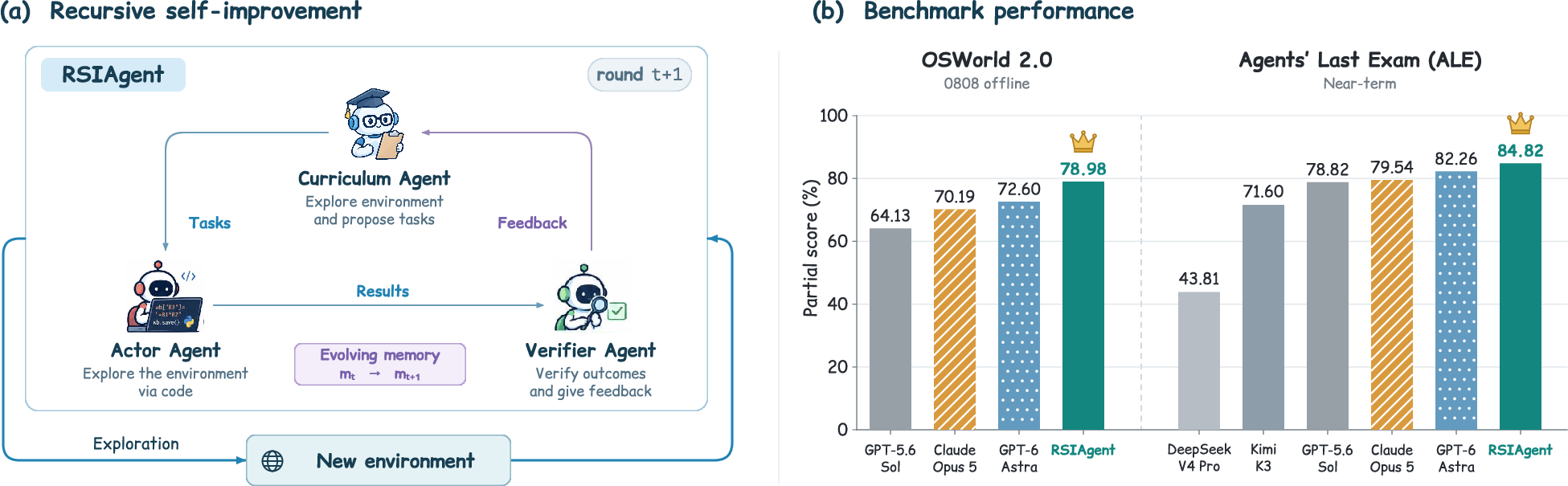
Abstract: Digital agents must often adapt to new environments whose interfaces, tools, and failure modes are not fully captured by pretrained models. We introduce \textbf{RSIAgent}, a training-free multi-agent framework for recursive self-improvement through autonomous memory construction. RSIAgent coordinates curriculum, actor, and verifier agents to continually explore the environment, validate outcomes, and retain environment-specific knowledge, including reusable causal relationships between actions, conditions, and consequences. It further adopts a \textbf{broad-then-deep} exploration strategy, combining parallel broad recursive self-exploration for discovering diverse environment structures with focused deep self-exploration for uncovering hard cases, hidden constraints, boundary conditions, and previously unknown causal dependencies. The resulting memory is frozen and can be directly reused for downstream tasks without updating model parameters. Experiments on OSWorld-v2 and Agent's Last Exam show that RSIAgent substantially improves strong open-source models, enabling Kimi-K3 and GLM-5.3 to outperform frontier closed-source models including GPT-6.
Paper Prompts
Sign up for free to create and run prompts on this paper.
Top Community Prompts
Explain it Like I'm 14
1. What is the paper about?
The paper introduces RSIAgent, a system designed to help computer-using AI agents learn how to work in unfamiliar software environments.
For example, an AI agent might be asked to edit a video, repair a spreadsheet, book a train ticket, or create a computer game. If the agent has never used that program before, it may make mistakes because it does not know the program’s special buttons, rules, or possible problems.
RSIAgent helps the agent learn by trying tasks, checking what happened, remembering useful lessons, and trying harder tasks. Importantly, it does this without retraining the main AI model. Instead of changing the model’s “brain,” it builds a useful external memory.
2. What questions are the researchers asking?
The researchers are mainly asking:
- Can an AI agent teach itself how to use a new software environment?
- Can it discover which actions cause success or failure?
- Can it remember these lessons and reuse them on later tasks?
- Is it better to first explore many different possibilities and then study difficult cases in detail?
- Can this approach make open-source AI models perform as well as, or better than, expensive closed-source models?
The paper focuses especially on learning cause-and-effect relationships. For example:
“If a file is saved in this format before clicking Submit, the task succeeds. If it is saved differently, the task fails.”
This kind of knowledge is more useful than simply memorizing one sequence of clicks.
3. How does RSIAgent work?
Three AI roles
RSIAgent uses several cooperating AI agents. Each one has a different job:
| Agent | Main job | Simple comparison |
|---|---|---|
| Actor agent | Performs tasks and uses computer programs | Like a student doing an assignment |
| Verifier agent | Checks whether the task was really completed correctly | Like a teacher checking the work |
| Curriculum agent | Chooses what the system should practice next | Like a tutor creating a study plan |
These agents repeatedly work together:
- The curriculum agent chooses a practice task.
- The actor agent tries to complete it.
- The verifier agent checks the result using evidence from the software.
- The system records useful lessons in its memory.
- The curriculum agent chooses another task based on what was learned.
This is called a recursive self-improvement loop. “Recursive” means that the process repeats, with each round using the lessons from earlier rounds.
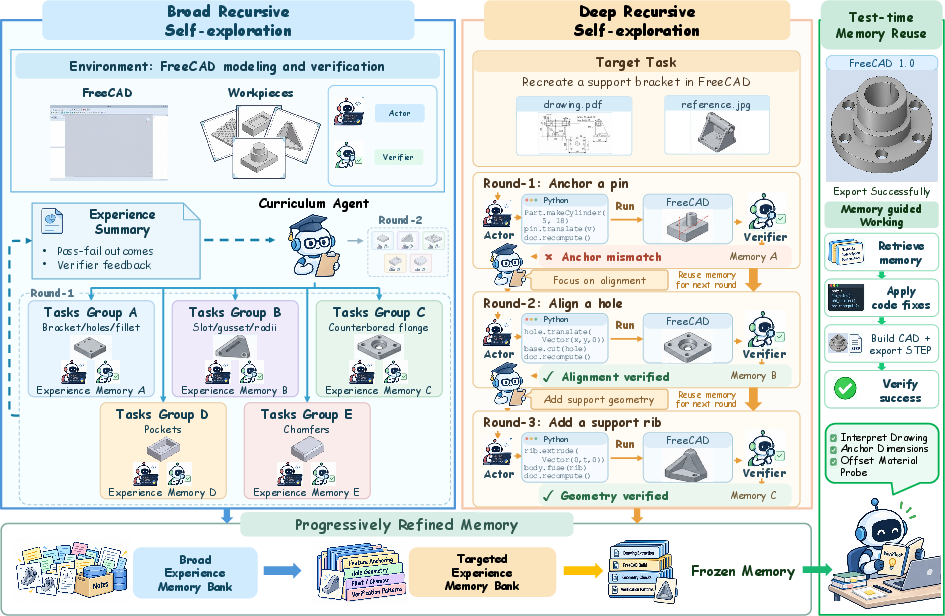
The two exploration stages
RSIAgent explores in two main stages.
Stage 1: Broad Recursive Self-exploration
First, the system explores many different parts of the environment. It may try several tasks at the same time, looking for:
- Common procedures
- Different software features
- Typical errors
- Useful reusable scripts
- Important rules and restrictions
This is similar to learning the layout of a new school by visiting many classrooms and hallways.
Stage 2: Deep Recursive Self-exploration
Next, the system focuses on difficult or uncertain areas. It tries harder tasks designed to reveal:
- Hidden rules
- Rare errors
- “Edge cases,” which are unusual situations
- Boundary conditions, such as what happens when a value is too large or too small
- Weaknesses in the current memory
This is like studying for a test by first reviewing every subject and then spending extra time on the hardest questions.
Memory instead of retraining
After exploration, RSIAgent freezes its memory. The AI model itself is not changed. The memory may contain:
- Step-by-step procedures
- Reusable computer programs
- Lessons from previous failures
- Conditions under which an action works
- Warnings about actions that may cause problems
The agent then uses this memory when solving new tasks.
The paper describes its actions as code-as-policy. This means that instead of only saying “click this button,” the agent can create and run small computer programs to control software.
4. What did the researchers find?
Better performance on computer tasks
The researchers tested RSIAgent on two computer-use benchmarks:
- OSWorld 2.0, containing 82 tasks
- Agents’ Last Exam, containing 67 tasks
The system improved the performance of the tested open-source models.
On OSWorld 2.0, the reported average partial score increased from 71.97% without recursive self-improvement to 78.98% with RSIAgent. Its full-task accuracy increased from 37.80% to 42.68%.
On Agents’ Last Exam, the partial score increased from 83.75% to 84.82%, while full-task accuracy increased from 49.25% to 50.75%.
A partial score means that an agent completed some parts of a task correctly. Binary accuracy means the percentage of tasks completed completely.
It performed strongly compared with larger systems
According to the paper’s reported results, RSIAgent using open-source models scored higher than several frontier closed-source systems.
For example, it achieved:
- 78.98% on OSWorld 2.0
- 84.82% on Agents’ Last Exam
These scores were higher than the reported scores of systems such as GPT-6 Astra and Claude Opus 5 on those tests.
This suggests that a good learning and memory system can sometimes make a smaller or open-source model much more effective.
Broad and deep exploration work best together
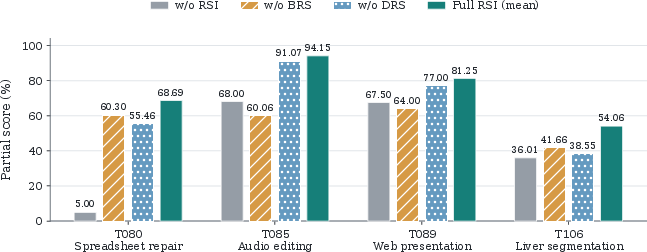
The researchers also tested the two exploration stages separately.
On four selected OSWorld tasks:
- No exploration achieved an average score of 56.50%
- Deep exploration alone achieved 56.50%
- Broad exploration alone achieved 65.52%
- Broad plus deep exploration achieved 74.54%
This shows that the system benefits from first learning many general skills and then carefully practicing difficult cases.
The approach also helped with game development
The researchers tested RSIAgent on 40 game-building tasks. The system helped improve games made by several different AI models.
It improved areas such as:
- Game mechanics
- Challenge and depth
- Visual quality
- Artwork
- Overall game quality
The paper reports that RSIAgent was useful for both weaker and stronger starting models. This suggests that the approach may work beyond ordinary office software.
The system still makes important mistakes
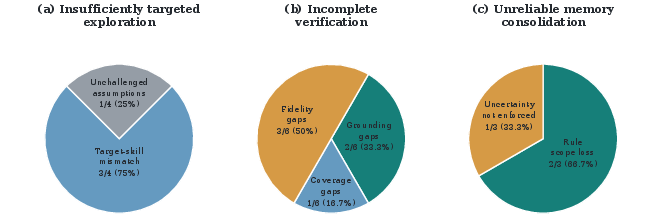
The researchers found three major problems:
- Poorly chosen practice tasks The system may practice many things but fail to test the exact weakness that matters.
- Incomplete checking The verifier may decide that a task succeeded even though some requirements were not met.
- Bad memories If a mistake is accepted as correct, the system may remember the wrong rule and repeat the error later.
For example, an agent might learn that writing “information unavailable” is an acceptable answer, even when the task actually requires finding the missing information.
5. Why are these findings important?
Training a large AI model usually requires a great deal of computing power, data, and sometimes human supervision. RSIAgent offers another possibility: let the model explore a new environment and store what it learns in memory.
This could be useful when:
- Software is private or constantly changing
- Human demonstrations are expensive
- The AI must learn a specialized program quickly
- The system needs to reuse skills across many tasks
- Developers want to improve an agent without retraining its model
The main idea is similar to how people learn a new application. We try things, notice what works, remember shortcuts, and avoid repeating mistakes.
Conclusion
RSIAgent is a method for helping AI agents learn new computer environments through practice. It uses three cooperating roles: one agent performs tasks, another checks the results, and a third decides what to practice next.
Its broad-then-deep strategy first explores many parts of an environment and then studies the hardest problems in detail. The system saves the lessons in memory and uses them later, without changing the underlying AI model.
The reported experiments show significant improvements in computer-use and game-development tasks. However, the method still depends on accurate checking and reliable memory. If the system misunderstands a result, it may learn the wrong lesson. It also requires extra time and computing power for exploration.
Overall, the research suggests that AI agents may become much more capable not only by becoming larger, but also by learning from their own experiences in a careful and organized way.
Knowledge Gaps
The paper leaves the following knowledge gaps, limitations, and open questions unresolved:
- Causal knowledge is not explicitly validated. Although RSIAgent claims to discover reusable causal relationships, the paper does not define a causal representation or test whether stored rules support counterfactual prediction, intervention planning, or transfer beyond the trajectories that produced them.
- The contribution of each framework component is not fully isolated. The experiments do not independently quantify the effects of the actor, verifier, curriculum agent, memory structure, memory revision, parallel BRS, sequential DRS, and test-time verification.
- The exploration strategy is not compared against strong alternative curricula. There is no systematic comparison with random exploration, uncertainty-driven exploration, novelty search, failure-only exploration, adaptive budget allocation, or existing automatic-curriculum methods.
- The broad-then-deep ordering remains unverified. The paper does not test whether BRS followed by DRS is superior to DRS followed by BRS, interleaving both stages, or dynamically switching between broad and deep exploration.
- The method’s stopping criterion is underspecified and unevaluated. The curriculum agent decides when further practice is unlikely to help, but the paper does not report stopping accuracy, premature-termination rates, unnecessary exploration, or performance under alternative stopping policies.
- Exploration cost is not quantified. The paper acknowledges substantial test-time computation but does not report token usage, wall-clock time, number of environment actions, API cost, verifier calls, concurrency benefits, or cost-normalized performance.
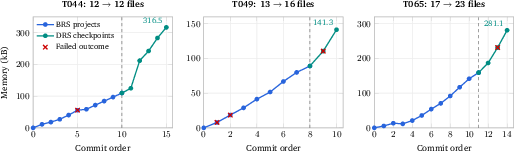
- The finite exploration budget is not systematically studied. The relationship between exploration budget and downstream performance is only illustrated on a small number of tasks; scaling curves, diminishing returns, and optimal budgets across environments are unknown.
- Results may be affected by target-task information leakage. Both exploration stages use the target query as a curriculum reference, but the paper does not clarify how much task-specific information is exposed during exploration or compare against environment-level preadaptation without access to downstream task queries.
- The reported aggregate results mix completed RSI evaluations with retained baseline scores. For tasks without completed RSI results, baseline scores are reused, which may inflate or obscure the overall improvement and prevents a clean comparison based on identical task coverage.
- Statistical reliability is not established. The paper provides aggregate scores but does not report confidence intervals, variance across random seeds, repeated runs, model sampling variability, or significance tests.
- The benchmark coverage is narrow. The main evaluation uses 82 OSWorld tasks and 67 ALE tasks, with ablations on only four OSWorld tasks; it remains unclear whether the method generalizes across applications, task lengths, interaction modalities, languages, and substantially different software environments.
- The generalization of memory across tasks and applications is unclear. The paper does not measure whether memory learned from one application transfers to another, whether it remains useful for novel task templates, or whether it overfits to the explored benchmark tasks.
- Memory quality and retrieval behavior are not evaluated directly. There are no metrics for memory correctness, coverage, redundancy, retrieval precision, retrieval recall, context length, contradiction rate, or the frequency with which stored knowledge is actually used.
- Memory persistence and staleness are unexplored. The paper does not test how memory behaves when software interfaces, versions, files, permissions, or task conventions change, nor how quickly outdated rules are detected and removed.
- Incorrect memory propagation lacks formal safeguards. The paper identifies erroneous consolidation but does not evaluate confidence tracking, provenance, uncertainty labels, versioning, rollback, contradiction resolution, or quarantine mechanisms for risky memories.
- Verifier reliability is not independently measured. Because the verifier is itself a model-based agent, the paper does not report verifier precision, recall, calibration, false-positive and false-negative rates, or robustness to adversarial and ambiguous outcomes.
- Verifier independence is only assumed. The actor, verifier, and curriculum agents use related language-model capabilities, but the paper does not test the degree to which their errors are correlated or whether independent models, rule-based checks, or external evaluators improve reliability.
- Verification against full task specifications is incomplete. The failure analysis shows that local checks can miss unsupported values and rubric violations, but the paper does not provide a systematic method for decomposing requirements into checkable conditions or measure performance under comprehensive verification.
- The role of environment feedback is not disentangled from model judgment. It remains unclear which improvements come from genuine execution-state signals and which come from the verifier’s interpretation of those signals.
- The effect of code-as-policy is underexplored. The method is presented as broadly applicable to digital environments, but experiments do not compare executable-code actions with GUI actions, natural-language tool calls, or other policy representations.
- Safety and authorization controls are not experimentally evaluated. The paper notes risks of unintended actions, unauthorized access, and privacy leakage but does not test permission boundaries, sandbox escape attempts, destructive actions, secret exposure, or safe stopping behavior.
- Robustness to stochastic, partially observable, and irreversible environments is unknown. The experiments do not establish how RSIAgent handles nondeterministic outcomes, delayed feedback, hidden state, transient failures, irreversible actions, or environments where exploration itself has meaningful costs.
- Long-term accumulation effects are not studied. It is unclear whether memory quality continues improving over many exploration rounds or eventually suffers from bloat, interference, contradiction, retrieval degradation, and error accumulation.
- Negative transfer is not quantified. The paper does not measure whether knowledge learned from earlier tasks causes failures on later tasks, especially when superficially similar interfaces have different semantics or constraints.
- The claimed model-agnosticism is not demonstrated broadly. Experiments primarily use GLM-5.3 as actor and Kimi-K3 as verifier/curriculum model; the framework’s sensitivity to model scale, modality, reasoning capability, and model-role assignment remains unresolved.
- Comparisons with frontier models are not fully controlled. Many baseline results are copied from external reports, with potentially different prompts, tools, budgets, evaluators, model versions, and task subsets, limiting the strength of the claim that RSIAgent outperforms those systems.
- The game evaluation does not establish broad cross-domain transfer. Although GameCraft-Bench is included, the paper does not show that memory or exploration strategies transfer between computer-use tasks and games, nor does it compare against additional game-development or interactive-learning baselines.
- Human supervision and data requirements are not fully characterized. The method is described as training-free and autonomous, but the paper does not clarify the extent of manual engineering in prompts, task generation, verification criteria, memory schemas, benchmark selection, and failure auditing.
- The relationship between partial credit and genuine task completion remains unclear. Improvements in partial scores are emphasized, but the paper does not analyze which specific requirements improve, whether gains reflect useful partial progress or robust end-to-end completion, and how performance changes under stricter success criteria.
- Real-world deployment under changing privacy and access constraints is unresolved. The controlled experiments do not establish whether RSIAgent can safely construct and reuse memory when data are sensitive, permissions vary across tasks, or multiple users and environments share the same persistent memory.
Practical Applications
Immediate Applications
- Adaptive automation for enterprise software (software, business operations) Deploy RSIAgent as a training-free adaptation layer for desktop, browser, and productivity applications such as spreadsheets, presentation tools, video editors, CAD systems, and data-analysis software. The system can first explore an organization’s specific software configuration, menus, file conventions, and failure modes, then reuse the resulting memory for tasks such as document repair, spreadsheet manipulation, presentation editing, and form completion. Potential product/workflow: an enterprise “agent onboarding” service that runs BRS exploration in a sandbox, follows with DRS stress testing, freezes the validated memory, and makes it available to production agents. Dependencies: reliable environment feedback, permissioned tool access, application-specific task checklists, and sufficient exploration budget. The paper’s failure analysis indicates that local success verification may be insufficient for complex business requirements.
- Private and rapidly changing software environments (enterprise IT, cybersecurity, internal tooling) Organizations can adapt open-source models to proprietary applications without sending interaction data to an external model provider or retraining model parameters. This is particularly useful for internal dashboards, legacy systems, custom CRM software, and frequently updated web interfaces. Potential tool: a locally hosted memory repository containing executable procedures, interface-specific constraints, and verified recovery strategies. Dependencies: secure sandboxing, access-control integration, memory versioning, and procedures for removing outdated or sensitive information. Autonomous exploration should not occur directly in production systems.
- Open-source agent deployment with lower model costs (AI infrastructure, software services) RSIAgent can improve strong open-source models through persistent, environment-specific memory rather than parameter updates. This creates a practical route for companies to deploy smaller or locally hosted models while reducing dependence on closed-source frontier APIs. Potential workflow: use an open-source actor, an independent verifier, and a separate curriculum context during an initial adaptation phase; reuse the frozen memory during routine execution. Dependencies: the reported results are benchmark-based and may not transfer uniformly to uncontrolled environments. Inference costs for parallel exploration and verification can still be substantial.
- Automated software testing and regression discovery (software engineering, quality assurance) The broad-then-deep strategy can generate diverse test workflows, discover application-specific constraints, and stress-test boundary conditions. DRS is especially suitable for reproducing failures that only occur under unusual sequences, missing inputs, conflicting values, or state-dependent conditions. Potential product: an autonomous GUI regression tester that proposes test cases, executes them, verifies postconditions, and stores reproducible failure procedures. Dependencies: deterministic or sufficiently observable test environments, machine-readable success criteria, isolated test data, and safeguards against destructive actions.
- Interactive game development and playtesting (games, creative software) The game experiments suggest an immediate use in iterative game development. RSIAgent can play executable games, identify mechanics or usability problems, and retain reusable debugging and improvement strategies across projects. Potential workflow: generate a game, run broad playtests across mechanics and visual elements, apply deep tests to difficult levels or edge cases, and use verified feedback to guide code or asset revisions. Dependencies: reliable quality metrics, access to source code or editing tools, and human review for artistic decisions. Automated improvement may optimize measurable scores while overlooking player experience.
- Reusable operational playbooks and support automation (customer service, IT help desks, operations) Verified memories can encode procedures for navigating internal portals, resolving recurring configuration issues, or completing administrative workflows. Agents can use failure lessons and environmental conditions rather than relying only on generic instructions. Potential output: automatically generated, executable support playbooks that include preconditions, actions, expected observations, recovery steps, and uncertainty annotations. Dependencies: strict verification of permissions and outcomes; incorrect memories could institutionalize unsafe or noncompliant procedures.
- Research on agent adaptation and curriculum design (academia, AI research) Researchers can use the publicly described framework and code as a baseline for studying training-free adaptation, multi-agent role separation, causal memory, exploration budgets, and verifier reliability. OSWorld-v2, Agents’ Last Exam, and game environments provide starting points for controlled replication. Potential research workflow: compare BRS-only, DRS-only, and combined systems; measure memory growth, task transfer, exploration cost, and error propagation across environments. Dependencies: careful reporting of task-selection and aggregation protocols is essential, since retaining baseline scores for tasks without completed RSI results can affect aggregate comparisons.
- Human-in-the-loop policy for high-impact automation (governance, compliance, public administration) Institutions can use RSIAgent in an advisory or approval-gated mode: the agent explores and proposes procedures, while humans approve memory entries and final actions. This is immediately applicable to low-risk administrative workflows and internal policy prototyping. Dependencies: human review must address unsupported assumptions, privacy leakage, authorization boundaries, and whether the verifier checked all requirements rather than merely observing a superficially successful output.
- Personalized assistance for routine computer tasks (daily life, accessibility, education) A locally running agent could learn a user’s preferred workflows for file organization, calendar management, document formatting, or navigating unfamiliar applications. Persistent memory would reduce repeated instruction and improve accessibility for users who have difficulty with complex interfaces. Dependencies: explicit user consent, transparent memory inspection and deletion, protection of credentials and personal data, and confirmation before irreversible actions such as purchases, submissions, or file deletion.
Long-Term Applications
- Self-adapting agents for specialized scientific workflows (AI for science, healthcare research, engineering) The framework could be extended to laboratory software, simulation packages, medical-imaging tools, electronic-structure codes, and domain-specific data pipelines. BRS could map available tools and procedures, while DRS could test numerical, physical, or experimental boundary conditions. Potential product: a domain-specific research assistant that learns validated tool workflows and records causal relations among parameters, operations, and outcomes. Dependencies: domain-expert verification, scientifically meaningful reward signals, reproducibility, provenance tracking, and safeguards against treating plausible but incorrect outputs as discoveries. The paper identifies this direction as future work rather than demonstrating it.
- Clinical and medical software automation (healthcare) RSIAgent could eventually assist with electronic health-record workflows, medical-image analysis software, scheduling systems, or clinical research platforms by adapting to institution-specific interfaces and procedures. Dependencies: independent clinical validation, regulatory approval, strict privacy controls, human authorization, and verification against clinical—not merely interface-level—requirements. The current model-based verifier would not be sufficient for autonomous diagnosis, treatment, or patient-record modification.
- Robotics and embodied agents (robotics, manufacturing, logistics) The curriculum–actor–verifier loop could be transferred from GUI actions to robot programs, simulators, sensors, and physical manipulation tasks. Broad exploration could discover reachable configurations and tool affordances; deep exploration could test collision boundaries, failure recovery, and operating limits. Potential system: a robot that builds a verified skill library for a new workstation or warehouse layout without retraining its base model. Dependencies: high-fidelity simulation, safe exploration, sensor grounding, real-time control, formal safety constraints, and a verifier capable of detecting physical damage or near misses.
- Autonomous adaptation in energy and industrial control systems (energy, utilities, manufacturing) Agents could learn facility-specific control interfaces, maintenance procedures, and diagnostic sequences, then reuse verified memories when systems or interfaces change. DRS could target rare operating states and fault conditions. Dependencies: safe digital twins, human approval, formal control limits, cybersecurity isolation, and evidence that the agent cannot cause unsafe physical state transitions. Exploration directly on live infrastructure would be inappropriate without extensive validation.
- Financial operations and compliance workflows (finance, insurance, accounting) Future systems could adapt to institution-specific trading back offices, reconciliation tools, claims systems, or regulatory reporting interfaces. Memories could encode conditional procedures for missing data, exception handling, and multi-step approvals. Dependencies: auditability, segregation of duties, immutable action logs, human sign-off, regulatory compliance, and robust verification of every field. The paper’s observed failure mode involving missing-data markers is especially relevant: an agent must not convert unavailable information into a negative or affirmative financial claim.
- Long-horizon web and commerce agents (retail, travel, procurement) RSIAgent could learn the constraints, recovery procedures, and changing interaction patterns of booking, purchasing, procurement, and marketplace systems. Deep exploration could test cancellations, inventory changes, authentication interruptions, and conflicting user requirements. Potential product: an auditable procurement or booking agent with a frozen, versioned memory for each merchant or platform. Dependencies: explicit transaction confirmation, fraud prevention, secure credential handling, interruption handling, price and availability volatility, and policies for ambiguous user intent.
- Policy simulation and public-service delivery (government, public policy) In simulated environments, agents could explore administrative portals and test how policy rules interact with incomplete information, exceptional cases, and changing forms. This could help identify bottlenecks and generate testable workflow documentation before deployment. Dependencies: representative simulations, legal review, fairness auditing, protection against encoding discriminatory administrative rules, and a clear separation between workflow assistance and policy decision-making.
- Causal memory graphs for transferable agent skills (academic research, AI infrastructure) The paper’s emphasis on relationships among actions, conditions, and consequences could evolve into structured memory graphs rather than text-only notes. Such graphs could support retrieval by precondition, expected outcome, uncertainty, and known failure mode, enabling transfer across related applications. Potential tool: a versioned “skill and causal knowledge base” with executable procedures, evidence links, confidence estimates, and environment-specific scopes. Dependencies: reliable causal attribution, conflict resolution between memories, temporal versioning, uncertainty representation, and evaluation of whether stored relations generalize beyond the original task.
- Verifier ensembles and formally grounded self-improvement (AI safety, verification) Because incorrect verifier judgments can propagate into memory, future systems should combine model-based verification with executable assertions, state-difference checks, external simulators, formal specifications, human review, or multiple independent verifiers. Potential architecture: a verifier ensemble that checks task completion, requirement coverage, authorization, artifact integrity, and safety constraints separately before permitting memory consolidation. Dependencies: environments must expose sufficient state and feedback; some goals remain difficult to formalize. Without stronger verification, recursive self-improvement can amplify rather than correct errors.
- Continually adapting agents for nonstationary environments (software platforms, cybersecurity, autonomous systems) A future version could maintain multiple memory versions and re-explore when interfaces, APIs, policies, or operating conditions change. Instead of freezing memory permanently, the system could detect distribution shifts and selectively rerun BRS or DRS. Dependencies: robust change detection, rollback mechanisms, expiration dates for memories, resource-aware exploration, and safeguards against malicious interface changes or prompt injection.
- Fully autonomous self-improving digital organizations (long-term AI systems) At the most ambitious level, coordinated curriculum, actor, and verifier agents could manage persistent skill acquisition across many tools and projects, progressively expanding an organization’s operational capabilities without retraining the underlying model. Dependencies: comprehensive authorization systems, independent oversight, reliable long-horizon evaluation, secure memory governance, resistance to reward hacking and verifier collusion, and strict limits on autonomous access. The paper’s results demonstrate environment-specific benchmark improvement, not yet safe general autonomy at this scale.
Glossary
- Ablation study: An experiment that removes or alters components of a system to measure their individual contributions. “We compare the exploration stages on four OSWorld 2.0 (0808 offline) tasks”
- Action space: The set of actions available to an agent in an environment. “This action space provides a general interface for controlling heterogeneous software systems”
- Agent harness: A software framework that coordinates an agent’s interaction, tools, memory, and evaluation processes. “We use a shared code-as-policy harness for RSIAgent.”
- Agentic causal discovery: The autonomous identification of causal relationships by an agent through interaction and experimentation. “Beyond simply memorizing successful trajectories, effective adaptation should also enable agents to discover stable causal relationships”
- Boundary condition: A limiting circumstance or edge case that determines how a system behaves. “DRS focuses on important knowledge gaps, hard cases, and boundary conditions revealed during task execution.”
- Binary accuracy: The proportion of tasks for which the system receives full credit. “binary accuracy, the proportion of tasks receiving full credit.”
- Broad Recursive Self-exploration (BRS): The parallel exploration stage designed to discover diverse environmental knowledge and procedures. “BRS explores diverse directions in parallel to acquire an overall understanding of the environment”
- Causal dependency: A relationship in which one factor influences or determines another. “previously unknown causal dependencies”
- Causal discovery: The process of inferring relationships between actions, conditions, and outcomes from observations or interventions. “This process is not merely experience accumulation, but also a form of causal discovery”
- Causal structure: An organized representation of relationships among causes, conditions, actions, and effects. “allowing the system to progressively uncover and consolidate reusable causal structures.”
- Code-as-policy: An agent design in which actions are represented as executable programs rather than fixed primitive commands. “we adopt a code-as-policy formulation, where each action is represented as an executable program.”
- Coarse-to-fine: A strategy that first establishes broad coverage and then progressively adds detailed refinements. “This coarse-to-fine process first builds broad coverage and then refines critical details”
- Context management: The organization and control of information supplied to a model during inference. “training-free adaptation through context management offers a more flexible alternative”
- Continual adaptation: The ongoing adjustment of an agent to changing or unfamiliar environments. “digital agent systems are often required to operate in new environments”
- Curriculum agent: The coordinating agent that selects or generates tasks for exploration and practice. “The curriculum agent decides what to explore next”
- Downstream task: A task performed after adaptation that uses knowledge acquired during an earlier process. “directly reuses this memory to support downstream tasks at test time.”
- Durable memory: Persistent information retained across separate tasks or interactions. “the durable memory persists and retains reusable knowledge acquired across tasks.”
- Evolvable memory: Memory that can be expanded, revised, or deleted as new evidence is obtained. “This memory is evolvable: after the verifier agent evaluates an outcome”
- Failure mode: A characteristic way in which a system can malfunction or fail. “Our failure mode analysis identifies three mechanisms that limit recursive self-improvement”
- Failure-driven practice: Exploration deliberately designed around previous errors or unsuccessful attempts. “By selecting prerequisite skills, informative variants, failure-driven practice, and stress-test cases”
- Foundation model: A broadly pretrained model that can be adapted to many downstream tasks. “narrow, and even reverse, the capability gap between open- and closed-source foundation models”
- Frontier model: A leading model representing the current state of performance in a field. “outperform frontier closed-source models”
- GUI grounding: Mapping visual interface elements to executable actions or semantic references. “Research has improved visual grounding and GUI interaction”
- Heterogeneous software system: A collection of software applications or platforms with different interfaces and control mechanisms. “controlling heterogeneous software systems, including GUI applications.”
- Hidden constraint: An unstated environmental or task condition that restricts valid behavior. “uncover corner cases, hidden constraints, and boundary conditions.”
- Inference-time memory update: Modification of an agent’s stored knowledge during execution rather than through model retraining. “supporting multi-hop retrieval and inference-time memory updates for computer-use agents”
- Interaction history: The ordered record of observations and actions accumulated during an agent’s current task. “the interaction history ”
- Knowledge gap: Missing or insufficient information needed to perform a task reliably. “the curriculum agent uses the accumulated experience to identify remaining knowledge gaps”
- Long-horizon exploration: Exploration involving many sequential actions, decisions, or interactions. “games, which provide complex and continuously evolving environments for studying long-horizon exploration”
- Memory consolidation: The process of integrating validated experience into persistent memory. “the actor agent consolidates the grounded experience by adding new knowledge”
- Memory reuse: Applying previously stored knowledge to later tasks or environments. “RSIAgent autonomously explores the environment under a broad-then-deep exploration strategy and uses environment feedback to construct reusable memory.”
- Multi-agent framework: A system in which multiple specialized agents collaborate to complete a process. “We introduce a multi-agent framework with three complementary roles”
- Multi-hop retrieval: Retrieval that follows multiple linked steps through stored information or a graph. “supporting multi-hop retrieval and inference-time memory updates for computer-use agents”
- Open-source model: A model whose implementation or parameters are made available for public use or inspection. “RSIAgent can recursively improve open-source models”
- Partial score: A performance measure that awards credit for partially completing a task. “We report partial score, the mean task score, and binary accuracy”
- Persistent memory: Information maintained across interactions or tasks instead of being reset after each task. “the actor agent is equipped with a persistent memory”
- Policy model: A model that selects actions given a task, state, history, or memory. “The actor agent is the primary policy model in the multi-agent system”
- Pretrained model: A model trained beforehand on a broad dataset and subsequently used for adaptation or inference. “whose interfaces, tools, conventions, and failure modes may not be fully captured by their pretrained knowledge.”
- Recursive self-improvement (RSI): A process in which an agent uses its own interaction outcomes to improve its future behavior or knowledge. “we design a recursive self-improvement~(RSI) framework for digital agents in new environments.”
- Reinforcement learning: A learning paradigm in which an agent improves behavior through feedback associated with actions and outcomes. “UI-TARS-2~\citep{wang2025ui} uses multi-turn reinforcement learning”
- Reusable causal structure: A persistent representation of causal relationships that can be applied to multiple tasks. “organize these relationships into reusable causal structures.”
- Reusable procedure: A sequence of actions or program steps that can be applied repeatedly to accomplish related tasks. “stores environment-specific knowledge, reusable procedures and scripts”
- Self-exploration: Autonomous interaction with an environment to discover knowledge without direct human instruction. “RSIAgent organizes autonomous exploration into two complementary stages”
- State transition: The change from one environment state to another after an action is executed. “humans gradually infer which factors determine success, failure, and state transitions.”
- Stress-test case: A deliberately difficult or unusual test intended to expose weaknesses. “By selecting prerequisite skills, informative variants, failure-driven practice, and stress-test cases”
- Synthetic experience: Artificially generated interaction data used to train or improve an agent. “EvoCUA combines synthetic experience with policy optimization.”
- Target-driven practice: Exploration directed toward particular goals, weaknesses, or knowledge gaps. “Deep Recursive Self-exploration (DRS), which refines the accumulated knowledge through target-driven practice.”
- Test-time adaptation: Modification or support of a model’s behavior during evaluation without retraining its parameters. “After exploration, the accumulated memory is frozen and provided to the actor agent for test-time use.”
- Training-free adaptation: Improving an agent’s task performance without updating its learned model parameters. “We introduce RSIAgent, a training-free multi-agent framework”
- Trajectory: A sequential record of states, observations, actions, and outcomes during an interaction. “Beyond simply memorizing successful trajectories”
- Uncertainty: Lack of confidence or incomplete knowledge concerning an action, condition, or outcome. “Based on the resulting successes, failures, and newly revealed uncertainties”
- Verifier agent: An agent that independently evaluates whether an action sequence satisfies task requirements. “The verifier agent serves as the independent evaluator in the multi-agent system”
- Visual grounding: Connecting visual elements in an interface to their meanings or executable actions. “Research has improved visual grounding and GUI interaction”

