Dream-RSI: Recursive Self-Improvement through Evolving Worlds
Abstract: Recursive self-improvement is becoming increasingly vital for autonomous AI agents, where progress hinges on discovering high-value solutions across complex domains. The driver of this process is effective exploration, however, managing and improving exploration strategies remains a major bottleneck. Current systems face a fundamental dilemma: fixed strategies fail to adapt as search spaces scale, while online policy optimization requires navigating vast meta-search spaces under delayed and expensive feedback over long-horizon rollouts. We introduce \textsc{Dream-RSI}, a framework for scalable and recursively self-improving exploration. A lightweight orchestration layer makes exploration explicit and programmable while leaving the underlying coding agent unchanged. Our key insight is that accumulated discovery history can serve as a replay simulator over the realized search space. By performing dreaming in the replay simulator constructed from historical discovery trees, \textsc{Dream-RSI} secures immediate, low-cost off-policy feedback to evaluate and refine exploration policies without invoking repetitive, expensive online evaluations. The improved policy is subsequently redeployed online to drive further discovery, continuously expanding the simulator pool in a self-improving loop. Across algorithm engineering, mathematical optimization, and GPU kernel engineering, \textsc{Dream-RSI} achieves competitive or improved discovery quality while substantially reducing discovery cost in several settings.
First 10 authors:
Paper Prompts
Sign up for free to create and run prompts on this paper.
Top Community Prompts
Explain it Like I'm 14
1. What is this paper about?
This paper introduces Dream-RSI, a system designed to help AI agents improve the way they search for solutions.
Imagine an AI trying to invent a faster computer program. It might try many ideas, test them, keep the good ones, and reject the bad ones. The problem is that this can take a lot of time and computer power.
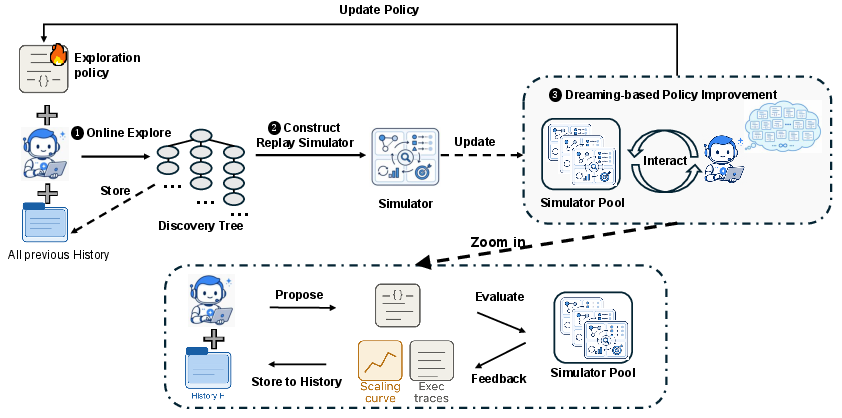
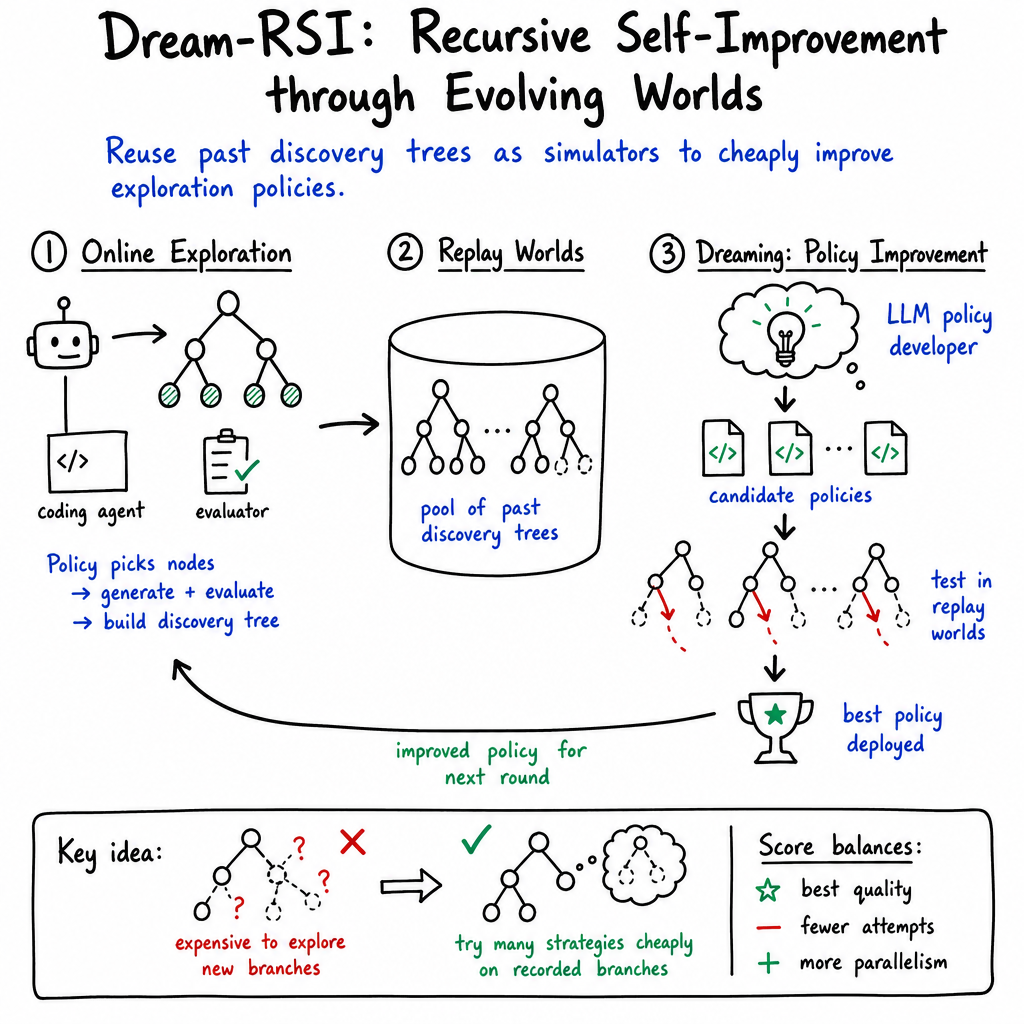
Dream-RSI helps the AI learn from its previous attempts. Instead of testing every new search strategy in the real world, it uses a record of earlier experiments as a kind of replay simulator. The AI can then “dream” about how different strategies would have worked, without actually running all the expensive experiments again.
The main idea is:
Use the history of past discoveries to practice and improve future search strategies cheaply.
2. What questions are the researchers asking?
The researchers focus on several important questions:
- Can an AI improve not only the solutions it discovers, but also the way it searches for solutions?
- Can old experiment records be used to test new search strategies?
- Can this make AI discovery faster and cheaper?
- Does this idea work in different areas, such as:
- improving algorithms,
- solving mathematics problems, and
- making GPU programs run faster?
The paper also asks whether a changing search strategy is better than a fixed strategy that never learns from experience.
3. How does Dream-RSI work?
A simple example
Suppose you are exploring a large maze. You try several paths and make a map showing:
- which paths you tried,
- where they led,
- which paths were dead ends, and
- which paths got you closer to the exit.
Later, you can use the map to imagine different exploration plans. You might ask:
- What if I had tried the left path first?
- What if I explored several paths at the same time?
- What if I stopped searching a path earlier?
- What if I spent more time on the most promising route?
You can answer these questions using the map, without walking through the maze again.
Dream-RSI uses a similar idea for AI discovery.
The three main stages
The system repeatedly performs three steps:
- Explore online The AI tries real solutions. For example, it may write a program, test it, and record how well it works. These attempts are organized into a tree, where each branch represents a different line of exploration.
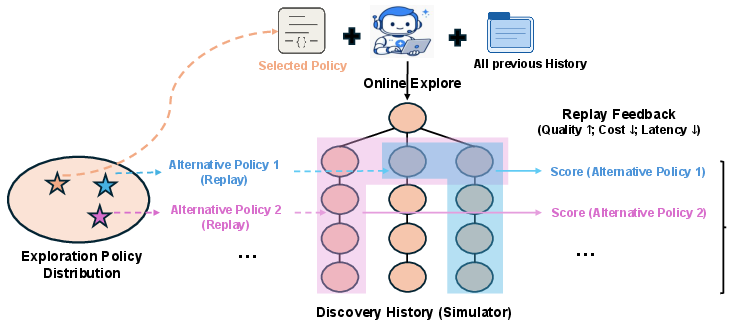
- Build a replay simulator The system stores the results of earlier attempts. This record becomes a simulator of the parts of the search space the AI has already visited.
- Improve by “dreaming” The AI tries many possible exploration strategies inside the simulator. Since the results of old attempts are already recorded, this process is much faster than performing new real experiments.
The best-performing strategy is then used during the next round of real exploration. New results are added to the history, making the simulator larger and more useful.
Important technical terms in simple language
- Exploration policy: The rules that decide what the AI should try next.
- Discovery tree: A map of all the attempts made so far and how they developed from earlier attempts.
- Replay simulator: A stored record that allows the AI to replay old experiments without running them again.
- Online exploration: Real experiments in which the AI creates and tests new solutions.
- Offline evaluation: Testing strategies using stored results instead of performing new experiments.
- Recursive self-improvement: A repeated cycle in which the AI improves its own method for improving solutions.
The system changes the exploration policy, but it keeps the main coding AI and the evaluator fixed. In other words, it changes how the AI searches, not the basic AI that writes the code or the test used to judge it.
4. What did the researchers find?
The researchers tested Dream-RSI in three broad areas.
Algorithm engineering
The AI was asked to create faster versions of a method called a Lasso solver, which is used in statistics and machine learning.
Dream-RSI produced programs that were faster than standard tools such as sklearn and glmnet. It also used far fewer AI attempts than another system called SimpleTES.
For example:
- With one AI model, Dream-RSI used 317 attempts instead of 550 for the fixed strategy.
- With another model, it used 1,879 attempts instead of 3,200.
- SimpleTES used 51,200 attempts, making Dream-RSI much less expensive.
Mathematical optimization
The system worked on problems involving:
- arranging numbers,
- packing circles, and
- finding good patterns in sequences.
Dream-RSI:
- performed better than the fixed exploration strategy on the Sum–Difference problem,
- matched the best known result on Circle Packing, and
- remained competitive on the Autocorrelation problem.
It reached these results with fewer than 1,000 generations in some cases, while another strong system needed 51,200 generations.
GPU kernel engineering
The researchers also asked the AI to write faster programs for GPUs. GPUs are special computer chips often used for graphics and large calculations.
On different GPU tasks, Dream-RSI:
- reached similar performance using 1.79 to 2.43 times fewer attempts, or
- achieved performance that was 1.44 to 2.09 times better with a similar number of attempts.
Other important finding
The researchers compared two ways of using history:
- giving the AI general advice about what direction to search in, and
- allowing the AI to interact with the detailed replay simulator.
The replay simulator worked better. General advice sometimes limited the AI too much because it encouraged it to focus on only a few directions. The simulator allowed more flexible exploration.
5. Why are these results important?
AI systems often spend enormous amounts of time testing ideas. If the AI can improve its search strategy using previous results, it may discover useful solutions with:
- fewer experiments,
- less computing power,
- less time, and
- lower cost.
This is especially important for difficult problems where each experiment may involve writing code, running tests, or using expensive hardware.
The paper suggests that past experience should not be treated merely as text for the AI to read. It can also act like a playable map of previous decisions and results.
6. What could this mean for the future?
Dream-RSI could help build AI systems that become better at solving problems over repeated rounds. Such systems might be useful for:
- designing faster algorithms,
- discovering mathematical solutions,
- improving computer hardware programs,
- optimizing scientific experiments, and
- automatically developing better software.
However, the system has limits. Its replay simulator only contains parts of the search space that the AI has already explored. It cannot perfectly predict what would happen in completely new areas. Also, the paper tests a limited number of tasks, so more research is needed to see how well the approach works in other fields.
Overall, the paper’s main message is simple:
An AI can improve its problem-solving process by using a detailed record of its past attempts to safely test new strategies before trying them in the real world.
Knowledge Gaps
Knowledge gaps, limitations, and open questions
The paper leaves the following issues unresolved:
- Replay fidelity is not formally validated. The paper assumes that a recorded discovery tree is a sufficiently informative simulator, but does not quantify how closely replay-based policy rankings correspond to rankings from fresh online rollouts.
- The replay simulator is strongly coverage-limited. A policy can only select branches and outcomes that already exist in historical trees; it cannot discover novel branches, recover from unrecorded states, or evaluate actions that were never taken online.
- Off-policy evaluation bias is not analyzed. Historical trees are generated by earlier exploration policies, so replay may systematically favor policies similar to the behavior policies and underestimate strategies that would produce different future trajectories.
- The effects of stochastic discovery agents are unclear. Online transitions are stochastic, whereas replay returns deterministic recorded outcomes. The paper does not measure how this determinization affects policy selection or the reliability of recursive improvement.
- The method’s performance under distribution shift is unknown. It is unclear whether policies optimized on older trees remain effective when task conditions, prompts, hardware, evaluator behavior, model versions, or search distributions change.
- No formal convergence or improvement guarantees are provided. The claim that the selected policy is no worse on historical replay scores does not imply improvement in online performance, because the replay objective and online outcomes can diverge.
- Replay-score improvement may not translate to discovery-quality improvement. The objective combines maximum score, number of attempts, and parallelism through manually chosen coefficients and , but the paper does not establish that these terms predict the actual utility of an online policy.
- The sensitivity to objective coefficients is unexplored. There is no systematic study of how different values of , , worker count , or round limits and affect policy behavior and final discovery performance.
- The replay objective may encourage undesirable behavior. Maximizing the best observed score can favor policies that exploit a small number of promising recorded branches while sacrificing robustness, diversity, reproducibility, or the probability of finding better unseen solutions.
- The treatment of root-node branching introduces a fixed historical ordering bias. Replay reveals the earliest-created root child first, so later branches may be inaccessible unless earlier branches are selected or exhausted; the consequences of this ordering choice are not evaluated.
- The method does not address stale or redundant historical data. As the history grows, the paper does not explain how outdated, low-quality, duplicate, or mutually inconsistent trees are filtered, weighted, compressed, or removed.
- Scalability of the history pool is unexamined. Offline evaluation is performed across all historical trees and multiple policy versions, but memory usage, replay latency, storage growth, and policy-development cost at substantially larger numbers of rounds are not reported.
- The cost of offline policy development is incompletely accounted for. The reported savings focus primarily on discovery-agent calls, while the computational, monetary, and latency costs of generating policy revisions and processing replay feedback are not fully quantified.
- The contribution of recursive policy improvement is not isolated sufficiently. The experiments compare mainly against fixed exploration, but do not separate the effects of replay, policy-code evolution, larger historical context, additional model calls, and selection among multiple candidate policies.
- Ablations of core design choices are missing. The paper does not systematically compare replay against simpler alternatives such as random branch sampling, greedy best-branch selection, trajectory memory, prompt-based history, learned world models, or online policy optimization with matched budgets.
- The policy-development agent is treated as a fixed component without analysis. Its model, prompting, revision reliability, code-generation errors, and susceptibility to replay artifacts are not evaluated, leaving unclear how much performance depends on this particular agent.
- Executable policy safety and correctness are underexplored. Since the policy-development agent modifies executable orchestration code, the paper does not report failure rates, invalid-policy handling, sandboxing, regression tests, or safeguards against policies that cause resource exhaustion or incorrect scheduling.
- The evaluation lacks statistical uncertainty estimates. Results appear to rely on limited runs or aggregate trajectories, with no confidence intervals, variance analysis, significance tests, or sensitivity to random seeds and stochastic model outputs.
- Generalization across agents and model families is limited. The experiments use a small set of Gemini-based discovery agents, and it remains unclear whether Dream-RSI transfers to open-weight models, weaker agents, multimodal agents, or agents with substantially different generation behavior.
- Generalization across tasks is narrower than the domain labels suggest. The experiments cover a limited number of benchmark instances, and the paper does not test substantially larger, noisier, interactive, multi-objective, or non-code-based discovery problems.
- The held-out evaluation is limited for algorithm engineering. Although six downstream datasets are used for Lasso, the discovery distribution consists of 17 synthetic instances; broader evaluations are needed to establish robustness across real-world data scales, sparsity patterns, numerical conditioning, and hardware environments.
- Kernel-engineering conclusions may be hardware-specific. The GPU experiments use only four KernelBench tasks and do not establish whether the learned exploration strategies transfer across GPU architectures, vendors, compiler versions, batch sizes, or numerical precision settings.
- Comparisons with external baselines are not fully controlled. Reported baselines may use different LLMs, budgets, stopping criteria, implementations, and evaluation protocols, making some cross-paper comparisons difficult to interpret.
- The claimed cost savings may depend on unequal quality targets. The paper often compares final scores or approximate performance at different budgets, but does not consistently report matched-target cost, matched-cost quality, or full Pareto-front comparisons with uncertainty.
- The role of explicit semantic guidance is tested only narrowly. The conclusion that high-level guidance is harmful is based on a limited guidance formulation and task setting; other forms of structured summaries, uncertainty-aware guidance, or conditional guidance may perform differently.
- The method’s behavior under negative or misleading historical evidence is unknown. Replay may cause the policy to overfit early failures, evaluator errors, accidental implementation artifacts, or historically poor exploration choices.
- Evaluator reliability is assumed rather than studied. The framework depends on fixed evaluators and stored scores, but does not examine noisy, biased, hacked, non-deterministic, or delayed evaluators and their effects on recursive policy improvement.
- Diversity and exploration–exploitation trade-offs are not measured directly. The experiments report final performance and discovery cost but do not quantify branch diversity, novelty, repeated-search frequency, premature convergence, or coverage of the underlying search space.
- Long-term recursive stability remains unresolved. Experiments span relatively few rounds, so it is unknown whether repeated policy updates eventually improve, plateau, oscillate, collapse into exploitative behavior, or accumulate harmful code changes.
- The method’s benefit relative to simply increasing online search is unclear in all settings. Although Dream-RSI reduces agent calls in reported tasks, the paper does not establish when offline replay yields greater returns than allocating the same resources to additional online exploration or broader parallel search.
- There is no principled mechanism for deciding when to deploy a revised policy. Selection is based on average replay score, without uncertainty estimates, safe online trials, adaptive deployment thresholds, or safeguards against policies that perform well on replay but fail catastrophically online.
Practical Applications
Dream-RSI’s practical value lies in treating accumulated agent interaction histories as replayable discovery environments. This enables exploration policies—such as branching, parallelization, prioritization, and stopping rules—to be improved offline before being redeployed to expensive or resource-constrained tasks.
Immediate Applications
The following applications are feasible with current agent orchestration infrastructure, provided that the target task has a reproducible evaluator and can record structured execution histories.
- Automated algorithm engineering and performance optimization — software, data science, and finance
- Use Dream-RSI to search for faster implementations of numerical routines such as Lasso solvers, matrix operations, optimization algorithms, and statistical procedures.
- A practical workflow would record candidate code, execution traces, correctness checks, runtime measurements, and diagnostic feedback in a discovery tree. The exploration policy could then be improved offline and reused for subsequent optimization rounds.
- Potential products include an AI-assisted compiler optimization service, an automated numerical-library tuning tool, or a platform for discovering specialized algorithms for genomics, quantitative finance, and large-scale machine learning.
- The paper’s Lasso results suggest that such systems can outperform standard implementations such as
sklearnandglmneton held-out datasets while using substantially fewer agent calls than large-budget discovery baselines. - Dependencies: reliable numerical-correctness tests, representative training instances, hardware-aware benchmarking, reproducible execution environments, and human review before production deployment.
- GPU kernel and systems optimization — AI infrastructure and high-performance computing
- Apply the framework to optimize CUDA, Triton, or other accelerator kernels for neural-network operations, tensor transformations, and scientific computing workloads.
- The resulting workflow could maintain a library of previously explored kernel variants and use replay to learn when to branch, when to refine an existing implementation, how much parallel exploration to launch, and when to stop.
- Potential tools include automated kernel-tuning services integrated with compilers, GPU profiling platforms, or machine-learning infrastructure pipelines.
- The reported KernelBench results indicate that comparable performance can sometimes be obtained with 1.79–2.43 times fewer generations, while other kernels achieve up to 2.09 times higher performance under similar budgets.
- Dependencies: stable hardware and software environments, trustworthy correctness checks, representative workloads, accurate runtime measurements, and controls against overfitting to a particular GPU or benchmark.
- Cost-aware orchestration of coding agents — software engineering
- Use Dream-RSI as a meta-controller for coding agents that generate, test, debug, and optimize software.
- The controller could learn to allocate parallel workers across promising branches, terminate low-value branches, reuse successful workspaces, and prioritize branches with favorable historical evidence.
- This could be integrated into autonomous programming systems, continuous-integration pipelines, code-repair services, and internal developer tools.
- Unlike retraining the underlying coding model, the approach changes only the executable exploration policy, making it suitable for existing agent systems.
- Dependencies: sandboxed code execution, deterministic or sufficiently stable tests, cost accounting for API and compute usage, and safeguards against deploying unverified generated code.
- Offline evaluation of search and experimentation strategies — academia and industrial research
- Research groups can use recorded discovery trees to compare alternative search policies without rerunning every expensive experiment.
- For example, a laboratory could test different branching factors, worker counts, prioritization rules, and stopping criteria against previous materials-design, optimization, or simulation campaigns.
- This may reduce the cost of methodological ablation studies and make expensive computational experiments more reproducible.
- Dependencies: complete logging of states, actions, outcomes, costs, and evaluator results; consistent interfaces between online and replay execution; and careful separation between exploratory data and final test data.
- Mathematical and combinatorial optimization — operations research and scientific computing
- Apply Dream-RSI to automated search over schedules, graph structures, geometric arrangements, packing configurations, and other algorithmically evaluated constructions.
- A practical system could use existing solvers or simulators as evaluators while Dream-RSI determines which candidate families to expand and when to stop pursuing them.
- Potential applications include logistics planning, facility layout, network design, resource allocation, and automated conjecture or construction search.
- The paper reports competitive results on sum-difference, autocorrelation, and circle-packing tasks with far fewer generations than some high-budget baselines.
- Dependencies: objective functions must be computable and sufficiently informative; the replay history must contain branches relevant to future solutions; and candidate quality must be independently verified.
- Resource-aware experimentation in education and research training — education
- Use a simplified version of Dream-RSI to teach students how search strategies affect computational discovery.
- Students could inspect a discovery tree, propose exploration policies, replay them at low cost, and compare quality, computation, parallelism, and stopping behavior.
- This could support courses in reinforcement learning, automated machine learning, software engineering, and scientific computing.
- Dependencies: educational versions would need interpretable traces, manageable task sizes, privacy-safe data, and interfaces that expose policy decisions rather than only final results.
- Operational policy tuning for automated workflows — industry and public-sector analytics
- Organizations can apply the method to workflows involving expensive simulations, test suites, or expert evaluations—for example, selecting which engineering designs to test next or which data-processing branches to continue.
- The replay objective can explicitly trade off solution quality, number of evaluations, latency, and parallel resource usage.
- Dependencies: the historical replay environment must be treated as an empirical approximation rather than a complete simulator. Policies should be validated on newly collected data before operational use.
Long-Term Applications
These applications require broader validation, more reliable simulators, stronger safety mechanisms, or extensions beyond the deterministic replay setting demonstrated in the paper.
- Autonomous scientific discovery — healthcare, materials, chemistry, and energy
- Dream-RSI could orchestrate agents that propose experiments, simulations, molecular structures, catalysts, battery materials, or treatment candidates.
- Historical experimental campaigns could become replay worlds in which alternative experiment-selection policies are evaluated before consuming laboratory resources.
- Potential products include autonomous laboratories that learn not only which candidate to test, but also how to allocate instruments, parallel experiments, and follow-up measurements.
- Dependencies: laboratory outcomes are often noisy, expensive, and affected by changing conditions. Replay based only on previously observed branches may fail to predict unseen outcomes. Physical experiments, uncertainty modeling, safety review, and causal validation would be essential.
- Robotics and embodied-agent exploration
- Robot fleets could use recorded navigation, manipulation, or inspection trajectories as replay environments for improving task-allocation and exploration policies.
- Applications include warehouse robots deciding which areas to inspect, autonomous vehicles selecting exploration routes, and manipulation systems choosing which action branches to pursue.
- Replay could reduce repeated physical trials and improve scheduling across multiple robots.
- Dependencies: the paper’s replay mechanism assumes that selected branches have recorded outcomes. Physical environments change, actions may be stochastic, and unrecorded interactions can cause collisions or damage. High-fidelity simulators, uncertainty-aware replay, safety constraints, and real-world validation are required.
- Adaptive multi-agent coordination
- The framework could optimize how multiple AI agents divide work, exchange information, revisit branches, and terminate redundant efforts.
- Possible uses include distributed software development, scientific collaboration agents, cybersecurity monitoring, and large-scale simulation management.
- The parallelism term in the replay objective provides a starting point for balancing throughput against redundant computation.
- Dependencies: agent interactions may not be independent, and replaying individual branches may not capture communication effects, resource contention, or emergent coordination failures.
- Personalized healthcare decision-support
- Longitudinal patient histories could potentially support offline evaluation of alternative care-planning or diagnostic-search policies before clinical deployment.
- An agent might learn when to request additional tests, explore alternative hypotheses, or stop gathering information.
- Dependencies: this is a high-risk application. Historical medical data are confounded, incomplete, and subject to distribution shift. Replay cannot establish treatment effectiveness or causal safety by itself. Clinical trials, privacy protections, fairness audits, regulatory approval, and clinician oversight would be mandatory.
- Energy-system optimization and smart-grid control
- Historical grid trajectories could be used to improve policies for battery dispatch, renewable-energy integration, demand response, and maintenance scheduling.
- Offline policy evaluation could reduce the need for costly online experimentation in operational infrastructure.
- Dependencies: grid dynamics are nonstationary and safety-critical. Replay histories would need to model demand changes, weather uncertainty, market responses, and cascading failures. Deployment would require conservative control, formal verification, and hardware-in-the-loop testing.
- Financial portfolio and market-policy optimization
- A replay-based controller could explore portfolio rebalancing, execution scheduling, or risk-management strategies using historical market trajectories.
- It could optimize not only expected return but also transaction costs, latency, drawdown, and parallel research capacity.
- Dependencies: historical replay is especially vulnerable to overfitting, survivorship bias, look-ahead bias, and regime changes. Any deployment would require strict out-of-sample testing, regulatory compliance, risk limits, and human approval.
- Recursive improvement of general-purpose autonomous agents
- In the longer term, Dream-RSI could become a general meta-learning layer that improves how an agent searches, plans, delegates, and uses tools across many tasks.
- The central innovation would be recursive improvement of the agent’s exploration policy without necessarily updating the underlying foundation model.
- Potential systems could maintain collections of task-specific replay worlds and select policies based on task characteristics, resource budgets, and uncertainty.
- Dependencies: the current evidence concerns structured discovery tasks with fixed evaluators and an explicit action interface. General-purpose agents face open-ended goals, changing environments, evaluator misspecification, and strategic behavior. Robust policy verification, bounded autonomy, adversarial testing, and reliable long-horizon evaluation are needed.
- Policy and public-sector decision experimentation
- Governments could use replay-based simulation to compare resource-allocation, inspection, scheduling, or service-delivery strategies before implementing them.
- For example, a system might evaluate alternative inspection priorities or emergency-response deployment policies against historical event data.
- Dependencies: public decisions involve fairness, legal constraints, human behavior, and feedback effects that may not appear in historical records. Replay should support—not replace—transparent impact assessment, stakeholder review, and accountable decision-making.
- Standardized infrastructure for reusable discovery histories
- A long-term ecosystem could emerge around portable “discovery-world” formats containing versioned workspaces, candidate artifacts, evaluator outputs, resource costs, provenance, and policy decisions.
- Such standards would enable researchers and companies to share replay environments, benchmark exploration policies, and reproduce autonomous discovery results.
- Dependencies: common schemas, secure artifact storage, protection of proprietary or personal data, evaluator reproducibility, and defenses against contaminated or adversarial histories are necessary for interoperability.
Glossary
- Active-set bookkeeping: Managing the subset of variables currently considered in an optimization procedure. “efficient active-set bookkeeping”
- Autocorrelation inequalities: Mathematical inequalities involving the correlation of a sequence with shifted versions of itself. “Autocorrelation Inequalities”
- Cauchy–Schwarz-based KKT pruning: Eliminating optimization variables using bounds derived from the Cauchy–Schwarz inequality and Karush–Kuhn–Tucker conditions. “Cauchy--Schwarz-based KKT pruning”
- Closed-loop self-improvement: A process in which a system uses the results of its own operation to modify and improve future behavior. “Dream-RSI establishes a closed-loop self-improvement mechanism”
- Concurreny: The execution of multiple computational operations at overlapping times. “parallel exploration”
- Discovery tree: A tree-structured record of alternative solution attempts and their outcomes. “A discovery tree is rooted at ”
- Downstream dataset: A dataset used to test whether a method generalizes beyond its development or search data. “six held-out downstream datasets”
- Dreaming: Offline simulation of alternative policies using previously recorded experiences. “This transforms meta-policy improvement from an expensive online trial-and-error process into a fast, simulation-based ``dreaming'' procedure.”
- Empirical replay simulator: A simulator constructed from previously observed execution histories rather than from an explicitly learned environment model. “this history can subsequently be treated as an empirical replay simulator”
- Execution trace: A recorded sequence of computational actions, observations, and outcomes. “containing historical execution traces”
- Exploration policy: A strategy that determines which alternatives to investigate and how computational resources are allocated. “The exploration policy's action is a batch”
- Generations: Individual cycles in which a candidate solution is produced and evaluated. “the total cumulative number of discovery-agent calls”
- GPU kernel engineering: The design and optimization of low-level GPU routines that implement computational operations. “We further evaluate Dream-RSI on GPU kernel engineering”
- Gram matrix: A matrix containing pairwise inner products between feature vectors, commonly used in regression and kernel methods. “lazy Gram-matrix construction”
- Held-out dataset: Data excluded from development and used to measure generalization performance. “six held-out downstream datasets”
- Inductive bias: A preference or assumption that guides a learning or search process toward particular solutions. “the nature of the historical inductive bias”
- KKT conditions: Necessary conditions characterizing optimal solutions for constrained optimization problems, named after Karush, Kuhn, and Tucker. “KKT pruning”
- Kernel optimization: Improving the implementation of a computational kernel to increase speed or reduce resource use. “kernel optimization”
- Lasso regularization path: The sequence of Lasso regression solutions obtained as the regularization parameter varies. “Lasso Regularization Path”
- Lazy Gram-matrix construction: Constructing entries of a Gram matrix only when they are required, rather than computing the entire matrix in advance. “lazy Gram-matrix construction”
- Long-horizon rollout: A sequence of decisions or interactions extending over many iterations. “long-horizon rollouts”
- Meta-exploration: The optimization of the strategy used to explore a search space, rather than the direct optimization of candidate solutions. “scalable and recursively self-improving meta-exploration”
- Meta-policy: A policy that controls or improves another policy, such as by determining how exploration is performed. “the meta-policy space is vast”
- Model-based reinforcement learning: Reinforcement learning that uses a learned or specified model of the environment to simulate interactions. “This idea parallels model-based reinforcement learning”
- Off-policy evaluation: Assessing a policy using data generated by another policy or by previously collected behavior. “immediate, low-cost off-policy feedback”
- Online rollout: The execution of a policy in the active environment to generate new experience. “The rollout allows at most rounds.”
- Orchestration layer: A control component that coordinates multiple operations or agents without replacing their underlying functionality. “A lightweight orchestration layer makes exploration explicit and programmable”
- Parallelism bonus: An objective term that rewards completing more attempts per decision round. “the parallelism bonus”
- Policy-development agent: An agent that modifies the executable policy based on evaluation feedback. “A fixed LLM-based policy-development agent uses this feedback to revise the exploration policy code”
- Replay simulator: A reusable simulation environment formed from recorded exploration histories. “this history can serve as a replay simulator”
- Replay trajectory: The sequence of decisions made by a policy while navigating a recorded discovery tree. “replay trajectories and scores”
- Recursive self-improvement (RSI): Repeated improvement of a system using mechanisms that incorporate its prior performance or outputs. “Recursive self-improvement is becoming increasingly vital for autonomous AI agents”
- Regularization: A method of constraining or penalizing model complexity to improve generalization or numerical behavior. “Lasso regularization path”
- Strong-rule screening: A heuristic for discarding predictors that are unlikely to be active in a Lasso solution. “It combines strong-rule screening with Cauchy--Schwarz-based KKT pruning”
- Synthetic instance: An artificially generated problem case designed to represent a particular class of inputs. “the same 17 synthetic instances as SimpleTES”
- Trajectory: An ordered sequence of states, actions, or decisions produced during an execution. “alternative exploration policies induce different trajectories”
- World model: A learned representation of how an environment changes in response to actions. “model-based reinforcement learning and World Models”
- Zero-execution-cost evaluation: Evaluation that uses stored outcomes and therefore does not require rerunning the underlying computation. “thousands of rapid, zero-execution-cost off-policy evaluations”

