Grounding Agent Memory: Environment-Probing Curation for Enterprise Agents
Abstract: Persistent memory is entering production-oriented agent platforms to help long-horizon agents accumulate experience across sessions. Yet a post-task curator agent restricted to completed trajectories can preserve errors, overgeneralize partial evidence, or retain stale knowledge. We introduce environment-probing curation, a deployment-compatible extension that gives an existing asynchronous curator agent least-privilege, read-only world tools to check, scope, and refresh candidate memories. It requires no model retraining and leaves the task agent, retriever, memory representation, and production write authority unchanged. In a production-like GitHub Copilot (GHCP) harness built on its SDK, we compare stateless execution, full in-context learning, GHCP + Mem, and GHCP + Mem (w/ Env Probing) on CLBench database exploration and 90 adapted APEX management-consulting tasks. On CLBench, probing raises pass rate from 39% to 73% and pass-discounted reward from 8.60 to 22.60 while reducing queries from 8.8 to 4.7 per question and task-agent cost from $3.38 to $1.68. Across six APEX worlds, all 18 memory-versus-baseline mean reward comparisons are positive and task-agent tool calls fall by 16--75%; probing gives the best task-agent reward gain per dollar in five worlds. Probing also attains higher mean reward than GHCP + Mem on both Sonnet 4.6 and Opus 4.7 without schema drift. Environment probing therefore turns existing agent-memory curation into an environment-informed, auditable process while preserving a compact task-time interface.
Paper Prompts
Sign up for free to create and run prompts on this paper.
Top Community Prompts
Explain it Like I'm 14
1. ¿De qué trata el artículo?
El artículo estudia cómo hacer que los agentes de inteligencia artificial aprendan de sus experiencias anteriores sin guardar información incorrecta o desactualizada.
Un agente de IA es un programa que puede realizar tareas, usar herramientas y tomar decisiones. Por ejemplo, puede consultar una base de datos, analizar documentos o preparar un informe.
Los agentes suelen tener una memoria externa. Esta memoria les permite recordar cosas de tareas anteriores, como:
- dónde encontrar cierta información;
- qué pasos seguir para resolver un problema;
- qué errores evitar;
- cómo usar una herramienta.
El problema es que un agente puede guardar una idea equivocada. También puede guardar una información que ya no es válida porque el entorno cambió.
Los autores proponen una solución llamada curación con exploración del entorno (environment-probing curation). La idea es que, después de terminar una tarea, otro agente revise los posibles recuerdos y los compruebe usando herramientas de solo lectura antes de guardarlos.
Es parecido a que un estudiante escriba una regla en su cuaderno y luego consulte el libro de texto para asegurarse de que la regla es correcta y sigue vigente.
2. ¿Qué preguntas intenta responder el estudio?
El artículo busca responder principalmente estas preguntas:
- ¿Ayuda la memoria a los agentes a resolver mejor tareas futuras?
- ¿Puede la memoria causar problemas si guarda errores o información vieja?
- ¿Mejora la memoria si un agente comprueba sus posibles recuerdos directamente en el entorno?
- ¿La comprobación reduce el número de acciones y el costo de los agentes?
- ¿Funciona este método en distintos tipos de tareas y con diferentes modelos de IA?
Los investigadores también quieren comprobar si pueden añadir esta mejora sin cambiar por completo el sistema existente. Es decir, no quieren entrenar de nuevo el modelo ni darle más poder al agente que realiza la tarea.
3. ¿Cómo realizaron la investigación?
El sistema utilizado
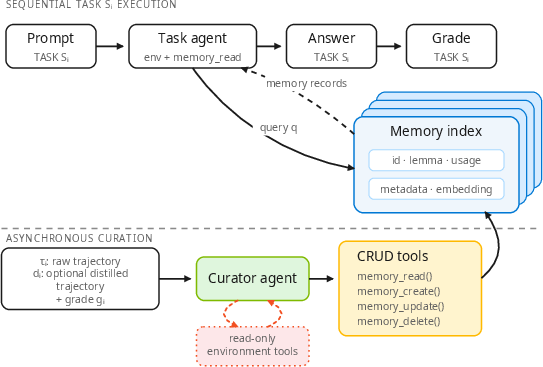
Los investigadores construyeron un sistema basado en GitHub Copilot. En cada tarea participan dos agentes diferentes:
- Agente de tarea: intenta resolver el problema actual.
- Agente curador: trabaja después de la tarea y decide qué información merece ser guardada en la memoria.
El agente de tarea puede leer recuerdos, pero no puede modificarlos. El agente curador es el único que puede crear, cambiar o eliminar recuerdos.
La nueva idea: comprobar antes de guardar
El agente curador sigue tres pasos:
- Proponer: decide qué posible recuerdo podría ser útil.
- Comprobar: usa herramientas de solo lectura para verificarlo.
- Guardar: crea, modifica, limita o elimina el recuerdo según lo que descubrió.
Por ejemplo, si el agente cree que una tabla de una base de datos debe conectarse con otra mediante una columna llamada ref_id, el curador puede comprobar esa relación directamente. Si la relación es correcta, la guarda. Si no lo es, la corrige o no la guarda.
Las herramientas de solo lectura son importantes porque el curador puede investigar, pero no puede cambiar la base de datos ni causar daños.
Las pruebas realizadas
El estudio comparó cuatro sistemas:
| Sistema | ¿Tiene memoria? | ¿Comprueba el entorno antes de guardar? |
|---|---|---|
| Sin memoria | No | No |
| Memoria con todo el historial | Sí | No |
| Memoria resumida | Sí | No |
| Memoria resumida con exploración | Sí | Sí |
Los investigadores usaron dos tipos de pruebas:
- CLBench: tareas de análisis de bases de datos. Durante algunas pruebas, la estructura de la base de datos cambiaba, para comprobar si la memoria podía actualizarse.
- APEX adaptado: tareas de consultoría que requerían buscar información en archivos PDF, hojas de cálculo, documentos y presentaciones.
Para evaluar los sistemas midieron:
- cuántas tareas resolvían correctamente;
- cuántas consultas o llamadas a herramientas necesitaban;
- cuántos tokens utilizaban;
- cuánto costaba ejecutar el agente.
Los tokens son pequeñas partes de texto que el modelo procesa. Usar menos tokens normalmente significa usar menos tiempo y dinero.
4. ¿Cuáles fueron los principales resultados?
La memoria ayudó a los agentes
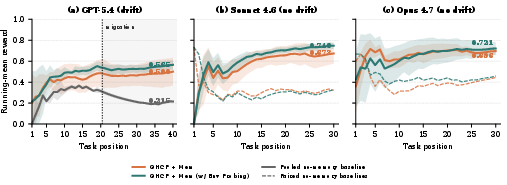
En CLBench, el sistema sin memoria resolvió correctamente alrededor del 39 % de las tareas.
Con memoria, el resultado mejoró:
- la memoria normal alcanzó aproximadamente el 70 %;
- la memoria con exploración del entorno alcanzó aproximadamente el 73 %.
Además, el sistema con exploración necesitó menos consultas: bajó de unas 8,8 consultas por tarea a unas 4,7.
El costo del agente también disminuyó, de aproximadamente 3,38 dólares por tarea a 1,68 dólares.
Esto significa que el sistema no solo acertó más, sino que también tuvo que investigar menos veces.
La exploración ayudó a evitar recuerdos incorrectos
Una memoria normal puede guardar una respuesta concreta sin explicar bien cómo se obtuvo. Por ejemplo, puede recordar:
“El resultado correcto es 96,23”.
Pero ese número podría servir solo para una tarea específica. No explica qué tablas usar, qué filtros aplicar o cómo repetir el cálculo.
Con exploración, el recuerdo podía convertirse en una instrucción más útil, como:
- unir dos tablas mediante una columna concreta;
- filtrar solo ciertas filas;
- usar la columna correcta para calcular el promedio;
- repetir el procedimiento en futuras tareas.
Así, la memoria deja de ser solo una colección de respuestas y se convierte en una colección de procedimientos reutilizables.
La exploración ayudó cuando el entorno cambió
En algunas pruebas, la base de datos cambiaba después de la mitad de las tareas. Por ejemplo:
- se cambiaban nombres de campos;
- se añadían nuevos datos;
- algunos campos antiguos dejaban de existir.
La memoria sin comprobación podía conservar instrucciones viejas. La exploración permitía detectar esos cambios y actualizar los recuerdos.
Esto es parecido a usar un mapa antiguo de una ciudad. Si se construye una carretera nueva, alguien debe revisar el mapa antes de volver a usarlo.
También funcionó en tareas de documentos y consultoría
En las pruebas APEX, los agentes tenían que encontrar archivos, analizar hojas de cálculo y realizar cálculos.
Los tres sistemas con memoria mejoraron con respecto al sistema sin memoria. En los seis entornos evaluados, todos obtuvieron una recompensa media mayor que la versión sin memoria.
La exploración del entorno fue la opción más eficiente en cinco de los seis entornos. También redujo la cantidad de llamadas a herramientas, en algunos casos entre un 16 % y un 75 %.
No fue necesario entrenar de nuevo el modelo
Una ventaja importante es que los investigadores no cambiaron:
- el modelo principal;
- el agente que realiza las tareas;
- el sistema de búsqueda de recuerdos;
- el formato de los recuerdos;
- los permisos de escritura del sistema de producción.
Solo añadieron herramientas de lectura al agente curador. Por eso, el método podría incorporarse a sistemas existentes con cambios relativamente pequeños.
5. ¿Por qué son importantes estos resultados?
Los resultados muestran que una memoria automática puede ser útil, pero no basta con guardar todo lo que un agente hizo.
Una memoria sin revisión puede:
- recordar un error;
- convertir una respuesta específica en una regla general;
- usar información que ya está desactualizada;
- guardar una forma lenta o innecesariamente complicada de resolver un problema.
La exploración permite que el agente curador actúe como un verificador. Antes de guardar una lección, comprueba si realmente funciona, en qué situaciones funciona y si sigue siendo válida.
Esto puede hacer que los agentes sean:
- más precisos;
- más rápidos;
- menos costosos;
- más fáciles de supervisar;
- más seguros para usar en empresas.
6. Implicaciones y posible impacto
El método podría ser útil para agentes que trabajan durante mucho tiempo en entornos que cambian. Por ejemplo:
- asistentes que trabajan con bases de datos empresariales;
- agentes que analizan documentos;
- programas que ayudan a desarrollar software;
- sistemas de atención al cliente;
- herramientas que realizan tareas repetidas en una empresa.
La idea principal es sencilla: los agentes no deberían guardar una experiencia como conocimiento permanente sin comprobarla primero.
También es importante que el curador solo tenga permisos de lectura. Puede mirar y comprobar la información, pero no modificar el entorno. Esto reduce el riesgo de que una exploración cause problemas.
Sin embargo, el estudio tiene algunas limitaciones. Se realizó en un número concreto de pruebas y entornos, y las mejoras no fueron iguales en todos los casos. En un entorno, la memoria normal fue ligeramente mejor que la memoria con exploración. Además, comprobar información también consume recursos, aunque esos costos no se incluyeron en el costo principal del agente de tarea.
Conclusión
El artículo propone una forma más cuidadosa de construir la memoria de los agentes de IA. En lugar de guardar automáticamente lo aprendido durante una tarea, un agente separado revisa la información y la comprueba en el entorno usando herramientas de solo lectura.
Las pruebas indican que este método puede ayudar a los agentes a cometer menos errores, trabajar con menos consultas y gastar menos dinero. En resumen, la investigación sugiere que una buena memoria para la inteligencia artificial no debe ser solo grande: también debe ser comprobada, actualizada y útil para futuras tareas.
Knowledge Gaps
Knowledge gaps, limitations, and open questions
- Limited external validity: Evaluation is restricted to one production-like GHCP harness, CLBench, and six adapted APEX document worlds; performance on other agent platforms, enterprise domains, tool ecosystems, and real production workloads remains untested.
- Small experimental sample sizes: Most comparisons use only three or five runs, and APEX contains between 11 and 18 tasks per world, limiting the reliability of confidence intervals and subgroup conclusions.
- Unclear statistical significance of probing gains: Although probing generally outperforms trajectory-only memory, several differences have overlapping uncertainty intervals, and no paired significance tests or effect-size analyses are reported for the main probing-versus-memory comparisons.
- No controlled probe-budget analysis: The study does not quantify how probing performance changes with the number of curator tool calls, probe depth, probe latency, or probe cost.
- Curation costs are excluded from efficiency metrics: Reported dollar costs and reward-per-dollar results exclude distillation and curator execution, so the claimed total economic advantage of probing is unresolved.
- No end-to-end latency evaluation: Because probing is asynchronous, the paper does not measure whether curation completes before the next task, how much delay it introduces, or how the method behaves under high task arrival rates.
- Insufficient ablation of the proposed mechanism: The experiments do not separately isolate the effects of read-only tools, additional curator instructions, extra curator computation, raw-trajectory access, feedback access, or changes in the number and content of memory records.
- Unclear contribution of the distillation stage: The paper keeps distillation fixed but does not compare probing with and without distillation or test whether the distiller itself introduces omissions, hallucinations, or systematic biases.
- No systematic measurement of memory quality: Results focus on downstream reward, tool calls, and cost, but do not directly evaluate memory correctness, factuality, transferability, scope calibration, redundancy, deletion quality, or staleness.
- No direct analysis of error propagation: The paper motivates probing as a way to prevent false memories but does not report rates of incorrect records, harmful retrievals, repeated errors, or recovery from an initially corrupted memory.
- Limited drift characterization: CLBench uses a particular schema migration after question 20, but the method is not evaluated under gradual, recurring, semantic, adversarial, or unannounced changes across multiple drift magnitudes.
- Fixed task ordering may confound continual-learning results: The canonical task order is held fixed, and the study does not establish whether gains persist under randomized, reversed, clustered, or alternative task sequences.
- No long-horizon scaling study: The experiments contain at most 40 CLBench tasks and 90 APEX tasks; memory growth, retrieval degradation, deletion behavior, and curation cost over hundreds or thousands of tasks remain unknown.
- Retrieval effects are not independently examined: The paper holds the retriever fixed but does not determine whether probing remains beneficial with different retrieval models, top- settings, indexing strategies, embedding models, or larger memory stores.
- Schema and record-design sensitivity is unresolved: The method relies on records containing categories, confidence, scope, provenance, utility, and usage metadata, but the impact of this schema and alternative memory representations is not evaluated.
- Dependence on model and prompt quality is unclear: Only a small set of frontier models is tested, and all agents within an experiment use the same base model; robustness to weaker, specialized, open-weight, or heterogeneous curator/task models is unknown.
- No evaluation of curator calibration: The paper does not test whether curator confidence corresponds to actual memory validity, whether uncertainty-aware skipping works, or whether the curator knows when probing is insufficient.
- Probe selection is not formally specified: The proposal describes several possible probe behaviors, but it does not provide a decision rule, uncertainty estimator, or reproducible policy for choosing which claims to probe.
- Potential benchmark leakage and answer anchoring are not fully addressed: Curators receive terminal grades and completed trajectories, and the study does not quantify whether probing or feedback indirectly reveals benchmark-specific answers rather than transferable procedures.
- Generalization beyond the observed environment is untested: Probes validate claims in the current environment, but the paper does not establish whether validated memories transfer to new tenants, datasets, schemas, organizations, or tool versions.
- Read-only access may still create security and privacy risks: The paper assumes least-privilege, audited read surfaces but does not evaluate sensitive-data exposure, inference of restricted information, prompt injection through environment contents, or malicious tool responses.
- Adversarial robustness is unexplored: There are no experiments involving poisoned trajectories, misleading documents, corrupted schemas, malicious memory records, deceptive tool outputs, or attackers attempting to manipulate curator writes.
- Failure behavior when no safe read surface exists is unclear: The fallback to trajectory-only curation is stated but not evaluated, and the paper does not define how systems should detect unsafe or incomplete tool coverage.
- Probe side effects are assumed away: Although tools are described as read-only, the study does not verify whether real enterprise connectors can leak state, trigger logging or billing effects, expose access patterns, or behave nondeterministically.
- Multi-user and multi-agent settings are not evaluated: The experiments use a shared persistent index but do not study conflicting users, concurrent curators, permissions across tenants, memory ownership, or synchronization races.
- Deletion and invalidation policies remain underspecified: The method permits narrowing, updating, merging, and deleting records, but the experiments do not report how often these actions occur or whether stale memories are reliably removed.
- Task-agent reliance on memory is not analyzed: It remains unclear whether probing improves performance because records are more correct, because they are easier for the task agent to follow, or because the task agent changes its exploration strategy after retrieval.
- Reward design may favor fewer tool calls over thoroughness: The pass-discounted reward uses fixed call budgets and strict binary task success; its sensitivity to alternative latency, token, monetary, partial-credit, or risk-adjusted objectives is unknown.
- Strict pass scoring hides partial improvements: Tasks that satisfy most rubric criteria receive zero reward, so the reported gains may not reflect how probing affects individual subtasks or degrees of correctness.
- Baseline coverage is incomplete: Comparisons omit stronger or differently designed memory managers, explicit verification modules, retrieval rerankers, external knowledge bases, and curator systems with equivalent environment access.
- Full in-context learning is not a fully matched baseline: Full ICL differs substantially in context size and representation from indexed memory, so the experiments do not determine whether the advantage arises from memory organization, context compression, or retrieval behavior.
- Human oversight is absent: The paper does not compare autonomous probing with human review, human-approved memory commits, or hybrid escalation for high-risk or low-confidence memories.
- Long-term memory contamination across task domains is untested: The study does not examine whether records from unrelated tasks are retrieved incorrectly, whether cross-domain memories interfere, or how scope boundaries are maintained in heterogeneous enterprise workloads.
- Reproducibility is incomplete: The full prompts, tool implementations, environment states, task sequences, memory contents, probe traces, and raw per-task outcomes are not all presented, making independent replication and detailed error analysis difficult.
Practical Applications
The paper’s central innovation is a deployment-compatible, environment-probing memory curator: after an agent completes a task, a separate curator uses least-privilege, read-only tools to verify, scope, refresh, or discard candidate memories before committing them. The task agent, model weights, retriever, memory schema, and production write authority remain unchanged. The following applications follow from the reported improvements in correctness, tool-call efficiency, cost, and resilience to environmental drift.
Immediate Applications
- Enterprise data-analysis copilots — software, business intelligence, and data engineering. Deploy an asynchronous curator alongside SQL- or database-enabled agents. It can verify join keys, table relationships, aggregation grain, encodings, soft-delete rules, and schema changes before storing reusable procedures. Future agents can retrieve validated SQL workflows instead of rediscovering the database structure. Feasibility assumptions: read-only access to metadata and representative data is available; sensitive records can be masked; the environment exposes stable identifiers and audit logs. The paper’s CLBench results suggest immediate potential for higher pass rates and fewer database queries, but production validation should use organization-specific schemas and workloads.
- Code-generation and software-maintenance agents. A GitHub- or IDE-integrated curator could probe repository structure, build commands, dependency relationships, test conventions, and branch-specific constraints. It could update memories when APIs, directory layouts, or build systems change, while preventing unsupported coding heuristics from becoming persistent guidance. Dependencies: read-only repository, issue tracker, CI, and documentation connectors; access controls matching the developer’s permissions; safeguards against storing secrets or proprietary code. The method is directly compatible with existing agent SDKs and repository tools, but its effectiveness depends on meaningful recurring tasks within evolving codebases.
- Enterprise document and spreadsheet assistants — consulting, finance, and operations. Apply probing to agents that search PDFs, DOCX files, XLSX workbooks, and presentation repositories. The curator can validate file locations, workbook sheets, relevant tables, formula conventions, and document-to-answer relationships, producing reusable workflows for recurring reporting or analysis. Dependencies: stable document permissions, read-only file and workbook APIs, and mechanisms for detecting document version changes. The adapted APEX results provide direct evidence for this use case, although the benchmark does not establish performance across all enterprise document formats.
- Customer-support and service-desk agents. After resolving a ticket, the curator can verify troubleshooting steps against current product documentation, configuration metadata, and service-status information. It can store scoped procedures such as “for version X and error Y, inspect configuration Z,” while deleting obsolete steps after a product update. Dependencies: current read-only access to knowledge bases, product versions, and diagnostic systems; strong privacy controls; human review for high-impact or safety-sensitive procedures. Immediate deployment is most appropriate for low-risk support workflows where the agent’s final response remains subject to existing approval policies.
- Agent observability and memory-governance tooling.
Build a middleware component that implements the paper’s
propose–probe–commitlifecycle. Each memory record can include confidence, applicability scope, provenance, utility, probe evidence, and update history. Administrators could inspect why a memory was created, what environment evidence supported it, and when it was invalidated. Dependencies: structured memory CRUD interfaces, authentication and audit integration, retention policies, and an operational policy for handling conflicting probe results. This is one of the most directly deployable outcomes because it does not require model retraining or changes to the task-time interface. - Cost and latency optimization for long-running agent workflows. Use validated procedural memories to reduce repeated environment exploration, tool calls, context size, and model spending. This is relevant to analytics agents, document-research systems, coding assistants, and internal automation where many related tasks are processed over time. Dependencies: the cost of asynchronous curation must be tracked separately; savings are most likely when tasks share environment structure and when discovery is expensive. The paper reports lower task-agent cost, but organizations should calculate total cost including curator calls, connector usage, storage, and monitoring.
- Academic research on continual learning and agent memory. Researchers can implement the method as a baseline or experimental module in agent-memory systems, comparing trajectory-only curation with environment-informed verification. The approach supports studies of stale knowledge, schema drift, memory deletion, provenance, retrieval quality, and cost-adjusted task performance. Dependencies: reproducible environments, controlled drift schedules, clear separation between task-agent and curator capabilities, and evaluation metrics that include curation cost and false-memory rates rather than accuracy alone.
- Policy and governance pilots for enterprise AI. Organizations can use the architecture as a practical control pattern: task agents remain read-only with respect to shared memory, while a separate curator performs auditable updates using narrowly scoped environmental access. This supports policies requiring least privilege, provenance, human escalation, and traceable knowledge refresh. Dependencies: regulatory requirements may require human approval, data residency controls, retention limits, or formal validation beyond an LLM-generated probe. Read-only access reduces risk but does not eliminate prompt injection, data leakage, or incorrect curation.
Long-Term Applications
- Self-maintaining enterprise knowledge systems. At scale, probing curators could maintain a continuously refreshed layer of facts, relationships, and procedures across databases, repositories, documents, and business applications. Memories could be automatically narrowed by tenant, department, software version, geography, or time period and invalidated when environmental evidence changes. Dependencies: cross-system identity resolution, reliable change detection, conflict resolution, provenance standards, and scalable asynchronous scheduling. Further research is needed to determine how often records should be re-probed and how to prevent systematic errors from propagating across connected systems.
- Healthcare and clinical operations assistants. In carefully constrained settings, a curator could verify workflow instructions against current hospital protocols, formularies, scheduling systems, or patient-care documentation before retaining them. Potential products include institution-specific clinical workflow assistants and validated operational memory for triage administration, coding, or care coordination. Dependencies: clinical validation, privacy protection, medical-device and health-regulatory compliance, human oversight, and strict separation between operational assistance and autonomous diagnosis or treatment. The paper does not evaluate healthcare, so clinical deployment requires substantial domain-specific evidence.
- Robotics and embodied agents. A robot’s curator could use read-only sensors or simulation interfaces to verify navigation routes, object affordances, workspace constraints, and task preconditions before storing reusable skills. This could reduce repeated exploration in warehouses, laboratories, or household robotics. Dependencies: reliable state estimation, safe probing interfaces, simulation-to-reality transfer, temporal validity of observations, and strict physical safety constraints. In physical environments, “read-only” probing may still have operational consequences, so the method must be extended with risk-aware action policies.
- Industrial control, energy, and infrastructure maintenance. Agents could maintain validated procedures for equipment diagnostics, plant layouts, grid operations, or maintenance scheduling while checking current sensor and configuration state before committing updates. This could support predictive-maintenance copilots and utility operations assistants. Dependencies: high-integrity telemetry, cybersecurity, safety certification, real-time constraints, and formal approval for changes affecting physical systems. The current method is better suited to read-only planning and decision support than autonomous control.
- Financial analysis and compliance automation. Probing curators could validate current ledger schemas, reporting definitions, market-data conventions, and compliance workflows before storing reusable analysis procedures. Possible products include audit-support agents, financial-reporting assistants, and institution-specific regulatory knowledge systems. Dependencies: data lineage, segregation of duties, model-risk governance, regulatory auditability, and protection against storing confidential or market-sensitive information. Probe results would likely require deterministic checks or human sign-off in regulated workflows.
- Personal digital assistants with privacy-preserving memory. A personal assistant could maintain memories about recurring routines, preferred workflows, or household systems while checking current calendars, devices, subscriptions, or travel information before updating them. This could reduce stale reminders and repeated setup actions in daily life. Dependencies: explicit consent, local or encrypted storage, user-visible provenance, easy deletion, and strong limits on cross-context inference. Because personal environments contain sensitive information, least-privilege access and transparent memory controls are essential.
- Autonomous workflow and multi-agent systems. In a larger agent organization, specialized curators could validate shared procedural memories used by coding, research, procurement, or planning agents. A common memory layer might support versioned skills, environment-specific policies, and automatic rollback when probes contradict existing records. Dependencies: standardized memory schemas, agent identity and permission management, conflict-resolution protocols, and defenses against one faulty curator contaminating many agents. Research is needed on whether independent curators, ensemble probes, or deterministic validators provide sufficient reliability.
- Adaptive policy and public-sector service delivery. Government service agents could maintain current procedures for benefits, licensing, permitting, or public-information workflows by checking read-only policy repositories and jurisdiction-specific systems. This may reduce errors caused by outdated rules and improve consistency across repeated cases. Dependencies: authoritative source systems, legal review, accessibility requirements, explainability, and human appeal mechanisms. Public-sector use should treat the curator as a support mechanism, not as an autonomous authority for eligibility or adjudication.
- Standardized benchmarks and certification for agent memory. The paper’s evaluation design could motivate industry standards measuring not only task accuracy but also stale-memory detection, evidence quality, tool-call reduction, memory contamination, curation cost, and performance under schema or policy drift. Certification suites could test whether a product safely handles unsupported, overly broad, or obsolete memories. Dependencies: representative multi-session environments, agreed risk categories, reproducible drift scenarios, and evaluation across models and domains. The reported experiments use CLBench and adapted APEX; broader independent replication is needed before treating the results as general guarantees.
- Learning systems that combine probing with formal verification. A future system could use the paper’s LLM-based propose–probe–commit loop to generate candidate memories, then apply database constraints, static analysis, schema validators, symbolic checks, or simulation-based tests before committing them. This would be especially valuable in software, finance, healthcare, and industrial settings. Dependencies: machine-checkable representations of procedures, domain-specific validators, calibrated uncertainty estimates, and mechanisms for handling cases where formal checks are unavailable. The paper establishes the value of environment-informed curation, but not that LLM probing alone is sufficient for high-assurance applications.
Glossary
- Actionability: The degree to which information can be directly used to perform a task. “Before writing, it considers evidential support, transfer value, scope, actionability, and overlap”
- Aggregation grain: The level of detail at which data is grouped or summarized in a database operation. “an explicit ref_id join and aggregation grain”
- Asynchronous curation: Memory maintenance performed independently of the task agent’s active execution. “only the asynchronous curator agent gains world tools”
- Continual learning: A machine-learning setting in which a system learns incrementally from a sequence of tasks or experiences. “Persistent state alone, however, does not guarantee continual learning.”
- Contextual replay buffer: A stored collection of prior interaction context used to support later reasoning or execution. “Contextual replay buffers, dynamic cheatsheets, and reusable reasoning templates compress prior execution at different granularities”
- CRUD: The four basic data-management operations: create, read, update, and delete. “The curator agent has four memory tools: memory_read, memory_create, memory_update, and memory_delete.”
- Distillation: The transformation of a detailed trajectory or dataset into a more compact representation that preserves important information. “We apply the non-writing preprocessing transformation”
- Environment drift: Changes in an external environment that make previously learned information inaccurate or obsolete. “CLBench shows that memory can encode spurious generalizations and stale beliefs under environment drift”
- Environment probing: The use of read-only interactions with an external environment to verify, scope, or refresh candidate memories. “We therefore propose environment-probing curation.”
- Episodic memory: Memory for specific past experiences or events, including their contextual details. “This is consistent with constructive accounts of episodic memory”
- Evidence boundary: The limit imposed by the information directly available to a system when forming a conclusion. “This retrospective evidence boundary is fundamentally incomplete.”
- External memory: Persistent information stored outside a model’s parameters and made available during later executions. “A natural remedy is external memory, with three core operations”
- Full in-context learning: A method that supplies previous examples or trajectories directly in the model’s input context rather than modifying model parameters. “GHCP + Full ICL”
- Least privilege: A security principle in which an agent receives only the minimum permissions required for its function. “The asynchronous curator agent receives only a least-privilege, read-only subset of existing connectors or MCP tools”
- Long-horizon agent: An agent designed to perform or improve across extended sequences of tasks, interactions, or sessions. “Persistent memory is entering production-oriented agent platforms to help long-horizon agents accumulate experience across sessions.”
- Latent environment structure: Underlying regularities or relationships in an environment that are not directly observable at first. “Success depends on accumulating feedback and, especially, knowledge of the latent environment structure shared across related tasks.”
- Memory schema: The defined structure and fields used to represent stored memories. “It keeps the task agent, retriever, distillation setting, curator agent, memory schema, and CRUD policy unchanged.”
- Model Context Protocol (MCP): A protocol for connecting language-model agents to external tools and data sources. “external tools expose the environment”
- Non-parametric continual learning: Learning through external memory or retrieved information without changing the model’s learned parameters. “Agent memory extends retrieval-augmented generation from external knowledge corpora to experience accumulated by the agent itself”
- Pass-discounted reward: A reward that is granted only for successful tasks and reduced according to the number of tool calls used. “Its pass-discounted reward is”
- Post-task curation: The process of reviewing and updating an agent’s memory after task completion. “Post-task curation in Mem0, Claude Managed Agents Dreams, ACE, ReasoningBank, and ReMe operates over some combination of existing records”
- Proactive validation: Verification performed before information is committed for future use, rather than only when it is later needed. “Environment probing therefore turns existing agent-memory curation into an environment-informed, auditable process”
- Provenance: Information describing the origin or supporting evidence of a stored record. “Each record carries a category, confidence, applicability scope, concise lemma, provenance, utility, and usage metadata.”
- Queryable index: A searchable data structure that returns records matching a query or relevance criterion. “Designs range from full-context trajectory replay, per-trajectory summaries, and a mutable notepad to queryable indexes.”
- Read-only tool: An external capability that permits observation or querying but prohibits modification. “it uses read-only world tools to check candidate claims”
- Retrieval-augmented generation (RAG): A method in which a LLM retrieves external information and uses it to generate a response. “Agent memory extends retrieval-augmented generation from external knowledge corpora to experience accumulated by the agent itself”
- Schema drift: A change in the structure, fields, or relationships of a database schema over time. “The primary 40-question drift schedule hides a SQLite schema that changes after question 20”
- Semantic index: An index that organizes or retrieves items according to their meaning rather than only exact lexical matches. “adapts retrieval across semantic, lexical, and symbolic indexes”
- Soft delete: A deletion mechanism that marks data as removed without physically erasing it. “drift also renames fields and adds soft deletes.”
- Stateful environment: An environment whose condition persists and can change across interactions or tasks. “Evaluating Frontier {AI} Systems in Real-World Stateful Environments”
- Stateless execution: Execution in which prior interactions or learned state are not retained for subsequent tasks. “Stateless execution discards trajectories, observations, discoveries, and missteps at every session boundary”
- Student- confidence interval: An uncertainty interval calculated using the Student- distribution, typically when estimating a mean from a limited sample. “We report run-level means with 95\% Student- confidence intervals.”
- Symbolic index: An index based on explicit, structured symbols or relations rather than only vector similarity. “adapts retrieval across semantic, lexical, and symbolic indexes”
- Task-conditioned rewriting: Rewriting stored information in a manner tailored to the requirements of the current task. “ReMe adds validation, deduplication, utility pruning, and task-conditioned rewriting”
- Trajectory: The complete sequence of observations, actions, tool calls, and outputs produced during an agent’s execution. “The raw trajectory contains the request, memory reads, action--observation pairs, and submitted answer.”
- Trajectory distillation: The creation of a compact representation of an agent’s full execution trace. “The distiller transforms the full raw trajectory into the distilled trajectory .”
- Trajectory-only curation: Memory creation or maintenance based solely on recorded task execution and related retrospective evidence. “Environment probing improves over trajectory-only memory in five of six APEX worlds”
- Transfer value: The usefulness of information for tasks beyond the specific task in which it was acquired. “Before writing, it considers evidential support, transfer value, scope, actionability, and overlap”
- Utility pruning: Removing stored information judged to have low practical value. “ReMe adds validation, deduplication, utility pruning, and task-conditioned rewriting”
- Vector or relevance retrieval: The process of selecting stored records judged relevant to a task or query. “The retriever returns a small set of records relevant to the task agent's request.”
- Write-time evidence quality: The strength and reliability of evidence available when information is added to persistent memory. “incremental gains measure write-time evidence quality rather than added task-agent capacity.”