TurboT2VA: Fast Large-Scale Text-to-Video-Audio Generation via Score-Regularized Consistency Distillation
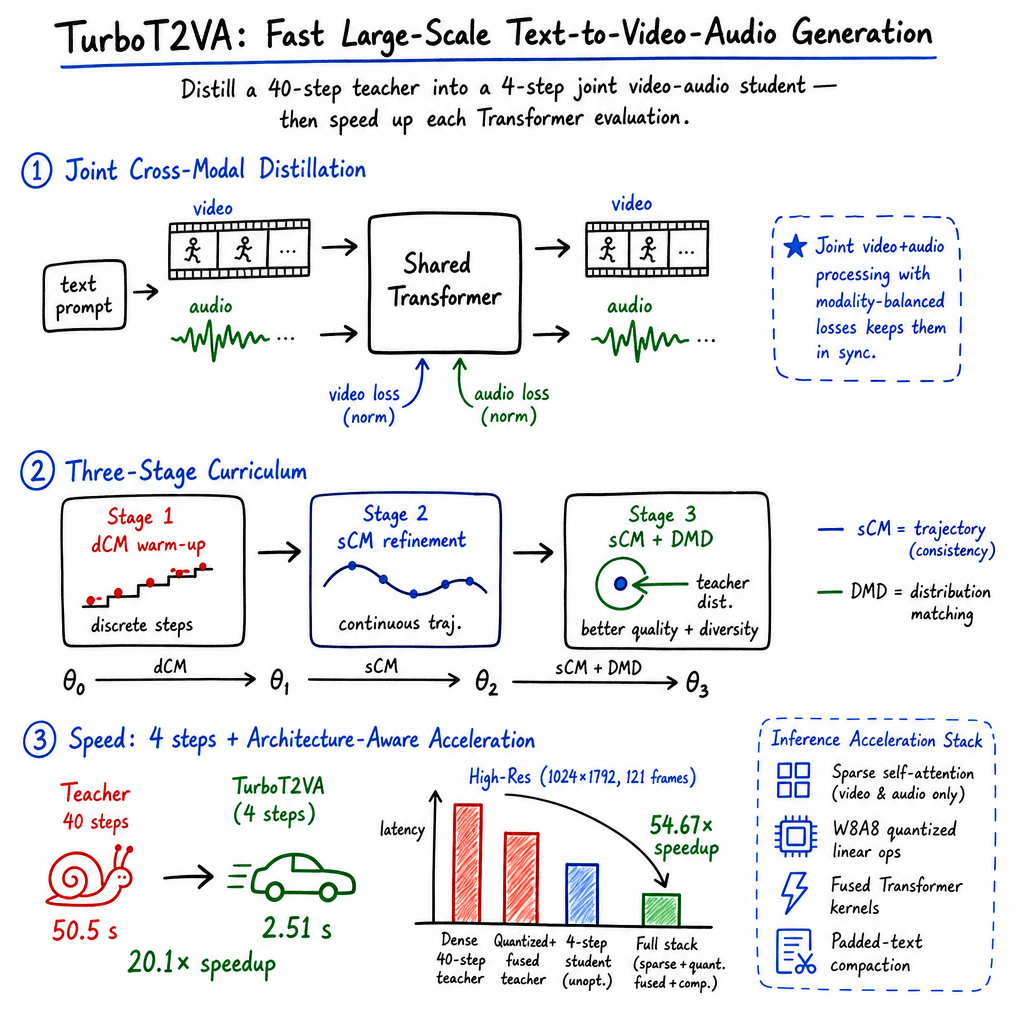
Abstract: Joint text-to-video-audio generation produces synchronized visual and acoustic content, but the long sampling trajectories and heterogeneous multimodal computation of large models make inference prohibitively expensive. We present TurboT2VA, a distillation and inference framework for accelerating a 19B-parameter joint video-audio model. Large-scale T2VA distillation is challenged by modality-imbalanced optimization, the difficulty of continuous-time consistency training at scale, and the quality--diversity trade-off. TurboT2VA addresses these issues with per-modality normalization and a progressive curriculum comprising discrete consistency warm-up, continuous consistency refinement, and joint consistency--distribution matching. The curriculum first establishes a stable, diverse generation trajectory and only then introduces distribution-level refinement. On LTX-2, four-step distillation reduces generator latency from 50.52s to 2.51s at the standard evaluation resolution of 512768, achieving a 20.1 speedup while maintaining strong visual quality, audio fidelity, diversity, and video-audio synchronization. We further develop an architecture-aware inference stack that combines guarded W8A8 and fused operators, padded-text compaction, and modality-aware sparse attention while preserving dense cross-modal and text-conditioning paths. Under the high-resolution deployment setting at 10241792, the complete stack reduces generator latency from 318.74s to 5.83s on one NVIDIA H20, achieving a 54.67 generator-only speedup. Inference code and generation demos are available at https://github.com/thu-ml/TurboDiffusion/tree/main/turbot2va.
Paper Prompts
Sign up for free to create and run prompts on this paper.
Top Community Prompts
Explain it Like I'm 14
1. What is this paper about?
This paper presents TurboT2VA, a system that creates both videos and sound from a written description much faster than earlier systems.
For example, a user might type:
“A dog runs through a park while birds sing and people clap.”
The system should create a video showing the dog, along with audio that matches what is happening. The important part is that the video and sound should be synchronized—for example, a clap should happen when people appear to clap.
The problem is that large video-and-audio AI models are very slow. They usually improve a random starting picture and sound through many repeated steps. TurboT2VA tries to produce similar-quality results using only four steps instead of forty, together with computer-programming tricks that make each step faster.
2. What questions does the research ask?
The researchers mainly want to know:
- Can a large video-and-audio model be changed so that it generates results in only a few steps?
- Can the system remain good at following the written prompt?
- Can it keep the video and audio synchronized?
- Can it produce different, creative results instead of repeating nearly the same output every time?
- Can additional software and hardware improvements make high-resolution generation even faster?
- How can the system stop the video part from overpowering the audio part during training?
These questions are difficult because video and audio are very different. A video contains many visual pixels and frames, while audio changes rapidly over time as sound waves.
3. How did the researchers do it?
Starting with a large “teacher” model
The researchers used LTX-2, a model with about 19 billion parameters. Parameters are adjustable numbers inside an AI model. They are a little like the many tiny settings the model uses to learn patterns.
This original model is called the teacher. It takes 40 generation steps to create a video and audio track.
The researchers trained a smaller, faster-behaving version called the student. The student learned by watching the teacher’s predictions, much like a student learning from an expert.
Distillation: learning to skip steps
The main technique is called distillation. Imagine a teacher solving a difficult math problem by writing 40 lines of work. The student learns how to reach a similar answer using only four important lines.
For video and audio generation, the student learns how the teacher moves from random noise toward a finished result. The goal is not simply to copy one final answer, but to learn the overall path used to create good results.
Training in three stages
Instead of using every difficult training method at once, TurboT2VA uses a gradual three-stage plan:
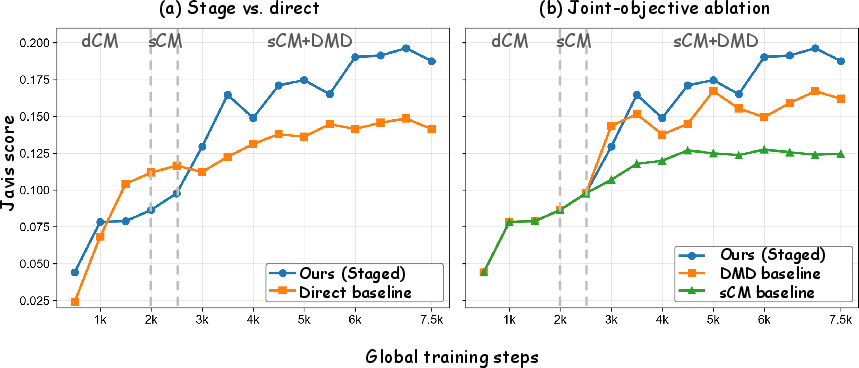
- dCM warm-up: The student first learns basic denoising at a few fixed points. In everyday terms, it learns how to turn a very noisy video and sound into something clearer.
- sCM refinement: The student then learns the teacher’s smooth generation path. This helps it make video motion, sound changes, and synchronization develop correctly over time.
- sCM plus DMD: Finally, the system adds a method called distribution matching. This encourages the student’s results to look more like the teacher’s realistic results.
This is similar to learning to ride a bicycle: first learning balance, then learning to steer, and only afterward practicing speed and smoothness.
Balancing video and audio
Video contains much more data than audio in some parts of the model. If the researchers simply added all the training errors together, the video errors could become much stronger than the audio errors.
TurboT2VA therefore calculates separate errors for video and audio and adjusts their sizes before combining them. This is like giving two students different-sized tests and making sure one test does not unfairly count much more than the other.
Although the errors are balanced, video and audio are still processed together inside one shared Transformer. This allows the model to learn relationships between them.
Making each step faster
Reducing the number of steps is only part of the solution. Each step still requires a lot of computer work, especially for high-resolution video.
The researchers add several acceleration methods:
- Sparse attention: The model does not compare every video or audio part with every other part. It focuses on the most important connections, similar to reading only the most relevant pages of a large book.
- Quantization: Some calculations use smaller 8-bit numbers instead of larger numbers. This is like using a shorter ruler with slightly less precision to measure things more quickly.
- Fused operations: Several small computer operations are combined into one larger operation, reducing wasted time.
- Removing padding: Extra empty spaces in the text input are removed before processing.
The researchers use safety checks so that these shortcuts are used only when they are unlikely to damage the result.
4. What did they find?
Much faster generation
At the standard test resolution of pixels, the original 40-step teacher took about 50.52 seconds to generate one result.
The four-step TurboT2VA student took about 2.51 seconds.
That is a speedup of about 20 times.
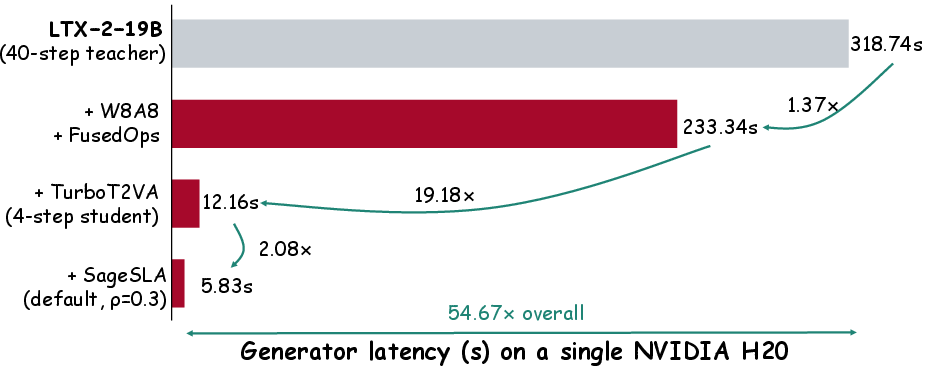
At a larger resolution of pixels, the full acceleration system reduced generation time from 318.74 seconds to 5.83 seconds on one NVIDIA H20 graphics card. This is about 54.67 times faster.
These times measure the model’s generation work only. They do not include tasks such as loading the model, decoding the final output, combining the video and audio files, or saving them to disk.
Quality stayed strong
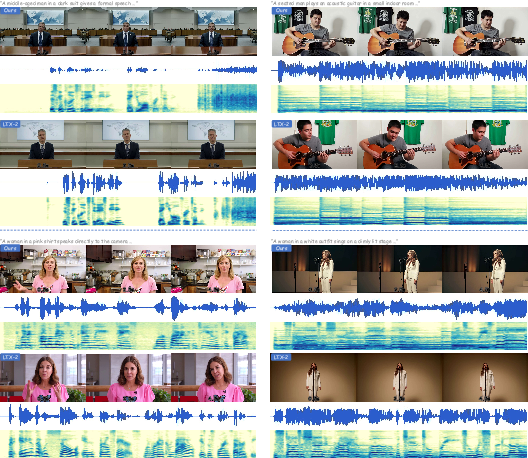
Even though the student used far fewer steps, its results were generally similar to the teacher’s results.
Compared with the teacher, the student showed:
- Strong visual quality and motion.
- Good sound quality.
- Good ability to follow the written prompt.
- Good video-audio synchronization.
- In some tests, better scores for visual quality and alignment.
For example, the student’s synchronization score was better than the teacher’s on one JavisBench measure, and its desynchronization score was lower. A lower desynchronization score means the sound was less likely to happen at the wrong time.
However, the student did not win on every measurement. The teacher still performed better on some audio-quality and motion measures. This means TurboT2VA is not identical to the teacher, but it provides a strong balance between speed and quality.
Better balance between realism and variety
The researchers compared different training methods:
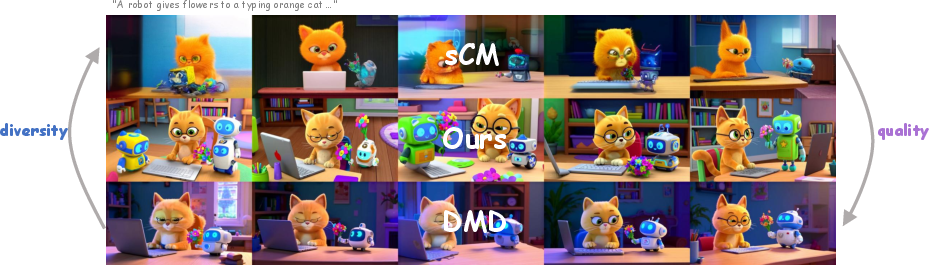
- sCM alone created more varied results, but the outputs were sometimes less realistic or less faithful to the prompt.
- DMD alone created polished and realistic results, but they were more repetitive.
- The staged TurboT2VA method achieved a better balance: realistic results that still differed from one another.
This is important because a useful creative AI should not produce the exact same video every time. For the same prompt, users may want different characters, camera angles, movements, sounds, or settings.
5. Why is this important?
TurboT2VA could make joint video-and-audio generation more practical. Faster generation could help with:
- Creating short films, advertisements, and games.
- Producing educational videos.
- Making quick video prototypes.
- Allowing more people to use video-and-audio AI without waiting several minutes.
- Running these systems in more real-world applications.
The paper also shows that training improvements and computer-system improvements work well together. Distillation reduces the number of generation steps, while quantization, sparse attention, and fused operations make each remaining step faster.
Simple conclusion
The main idea of the paper is:
Teach a large, slow video-and-audio AI model to reach nearly the same result in only a few steps, then use careful computer shortcuts to speed it up even more.
TurboT2VA succeeds in generating synchronized video and audio much faster while keeping fairly strong quality, realism, variety, and prompt understanding. Its biggest potential impact is making high-quality multimedia generation quicker and more affordable. Still, some quality differences remain, and the shortcuts may need to be tested again when the video size, prompt type, or hardware changes.
Knowledge Gaps
Knowledge gaps, limitations, and open questions
- Generality beyond LTX-2 is unestablished: The method is evaluated on a single 19B-parameter teacher architecture, so it remains unclear whether the curriculum and modality-balancing strategy transfer to other joint T2VA models, backbone designs, or parameter scales.
- Dependence on the teacher’s capabilities is unknown: The paper does not determine whether TurboT2VA can preserve or improve the quality of a weaker, differently parameterized, or more diverse teacher, nor how teacher errors and modality-specific biases propagate to the student.
- Training-data generalization is insufficiently tested: Distillation uses 100K paired text-video-audio samples, but the paper does not report dataset composition, licensing and demographic coverage, domain diversity, or performance on out-of-distribution prompts and audio-visual domains.
- Evaluation is limited to a small prompt set: Most quality and diversity results use a fixed 200-prompt split, leaving uncertainty about statistical reliability and performance across larger, more diverse prompt distributions.
- Robustness to prompt complexity is unexplored: The method is not systematically evaluated on long prompts, multiple simultaneous events, fine-grained temporal descriptions, negation, conversational speech, multilingual text, or prompts requiring several distinct audio-visual interactions.
- Longer-duration generation is not evaluated: Results use 121 frames, so it remains unknown whether four-step distillation preserves synchronization, motion coherence, and audio structure for substantially longer videos.
- Resolution and aspect-ratio generalization is unclear: The student is trained at and profiled at , but generation quality at the high-resolution setting and at other resolutions or aspect ratios is not reported.
- Temporal synchronization is not causally analyzed: Aggregate alignment metrics do not establish whether the student preserves event-level timing, such as the precise alignment of impacts, speech, gestures, musical beats, and scene transitions.
- Audio-specific failure modes remain underexplored: The paper does not analyze speech intelligibility, speaker consistency, musical structure, environmental sound realism, clipping, silence handling, or the frequency and severity of audio artifacts.
- Cross-modal interactions are not isolated experimentally: Although the method uses a shared Transformer and paired latents, the paper does not quantify how much of the synchronization benefit comes from joint distillation versus shared conditioning, correlated sampling, or the original LTX-2 architecture.
- The independent-noise design is not justified empirically: Video and audio use independently sampled noise while sharing timestep and text condition; the effects of correlated noise, modality-specific timesteps, or alternative joint-noise constructions on synchronization and diversity remain unknown.
- Modality weights and normalization choices are insufficiently characterized: The paper does not provide sensitivity analyses for , , , , the normalization stabilizers, or the choice of L2 versus residual-scale normalization.
- The curriculum schedule is not fully validated: The reported 2K/0.5K/4.5K stage allocation is a single configuration; the paper does not establish optimal transition criteria, stage lengths, alternative ordering, repeated cycling, or whether the curriculum remains effective under different training budgets.
- The source of the curriculum’s benefit is not disentangled: Direct sCM+DMD training and staged training are compared, but the effects of initialization, total optimization steps, learning-rate schedules, checkpoint selection, and exposure to different objectives are not independently controlled.
- The role of DMD’s fake-score network is insufficiently documented: Its architecture, training procedure, update frequency, objective, stability, computational cost, and sensitivity to student distribution drift are not specified in enough detail to assess reproducibility or failure modes.
- The diversity evaluation may not capture meaningful diversity: ImageBind pairwise distances and their arithmetic mean do not distinguish desirable variation from loss of prompt adherence, temporal incoherence, audio corruption, or mismatched video-audio pairings.
- Quality–diversity trade-offs lack uncertainty estimates: Results are reported as point averages without confidence intervals, per-prompt distributions, significance tests, or analysis of difficult versus easy prompts.
- Human perceptual validation is absent or limited: The paper does not report human judgments of visual quality, audio quality, event synchronization, prompt adherence, artifact severity, or preference between teacher and student outputs.
- Baseline comparisons are not fully controlled: Several baseline systems have unavailable runtime entries, different parameter counts, architectures, resolutions, sampling settings, or pipelines, making quality–latency comparisons difficult to interpret as matched comparisons.
- The reported speedups are generator-only: Latency excludes model loading, VAE decoding, audio/video muxing, disk I/O, and other deployment costs, so the end-to-end user-visible speedup and throughput remain unknown.
- Hardware and batch-size scalability are unexamined: Performance is reported primarily for batch size one on a single NVIDIA H20; multi-GPU scaling, other accelerators, consumer GPUs, larger batches, memory consumption, and energy efficiency are not evaluated.
- Sparse-attention quality degradation is not systematically measured: The fixed retention ratio is used for the high-resolution profile, but there is no comprehensive quality, synchronization, or diversity sweep across retention ratios, layers, resolutions, prompt types, and audio sequence lengths.
- Sparse-attention approximation may introduce rare failures: The paper does not investigate whether discarded attention blocks cause localized temporal errors, missed audio events, prompt-conditioning failures, or degradation on short or highly structured sequences.
- Quantization effects are reported mainly through latency, not quality: The separate contributions of W8A8 quantization, FP8 value aggregation, fused kernels, and fallback paths to visual fidelity, audio fidelity, synchronization, and diversity are not fully ablated.
- Fallback behavior reduces uniformity of deployment claims: Some unsupported shapes and dtypes revert to native BF16 operations, but the proportion of fallback layers, their latency impact, and behavior across resolutions and batch sizes are not reported.
- Numerical reliability of the optimized kernels is insufficiently bounded: The paper does not provide error distributions or worst-case analyses for quantization, sparse attention, fused normalization, and modulation operations, particularly for audio-sensitive outputs.
- Memory and training costs are incompletely characterized: The 21-hour training estimate excludes evaluation and checkpoint-sweep overhead, while peak memory, teacher/fake-score-network costs, and total compute or carbon footprint are not reported.
- Four-step sampling is emphasized without a broader operating curve: The paper does not fully characterize quality, synchronization, diversity, and latency across one-, two-, four-, eight-, and higher-step students, nor identify the minimum viable step count for different applications.
- Failure cases are not systematically documented: Qualitative examples focus on successful outputs; the paper leaves unresolved when the student loses fine details, collapses audio diversity, produces desynchronization, or fails to follow complex semantic instructions.
- Reproducibility details are incomplete: Exact dataset preprocessing, prompt lists, random seeds, checkpoint-selection criteria, optimizer schedules for all stages, fake-score training details, and implementation settings for the inference stack are not fully specified.
- Safety and content-control behavior is not evaluated: The paper does not assess whether distillation or acceleration changes the teacher’s behavior on unsafe, copyrighted, sensitive, or socially biased text and audio-visual prompts.
Practical Applications
Immediate Applications
The paper’s demonstrated combination of four-step distillation, modality-balanced training, quantized operators, sparse attention, and fused Transformer kernels supports the following applications that are technically deployable now, provided the required GPU infrastructure and model license are available.
- Interactive text-to-video-audio creation tools — Media, advertising, entertainment
- Integrate TurboT2VA into a desktop or web-based creative application that converts prompts into short videos with synchronized sound effects, ambience, speech-like audio, or music.
- The reduction from approximately 50.52 seconds to 2.51 seconds at standard resolution enables rapid prompt iteration, storyboard exploration, and near-interactive preview generation.
- A practical workflow could generate low-cost four-step drafts first, allow user selection or editing, and reserve slower high-quality rendering for final exports.
- Dependencies: sufficient GPU memory, access to paired video-audio training data, reliable content moderation, and validation outside the reported 200-prompt evaluation set.
- High-resolution video generation services — Cloud inference and software platforms
- Deploy the architecture-aware inference stack as an optimized backend for batch-one, high-resolution generation. The reported 5.83-second generator latency at 1024 × 1792 on one NVIDIA H20 could support commercial APIs, internal media pipelines, and automated content production.
- Potential products include prompt-to-social-video APIs, automated product demonstration generators, and rapid generation endpoints for media-management platforms.
- Dependencies: the reported latency excludes model loading, decoding, video-audio muxing, and disk I/O; end-to-end service latency and cloud cost will therefore be higher. Sparse-attention retention ratios must also be revalidated for different resolutions, sequence lengths, and prompt distributions.
- Automated sound design for generated or edited video — Film, games, marketing, and education
- Use joint generation to produce sound events that correspond to visual actions, such as footsteps, impacts, environmental ambience, mechanical sounds, or musical rhythms.
- Unlike a purely cascaded video-to-audio workflow, the joint model can preserve shared temporal structure during generation.
- A production workflow could use the generated audio as an editable first pass for sound designers rather than as an unreviewed final soundtrack.
- Dependencies: audio quality remains comparable to, but slightly below, the teacher on some reported measures; professional applications may require human review, waveform editing, loudness normalization, and copyright screening.
- Rapid prototyping in game development and virtual production — Games, robotics simulation, and XR
- Generate short synchronized audiovisual assets for concept testing, level design, cinematic blocking, virtual environments, or augmented/virtual-reality prototypes.
- Multiple random seeds can provide alternative scene layouts, character appearances, motion trajectories, and sound patterns, which is useful during ideation.
- Dependencies: generated content may not satisfy strict temporal, physical, character, or spatial-audio constraints. Production systems would likely need asset filtering, deterministic seeds, temporal editing, and integration with game engines or digital-content-creation software.
- Multimodal generation research infrastructure — Academia and industrial R&D
- Use the released inference code and demos as a baseline for studying joint video-audio generation, consistency distillation, score distillation, quantization, and multimodal attention.
- The three-stage curriculum—
dCM → sCM → sCM+DMD—provides a reproducible experimental workflow for comparing trajectory preservation against distribution matching. - Researchers can adapt the modality-wise normalization strategy to other paired generation problems, such as video–text-to-speech, image–music, or sensor–action generation.
- Dependencies: reproducing training requires a 19B-parameter teacher, approximately 100K paired samples, eight H20 GPUs, and around 21 hours for the reported training run, excluding additional evaluation and checkpoint-selection costs.
- Efficient inference for internal media workflows — Enterprises and public institutions
- Organizations that already operate compatible CUDA infrastructure can apply the post-training optimization stack without retraining the student model.
- W8A8 linear operators, fused normalization/modulation kernels, padded-text compaction, and modality-specific sparse attention can reduce inference cost in internal content-generation or indexing pipelines.
- Dependencies: the optimized kernels require constraints such as BF16 inputs and matrix dimensions divisible by 128; unsupported shapes or data types must fall back to BF16 computation. This creates a mixed optimized/fallback execution path that should be benchmarked for reliability.
- Educational and training-content prototyping — Education
- Teachers, publishers, and instructional designers could generate short audiovisual explanations, historical reconstructions, laboratory demonstrations, or language-learning scenes.
- Fast sampling makes it practical to create several variants of an explanation for different age groups, languages, or learning contexts.
- Dependencies: factual accuracy, accessibility, caption quality, cultural appropriateness, and audio intelligibility require human review. The model should not be treated as an authoritative source for scientific, historical, or medical content.
- Personal creative assistance — Daily life
- Individuals could use the model to create narrated clips, personalized greetings, travel montages, social-media drafts, or music-synchronized short videos from natural-language descriptions.
- The diversity preserved by staged distillation allows users to request multiple alternatives rather than receiving nearly identical outputs.
- Dependencies: consumer deployment requires smaller memory footprints, clear consent and provenance mechanisms, protection against impersonation, and safeguards against generating deceptive or abusive media.
- Policy and standards benchmarking for audiovisual AI — Public policy and governance
- The paper’s separate measurements of visual fidelity, audio quality, text alignment, cross-modal consistency, synchronization, and diversity can inform evaluation protocols for multimodal generative systems.
- Policymakers, standards bodies, and procurement teams could use similar scorecards when assessing audiovisual AI systems rather than relying only on image quality or text similarity.
- Dependencies: benchmark scores are model- and dataset-dependent. The reported evaluation uses specific datasets, metrics, prompts, and resolutions, so broader demographic, linguistic, cultural, safety, and robustness testing is necessary.
Long-Term Applications
The following applications are plausible extensions of the work but require additional research, scaling, validation, or product development before dependable deployment.
- Real-time or near-real-time audiovisual generation — Interactive media, XR, and robotics
- Further optimization could enable live generation of synchronized video and audio for virtual characters, immersive environments, interactive storytelling, or robot companions.
- The current results demonstrate substantial acceleration, but high-resolution generation remains computationally expensive and is not equivalent to frame-rate real-time rendering.
- Dependencies: temporal consistency over long sequences, low-latency decoding and muxing, stable generation under streaming conditions, energy efficiency, and hardware support beyond the tested H20 GPU.
- Controllable audiovisual content production — Film, advertising, and games
- A future system could accept structured controls for camera motion, object trajectories, dialogue timing, musical beat, sound-event placement, scene cuts, and character identity.
- TurboT2VA’s shared video-audio trajectory provides a foundation for conditioning these controls jointly rather than synchronizing independently generated tracks afterward.
- Dependencies: research is needed on controllable latent interfaces, long-range planning, editing and regeneration of individual modalities, identity persistence, and exact event-level synchronization.
- Long-form video and audio generation — Entertainment and education
- The framework could be extended from short clips to documentaries, lectures, advertisements, game cinematics, or episodic media with coherent audiovisual structure over minutes or hours.
- Distillation could reduce the cost of repeatedly generating shots while maintaining consistent characters, locations, soundscapes, and narrative events.
- Dependencies: the reported experiments use 121 frames and short paired samples. Long-context memory, scene-level planning, error accumulation, narrative coherence, and persistent audio identity remain unresolved.
- Edge and on-device multimodal generation — Mobile devices, cameras, and consumer electronics
- More aggressive quantization, pruning, model compression, or distillation could enable generation on workstations, laptops, mobile devices, smart cameras, or embedded systems.
- This could support offline video editing, privacy-preserving personal media creation, and low-connectivity educational tools.
- Dependencies: the current model has 19B parameters and the demonstrated acceleration still targets a high-end data-center GPU. Edge deployment requires substantial reductions in memory, power consumption, thermal load, and model size while preserving synchronization and quality.
- Assistive and therapeutic audiovisual systems — Healthcare and accessibility
- Joint generation could eventually create personalized visual-and-audio instructions, rehabilitation scenarios, simulation content, accessible educational material, or calming audiovisual environments.
- Synchronized modalities may be useful for users who benefit from coordinated visual cues and sound.
- Dependencies: clinical or therapeutic use requires validated outcomes, privacy protection, bias testing, clinician oversight, accessibility standards, and strict avoidance of unsupported medical advice. The paper provides no clinical evidence.
- Multimodal simulation for autonomous systems — Robotics, autonomous vehicles, and industrial training
- Generated paired video and audio could augment simulation environments with synchronized visual events and realistic acoustic cues, supporting robot perception, sound-source localization, navigation, or human–robot interaction training.
- The modality-balanced distillation method may be adapted to preserve relationships between visual events and sensor-like audio signals.
- Dependencies: synthetic data must be validated against real-world distributions, including acoustics, lighting, occlusion, motion blur, and sensor noise. Safety-critical systems require domain-specific certification and robust out-of-distribution testing.
- Low-cost personalized broadcasting and virtual agents — Customer service, commerce, and finance
- Future systems could create synchronized virtual presenters, product explainers, financial-literacy videos, or multilingual customer-service content at scale.
- Fast generation could support personalization by user, region, language, or product configuration.
- Dependencies: strong identity, lip-sync, pronunciation, factuality, and regulatory controls are required. Financial and customer-service deployments additionally need audit trails, disclosure that content is synthetic, approval workflows, and protection against fraud or impersonation.
- Energy-efficient generative-AI infrastructure — Data centers and sustainability policy
- Reducing sampling steps and accelerating per-step computation could lower energy use and operating costs per generated audiovisual sample.
- The method could contribute to carbon-aware scheduling, smaller inference clusters, and more economical public or academic access to multimodal generation.
- Dependencies: the paper reports latency rather than energy consumption. Real sustainability benefits require direct measurements of GPU power, cooling overhead, hardware utilization, model-loading cost, and the energy required for distillation training.
- Automated content moderation and provenance-aware media pipelines — Policy, platforms, and journalism
- Fast joint generation can be paired with watermarking, provenance metadata, content classifiers, and human approval systems to support controlled synthetic-media production.
- The same synchronization-aware metrics could help detect audiovisual inconsistencies or identify outputs that fail alignment checks.
- Dependencies: provenance methods must survive editing and recompression; watermarking and detection must be independently validated. Governance is also needed for consent, copyright, biometric identity, disclosure, and misuse prevention.
- General-purpose distillation framework for other multimodal models — Academia and industry
- The central innovation—modality-specific normalization combined with staged consistency and distribution matching—could be generalized to models involving text, images, speech, music, depth, tactile data, or sensor streams.
- Potential tools include reusable distillation libraries, automatic modality-weight tuning, architecture-aware kernel dispatchers, and training curricula selected according to modality imbalance.
- Dependencies: transferability is not established by the paper. Different modalities may require distinct noise schedules, teacher architectures, loss geometries, alignment objectives, and evaluation metrics; experiments beyond video and audio are necessary.
Glossary
- Adaptive scale–shift modulation: A conditioning mechanism that dynamically adjusts normalized activations using learned scale and shift parameters. “adaptive scale--shift modulation”
- Architecture-aware inference: Optimization of model execution based on the specific computational structure and tensor shapes of an architecture. “architecture-aware inference stack”
- Classifier-free guidance: A sampling technique that strengthens conditioning by combining conditional and unconditional model predictions without a separately trained classifier. “the teacher prediction is computed with classifier-free guidance”
- Consistency distillation: Training a student generator to produce compatible predictions across different noise levels or sampling times. “Consistency-based distillation enables few-step sampling by enforcing compatible predictions across noise levels.”
- Continuous-time consistency model (sCM): A consistency model that enforces agreement along a continuous-time generative trajectory rather than only at discrete noise levels. “sCM refers to the continuous-time consistency model”
- Cross-modal attention: An attention operation in which tokens from one modality attend to information from another modality. “Bidirectional cross-modal attention and masked text cross-attention remain dense”
- Cross-modal correspondence: The semantic or temporal relationship between content in different modalities, such as audio and video. “Related audio-visual co-generation tasks have also explored cross-modal correspondence between music and visual dynamics”
- dCM (discrete-time consistency model): A consistency formulation that operates over discretized noise or time levels. “we use dCM to denote discrete-time consistency formulations”
- Denoising trajectory: The sequence of intermediate transformations by which a generative model converts noisy data into a clean sample. “video and audio are distilled along the same generation trajectory”
- Distribution matching: Optimization that makes the probability distribution of generated samples resemble a target, usually the teacher’s distribution. “Distribution Matching Distillation (DMD), in contrast, aligns student and teacher distributions through score discrepancies”
- Distribution-matching distillation (DMD): A distillation method that trains a student by reducing discrepancies between its distribution and the teacher’s distribution. “We therefore introduce DMD after the student has learned a stable joint trajectory.”
- Dynamic per-row activation quantization: Quantization in which activation scaling factors are computed separately for each activation row during execution. “dynamic per-row activation quantization”
- Epilogue: The final computation stage of a fused matrix-multiplication kernel, often involving scaling, bias addition, or activation functions. “then applies both scales and bias once in the epilogue”
- FSDP (Fully Sharded Data Parallel): A distributed-training method that shards model parameters, gradients, and optimizer states across devices to reduce memory use. “Training uses BF16 mixed precision, gradient checkpointing, and FSDP”
- Fused kernel: A GPU implementation that combines multiple operations into one kernel launch to reduce memory traffic and execution overhead. “Every fused kernel has dtype, contiguity, shape, and mask guards”
- Gradient checkpointing: A memory-saving training technique that stores selected activations and recomputes others during backpropagation. “Training uses BF16 mixed precision, gradient checkpointing, and FSDP”
- JVP (Jacobian–vector product): The product of a function’s Jacobian matrix and a vector, computable without explicitly constructing the full Jacobian. “The latter requires trajectory-tangent estimation through Jacobian--vector products (JVPs)”
- Latent: A learned internal representation of data used by a generative model instead of directly operating on raw pixels or waveforms. “each clean sample is represented as ”
- Layer-wise schedule: A configuration in which a parameter or computational setting varies across model layers. “with support for either one global ratio or a layer-wise schedule”
- Mode-seeking behavior: A tendency of a generative model to concentrate on a limited subset of likely outputs, reducing diversity. “may exhibit mode-seeking behavior and reduce sample diversity”
- Modality imbalance: Unequal influence or optimization behavior among data modalities, typically caused by differences in scale, dimensionality, or resolution. “(C1) Modality imbalance.”
- Modality-aware sparse attention: Sparse attention whose approximation strategy differs according to the semantic role and modality of each attention path. “modality-aware sparse attention”
- Mixed precision: Computation using multiple numerical precisions, commonly lower precision for efficiency and higher precision where necessary for stability. “Training uses BF16 mixed precision”
- On-policy sample: A sample generated by the current model being optimized, rather than drawn directly from the training data or teacher. “Given an on-policy paired sample generated by the student”
- Perceptual quality: The judged realism or visual and acoustic plausibility of generated content. “DMD improves final-sample realism without breaking the cross-modal structure learned by joint sCM.”
- Post-scale quantization: A quantization strategy that applies dequantization scales after the integer matrix multiplication has completed. “We instead use a post-scale W8A8 operator”
- Rectified flow: A generative-flow parameterization that models a velocity field connecting noise and data distributions. “The original LTX-2 backbone follows a rectified-flow velocity parameterization”
- RMSNorm (root mean square normalization): A normalization method that rescales activations using their root mean square without subtracting the mean. “We replace module-level RMSNorm and LayerNorm”
- Score discrepancy: A difference between score functions, where a score function represents the gradient of the log probability density. “this prediction discrepancy is equivalent to a score discrepancy”
- Score distillation: A training approach that uses differences between teacher and student score estimates to guide a generator. “score distillation to improve the quality--diversity trade-off”
- Score-regularized consistency model (rCM): A consistency model augmented with score-based distribution refinement. “The score-regularized continuous-time consistency model (rCM) further combines sCM with score distillation”
- SageSLA: An attention-acceleration method used to approximate selected attention paths with sparse computation and low-precision arithmetic. “Our dispatcher identifies modules by their architectural role and applies SageSLA”
- Sparse attention: An attention mechanism that computes interactions for only a selected subset of query–key pairs. “Sparse attention is approximate”
- Stop-gradient: An operation that prevents gradients from propagating through a specified tensor during backpropagation. “ denotes stop-gradient”
- Teacher distribution: The probability distribution over outputs represented or induced by a pretrained teacher model. “DMD enhances perceptual quality and teacher-distribution alignment.”
- Teacher trajectory: The sequence of denoising directions or intermediate states produced by the teacher model. “sCM transfers the teacher's generation trajectory to the student”
- Temporal coherence: The consistency of motion, events, and structure across successive video frames or audio segments. “preserving visual quality, audio fidelity, temporal coherence, sample diversity, and video-audio synchronization”
- Token compaction: Removal of padding or otherwise unnecessary tokens to reduce the sequence length processed by a Transformer. “padded-text compaction”
- Trajectory-tangent estimation: Estimation of the local direction of a generative trajectory, often using derivatives or Jacobian–vector products. “continuous-time trajectory-tangent estimation”
- TrigFlow: A trigonometric flow parameterization that represents noisy latents and generative trajectories using sine and cosine functions. “sCM uses the TrigFlow parameterization”
- W8A8 quantization: A low-precision format using 8-bit weights and 8-bit activations. “shape-aware post-scale W8A8 linear operators”

