EnvHarness: Awakening Static Worlds for Agent Learning
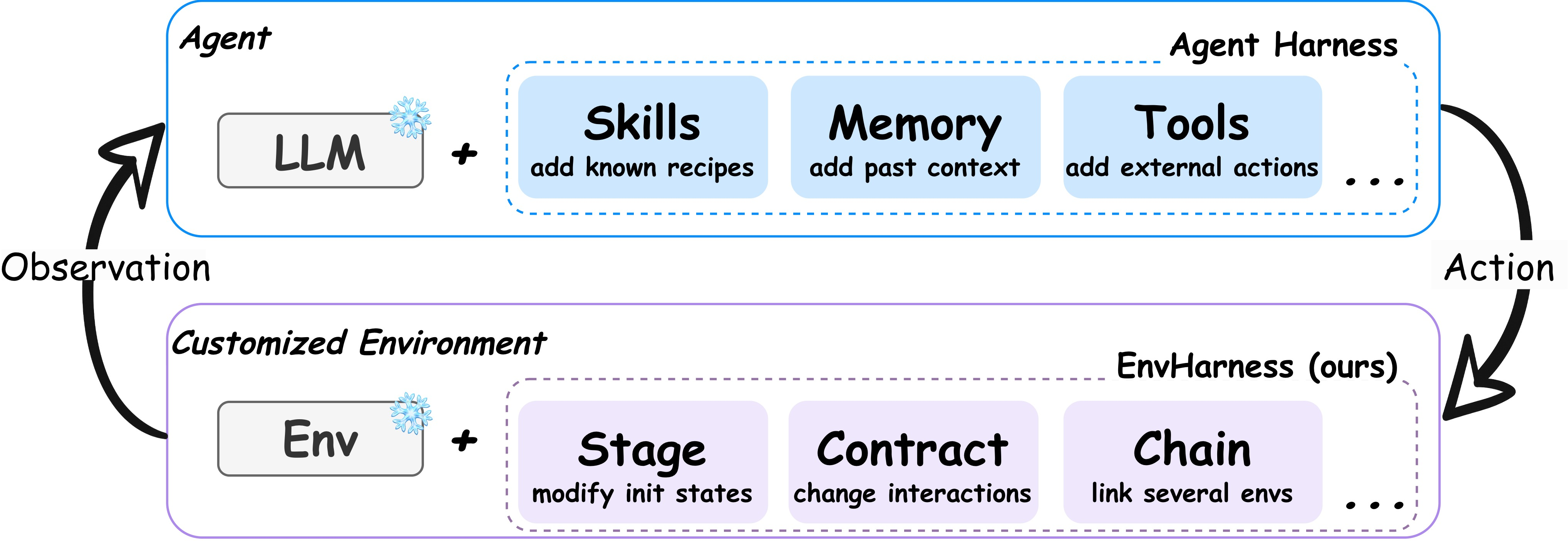
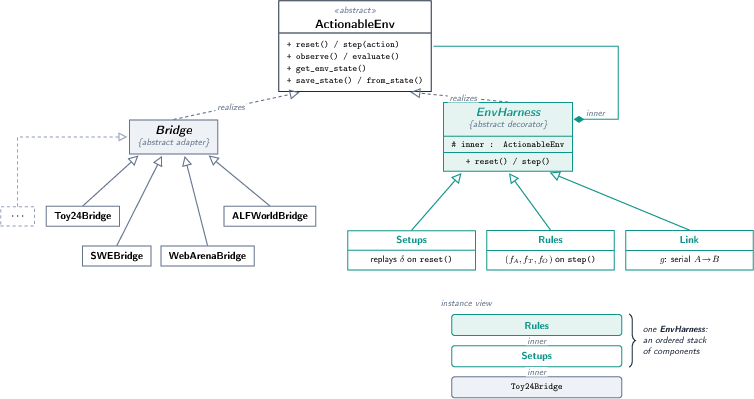
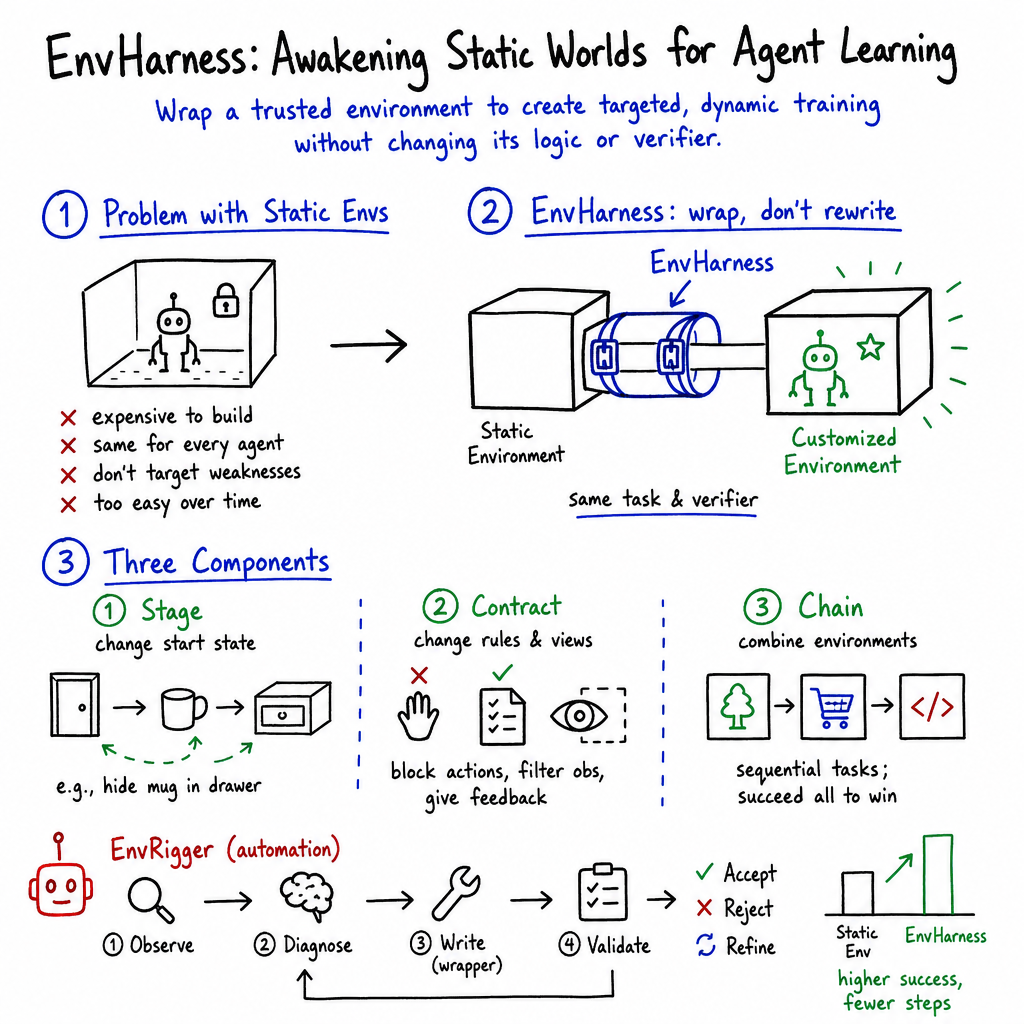
Abstract: LLM agents learn by interacting with environments, yet these environments are hand-built and static: blind to an agent's weaknesses, and quickly left behind as it improves. While recent environment generation methods attempt to address this, they require domain-specific pipelines, rely on expensive or unreliable verifiers, and still produce static environments. To alleviate the engineering burden of rebuilding environments from scratch, we propose Environment Harness (EnvHarness), a programmable layer of plug-in components that wraps a static environment to reshape its behavior without modifying the underlying logic. Operating through standard interfaces, EnvHarness applies across diverse domains while ensuring every reshaped environment retains its original verifier. To automate this process, we introduce EnvRigger, which treats the target policy as a black box, observing its execution trajectories to synthesize EnvHarness components targeting diagnosed flaws, and validating them via fresh rollouts. Across five benchmarks in four domains, EnvHarness outperforms both original environments and domain-specific environment generation pipelines, achieving up to a 9.0-point improvement on held-out instances with 9.8% fewer execution steps. Furthermore, EnvHarness provides a superior optimization signal for reinforcement learning, enabling continuous, targeted co-evolution of the policy and its environment.
First 10 authors:
Paper Prompts
Sign up for free to create and run prompts on this paper.
Top Community Prompts
Explain it Like I'm 14
1. What is this paper about?
This paper introduces EnvHarness, a system that helps artificial intelligence agents learn better by changing the way they practice tasks.
An AI agent might be asked to browse a website, fix computer code, organize a spreadsheet, or complete a household task in a virtual world. Usually, the “world” where it practices is fixed and behaves the same way every time. The paper argues that this is a problem because the environment may not challenge the agent’s particular weaknesses.
EnvHarness acts like a customizable layer around an existing environment. It changes the training experience without changing the original environment’s main code or its trusted system for checking answers.
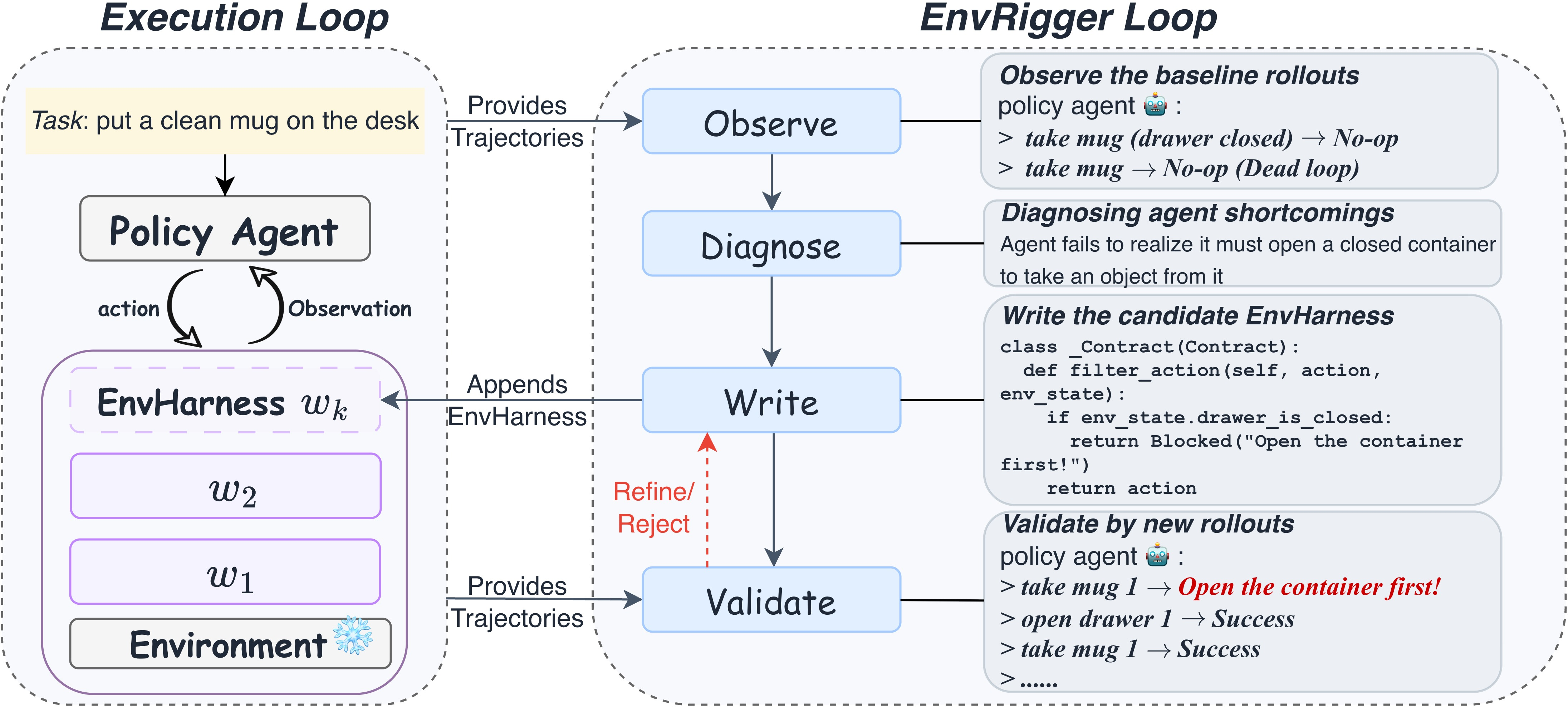
The researchers also created EnvRigger, an automatic tool that watches an agent, finds its mistakes, and creates a better practice environment designed to fix those mistakes.
2. What questions are the researchers asking?
The paper focuses on several main questions:
- Can an existing environment be changed to give an AI agent more useful practice?
- Can the system discover an agent’s weaknesses by watching what it does?
- Can it create training situations that target those weaknesses?
- Will agents trained in these customized environments perform better on new tasks?
- Does this idea work in many different areas, such as web browsing, programming, and office work?
- Can customized environments help an agent solve tasks using fewer steps?
- Can they also improve reinforcement learning, where an agent learns through rewards and penalties?
The central idea is:
Instead of giving an agent more random practice, give it practice that is specially designed for the mistakes it is currently making.
3. How did the researchers do this?
EnvHarness: a wrapper around an environment
Imagine a video game with fixed rules. Now imagine putting a special control panel around the game. The control panel does not rewrite the game itself, but it can decide:
- where the player starts,
- which actions are allowed,
- what information the player can see,
- and whether another task should follow the first one.
That is roughly what EnvHarness does.
It uses three main kinds of plug-ins.
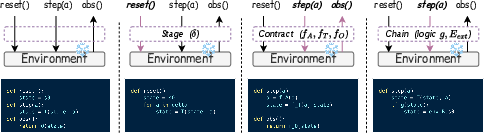
Stage: changing the starting situation
A Stage changes what has already happened before the agent begins.
For example, in a virtual house task, the agent may normally see a mug sitting on a table. A Stage could hide the mug inside a drawer. The agent must then learn to search for it instead of simply picking it up.
A Stage can also make a task easier by completing some early steps in advance. This allows the agent to focus on one skill at a time.
Contract: changing the interaction rules
A Contract changes what the agent can do or see while it works.
For example, it might:
- hide part of a long description,
- prevent the agent from using an easy “teleport” command,
- require the agent to hold an object before cleaning it,
- or give special feedback when the agent makes a mistake.
This is similar to adding rules to a game. The goal is not to trick the agent unfairly, but to make it practice an important ability.
Chain: joining tasks together
A Chain connects two or more tasks into one longer challenge.
For example, the agent might first need to complete one household task and then heat a potato and place it somewhere else. The agent only succeeds if it completes both parts.
This helps train the agent to remember its larger goal and keep working instead of stopping as soon as it completes the first small task.
EnvRigger: finding and fixing weaknesses
EnvRigger follows four basic steps:
- Observe: It watches the agent attempt a task.
- Diagnose: It studies the agent’s successful and failed attempts to identify the problem. For example, the agent may repeat the same action, misunderstand a long description, or submit code without testing it.
- Write: It creates one or more EnvHarness plug-ins aimed at that weakness.
- Validate: It tests the new environment with fresh attempts by the agent.
If the new environment is too easy, too difficult, or impossible to solve, EnvRigger changes it and tries again. It only keeps a customized environment if it gives useful practice.
The researchers treat the AI agent as a black box. This means they do not need to look inside the model’s complicated internal calculations. They only watch its actions and results, much like a teacher observing a student’s work.
4. What did they find?
The researchers tested EnvHarness on five benchmarks in four areas:
- ALFWorld: completing tasks in a text-based virtual home
- WebArena: browsing and interacting with websites
- SWE-bench Verified: fixing software problems
- OfficeQA: answering questions using office documents
- SpreadsheetBench: completing spreadsheet tasks
Better performance on new tasks
Agents trained using EnvHarness generally performed better than agents trained using the original, unchanged environments.
Some important results include:
- On ALFWorld’s held-out tasks, performance improved by up to 9 percentage points.
- On WebArena, the average score improved by about 3.1 points.
- On SWE-bench Verified, the success rate increased by about 2.7 points.
- On OfficeQA, both exact-answer and partial-answer scores improved.
- On SpreadsheetBench, both the pass rate and average score increased.
“Held-out tasks” are tasks the agent did not practice directly. Doing well on them suggests that the agent learned a useful general skill rather than simply memorizing examples.
Agents used fewer steps
On software-engineering tasks, agents trained with EnvHarness used about 9.8% fewer steps on average.
This matters because taking fewer steps can mean:
- less wasted effort,
- lower computing costs,
- fewer chances to make mistakes,
- and faster completion of tasks.
The researchers connected this improvement to customized training that reduced repetitive actions and helped agents deal with information more efficiently.
Better than some specialized environment generators
The paper compares EnvHarness with systems designed specifically for certain areas, such as programming or web interaction.
EnvHarness performed better than these specialized systems in the tested comparisons. Its advantage is that the same general idea can be used in many different domains instead of requiring a completely new environment-generation system for each one.
Useful for reinforcement learning
The researchers also tested EnvHarness with reinforcement learning, a method where an agent learns by receiving rewards for good actions and penalties for poor ones.
Agents trained in EnvHarness environments performed better on most of the tested measures. For example, on one ALFWorld setting, success increased from 81.4% to 87.9%.
This suggests that EnvHarness environments can provide better learning signals, not just better examples for creating a skill library.
Longer tasks became easier to handle
The Chain component helped agents practice long tasks. Agents trained with chained tasks used far fewer steps—about 42 steps instead of 54 in one comparison.
When Chain was combined with Stage and Contract, the agent achieved both:
- a higher success rate, and
- much better efficiency.
The system kept improving as more environments were added
Ordinary training environments eventually became less useful because the agent had already learned what they could teach. EnvHarness continued creating environments that targeted the agent’s newest weaknesses.
This allowed the agent and its training environments to improve together, a process the paper describes as co-evolution.
5. Why is this research important?
The main importance of this work is that it changes how researchers think about training environments.
Traditionally, improving an AI agent often means:
- collecting more examples,
- building more tasks,
- or changing the model itself.
EnvHarness suggests another option: change the practice environment to match the agent’s current needs.
For example, if an agent repeatedly submits code without testing it, EnvRigger can create a rule that rejects submissions until tests have been run. The agent is then encouraged to learn a general habit: test a fix before declaring it finished.
This could make AI agents more reliable in real-world settings, including:
- computer programming,
- office administration,
- web research,
- robotics,
- and digital assistants.
Another important benefit is safety. EnvHarness changes the environment from the outside and keeps the original task-checking system. This means researchers can customize training without replacing the trusted method used to decide whether the agent succeeded.
Simple conclusion
EnvHarness is like a smart coach for AI agents. Instead of making an agent repeat the same exercises, it watches for mistakes and creates practice tasks that focus on those mistakes.
The experiments show that this approach can help agents:
- solve more new problems,
- make fewer wasted moves,
- learn longer task sequences,
- and improve through reinforcement learning.
The research could lead to AI systems that learn more efficiently and become better at handling the specific challenges they face. However, the system still depends on correctly diagnosing weaknesses and designing environments that are challenging but not impossible. Further research will be needed to test how well it works in even more complex and real-world situations.
Knowledge Gaps
The paper leaves the following knowledge gaps, limitations, and open questions unresolved:
- Limited benchmark coverage: Evaluation spans five benchmarks, but only four broad domains; transfer to multimodal, embodied-robotic, real-time, stochastic, or safety-critical environments remains untested.
- Dependence on deterministic resets: The EnvRigger validation procedure assumes reproducible initial states for
Stage, leaving its reliability in stochastic environments, live websites, and non-resettable systems unclear. - Incomplete support for
Chain:Chainis excluded from the automated EnvRigger pipeline because joined-environment internal states are difficult to observe; methods for automatically diagnosing and composing multi-environment tasks remain unresolved. - Unclear verifier preservation under transformations: Although the original verifier is retained,
ContractandChaincan alter transitions, rewards, termination conditions, and accessible actions. The paper does not formally prove when these changes preserve semantic correctness or prevent unintended reward hacking. - No systematic safety analysis: The generated contracts may block actions, modify observations, or impose new preconditions. Their effects on safety, fairness, accessibility, and unintended agent behavior are not evaluated.
- Potentially misleading learning signals: The validation criteria rely on success rates, failure distributions, and trajectory metrics, but do not establish that an accepted component teaches the intended capability rather than encouraging superficial workaround behaviors.
- Weak causal attribution: The experiments do not isolate whether gains arise from policy-conditioned diagnosis, interface rewriting, additional interaction diversity, harder tasks, or the skill-extraction procedure.
- Insufficient component ablations: The relative contributions of
Stage,Contract, different transformation axes, component ordering, and multi-component combinations are not comprehensively quantified. - Composition-order effects are uncharacterized: The paper notes that components are non-commutative, but does not provide algorithms or experiments for selecting an effective composition order or detecting harmful interactions.
- No formal solvability guarantees: EnvRigger may generate environments that are technically solvable but practically inaccessible, excessively difficult, or dependent on narrow action sequences. The validation loop provides no theoretical guarantee against these cases.
- Validation may overfit to the target policy: Candidates are validated using fresh rollouts from the same target policy that motivated their construction. This can accept environments that exploit idiosyncrasies of that policy and fail to improve other policies.
- Limited transfer evaluation: The paper reports cross-model results on SWE-bench, but does not test whether a harness generated for one policy transfers to substantially different models, prompting strategies, tool interfaces, or agent architectures.
- Same-model generator and policy create correlated failures: EnvRigger and the target policy use the same model backbone in the main experiments, so the generator may share the policy’s blind spots and fail to diagnose errors that an independent evaluator would detect.
- Prompt dependence is underexplored: Domain adaptation still requires domain-specific prompt templates, yet the effect of prompt design, prompt sensitivity, and prompt quality on EnvRigger’s diagnoses and generated components is not measured.
- Diagnosis reliability is not quantified: The paper does not report how often EnvRigger correctly identifies the root cause of a failure, how frequently diagnoses are inconsistent across rollouts, or how diagnosis errors affect downstream learning.
- No comparison with human-designed curricula: The main comparisons are against original environments and automated generation baselines; the method is not evaluated against expert-authored curricula, targeted interventions, or manually designed contracts.
- Resource and cost accounting is incomplete: The computational cost, number of rollouts, model calls, revision iterations, latency, and monetary expense of EnvRigger are not compared systematically with baseline environment generation or additional policy training.
- Scaling beyond the reported budget is unknown: The co-evolution experiment reaches 300 SWE-bench environments, but does not establish whether gains continue, saturate, or destabilize at much larger environment counts.
- Risk of curriculum collapse is unresolved: Repeatedly targeting current weaknesses could produce increasingly narrow or adversarial environments that improve benchmark performance while reducing broad competence or robustness.
- Long-term co-evolution stability is unclear: The paper reports compounding gains but does not examine whether policy–environment co-evolution enters feedback loops, forgets previously learned skills, or becomes unstable over many generations.
- Generalization beyond training task distributions is limited: Held-out instances are evaluated, but robustness to new task families, substantially different objectives, novel tool configurations, and distribution shifts is not established.
- One-shot evaluation limits statistical confidence: Each evaluation instance is attempted once, and most results average only three independent runs; this limits measurement of variance, reliability, and sensitivity to rollout randomness.
- Statistical significance is not fully reported: Improvements are presented with standard deviations, but the paper does not provide confidence intervals, hypothesis tests, effect sizes, or corrections for multiple benchmark comparisons.
- Baseline comparisons are not fully uniform across domains: Specialized generation baselines are unavailable for some benchmarks, and the differences in generation mechanisms, filtering, and available oracle information may complicate cross-method conclusions.
- The effect of oracle verifier access is unclear: EnvRigger is allowed the same oracle verification access as the baselines, but the paper does not evaluate performance when verifiers are noisy, delayed, partial, expensive, or unavailable.
- Robustness to stochastic or changing environments is unknown: The framework is primarily demonstrated on static benchmark environments; its behavior under changing website layouts, evolving APIs, nondeterministic tools, or hidden state is not assessed.
- Action and observation-space transformations may violate interface assumptions: Filtering or rewriting actions and observations can create invalid states, ambiguous feedback, or incompatibilities with agents that rely on fixed schemas; these integration failure modes are not characterized.
- Chain reward design is underspecified: The composite reward and success semantics for chained environments are described generally, but the effects of different reward aggregation rules, partial credit, and failure recovery policies are not studied.
- Efficiency gains are benchmark-specific: Reduced execution steps are reported primarily for SWE-bench and chained tasks; the relationship between customized environments and interaction efficiency across all domains remains uncertain.
- Skill quality is evaluated indirectly: Improvements in downstream benchmark scores are used as evidence of useful skills, but the paper does not independently evaluate skill correctness, reusability, interpretability, or retention.
- Negative transfer and forgetting are not examined: The study does not test whether skills extracted from customized environments harm unrelated tasks, conflict with existing skills, or cause the policy to over-apply environment-specific rules.
- Human oversight requirements remain unclear: Although the workflow is presented as fully automated, the paper does not specify how generated components should be audited, debugged, approved, or rolled back before deployment in high-stakes environments.
- Security vulnerabilities are not addressed: A model-generated
Contractcan modify action handling and feedback, creating opportunities for prompt injection, policy manipulation, hidden reward shaping, or unsafe restrictions that are not evaluated. - Reproducibility is constrained by unavailable implementation details: The provided text refers to appendices for prompts, splits, baselines, RL settings, and limitations, but those details are not included here; consequently, the exact generation and validation protocol cannot be independently assessed from the paper text alone.
Practical Applications
Immediate Applications
- Targeted training for software-engineering agents (Software engineering; industry and academia)
Teams can wrap existing coding environments with
Contractcomponents that enforce behaviors such as running tests before submission, validating patches, avoiding repeated commands, or requiring repository inspection. This can produce more reliable coding agents without rewriting SWE-bench-like environments or their verifiers. Potential tools/workflows: automated agent-training pipelines, CI-integrated agent evaluators, policy-specific regression environments, and skill libraries distilled from validated trajectories. Dependencies: access to a trustworthy execution environment and verifier; deterministic or sufficiently reproducible resets; safeguards against contracts that make tasks artificially unsolvable. - Adaptive training for web-navigation and browser agents (Web automation, e-commerce, enterprise software)
Stagecan place an agent in less obvious page states, whileContractcan hide shortcuts, limit available actions, or require intermediate checks such as confirming cart contents or permissions. This is immediately useful for training agents that operate websites, administrative consoles, GitLab-like systems, and shopping workflows. Dependencies: stable browser APIs, permission-safe action interception, compatibility between wrapped observations and the underlying web environment, and protection against training artifacts that do not occur in production websites. - Personalized curriculum generation for embodied and robotic agents (Robotics, smart environments, assistive technology)
In text-based embodied environments such as ALFWorld, the framework can expose weaknesses in search, object manipulation, navigation, or goal persistence. Similar wrappers could be applied to simulators for household robots, warehouse systems, or virtual assistants.
Potential products: simulator plug-ins that hide objects, remove navigation shortcuts, impose manipulation preconditions, or stage increasingly difficult layouts.
Dependencies: a simulator with a stable
reset/stepinterface and a reliable task verifier; transfer from text or simulated actions to physical robots remains unproven. - Adaptive office-automation training (Enterprise productivity and education)
EnvHarness can customize spreadsheet, document, and question-answering environments to target failures such as incorrect cell references, premature answers, poor table inspection, or inability to handle partial observations.
Contractrules could require formula checking, source inspection, or intermediate calculations. Potential workflows: training agents for spreadsheet analysis, document retrieval, reporting, and back-office operations using existing benchmark or internal environments. Dependencies: organization-specific verifiers must accurately distinguish correct from incorrect work; private documents and business rules require strong data-governance controls. - More efficient reinforcement-learning training (AI infrastructure and research) Researchers can use EnvHarness environments as targeted optimization signals rather than simply increasing the number of static episodes. The reported results show improved performance on ALFWorld and WebShop, with gains on most reported metrics. Potential tools: adaptive environment schedulers that monitor failure patterns and automatically generate harder or corrective episodes for GRPO and related RL methods. Dependencies: sufficient rollout budget for diagnosis and validation; reward signals must remain aligned with the actual task objective; distribution shifts should be monitored because the paper reports a small OOD trade-off in one RL setting.
- Benchmark augmentation without changing benchmark verifiers (Academic evaluation and model testing) Benchmark maintainers can release wrapper configurations that test specific capabilities—partial observability, long-horizon planning, prerequisite satisfaction, or resistance to shortcuts—while retaining the original environment and scoring logic. Benefits: more diagnostic evaluations and better comparability than creating entirely new benchmark implementations. Dependencies: wrapper behavior must be documented and standardized; results from modified environments should not be conflated with scores on the original benchmark.
- Black-box capability diagnosis for deployed agents (Model auditing and quality assurance) EnvRigger can analyze execution trajectories without inspecting model weights, identify recurring failures, and generate targeted test cases. Organizations can use this for pre-deployment evaluation of customer-service, coding, browsing, or workflow agents. Potential outputs: failure taxonomies, automatically generated regression tests, and capability-specific evaluation reports. Dependencies: trajectory logs must be available and privacy-preserving; diagnosis by an LLM may be incomplete or biased; human review remains advisable for high-risk systems.
- Policy-constrained agent testing (Finance, healthcare administration, legal operations, and compliance)
Contractcomponents can enforce operational rules such as requiring evidence retrieval before an answer, approval before an irreversible action, or validation before submitting a transaction. This provides a practical sandbox for testing whether agents follow procedural controls. Dependencies: contracts should supplement—not replace—real authorization, monitoring, and compliance systems; incorrect or incomplete rules could create false assurance. - Daily-life practice environments for multi-step digital tasks (Consumer software and education) The same mechanism could create personalized practice tasks for email organization, travel booking, budgeting, online forms, or household planning. An agent or tutor could identify a user’s weakness and generate exercises requiring the missing subskill. Dependencies: consumer environments would need safe sandboxes, synthetic accounts, and explicit consent; the paper demonstrates agent learning rather than human learning, so effectiveness for people requires separate validation.
Long-Term Applications
- Scalable training infrastructure for general-purpose autonomous agents (AI platforms and industry) EnvHarness could become a general environment layer that continuously reshapes simulators and enterprise workflows as an agent improves. Repeated EnvRigger cycles would support co-evolution: the policy advances, the environment targets its new capability boundary, and training continues without manually authoring every task. Potential products: environment registries, wrapper marketplaces, policy-specific curriculum services, and cloud APIs for adaptive agent training. Dependencies: robust scaling of the diagnosis–write–validate loop, controls against curricula becoming adversarial or repetitive, and evidence that gains persist in real-world environments.
- Long-horizon planning for robotics and autonomous systems (Robotics, logistics, drones, and industrial control)
Chaincan join tasks so that success requires preserving goals across multiple subtasks. This could train warehouse robots to pick, transport, inspect, and place items, or service robots to complete sequences of dependent operations. Dependencies: reliable state and reward composition across simulators; safe sim-to-real transfer; physical-world verification is substantially harder than benchmark verification; the paper excludesChainfrom automated EnvRigger generation because joined internal states are difficult to observe. - Adaptive digital-twin training for enterprise workflows (Manufacturing, energy, healthcare operations, and finance) Multiple simulators could be chained to represent complete processes—for example, an energy forecast followed by dispatch, or a medical scheduling task followed by insurance verification. Contracts could enforce domain procedures while the original workflow simulators remain unchanged. Dependencies: interoperable state representations, validated process models, domain-expert review, and strict controls against learning from inaccurate or outdated digital twins.
- Safety curricula for high-stakes agents (Healthcare, finance, public administration, and critical infrastructure) A future EnvHarness system could deliberately expose agents to rare but consequential cases: missing records, conflicting instructions, ambiguous permissions, or failed tools. Contracts could require escalation, confirmation, or evidence checks before action. Dependencies: safety constraints must be formally specified and independently audited; benchmark success is not equivalent to real-world safety; rare-event generation may require expert-designed scenarios and certified simulators.
- Automated generation of interpretable capability curricula (Education and workforce training) EnvRigger diagnoses weaknesses in behavioral terms and produces targeted environments. With further research, this could support learning platforms that generate sequenced exercises for coding, spreadsheet analysis, navigation, or tool use based on a learner’s observed errors. Potential outputs: skill graphs, mastery dashboards, remediation plans, and adaptive practice modules. Dependencies: the paper evaluates LLM policies rather than human learners; educational validity, fairness, privacy, and reliable mastery measurement must be established.
- Self-maintaining benchmark ecosystems (Academic research and policy evaluation) Benchmarks could evolve as models saturate them: once agents solve existing tasks, wrappers would introduce controlled difficulty increases or test previously unmeasured weaknesses while preserving a common verifier. This could reduce benchmark obsolescence. Dependencies: stable longitudinal scoring, safeguards against hidden benchmark leakage, transparent versioning, and independent validation that generated challenges measure meaningful capabilities rather than wrapper-specific tricks.
- Formal interfaces for modular environment composition (AI software engineering and standards)
The shared
reset/stepprotocol and composableStage,Contract, andChainabstractions could motivate standards for portable environment wrappers. Different research groups or vendors could exchange environment components across web, robotics, coding, and office domains. Dependencies: agreed schemas for states, actions, observations, rewards, and verifiers; version compatibility; handling of non-commutative wrapper order; and security review of executable components. - Continuous deployment and regression testing for autonomous agents (Software operations and enterprise AI governance) After each model or prompt update, EnvRigger could regenerate tests targeting newly observed regressions, while accepted components become a persistent adversarial or corrective test suite. This could provide an automated feedback loop between production traces, evaluation environments, and agent updates. Dependencies: careful separation of private production data from training data, robust causal attribution of failures, protection against reward hacking, and human approval for changes affecting production policies.
- Agent-environment co-design for energy and resource efficiency (Cloud computing and sustainability) Because EnvHarness improved task completion while reducing execution steps in SWE-bench, future systems could optimize not only success but also latency, tool calls, energy use, or compute cost. Contracts could penalize redundant calls and Chains could train agents to plan globally rather than repeatedly re-solving local subtasks. Dependencies: reliable cost and energy measurements, multi-objective reward design, and confirmation that efficiency improvements do not reduce reliability or safety.
- Policy stress testing and regulatory sandboxes (Public policy and governance) Regulators and organizations could use controlled wrappers to test whether autonomous systems comply with procedural requirements under progressively difficult conditions. For example, an agent could be evaluated on whether it seeks approval, preserves audit trails, or refuses actions outside its authority. Dependencies: legally accurate policy representations, regulator access to auditable traces, standardized reporting, and recognition that simulated compliance cannot establish compliance in deployment.
Glossary
- Action space: The set of actions available to an agent in an environment. “ the action space”
- Agent harness: A software layer that equips a LLM with tools, memory, execution loops, and other capabilities. “An agent harness~\citep{anthropic2025effective, anthropic2026harness, lopopolo2026harness} is the software layer (execution loops, tool registries, and context management)~\citep{meng2026agentharness} that wraps a LLM to form an autonomous agent”
- Black box: A system whose internal mechanisms are not inspected; only its inputs and outputs are observed. “By treating the policy strictly as a black box”
- Capability boundary: The current limit of what an agent can reliably accomplish. “targeting the learner's current capability boundary”
- Chain: An EnvHarness component that combines multiple environments into one extended episode. “A Chain, , is specified by a pair”
- Composite environment: An environment formed by combining two or more component environments. “into a composite environment exposed through the same interface”
- Composition logic: Rules that determine how multiple environments are combined or sequenced. “ is a composition logic”
- Context management: The organization and maintenance of information supplied to a LLM during execution. “tool registries, and context management”
- Co-evolution: The joint and iterative improvement of an agent and the environment in which it learns. “enabling continuous, targeted co-evolution of the policy and its environment”
- Curriculum generation: The automated creation or ordering of training tasks with controlled difficulty. “from curriculum generation in reinforcement learning”
- Domain-agnostic: Designed to operate across different application areas without domain-specific implementation. “operating strictly at the interface level makes EnvHarness domain-agnostic”
- Embodied platform: A system, often robotic or simulated, that interacts with the physical or virtual world through actions. “or controlling an embodied platform”
- Environment-agnostic transformation: A modification that can be applied to environments without relying on their particular domain. “An EnvHarness component is an environment-agnostic transformation ”
- Execution trajectory: The ordered sequence of states, observations, and actions produced during an agent’s interaction with an environment. “observing both successful and failed execution trajectories”
- Frozen environment: An environment whose underlying implementation and behavior are kept unchanged. “customizes a frozen environment with plug-in components”
- Frozen policy: An agent policy whose parameters are not updated during a process. “the target policy as a black box”
- Ground-truth evaluation logic: The authoritative mechanism used to determine whether an episode or task was solved correctly. “the ground-truth evaluation logic is preserved”
- Held-out instance: A test example excluded from training or environment customization. “achieving up to a 9.0-point improvement on held-out instances”
- Identity map: A transformation that returns its input unchanged. “each defaulting to the identity”
- In-distribution: Referring to examples drawn from the same distribution as the training data. “success rate on in-distribution and held-out instance types”
- Interface protocol: A standardized set of methods and interaction rules that components must implement. “The underlying interface protocol, EnvRigger loop, and the skill extraction pipeline apply consistently”
- Long-horizon task: A task requiring many sequential decisions or interactions before completion. “Chain enables efficient long-horizon task solving”
- Modular plug-in component: An independently configurable software unit that can be added to extend or alter a system. “EnvHarness is assembled from modular plug-in components”
- Non-commutative: Describing operations whose result depends on the order in which they are applied. “these transformations are non-commutative”
- Observation space: The set of information or percepts that an environment can present to an agent. “ the observation space”
- Online reinforcement learning: Reinforcement learning in which an agent learns while actively interacting with an environment. “under the online reinforcement learning paradigm”
- Out-of-distribution (OOD): Referring to examples that differ from the distribution used for training. “WebArena reports environment score and success rate”
- Partial observability: A setting in which the agent cannot directly access the complete underlying state. “to evaluate partial observability”
- Policy: A strategy that maps an agent’s observations or states to actions. “Given a base environment supporting a set of base tasks, and a target policy agent ”
- Policy-conditioned: Determined in part by the behavior or characteristics of a particular policy. “we introduce the task-policy-conditioned map ”
- Reinforcement learning (RL): A learning paradigm in which an agent improves its behavior through rewards received from environmental interactions. “EnvHarness provides a superior optimization signal for reinforcement learning”
- Reward shaping: The design or modification of reward signals to encourage desired behaviors. “hand-designed corrective feedback and reward shaping”
- Rollout: One complete execution of a policy in an environment, producing an interaction trajectory. “EnvRigger then runs fresh policy rollouts”
- Scaffold: To provide intermediate structure or assistance that helps an agent perform a task. “the goal is to scaffold missing steps and simplify the task”
- Self-evolving agent: An agent that improves its capabilities using its own experience, often with limited human intervention. “Self-evolving agents improve themselves from their own experience without additional human supervision”
- Skill-based learning: A learning approach in which reusable skills are extracted from interactions and applied to future tasks. “we mainly focus on the skill-based learning paradigm”
- State space: The set of all possible states an environment can occupy. “ is the state space”
- Static environment: An environment whose tasks, behavior, and interaction logic do not adapt to the agent. “these environments are hand-built and static”
- Task horizon: The length or number of steps over which a task unfolds. “extending a task's horizon”
- Transition dynamics: The rules describing how an environment changes after an agent takes an action. “a Contract ... rewrites the interaction”
- Transition function: A function mapping a current state and action to the next state. “ the transition function that maps a state and an action to the next state”
- Verifier: A mechanism that evaluates whether an agent’s actions satisfy a task’s success conditions. “while ensuring every reshaped environment retains its original verifier”
- World model: A model that simulates or represents environments and their dynamics. “up to world models that simulate or synthesize whole families of agentic environments”

