Recirculation
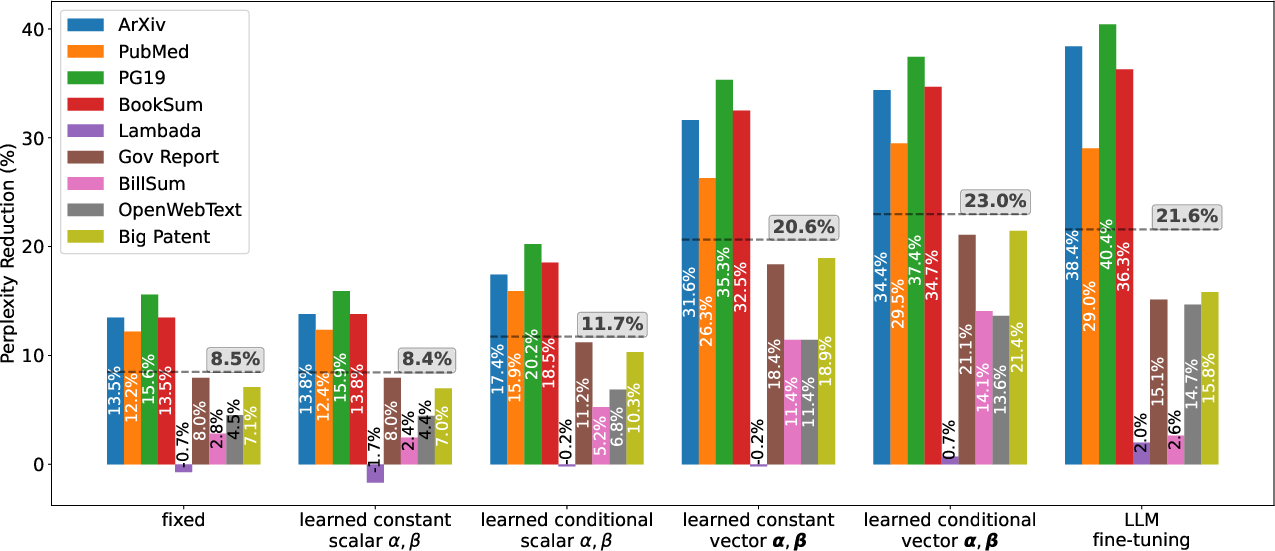
Abstract: We describe an inference-time architectural enhancement for off-the-shelf foundation models that markedly reduces perplexity and boosts accuracy across generation and reasoning tasks. Our approach incurs essentially no additional latency during generation, though it requires serial processing in the prefill phase. Motivated by the fundamental limitation that state updates in feedforward transformers are bounded by model depth, our technique, recirculation, introduces a specific form of recurrence that allows the model to act as a dynamical system and track belief states. We distinguish this technique from chain-of-thought computation---which is better reserved for complex inferences rather than basic state tracking---as well as from popular depth-recurrence techniques (looping) and the costly training of recurrent transformers. We also propose and evaluate an adaptive variant of recirculation which requires only light tuning of hyperparameters while freezing the original model weights. Relative to the off-the-shelf baseline, adaptive recirculation achieves remarkable gains on the Gemma3 family, including a 23% reduction in perplexity on a suite of datasets, a 21% increase in accuracy on GSM8k, and reliable improvements in accuracy on other downstream tasks. Our training-free approach succeeds by leveraging the model itself to inform architectural modifications, suggesting a route to architectural evolution guided by a trained network's properties rather than forced, arbitrary design choices.
Paper Prompts
Sign up for free to create and run prompts on this paper.
Top Community Prompts
Explain it Like I'm 14
1. What is the paper about?
This paper introduces a method called recirculation for improving LLMs, such as models used to write text, answer questions, and solve problems.
The main idea is that LLMs sometimes understand information correctly at one point but then “forget” or fail to use that understanding later. Recirculation sends some of the model’s deeper understanding back to earlier parts of the model so that it can use that information again.
Importantly, the method works during use, without retraining all the model’s original knowledge.
2. What questions are the researchers asking?
The researchers mainly want to know:
- Can recirculation help a transformer model remember and update information as a conversation or piece of text develops?
- Can it reduce mistakes caused by losing track of context?
- Can it improve language prediction, question answering, instruction following, and mathematical reasoning?
- Does it work only for one model family, or can it help many different models?
- Is recirculation better than simply making the model deeper by repeating some of its layers?
A central problem is called state tracking. This means keeping track of important information that changes over time.
For example, imagine a story says:
“The boy put the ball in the box. Then he moved the box to the garage.”
To understand the story, a model must remember where the ball is now. If it forgets that the ball is inside the box, it may give an incorrect answer later.
3. How does the method work?
Transformers and their limitation
Most modern LLMs use a structure called a transformer. A transformer processes text through many layers, somewhat like a group of students passing a message along a line. Each layer adds more understanding to the message.
The model can process many words at the same time, which makes it fast. However, this design can make it difficult to repeatedly update information as new words arrive.
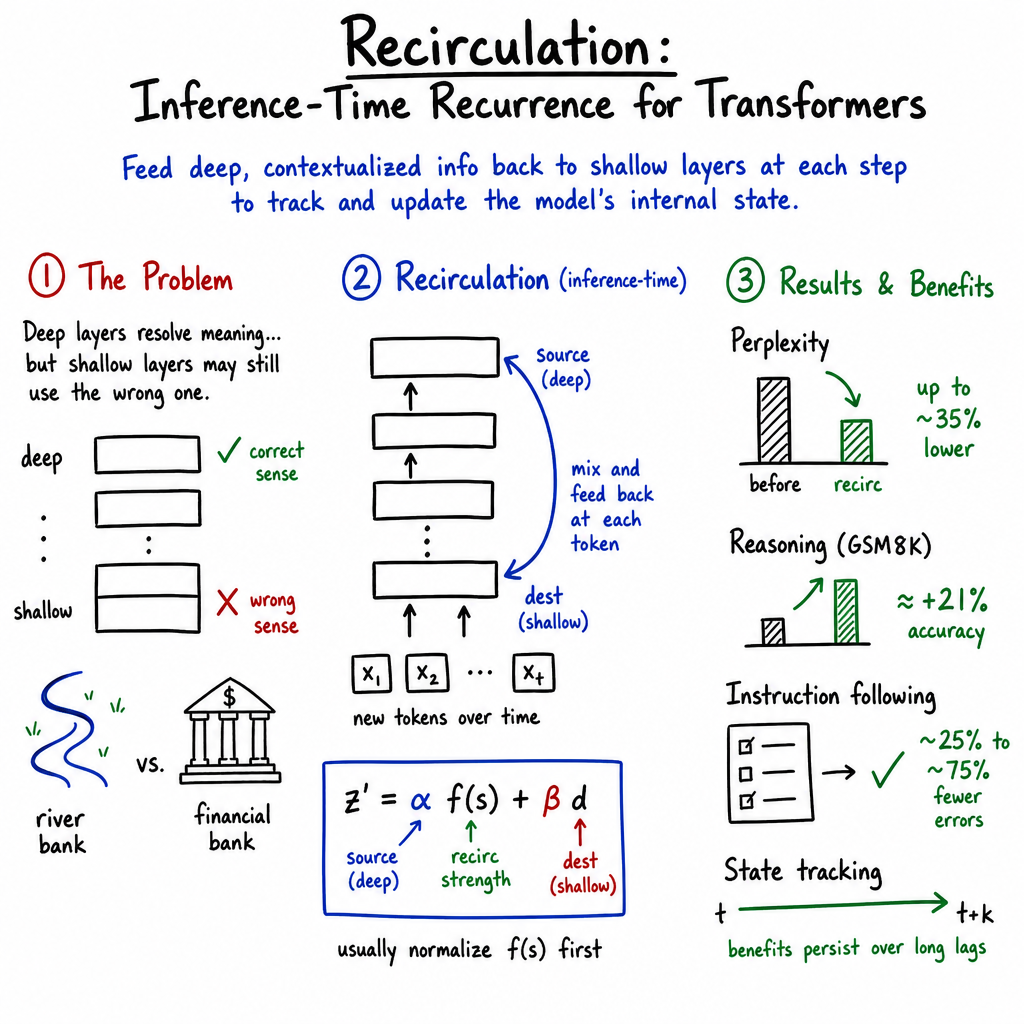
A piece of information may become clear only in a deep layer. Earlier layers, which help produce the next word, may not have access to that improved understanding.
The “bank” example
The paper describes a word such as “bank”, which can mean either:
- a financial institution, or
- the side of a river.
Suppose a text says:
“I was fishing near the bank.”
The model should understand that “bank” means the side of a river. But later, if it sees the word “ATM,” it might incorrectly switch to the financial meaning because “bank” and “ATM” are strongly associated.
This is a contextualization error: the model fails to keep using the meaning that fits the earlier context.
Recirculation as a feedback loop
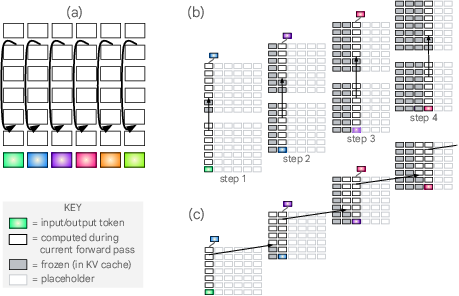
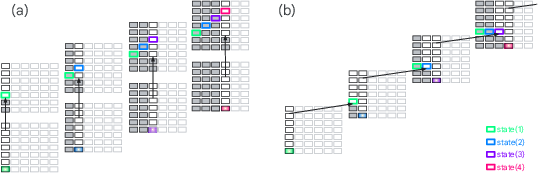
Recirculation creates a small feedback connection inside the model. After a deep layer develops a better understanding, a small amount of its information is sent back to an earlier layer.
This is similar to a student solving a puzzle, discovering an important clue, and then going back to reread the earlier part of the puzzle using that clue.
The researchers carefully mix the old information with the new information rather than completely replacing it. They also use normalization, which adjusts the size of the signals so they do not become too large.
The method is different from:
- Chain-of-thought reasoning, where the model writes or internally creates a sequence of reasoning steps.
- Looping, where the same transformer layers are simply run again to make the model effectively deeper.
- Recurrent models, which are specially trained to update their internal state step by step.
Recirculation instead modifies an already-trained model at the time it is being used.
Adaptive recirculation
The paper also tests adaptive recirculation. In this version, the model’s original weights remain frozen, but a few settings—such as how strongly information is sent backward—are lightly adjusted for a task.
This is like changing the volume of a helpful signal without changing the entire machine that produces it.
4. What methods did the researchers use?
The researchers tested recirculation in several ways.
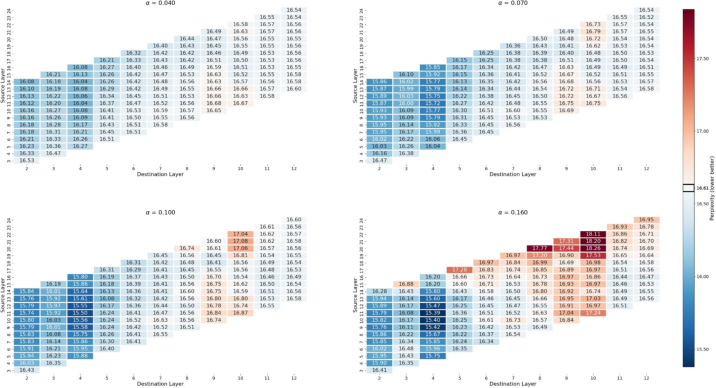
First, they tried many combinations of:
- the layer sending information,
- the layer receiving information, and
- the strength of the feedback signal.
This process is called a hyperparameter sweep. It is similar to trying many settings on a video game controller to find which combination works best.
They then compared ordinary models with models using recirculation on:
- ten language-modeling datasets,
- instruction-following tasks,
- questions involving confusing words and changing contexts,
- multiple-choice benchmarks,
- reading and common-sense tasks, and
- GSM8k, a dataset of grade-school mathematics problems.
The models included several sizes of the Gemma3 family, as well as other model families such as Ministral, Pythia, Qwen, and Phi.
One important measurement was perplexity. Perplexity measures how surprised a LLM is by the correct next word. Lower perplexity generally means the model is better at predicting text.
For example, if a sentence says:
“The cat sat on the ___”
a model with lower perplexity is more likely to consider “mat” or “chair” reasonable predictions than a completely unrelated word.
5. What did the researchers find?
Better language prediction
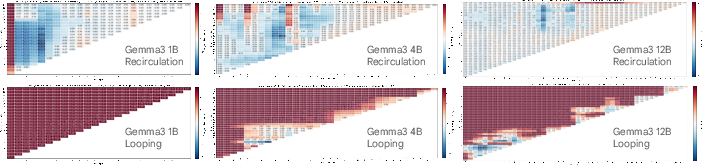
Recirculation usually reduced perplexity. Across the tested Gemma3 models:
- The 1B and 4B models improved by as much as about 16% on some datasets.
- The 12B model improved by as much as about 35% on some datasets.
- Improvements appeared on nine out of ten language datasets.
- The main exception was the Lambada dataset, where the results were mixed or slightly worse.
The paper’s abstract summarizes the overall results as roughly a 23% reduction in perplexity across a larger collection of datasets.
Better reasoning and task accuracy
Recirculation also helped with several tasks:
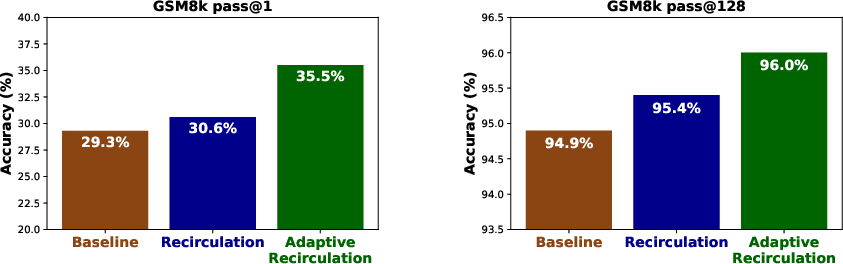
- On GSM8k math problems, adaptive recirculation produced a reported accuracy increase of about 21% compared with the ordinary model.
- On standard multiple-choice and single-answer tasks, recirculation improved results on six of eight datasets, although the improvements were usually small.
- On instruction-following tasks, the error rate fell by about 25% for one model and 75% for another larger model.
- On contextualization tasks, recirculation often helped models keep track of the intended meaning of words and facts, although it did not help every model or every question type.
It was not just a temperature trick
LLMs use a setting called temperature that changes how strongly they prefer likely words. The researchers checked whether recirculation was simply making the model’s answers more predictable.
They found that recirculation and temperature adjustment had different effects. This suggests that recirculation was actually changing how the model processed information rather than merely making its word choices more or less random.
It was different from ordinary looping
The researchers also compared recirculation with looping, which repeats transformer layers.
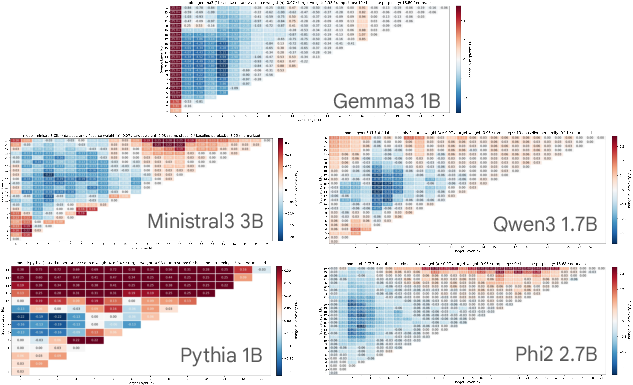
For the Gemma3 models, looping a pretrained model did not produce the same reliable improvements. Recirculation worked better across different model sizes, suggesting that the two methods improve models in different ways.
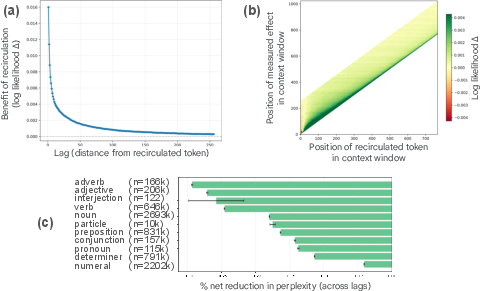
Some tokens benefit more than others
Recirculation was especially helpful for words that carry a lot of meaning, such as:
- verbs,
- adjectives, and
- adverbs.
It helped less with words such as numbers, determiners, and pronouns.
The first few words in a passage sometimes became worse for the small 1B model because there was not yet much context to remember. Later words, which had more information behind them, benefited more.
It worked on several model families
The researchers found signs of improvement in five different model families. However, the gains were much larger for Gemma models than for some of the others.
This suggests that recirculation may be broadly useful, but the best settings probably depend on how each model was designed and trained.
6. Why are these results important?
LLMs are very good at processing large amounts of information quickly, but they can struggle when they need to maintain a changing internal record of what is happening.
Recirculation may help with problems such as:
- keeping track of a long conversation,
- remembering who said or did what,
- understanding words whose meanings depend on context,
- following several instructions,
- solving multistep problems, and
- maintaining a consistent view of a situation.
The method is also attractive because it does not require completely retraining the model. Instead, researchers can add a small architectural change and adjust only a few settings.
The paper also suggests a new way to improve AI systems: rather than designing every improvement by hand, researchers can study how a trained model already represents information and use that knowledge to guide changes to its structure.
7. What could this mean for the future?
If the results hold up in further testing, recirculation could make LLMs more reliable at tasks that require memory and context. It might help models avoid changing their answers simply because a later word strongly suggests a different interpretation.
However, the method is not perfect. It helped some tasks but hurt others, especially in a few larger-model experiments. The best layer locations and feedback strengths also had to be carefully selected. In addition, recirculation requires more sequential processing when the model first reads a whole passage, which could make that stage slower.
Overall, the paper presents recirculation as a promising way to give existing transformer models a better “working memory.” It does not turn them into human-like thinkers, but it may help them keep important information active for longer and use it more consistently.
Knowledge Gaps
Knowledge gaps, limitations, and open questions
The paper leaves the following issues unresolved:
- Incomplete evaluation of the reported downstream results: The provided paper text ends during the GSM8k section, so the full experimental results, statistical analyses, and conclusions for reasoning tasks cannot be independently assessed.
- Limited model-family coverage: Most major gains are reported for Gemma models, while the other model families show improvements of less than 0.5% without extensive tuning. It remains unclear whether recirculation is broadly effective or particularly compatible with Gemma’s architecture and training procedure.
- Insufficiently controlled hyperparameter selection: Source and destination layers are selected using perplexity-based tuning and then reused for some downstream tasks, whereas other experiments tune directly on task performance. This makes it difficult to separate general benefits from task-specific or validation-set overfitting.
- No comprehensive comparison with inference-time baselines: The study compares recirculation mainly with temperature scaling and looped transformers, but does not systematically compare it with chain-of-thought, latent reasoning, activation steering, test-time training, recurrent transformers, state-space models, or other inference-time scaling methods under matched compute budgets.
- Unclear compute and memory costs: Although generation latency is described as essentially unchanged, the additional serial processing during prefill is not quantified in wall-clock time, FLOPs, energy use, memory consumption, or hardware utilization.
- No end-to-end deployment analysis: The practical effects of recirculation on long-context serving, batching, streaming generation, KV-cache management, throughput, and latency under realistic workloads remain untested.
- Unresolved optimality of one additional iteration: All reported experiments use only one additional recirculation iteration. It is unknown whether further iterations produce continued gains, diminishing returns, instability, or degradation.
- No analysis of recurrence stability: The paper does not characterize whether repeated activation mixing converges, oscillates, amplifies errors, or becomes numerically unstable as the number of iterations or sequence length increases.
- Limited understanding of the renormalization function: The proposed -norm matching is motivated heuristically, and the paper does not establish why it works, when it fails, or whether alternatives based on layer normalization statistics, learned projections, whitening, or token-wise scaling would be superior.
- Unexplained need for different mixture rules across model sizes: The Gemma3 4B and 12B models reportedly require a non-convex mixture with , unlike the convex mixture used elsewhere. The reason for this behavior and its implications for distribution shift are not investigated.
- No formal causal account of the mechanism: The results are consistent with improved state tracking, but do not establish that recirculation specifically propagates belief states rather than improving representations through generic feature amplification, calibration, sharpening, or other mechanisms.
- Insufficient mechanistic interpretability analysis: The paper does not identify which features are transferred from deep to shallow layers, how their semantic roles change with depth, or whether the recirculated signal corresponds to contextualized concepts, task instructions, uncertainty, or other latent variables.
- The assumed cross-layer feature alignment is not directly validated: The method relies on a 1:1 correspondence between residual-stream features at different layers, but the paper does not empirically test this assumption across models, layers, tokens, or feature subspaces.
- Potential out-of-distribution effects are underexplored: Recirculation modifies activations in a model that was not trained to receive such feedback. The study does not systematically measure representation drift, abnormal activation statistics, degraded calibration, or rare catastrophic failures.
- Limited assessment of harmful side effects: The paper reports some negative effects, including worse performance on early tokens, Lambada, and certain contextualization conditions, but does not provide a comprehensive failure taxonomy or identify when recirculation should be disabled.
- No robustness analysis across decoding settings: Effects under greedy decoding, temperature sampling, top- sampling, beam search, repetition penalties, and different maximum generation lengths are not systematically reported.
- Unclear interaction with instruction tuning and alignment: Hyperparameters are often selected on pretrained models but applied to instruction-tuned models. The differing effects on pretrained versus instruction-tuned representations, refusal behavior, helpfulness, and instruction hierarchy remain unresolved.
- Safety and behavioral alignment are not evaluated: The paper does not test whether recirculation changes hallucination rates, truthfulness, refusal consistency, jailbreak susceptibility, toxicity, bias, privacy leakage, or other safety-relevant behaviors.
- No calibration or uncertainty evaluation: Because the method is framed as belief-state tracking, it is important to determine whether recirculation improves calibrated probabilities, selective prediction, ambiguity representation, and confidence on uncertain or contradictory inputs.
- Insufficient diversity of state-tracking tasks: The contextualization experiments focus on a relatively narrow set of synthetic or curated examples. Performance on dialogue memory, coreference, temporal reasoning, social reasoning, multi-agent interaction, planning, and dynamically changing world states remains largely unexplored.
- Long-context scalability is unknown: Token-level analyses use windows up to 1,024 tokens, but the method’s effectiveness and cost at 8K, 32K, or longer contexts are not established.
- The effects of token-selective recirculation are not operationalized: The paper finds that token position and part of speech influence benefit, but does not develop or evaluate a principled adaptive policy for deciding which tokens to recirculate at inference time.
- No causal test of the proposed token-level explanation: Single-token and all-but-one-token interventions suggest additive effects, but the paper does not test whether the benefits arise from specific contextual dependencies, token interactions, or simple changes in local likelihood.
- Potential data leakage and benchmark overlap are insufficiently addressed: Adaptive recirculation is tuned on benchmark data, including a setting with train–test distribution overlap in MMLU. Independent test sets, cross-benchmark transfer, and strict separation of tuning and evaluation are needed to determine generalization.
- Statistical significance and uncertainty are underreported: The paper presents percentage changes and accuracy differences but does not consistently report confidence intervals, repeated runs, random-seed variability, or significance tests.
- No ablation of the full recirculation design: The contributions of source-layer choice, destination-layer choice, norm rescaling, convex mixing, token-wise application, recurrence across input steps, and readout timing are not isolated in a comprehensive factorial ablation.
- The relationship to ordinary deeper computation remains unclear: Recirculation may provide benefits partly because it increases the number of effective transformations. Comparisons against matched-depth models, additional forward passes, or other compute-equivalent architectures are needed.
- No theoretical characterization of expressivity or learnability: The paper argues that recirculation can support arbitrary state updates, but does not provide formal results showing what functions can be represented, how many serial steps are required, or whether the resulting dynamics are learnable from an off-the-shelf model.
- The claim of “training-free” improvement is qualified by tuning: Although model weights remain frozen, the method requires selecting layer pairs, mixture coefficients, normalization rules, and sometimes task-specific hyperparameters. The amount of tuning required and its reproducibility across models and domains remain unclear.
- Generalization to multimodal and non-LLMs is unresolved: Evidence from vision-language activation patching is cited, but recirculation itself is not evaluated on vision-language, audio-language, video, or other architectures.
- Effects on factual knowledge and world-model consistency are unknown: The paper motivates recirculation in terms of internal world models and belief tracking but does not test factual consistency across turns, contradiction resolution, knowledge updating, or resistance to misleading context.
- No investigation of compositional or adversarial interactions: It remains unknown whether recirculation improves state tracking when multiple ambiguous entities, nested beliefs, conflicting instructions, distractors, or adversarially designed contexts are present simultaneously.
- The universality of the observed middle-layer optimum is unexplained: Several models reportedly benefit most when the destination lies in the middle of the architecture, but the relationship between this pattern and model depth, attention structure, normalization, training objective, or hidden-state geometry is not established.
Practical Applications
The paper presents recirculation, an inference-time modification that feeds a normalized mixture of deeper-layer activations back into shallower layers while processing tokens sequentially. Its main practical value is improved state tracking, contextualization, working memory, and reasoning without changing the original model weights. The evidence is strongest for Gemma-family models and longer contexts; some tasks and model sizes show neutral or negative effects.
Immediate Applications
- Drop-in improvement for deployed LLMs
- Sector: Software, cloud AI platforms, enterprise applications.
- Use case: Add recirculation to compatible pretrained or instruction-tuned transformer models to improve language modeling and downstream accuracy without retraining all model parameters.
- Potential product/workflow: An inference wrapper or serving-library module exposing parameters such as source layer, destination layer, mixture coefficient , normalization, and token-position ramping.
- Evidence: The paper reports substantial perplexity reductions across many datasets, including improvements of up to approximately 35% for the Gemma3 12B model, with gains on six of eight tested single-token benchmarks.
- Dependencies: Requires access to intermediate activations and modification of the model’s inference graph. Layer pairs and mixture coefficients must be tuned for each model family and model size. Improvements are not guaranteed on every task; the paper reports occasional regressions, particularly on short sequences and certain benchmarks.
- Improved long-context document processing
- Sector: Legal technology, research, publishing, government, enterprise knowledge management.
- Use case: Apply recirculation when processing long reports, books, patents, scientific papers, or policy documents where information introduced earlier must remain available and correctly contextualized later.
- Potential tools: Document summarizers, retrieval-augmented question-answering systems, contract-analysis assistants, literature-review agents, and long-form report generators.
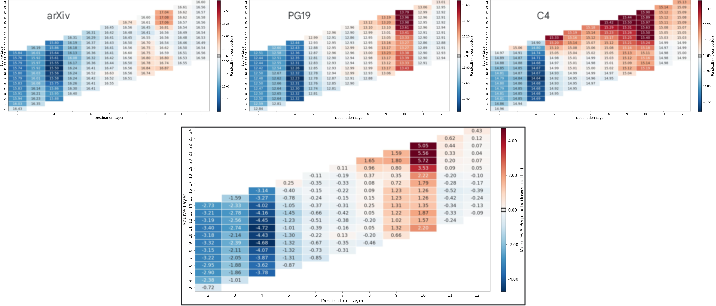
- Evidence: Benefits were observed across datasets such as arXiv, PG-19, BigPatent, government reports, PubMed, and books. Token-level analysis suggests that recirculation can improve predictions over relatively long lags.
- Dependencies: The method is especially promising when the task requires persistent state, but its computational cost increases during prefill because sequential processing prevents full parallelization. Evaluation should use document lengths and domains representative of deployment.
- Reduction of contextualization and polysemy errors
- Sector: Conversational AI, customer service, search, personal assistants.
- Use case: Improve an assistant’s ability to preserve the meaning assigned to ambiguous terms after subsequent context clarifies them—for example, distinguishing a river “bank” from a financial institution.
- Potential workflow: Insert recirculation into dialogue-model inference to reduce responses that contradict earlier turns or revert to a more common but contextually incorrect interpretation.
- Evidence: The paper builds on activation-patching results showing large reductions in contextualization errors and reports generally improved performance on contextualization tests, although results vary by model size and question type.
- Dependencies: The model must have sufficiently aligned representations across layers. Safety-critical applications still require external verification because recirculation does not eliminate factual errors, hallucinations, or instruction-following failures.
- More reliable multi-turn dialogue state tracking
- Sector: Customer support, healthcare triage, education, scheduling, commerce.
- Use case: Maintain user preferences, constraints, commitments, and evolving interpretations over a conversation.
- Potential products: Appointment schedulers that preserve changing availability constraints, support bots that track troubleshooting history, and tutoring systems that remember a learner’s current misconception or goal.
- Evidence: The proposed mechanism is specifically designed to propagate state information from later, more contextualized processing into representations used by subsequent processing.
- Dependencies: The paper evaluates contextualization and instruction-following tasks rather than full production dialogue-state benchmarks. Real deployment would require tests for contradiction handling, memory boundaries, privacy, and adversarial context changes.
- Inference-time enhancement of instruction following
- Sector: General-purpose assistants, workflow automation, robotics interfaces.
- Use case: Improve compliance with simple conditional or multi-step instructions, especially when the model must retain a rule while interpreting later inputs.
- Potential workflow: Use recirculation in agents that classify requests, apply business rules, or execute structured commands.
- Evidence: On a simple fruit-classification instruction-following task, the paper reports roughly 25% error reduction for Gemma3 4B and roughly 75% for Gemma3 12B under the tested conditions.
- Dependencies: These results come from a narrow synthetic task. Hyperparameters optimized for perplexity may not be optimal for instruction following, so validation on the target workflow is necessary.
- Low-cost model adaptation through adaptive recirculation
- Sector: Enterprise AI, academic model adaptation, edge deployment.
- Use case: Tune only recirculation parameters while freezing the original model weights, providing a lightweight alternative to full fine-tuning.
- Potential tools: A calibration procedure that learns layer-pair and mixing coefficients on a small task-specific validation set, followed by deployment of the frozen base model with the learned inference configuration.
- Evidence: The paper reports adaptive recirculation with light tuning of and , including improved GSM8K and benchmark performance under some tuning conditions.
- Dependencies: The results are highly dependent on the dataset used for tuning. Care is required to avoid validation/test leakage, overfitting, and degradation on unrelated tasks.
- Improved reasoning and mathematical problem solving
- Sector: Education, programming assistance, analytical software.
- Use case: Apply recirculation alongside chain-of-thought or other reasoning procedures to help preserve intermediate state across multi-step solutions.
- Potential products: Homework assistants, mathematical tutoring systems, code-analysis tools, and planning assistants.
- Evidence: The abstract reports a 21% increase in GSM8K accuracy for adaptive recirculation, and the paper distinguishes recirculation’s state-tracking role from chain-of-thought’s role in complex inference.
- Dependencies: The available excerpt ends during the GSM8K discussion, so the detailed experimental setup and full results are not included. Any production claim should therefore be limited until the complete evaluation is replicated.
- Model evaluation and diagnostics for state-tracking failures
- Sector: Academia, AI assurance, model governance.
- Use case: Use recirculation as a diagnostic intervention to identify whether a model’s errors arise from insufficient state propagation rather than lack of factual knowledge or decoding calibration.
- Potential workflow: Compare baseline and recirculated outputs on polysemy, distractor, contradiction, multi-turn, and long-range dependency tests; inspect layer-pair heatmaps to locate useful information-transfer paths.
- Dependencies: Activation interventions may improve scores without revealing a complete causal explanation. Results should be combined with behavioral tests, interpretability analyses, and robustness checks across prompts and random seeds.
Long-Term Applications
- Stateful autonomous agents
- Sector: Software agents, robotics, operations management.
- Use case: Support agents that maintain a persistent belief state while gathering information, revising plans, and interacting with users or other agents.
- Potential products: Research agents, browser agents, logistics planners, household robots, and multi-agent coordination systems.
- Rationale: The paper frames recirculation as a mechanism for arbitrary state updating of the form , potentially addressing weaknesses in transformers on sequential state-tracking tasks.
- Dependencies: Long-running agents require stable memory, uncertainty calibration, recovery from incorrect beliefs, and bounded computational cost. The paper does not yet establish reliability over extended autonomous trajectories or real-world sensor streams.
- Robotic perception and control with persistent situational state
- Sector: Robotics, manufacturing, autonomous vehicles.
- Use case: Preserve interpretations of objects, goals, hazards, and environmental changes across sequential observations and actions.
- Potential workflow: Integrate recirculation into vision-language-action models so that later observations can refine earlier latent representations before action selection.
- Rationale: The proposed mechanism may be applicable beyond text, and the paper cites related evidence that activation interventions can improve visual-token processing.
- Dependencies: Multimodal alignment, real-time latency, sensor noise, action safety, and closed-loop stability must be demonstrated. Prefill serialization may be particularly costly for high-frequency control.
- Adaptive compute and selective recirculation
- Sector: AI infrastructure, edge computing, mobile devices.
- Use case: Recirculate only tokens or segments likely to carry evolving state—such as verbs, adjectives, plural nouns, or tokens identified by uncertainty or attention signals—instead of processing every token.
- Potential tools: A learned gating mechanism that activates recirculation for salient positions, dynamically chooses layer pairs, or increases the number of recurrence iterations only when needed.
- Rationale: The paper finds that benefits depend on token position and content, with early tokens sometimes harmful in the Gemma3 1B model and certain parts of speech producing larger gains.
- Dependencies: Token-level gating must be accurate; gating overhead could offset computational savings. Selective operation may also introduce discontinuities or exploitable failure modes.
- Architecturally evolved foundation models
- Sector: AI research and model design.
- Use case: Develop training pipelines that automatically discover useful recurrence paths, layer connections, normalization rules, or mixing schedules from the behavior of an already-trained network.
- Potential research direction: Architecture-search systems that use activation statistics and task performance to propose inference-time modifications, followed by selective fine-tuning or distillation.
- Rationale: The paper suggests architectural evolution guided by a trained model’s internal properties rather than imposing arbitrary recurrent designs before training.
- Dependencies: Discovered modifications must generalize across datasets, prompts, model scales, and hardware. Automated search also requires safeguards against benchmark overfitting and hidden distribution shifts.
- Efficient recurrent or hybrid transformer architectures
- Sector: AI hardware, cloud inference, large-scale model serving.
- Use case: Combine recirculation with recurrent transformers, state-space modules, or chunk-level memory to obtain models with stronger sequential reasoning and lower inference cost than fully recurrent processing.
- Potential products: Hybrid LLMs for streaming text, real-time assistants, and continuous sensor or event processing.
- Rationale: Recirculation offers a middle ground between a purely feedforward transformer and a fully trained recurrent network: it can be added at inference time but introduces serial state updates.
- Dependencies: Hardware and compiler support for activation feedback, efficient KV-cache management, and parallelization across independent requests are needed. Training may ultimately be required for optimal stability and efficiency.
- Improved multi-agent communication and cooperation
- Sector: Robotics, simulation, collaborative software agents, economic modeling.
- Use case: Enable agents to maintain consistent representations of shared goals, commitments, social roles, and other agents’ beliefs.
- Rationale: The paper identifies breakdowns in communication and cooperation as consequences of inadequate state tracking and positions recirculation as a possible remedy.
- Dependencies: This requires evaluation in interactive environments rather than static benchmarks. Agents must also represent uncertainty, distinguish their own beliefs from others’ beliefs, and avoid propagating mutually reinforcing errors.
- Educational and clinical cognitive-assessment tools
- Sector: Education, psychology, neuroscience, healthcare research.
- Use case: Use controlled instruction-following and contextualization tasks to compare model state tracking with human executive-function or neurological-assessment paradigms.
- Potential tools: Research platforms for studying working memory, rule maintenance, distractor resistance, and belief updating in artificial systems.
- Rationale: The paper notes that its instruction-following task is relevant to evaluating executive function in children and neurological patients.
- Dependencies: This is primarily a research application, not a clinical diagnostic product. Human validity, ethical approval, demographic fairness, and correlation with established assessments must be established before clinical or educational decisions are supported.
- Policy and regulated-domain decision support
- Sector: Government, law, healthcare, finance.
- Use case: Improve systems that must maintain changing rules, case facts, or policy constraints across lengthy documents and interactions.
- Potential workflows: Drafting and reviewing policy documents, regulatory question answering, clinical-record summarization, and financial-compliance assistance.
- Dependencies: These domains require audit trails, source citation, privacy protections, explainability, and human review. Better state tracking alone does not establish correctness or legal, medical, or financial reliability. Extensive domain-specific validation would be required before operational deployment.
Glossary
- Activation patching: An interpretability intervention that replaces an activation with one taken from another model run or layer. “with activation patching on only the critical token”
- Activation steering: The deliberate modification of internal neural representations to influence model behavior. “Recent work in activation steering demonstrates that a LLM's behavior can be predictably modulated by intervening on its latent representations”
- Adaptive recirculation: A recirculation variant that tunes its mixing coefficients while keeping the original model parameters fixed. “We also propose and evaluate an adaptive variant of recirculation”
- Autoregressive decoding: Sequential generation in which each new token is conditioned on previously generated tokens. “as would be used with autoregressive decoding”
- Belief state: An internal representation encoding an agent’s current uncertainty about possible states of the world. “track belief states”
- Blockwise recurrence: Recurrence applied to groups of transformer layers or tokens rather than individually at every token. “but most operate with blockwise recurrence”
- Chain-of-thought: A reasoning procedure in which a model generates intermediate steps before producing an answer. “chain-of-thought style ``thinking''”
- Commutativity of addition: The mathematical property that the order of adding values does not change their sum. “the direct effect on the output distribution is identical due to commutativity of addition”
- Contextualization error: A failure to resolve or maintain the context-appropriate meaning of an ambiguous representation. “known as a contextualization error”
- Convex mixture: A weighted combination of values whose nonnegative coefficients sum to one. “We always use a convex mixture with ”
- Cross attention: An attention mechanism in which representations from one sequence or source attend to another. “we do not require an arbitrary adapter such as a full-rank affine transformation or cross attention”
- Dynamical system: A system whose state evolves over time according to specified update rules. “allows the model to act as a dynamical system and track belief states”
- Expressivity: The range or complexity of functions that a model architecture can represent. “Looping can increase the expressivity of a transformer”
- Feedforward transformer: A transformer architecture whose computation proceeds through layers without recurrent state updates. “Because the architecture is feedforward”
- Fine tuning: Additional training of a pretrained model on a narrower task or dataset. “fine tuning a pretrained model”
- Foundation model: A broadly pretrained model intended to support many downstream applications. “off-the-shelf foundation models”
- Full-rank affine transformation: A learned linear transformation with an added bias whose matrix has maximal rank. “a full-rank affine transformation”
- Hyperparameter sweep: A systematic evaluation of multiple combinations of configuration values not learned directly as model weights. “We begin by sweeping over the three hyperparameters of recirculation”
- In-context instruction following: Performing a task based on instructions and examples supplied within the input context. “a simple in-context instruction-following task”
- Inference-time: Occurring while a trained model is generating predictions rather than during training. “an inference-time architectural enhancement”
- Instruction tuning: Fine-tuning a pretrained model to follow natural-language instructions. “instruction tuned”
- Latent space: An internal representational space whose dimensions encode learned features or states. “Thinking can be performed in natural language tokens or in latent space”
- Layer normalization: A normalization operation that rescales neural activations using statistics computed within each representation. “Layer normalization is one way that roles might depend on depth”
- Looped transformer: A transformer that repeatedly applies shared blocks to obtain additional computational depth. “A looped transformer is a parameter-efficient variant of the standard architecture”
- MAP estimate: A maximum a posteriori estimate, representing the most probable hypothesis given observations and prior assumptions. “kind of like a MAP estimate”
- Multihop inference: Reasoning that requires combining information across multiple intermediate steps or relations. “such as state tracking, multihop inference, and planning”
- Out of distribution: Describing an input or representation that differs from the distribution encountered during training. “without pushing representations out of distribution”
- Perplexity: A language-modeling metric derived from predictive likelihood, commonly interpreted as the model’s uncertainty about a sequence. “a 23\% reduction in perplexity”
- Polysemy: The property of a word having multiple related meanings. “An ambiguous token such as {bank} may not yield much intrinsic activation for moisture due to polysemy”
- Prefill phase: The stage in language-model inference that processes the supplied input context before token-by-token generation. “it requires serial processing in the prefill phase”
- Residual stream: The shared activation pathway formed by the accumulated residual representations across transformer layers. “a transformer's residual stream acts like a shared blackboard onto which all layers can write”
- Recirculation: An inference-time method that feeds a small portion of a deep-layer activation back into a shallower layer during sequential processing. “our technique, recirculation, introduces a specific form of recurrence”
- Recurrence: A computational mechanism in which a model’s current processing depends on a previously computed state. “Recurrence in a looped transformer is solely in depth”
- Renormalization: Rescaling a representation to control its magnitude before combining it with another representation. “The motivation for the renormalization function is to accommodate the possibility that embedding magnitudes grow”
- Residual stream embedding: A vector representation carried through the transformer’s shared residual pathway. “Because the magnitude of residual-stream embeddings tends to grow over layers”
- State-space model (SSM): A sequence model that represents temporal information through an evolving latent state and state-transition operations. “State-space models (SSMs)”
- Temperature tuning: Adjusting the softmax temperature to control the sharpness of a model’s output distribution. “Recirculation versus temperature tuning”
- Theory of mind: The capacity to represent other agents’ beliefs, intentions, or mental states. “unstable theory-of-mind representations”
- Training-free evaluation: Testing a modified model without updating its learned weights through additional training. “To be comparable to recirculation, we perform training-free evaluation”
- Unrolling: Expanding recurrent or repeated computation into an explicit sequence of computational steps. “Unrolling the recurrent architecture in depth yields a looped transformer”
- Zero-shot evaluation: Evaluating a model on a task without providing task-specific examples during inference. “All results are based on zero-shot evaluation”

