Full-bandwidth transformer
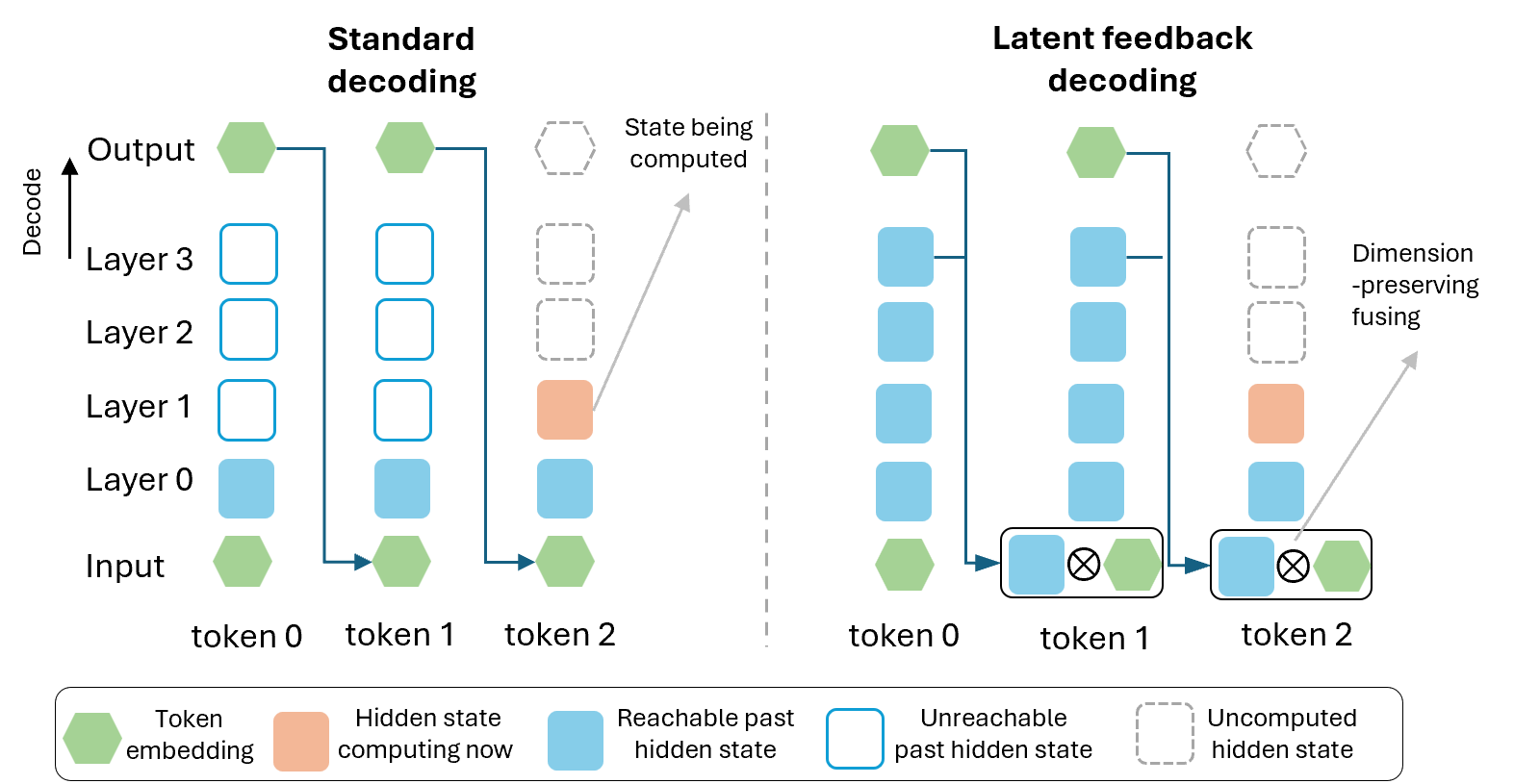
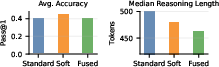
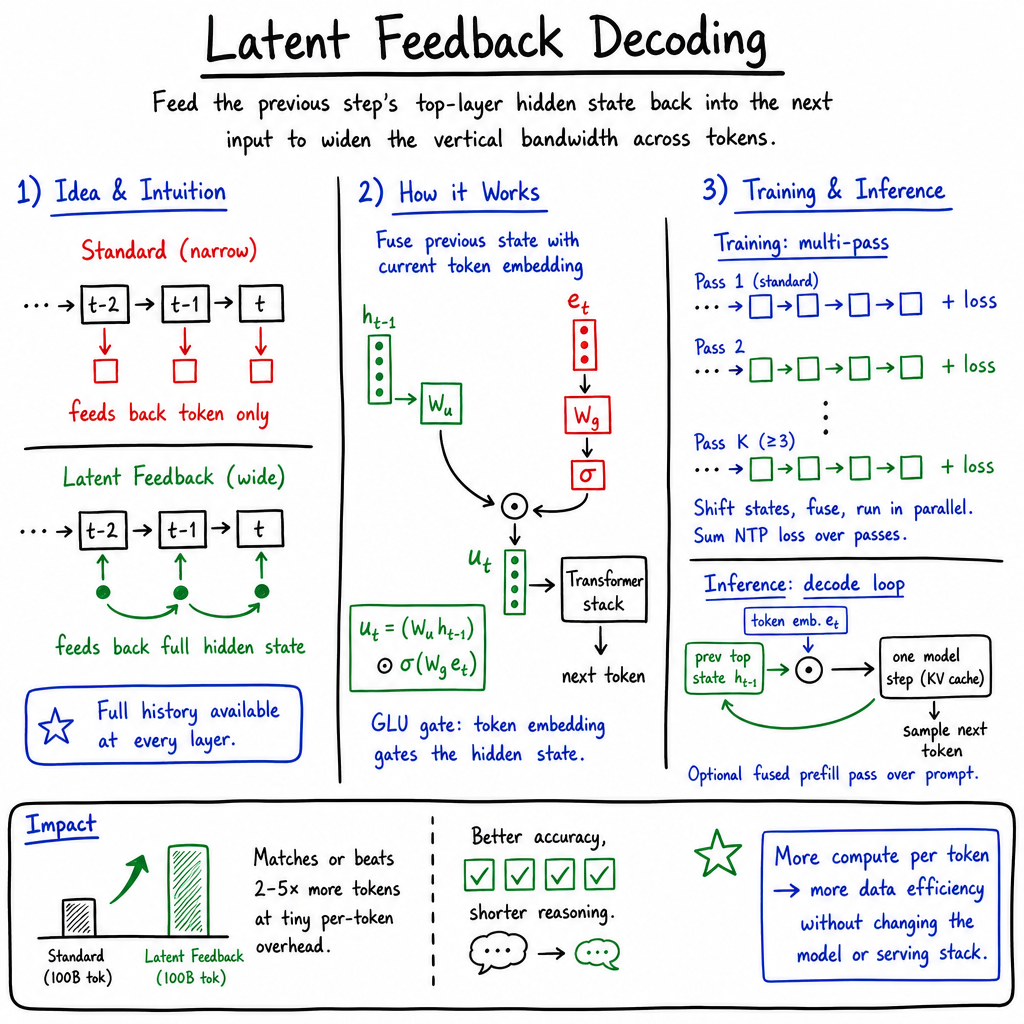
Abstract: Autoregressive transformers compute along two axes: horizontally across generated tokens, and vertically through model depth. Dense attention gives each token broad horizontal access to the past, but the vertical feedback channel between decoding steps remains narrow: only the sampled token returns to the bottom of the stack, while the top-layer hidden state is discarded. We introduce the \emph{full-bandwidth transformer}, which widens this channel with \emph{latent feedback}: at each decoding step, the previous top-layer hidden state is fused with the sampled token embedding through a gated linear unit and fed back as the next input. Latent feedback lets non-verbalized computation re-enter the stack with a renewed depth budget, while preserving the standard transformer architecture, KV cache, and language-modeling objective. To train full-bandwidth transformers without losing parallel teacher forcing, we use a scheduled multi-pass objective that introduces latent feedback late in pretraining and mixes a small fraction of deeper feedback passes for stability. We train 1B-parameter full-bandwidth transformers up to 400B tokens and find that latent feedback improves validation loss, 5-shot language-model evaluation, math and coding generation, and instruction-tuned performance. With negligible per-token decoding overhead, full-bandwidth transformers match or approach standard transformers trained with roughly $1.5\times$ more tokens, and manage to produce shorter reasoning traces at equal or better accuracy.
Paper Prompts
Sign up for free to create and run prompts on this paper.
Top Community Prompts
Explain it Like I'm 14
Full-Bandwidth Transformer: An Easy-to-Understand Summary
1. What's the main topic of this paper?
This paper is about a new way to improve transformer neural networks—the main technology behind popular AI models like ChatGPT. The authors introduce something called a full-bandwidth transformer, which helps the model "think" more effectively by letting it remember more information from previous steps and use it better at each step. Basically, it finds a way for the model to reuse its own previous knowledge smarter, making it learn faster and solve problems better.
2. What is the key question or goal?
The authors ask: "Can we make transformers smarter by allowing them to use more information from their past thinking, instead of just the previous word they generated?"
In current transformers, when writing out a sentence, the model only passes forward the last predicted word. The rest of its "internal thoughts" (its deeper understanding or memory) are not reused in the next step. The new idea here is to allow the model to also reuse its hidden knowledge (called the "latent state") from previous steps—not just the words it already generated.
3. How did they try to solve this? (Methods in plain language)
Imagine the transformer like a multi-layered assembly line, where each step of writing a sentence is like passing a note from one worker to another. In the current way, when the model writes a new word, it passes just that word to start the next step. But all the "thoughts" it had to reach that word disappear for the next step.
The full-bandwidth transformer changes things by letting each new step start with both:
- The word just written (as usual), and
- The internal thoughts (the hidden state) of the last step, kind of like a notepad that the worker can bring back to the beginning of the line for the next step.
To do this, the model uses a "gated linear unit" (think of it like a smart blender) that combines the new word and the previous thoughts into a single package, which then becomes the input for the next round.
But there was a problem: training models like this is tricky because it usually means you can't use the fast training tricks from standard transformers. To fix this, the authors came up with a clever way to "fake" multiple steps using special training passes so that the model can still learn efficiently.
4. What did they find, and why does it matter?
The researchers trained LLMs (like smaller versions of ChatGPT) in this new way and found:
- The models got better with less data: Models using latent feedback (the new method) learned as much or more as regular transformers, but using about half the training data.
- They solved math and coding problems better: On tests like math word problems and code generation, these models performed as well as or better than standard models that were given up to 5 times more training data.
- They could reason more compactly: Sometimes, the model could find answers in fewer steps, writing out fewer words but still getting correct results.
- Negligible extra cost: The extra computations per word are tiny—barely slowing things down at all.
This suggests that by making the model "reuse" its previous deep thoughts, not just the last word, it becomes much smarter and more efficient.
5. What does this mean for the future? (Implications)
This result is important because training AI models is extremely expensive and needs huge amounts of data, which is getting harder to find. If we can make AI models learn more efficiently from the same data by letting them "remember" more between steps, AI will get better, faster, and cheaper.
Also, this brings transformers a step closer to being able to reason more like humans, where we don't forget everything except our last word when thinking—we carry our thoughts along, update them, and use them the next time we need them.
Summary Table
| Regular Transformer | Full-Bandwidth Transformer |
|---|---|
| Passes only token info (last word) forward | Passes both token and deep internal thoughts forward |
| Needs lots of data to improve | Can do better with less training data |
| Sometimes repeats work, can't update its own hidden thinking | Updates and reuses its hidden information at each step |
| Works well, but sometimes verbose | Can solve problems in fewer steps, writing less |
In Short
The full-bandwidth transformer helps AI models be more efficient learners and better at complex tasks. It does this by remembering and using more of its own “thoughts” each time it writes the next word, instead of starting almost from scratch every time. This could make future AI faster, smarter, and less wasteful with data and computation!
Knowledge Gaps
Knowledge gaps, limitations, and open questions
- Scale generalization is unresolved: Experiments are limited to 1B-parameter models, so it is unknown whether latent feedback remains beneficial, stable, and computationally negligible at substantially larger model scales.
- Architecture generality has not been established: The method is evaluated with one transformer configuration, normalization scheme, optimizer setup, tied embedding/readout weights, and GLU fusion design; its effectiveness across architectures, positional encodings, attention variants, and normalization strategies remains unknown.
- The contribution of individual design choices is unclear: The paper does not provide comprehensive ablations isolating GLU asymmetry, RMSNorm, depth scaling, weight tying, jitter noise, prefix mixin, feedback-pass scheduling, and the choice of .
- The optimal fusion mechanism is underexplored: Alternatives such as additive fusion, concatenation, cross-attention, learned residual adapters, vector gates, or low-rank projections are not systematically compared, making it unclear whether the proposed gate is essential.
- The claimed data-efficiency gains are not fully disentangled from extra compute: Feedback-trained models receive multiple forward passes during training, but comparisons are often framed in terms of training tokens; compute-matched and wall-clock-matched comparisons against stronger standard-transformer baselines are needed.
- The “equivalent to more data” claim lacks broad scaling-law validation: The reported correspondence between latent-feedback training and – or more training tokens is based on a limited set of model sizes, token budgets, and evaluations, and may not extrapolate across scales or datasets.
- Baseline quality and reproducibility require more detail: The paper does not fully establish whether standard baselines use identical data ordering, batch sizes, optimization schedules, tokenizer settings, evaluation procedures, and tuning budgets, particularly where the 1T-token baseline uses a different global batch size.
- The impact of feedback training on ordinary transformer use remains uncertain: Standard decoding generally improves less than Soft or Fused decoding, but the paper does not thoroughly characterize when latent-feedback training helps, is neutral, or harms deployments that cannot use recurrence.
- Long-horizon stability is only partially demonstrated: Stability is tested through repeated feedback passes and selected rollouts, but there is no systematic analysis across prompts, sequence lengths, temperatures, model checkpoints, or rare hidden-state trajectories.
- Contraction and fixed-point behavior are not theoretically established: The observed decay of hidden-state updates does not prove that the learned feedback map is globally contractive; local instability, multiple attractors, limit cycles, or distribution-dependent divergence may still occur.
- The relationship between prefill recurrence and token-by-token recurrence is underjustified: Multi-pass Jacobi-style training is only an approximation to the sequential inference recurrence, and the paper does not quantify the discrepancy between their state distributions or gradients.
- Inference failures under recurrence are not characterized: The paper reports successful long rollouts but does not measure error accumulation, hidden-state norm drift, degeneration, repetition, semantic inconsistency, or abrupt behavioral failures over very long generations.
- The effect of sampling strategy is narrow: Generation experiments use temperature selection from a small grid and omit top-, top-, typical sampling, beam search, deterministic decoding, and calibrated sampling, so the robustness of gains across decoding policies is unknown.
- The method’s effect on output reliability is unclear: Improvements in benchmark accuracy are not accompanied by systematic evaluations of hallucination, factuality, calibration, uncertainty estimation, refusal behavior, or robustness to adversarial prompts.
- Reasoning concision is not causally established: Shorter reasoning traces are interpreted as evidence that latent computation replaces verbalized computation, but the study does not distinguish genuine internal computation from altered stopping behavior, changed answer heuristics, or decoding-distribution effects.
- The disappearance of concise reasoning after instruction tuning is unresolved: The paper attributes this to off-policy supervised traces, but does not test on-policy instruction tuning, preference optimization, reinforcement learning, or training objectives that explicitly reward concise and correct reasoning.
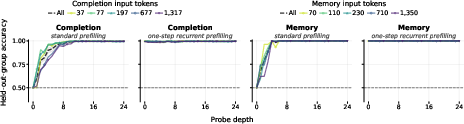
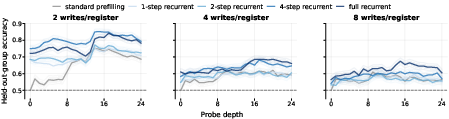
- The role of the latent state is not directly identified: Linear-probe improvements on synthetic tasks show increased decodability, but do not establish which information is carried, how it is transformed, whether it is causally used for predictions, or whether it mainly functions as a shortcut.
- Synthetic state-tracking tasks may not represent natural-language reasoning: The controlled probes use binary counters, memory tasks, and register tracking; evidence is still lacking that latent feedback improves shallow-layer access to useful intermediate states in realistic language, mathematics, coding, or multi-step planning.
- Causal intervention studies are missing: The paper does not test whether editing, corrupting, zeroing, or replacing carried hidden states predictably changes later outputs, which would distinguish functional latent memory from merely correlated representations.
- The information capacity of the feedback channel is not measured: Although the channel is described as “full-bandwidth,” the effective information transmitted after gating, normalization, noise, and model dynamics is not quantified or compared with the token channel.
- KV-cache and memory implications are insufficiently evaluated: The method stores top-layer states in an additional buffer, but practical memory use, batching behavior, fragmentation, throughput, latency, and performance under paged or distributed serving are not reported.
- The claimed negligible decoding overhead lacks system-level measurements: Two matrix multiplications may be small relative to a forward pass, but end-to-end latency, energy use, hardware utilization, and throughput at different batch sizes and sequence lengths remain unreported.
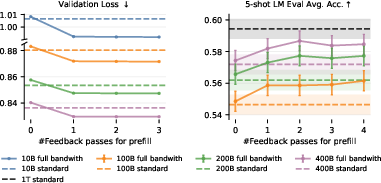
- The benefit of fused prefill versus Soft decoding is not systematically optimized: The experiments mainly examine zero or one additional fused prefill pass; the cost–quality trade-off for multiple prefill passes and adaptive per-prompt iteration is left open.
- Adaptive stopping criteria are unexplored: The paper does not investigate whether the number of feedback or prefill passes can be selected dynamically based on hidden-state convergence, predictive uncertainty, task type, or available latency.
- Context-length generalization remains uncertain: Long-context extension is reported up to 32K tokens, but there is no systematic evaluation of latent feedback at substantially longer contexts or under context truncation and retrieval-heavy workloads.
- Training efficiency and memory overhead are incompletely quantified: Backpropagating through multiple passes without detachment increases memory usage, but the paper does not provide peak-memory, activation-storage, communication, or wall-clock training comparisons.
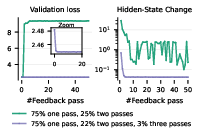
- The scheduling recipe may be dataset- and scale-dependent: The 75%/22%/3% pass mixture is presented as effective, but its sensitivity to token budget, context length, model size, domain mixture, and training stage is not established.
- Robustness to distribution shift is untested: The feedback map is trained primarily on the Phi-4 data mixture and selected benchmarks; its behavior on multilingual, domain-specific, noisy, code-heavy, conversational, and out-of-distribution inputs remains unknown.
- Post-training compatibility is not fully explored: Results cover one long-context extension and instruction-tuning setup, but compatibility with preference tuning, tool use, retrieval augmentation, multimodal inputs, function calling, and agentic interaction is unresolved.
- The method’s effect on controllability and interpretability is unknown: Persistent continuous states may improve computation but could also make behavior harder to inspect, reset, reproduce, or constrain; these operational and interpretability consequences are not evaluated.
- Reproducibility is limited by incomplete experimental reporting: The paper does not provide sufficient details on random seeds, evaluation variance across training runs, checkpoint selection, prompt templates, exact data composition, or implementation-specific numerical-stability settings to determine whether the gains are consistently reproducible.
Practical Applications
Immediate Applications
- More efficient deployment of LLMs (software/AI infrastructure).
Integrate latent-feedback decoding into compatible decoder-only LLM serving stacks, such as
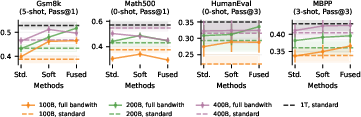
vLLM-style systems, by storing the previous top-layer hidden state in a small additional buffer and applying the gated fusion before each decoding step. The paper reports less than 1% per-token overhead, while preserving the standard KV-cache layout. Potential products/workflows: drop-in “soft feedback” inference modes, model-server flags that trade a small amount of prefill computation for higher accuracy, and adaptive decoding policies that enable feedback only for difficult prompts. Dependencies: the model must be trained with the latent-feedback objective; pretrained standard transformers cannot generally use the mechanism reliably without adaptation. Memory bandwidth, kernel fusion, quantization, and hardware support must also be validated in production. - Improved mathematical problem solving with shorter generated traces (education, tutoring, automated reasoning). Deploy soft latent-feedback decoding for arithmetic, algebra, and competition-style mathematics. The reported gains on GSM8K and MATH-500 suggest that intermediate plans and partial calculations can be carried in the hidden state rather than verbalized token by token. Potential products/workflows: tutoring systems that produce concise solutions, automated grading assistants, and reasoning APIs with separate “answer,” “explanation,” and “internal computation” modes. Dependencies: accuracy must be evaluated on domain-specific problems, and systems should not treat hidden states as auditable explanations. Safety and educational requirements may still require an externally visible derivation.
- Code generation and program synthesis (software engineering). Use fused-prefill and latent-feedback decoding in coding assistants, repository agents, and code-completion tools. The paper finds that fused prefilling is particularly beneficial for coding, presumably because it gives the model a deeper representation of the prompt before generation. Potential products/workflows: repository-aware code assistants, unit-test generation, automated bug-fixing agents, and code-review tools that use fused prefill for long specifications and soft feedback during multi-step generation. Dependencies: results were measured on HumanEval and MBPP, so real repositories require additional testing for compilation, security, dependency management, and long-context behavior. Pass@3 improvements do not guarantee production correctness.
- Inference-time quality upgrades without retraining on substantially more data (cloud AI and model operations). Apply one or two additional fused passes during prompt prefilling to improve perplexity and few-shot task performance. This is attractive for workloads where prompt processing is parallel and relatively inexpensive compared with long generation. Potential products/workflows: configurable “accuracy mode” inference, premium API tiers, and routers that apply extra prefill passes to complex prompts while using standard decoding for simple requests. Dependencies: the benefit depends on prompt length, batch size, hardware utilization, and the relative cost of prefill versus decoding. Extra passes may increase latency and energy use for short prompts.
- Improved data efficiency in language-model pretraining (AI research and industrial model development). Adopt the multi-pass training objective as an auxiliary learning signal even when latent feedback is not enabled at serving time. Later feedback passes expose hidden states to losses at multiple future positions, potentially extracting more learning signal from the same token stream. Potential workflows: continue-training a standard checkpoint with progressive two-pass and limited three-pass batches, then deploy either standard or feedback decoding. Dependencies: training compute is not free: the reported configurations have token-equivalent costs above the nominal token count. Benefits should be compared against simply training on more tokens or using other auxiliary objectives.
- More concise AI-generated responses (consumer assistants and enterprise communication). Use latent-feedback decoding to reduce unnecessary reasoning-token generation while maintaining task performance. This can lower output-token costs and make responses faster and easier to read. Potential products/workflows: concise answer modes for customer support, summarization, search assistants, and workplace copilots. Dependencies: the paper reports that concision may disappear after instruction tuning, because supervised traces often reward conventional verbosity. Post-training data and evaluation criteria must therefore be aligned with latent-feedback behavior.
- Adaptive compute allocation for language-model APIs (finance, customer service, search). Build a routing policy with three modes: standard decoding, soft latent feedback, and fused prefill plus soft decoding. Easier requests can use the cheapest mode, while mathematical, coding, or long-context requests receive additional feedback computation. Dependencies: a reliable difficulty detector and calibrated quality/latency thresholds are required. A policy must also account for hidden-state caching, privacy, and reproducibility across sampling settings.
- Academic tools for studying representation accessibility and recurrent computation. Researchers can use full-bandwidth transformers as an experimental platform for probing how information moves between token positions and model layers. The paper’s synthetic state-tracking tasks provide a practical benchmark for testing whether global context is accessible at shallow layers. Potential outputs: interpretability probes, layer-wise information-flow diagnostics, and benchmarks comparing transformers, recurrent models, state-space models, and chain-of-thought systems. Dependencies: linear-probe accuracy measures decodability, not necessarily causal use or semantic understanding. Results should be supplemented with intervention and causal-ablation experiments.
- Policy and procurement evaluation of AI efficiency claims. Organizations purchasing or regulating LLM services can evaluate systems using compute-normalized metrics: task quality per training token, per inference FLOP, joule, dollar, and output token. Full-bandwidth models offer a concrete example of improving capability through architectural and inference-time computation rather than only model size or dataset scale. Dependencies: comparisons must use equivalent hardware, latency targets, sampling budgets, context lengths, and quality tests. The paper’s 1B-parameter experiments should not be assumed to scale unchanged to frontier models.
Long-Term Applications
- Large-scale reduction in training-data requirements (AI infrastructure and data governance). If the reported data-efficiency gains scale to much larger models, full-bandwidth training could reduce dependence on acquiring additional high-quality text and code. This could lower data acquisition costs and mitigate bottlenecks caused by limited unique training data. Potential outcomes: smaller but more compute-efficient pretraining corpora, domain-specialized models trained on scarce expert data, and more sustainable model-development pipelines. Dependencies: scaling laws for latent feedback are not established by the 1B-parameter experiments. The additional training FLOPs, optimization complexity, and memory requirements may offset the savings from using fewer tokens.
- Latent scratchpads for agents and multi-step planning (robotics, autonomous systems, enterprise agents). A recurrent hidden-state channel could support persistent plans, uncertainty estimates, partial results, and task state without requiring every intermediate step to be expressed in natural language. This may be useful for software agents, workflow automation, and embodied systems that repeatedly update a plan while interacting with an environment. Potential products/workflows: agents with private continuous planning states, tool-use controllers, and task managers that alternate between external actions and latent updates. Dependencies: the method does not provide a mutable register in the RNN sense; prior states remain in the KV cache. Long-horizon memory, state overwriting, error accumulation, interpretability, and recovery from corrupted latent states require further work.
- Robotics control with language-conditioned latent state (robotics and manufacturing). Future systems could use latent feedback to carry task-relevant visual, linguistic, and control information across action steps while retaining ordinary token or action outputs. The broader vertical feedback path may help a transformer repeatedly refine a partially completed plan. Dependencies: the paper evaluates language-only tasks, not real-time control, multimodal inputs, or safety-critical actuation. Robotics deployments require bounded latency, robust state estimation, sensor fusion, closed-loop physical evaluation, and guarantees against unstable recurrence.
- Private or compressed reasoning interfaces (healthcare, law, finance). Models might generate concise user-facing outputs while maintaining richer latent intermediate computation internally. This could reduce response length and expose less sensitive intermediate text in applications such as clinical triage, legal document analysis, and financial research. Dependencies: latent states are not automatically private, truthful, or safe. Sensitive information may still be encoded in activations or KV caches, and the absence of a verbal reasoning trace can make auditing more difficult. Human review, logging policies, privacy controls, and domain-specific validation remain necessary.
- Test-time scaling through iterative prompt refinement (search, scientific literature, enterprise knowledge systems). Additional fused prefill passes could act as a relatively inexpensive form of test-time computation, refining the representation of a long document, query, or set of retrieved passages before answer generation. Potential products/workflows: document-analysis systems that run one or more refinement passes over retrieved evidence, scientific assistants that process complex research prompts, and search systems with accuracy-oriented reranking or synthesis modes. Dependencies: gains may diminish after the first pass, and longer prompts increase prefill cost. The method must be tested for retrieval faithfulness, evidence attribution, prompt-injection resistance, and robustness to noisy context.
- New transformer architectures combining full-bandwidth feedback with other reasoning methods (academic and industrial research). The proposed feedback channel could be combined with speculative decoding, multi-token prediction, tool use, next-latent prediction, mixture-of-experts routing, or explicit chain-of-thought supervision. Such systems could allocate computation between verbal tokens and continuous latent updates. Dependencies: interactions between these objectives may destabilize the recurrence or reduce sampling diversity. Training must determine appropriate feedback horizons, contraction behavior, normalization, noise levels, and whether the token gate remains effective at larger scales.
- Long-horizon stable recurrent transformers (general-purpose AI systems). The reported observation that a small fraction of three-pass batches improves extrapolation toward a stable fixed point suggests a path toward transformers that can repeatedly refine states beyond their nominal training horizon. Such models could support iterative planning, deliberation, and refinement without producing a proportionally longer text trace. Dependencies: stability in repeated prefill and hundred- or thousand-step tests does not establish reliable semantic behavior over arbitrarily long interactions. Fixed-point convergence may also erase useful information, amplify systematic errors, or create undesirable attractors.
- Energy- and cost-aware model deployment (energy policy and sustainable computing). By potentially matching models trained on substantially more tokens with less data, full-bandwidth training could reduce data-center training demand. Conversely, extra feedback passes increase compute during training and sometimes during prefill, so lifecycle energy accounting is essential. Potential policy tools: standardized reporting of quality per joule and per dollar, deployment schedulers that select feedback depth according to carbon intensity, and carbon-aware model serving. Dependencies: net environmental benefit depends on the ratio of saved training tokens to added multi-pass computation, hardware efficiency, model reuse, and workload mix; it cannot be inferred from accuracy gains alone.
- Post-training methods designed specifically for latent-feedback behavior (alignment and instruction tuning). Future instruction-tuning datasets could be generated and optimized under soft or fused decoding so that the model retains concise reasoning while following instructions reliably. Preference optimization could reward correctness, calibrated uncertainty, and useful final explanations without forcing verbose intermediate traces. Dependencies: the current paper notes that conventional instruction tuning removes some concision benefits. New objectives must avoid rewarding opaque or unfaithful latent computation and should include evaluations for controllability, explanation quality, refusal behavior, and distribution shift.
Glossary
- 5-shot evaluation: Assessment in which the model receives five examples before answering each task instance. “5-shot language-model evaluation”
- autoregressive decoding: Sequential generation in which each new token is conditioned on previously generated tokens. “During autoregressive decoding with transformers”
- auxiliary objective: An additional training loss that supplements the primary learning objective. “acting as an auxiliary objective”
- bandwidth: The amount of information that can be transmitted through a computational or communication channel. “we widen this channel to its full width”
- causal attention: Attention restricted so that a position can access only earlier positions, preserving autoregressive ordering. “can influence losses at multiple future positions through causal attention”
- chain-of-thought (CoT): A reasoning method in which a model generates intermediate textual steps before producing an answer. “Standard CoT performs serial computation through a single feedback channel”
- contraction: A mapping that progressively reduces differences between states, often converging toward a fixed point. “the learned map into a contraction toward a fixed point”
- depth-frozen: Describing a representation that can be accessed only by subsequent deeper layers and cannot be returned to shallower layers. “it is depth-frozen”
- dimension-preserving gate: A gating operation that combines inputs without changing their dimensionality. “through a dimension-preserving gate”
- distribution mismatch: A discrepancy between the input distribution encountered during training and that encountered during inference. “A distribution mismatch remains between multi-pass training and inference”
- embedding space: The vector space in which discrete tokens are represented as continuous numerical vectors. “encourage the embedding space and top-layer hidden-state space to remain in a compatible basis”
- fixed point: A state that remains unchanged when a function is applied to it. “reaches a stable fixed point”
- forward pass: One complete evaluation of a neural network on an input. “each pass multiplies the cost of the run”
- gated linear unit (GLU): A neural-network transformation that modulates one linear pathway using a learned gate. “The fusion is a gated linear unit”
- gradient: A derivative indicating how model parameters should change to reduce a loss function. “We do not detach the gradient”
- hidden state: A learned vector representation produced inside a neural network for a token or sequence position. “the previous top-layer hidden state”
- instruction tuning: Additional training that adapts a pretrained model to follow natural-language instructions. “instruction tuning (6B tokens)”
- Jacobi-style update: A parallel iterative update in which all positions are computed from states produced in the preceding iteration. “Each pass is a Jacobi-style update of the latent-feedback recurrence”
- KV cache: Stored attention keys and values from earlier tokens, reused during autoregressive generation. “the KV cache of all earlier positions”
- latent feedback: Reinjecting a continuous hidden representation from a previous decoding step into the next input. “we introduce latent feedback decoding”
- language-model head: The output projection that converts a hidden state into a distribution over vocabulary tokens. “projected by the language-model head”
- linear probe: A simple linear model trained on internal representations to test whether specific information is encoded there. “We then fit a linear probe for the target”
- long-context extension: Adaptation of a model to process substantially longer input sequences than those used in its original training. “The gains carry over through long-context extension”
- multiplicative gate: A gating mechanism that controls one vector by element-wise multiplication with another. “the token embedding enters only as a multiplicative gate”
- multi-pass objective: A training loss computed from multiple successive evaluations of a model with feedback. “We use a scheduled multi-pass objective”
- next-token prediction (NTP): Training a LLM to predict the token immediately following a given context. “the standard next-token-prediction loss”
- off-policy: Describing training data or behavior generated by a policy different from the model’s current inference policy. “the tuning data being off-policy with respect to latent-feedback decoding”
- prefill: The initial processing of a prompt before token-by-token generation begins. “At evaluation, we can apply additional fused passes over the prompt”
- prefix mixin: A training technique that combines an unfused prefix with feedback-fused suffix positions. “To close this gap we apply a prefix mixin”
- residual stream: The sequence of vectors passed through and updated by the layers of a transformer. “a -dimensional residual stream”
- recurrent state: A representation carried from one computational step to the next to support iterative processing. “only , which the cache never stores, propagates as a recurrence variable”
- recurrence: A computation in which a later state depends on an earlier state through repeated application of a transition function. “The central innovation in full-bandwidth transformer is latent feedback decoding, which feeds the previous top-layer hidden state back into the input”
- RMSNorm: A normalization method that rescales vectors using their root-mean-square magnitude. “We also apply RMSNorm to the fused input”
- state-space model: A sequence model that summarizes prior inputs in a fixed-size evolving state. “RNNs and state-space models, which compress history into a fixed-size recurrent state”
- teacher forcing: Training a sequence model using the correct preceding tokens rather than its own generated predictions. “the parallel teacher forcing that makes transformers efficient to train”
- temporal parallelism: Parallelizing recurrent computation across sequence positions by distributing sequential updates across multiple passes. “We refer to this training scheme as temporal parallelism”
- token-equivalent compute: A measure that accounts for the number of training tokens multiplied by the average number of model evaluations per batch. “the token-equivalent compute, defined as training tokens multiplied by the average number of forward passes per batch”
- top-layer hidden state: The representation produced at the greatest depth of the transformer stack. “the previous top-layer hidden state is fused with the sampled token embedding”
- weight tying: Sharing the same parameters between different model components, such as input embeddings and output projections. “Shared input basis with weight tying”
- zero-shot evaluation: Evaluation without providing task-specific examples in the prompt. “0-shot LM Eval performance”
Collections
Sign up for free to add this paper to one or more collections.