Beyond Pixels: From Video Priors to 4D Worlds
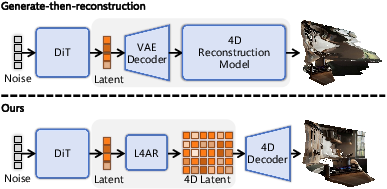
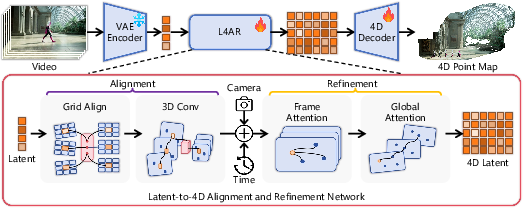
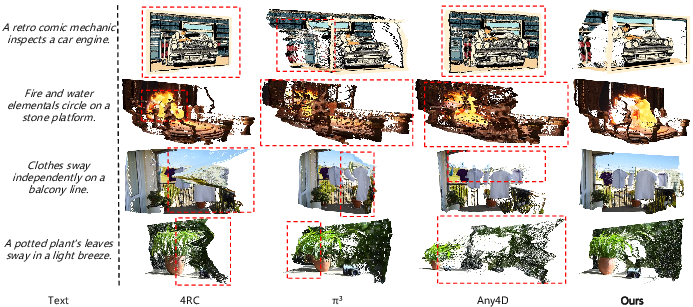
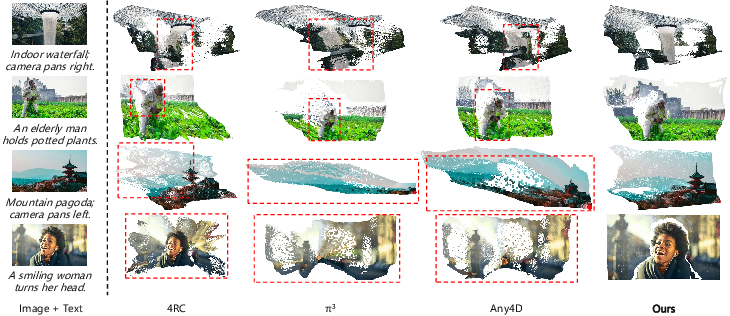
Abstract: 4D generation synthesizes dynamic 3D scenes from conditions such as text or images. Existing methods either reconstruct generated RGB videos with a separate 4D model or adapt a particular video generator to predict geometry directly. The former suffers from distribution mismatch and error propagation, whereas the latter ties 4D prediction to a specific generator and may require retraining when the generator or conditioning regime changes. We ask whether the final denoised latents of video models that share a variational autoencoder (VAE) can instead provide a reusable interface to explicit 4D prediction. Building on this insight, we introduce direct latent-to-4D generation and instantiate it as Latent-to-4D, which bypasses RGB by aligning a video latent with the token grid of a pretrained 4D decoder and refining it through frame-wise and global spatiotemporal attention. Trained on roughly 1K existing reconstruction clips, a single checkpoint transfers unchanged across multiple video diffusion transformers within the same VAE family. On Text4D-200 and I4D-200, Latent-to-4D surpasses matched same-latent Wan+4RC cascades in projection-based DINO-F1 by 2.88--3.45 and 5.81 points, respectively, while also being preferred by human raters for geometry, temporal stability, and overall quality.
Paper Prompts
Sign up for free to create and run prompts on this paper.
Top Community Prompts
Explain it Like I'm 14
1. Überblick: Was untersucht der Beitrag?
Der Beitrag stellt eine Methode namens Latent-to-4D vor. Sie soll aus einem Text oder einem Bild eine bewegte 3D-Welt erzeugen.
Warum heißt das „4D“? Eine normale 3D-Szene beschreibt Länge, Breite und Höhe. Die vierte Dimension ist die Zeit. Eine 4D-Szene zeigt also, wie sich Objekte und die Kamera in einer 3D-Welt bewegen.
Zum Beispiel könnte das System aus dem Text „Ein Hund rennt durch einen Park“ eine Szene erstellen, in der:
- der Hund eine 3D-Form besitzt,
- der Hund sich von Bild zu Bild bewegt,
- die Kamera ihre Position verändern kann,
- man die Szene später aus anderen Blickwinkeln betrachten kann.
2. Die wichtigsten Forschungsfragen
Bisherige Methoden arbeiten meistens auf eine von zwei Arten:
- Sie erzeugen zuerst ein normales Video mit Farbbildern und wandeln dieses anschließend in eine 4D-Szene um.
- Sie verändern ein bestimmtes Videomodell so, dass es direkt 3D-Geometrie ausgibt.
Beide Möglichkeiten haben Nachteile. Bei der ersten Methode können Fehler aus dem erzeugten Video später zu falschen 3D-Formen führen. Bei der zweiten Methode funktioniert das System oft nur mit genau dem Videomodell, für das es trainiert wurde.
Die zentrale Frage des Beitrags lautet daher:
Kann man die internen Informationen eines Videomodells direkt verwenden, um eine 4D-Welt zu erzeugen, ohne das Video zuerst in normale Farbbilder umzuwandeln?
Die Forschenden wollten außerdem herausfinden:
- Kann ein einziges trainiertes System mit mehreren Videomodellen funktionieren?
- Erzeugt die direkte Nutzung der internen Videoinformationen bessere Geometrie?
- Bleiben Bewegungen und Formen über die Zeit stabil?
- Kann das Verfahren sowohl mit Text- als auch mit Bildbedingungen umgehen?
3. Wie funktioniert die Methode?
Grundidee
Ein Videomodell speichert seine Informationen nicht nur als fertige Bilder. Während der Erzeugung verwendet es eine komprimierte interne Darstellung, den sogenannten VAE-Latentraum.
Einfach gesagt ist ein Latent eine Art kompakte Notiz über ein Video. Diese Notiz enthält wichtige Informationen über:
- das Aussehen von Objekten,
- ihre Bewegungen,
- die Reihenfolge der Bilder,
- die vom Text oder Bild vorgegebenen Inhalte.
Man kann sich das wie einen Bauplan vorstellen. Das fertige RGB-Video ist das gebaute Haus, während das Latent der Bauplan davor ist.
Bisherige Methoden wandelten den Bauplan zuerst in Bilder um und versuchten dann, daraus wieder eine 3D-Welt zu rekonstruieren. Latent-to-4D überspringt diesen Zwischenschritt.
Die drei Hauptteile
Die Methode besteht im Wesentlichen aus drei Stufen.
1. Ausrichtung der Informationen
Die interne Darstellung des Videomodells sieht anders aus als die Darstellung, die ein 4D-Rekonstruktionsmodell benötigt. Deshalb wird sie zunächst angepasst.
Die Forschenden verwenden dafür:
- eine Größenanpassung des Datenrasters,
- eine sogenannte 3D-Faltung, die benachbarte Informationen aus Raum und Zeit zusammenfasst.
Das ist vergleichbar damit, verschiedene Kartenmaßstäbe so umzuwandeln, dass sie auf dieselbe Landkarte passen.
2. Untersuchung von Raum und Zeit
Danach verarbeitet das System die Informationen mit zwei Arten von Aufmerksamkeit:
- Frame-weises Achten: Es untersucht, was innerhalb eines einzelnen Bildes zusammengehört.
- Globale zeitliche Aufmerksamkeit: Es vergleicht Informationen aus allen Bildern und erkennt, wie sich Dinge bewegen.
Ein Beispiel: Das System kann in einem einzelnen Bild die Form eines Hundes erkennen. Durch den Vergleich vieler Bilder kann es zusätzlich verstehen, dass sich der Hund nach vorne bewegt und nicht jedes Bild einen völlig neuen Hund zeigt.
3. Erzeugung der 4D-Szene
Am Ende sagt ein 4D-Decoder voraus:
- wo sich die Kamera zu jedem Zeitpunkt befindet,
- wie weit verschiedene Punkte entfernt sind,
- wo sich diese Punkte in der 3D-Welt befinden,
- wie sich die Geometrie über die Zeit verändert.
Das Ergebnis ist eine Sammlung von bewegten 3D-Punkten und Kamerapositionen. Dadurch kann die Szene aus neuen Blickwinkeln betrachtet werden.
Training
Für das Training verwendeten die Forschenden ungefähr 1.000 bis 1.143 Videoclips, zu denen Informationen über 3D-Formen, Kameras und Bewegungen vorhanden waren.
Sie trainierten vor allem die Verbindung zwischen dem Videolatent und dem 4D-Decoder. Die großen Videomodelle selbst blieben unverändert. Dadurch kann ein bereits trainiertes Videomodell weiterhin seine ursprünglichen Text-, Bild- oder Bewegungssteuerungen verwenden.
Wichtig ist: Die Methode funktioniert besonders dann, wenn die verwendeten Videomodelle denselben VAE und dieselben Regeln für ihre Latents verwenden. Der VAE ist dabei wie ein gemeinsames Übersetzungsformat.
4. Was waren die wichtigsten Ergebnisse?
Die Forschenden testeten Latent-to-4D auf zwei Aufgaben:
- Text-to-4D: Eine 4D-Szene wird aus einer Textbeschreibung erzeugt.
- Image-to-4D: Eine 4D-Szene wird aus einem Bild erzeugt.
Die Tests enthielten jeweils 200 Beispiele.
Bessere Ergebnisse als die Vergleichsmethoden
Die Methode wurde vor allem mit einer herkömmlichen Pipeline verglichen:
- Videolatent in ein RGB-Video umwandeln,
- dieses Video mit einem 4D-Rekonstruktionsmodell verarbeiten.
Latent-to-4D erzielte höhere Werte bei den DINO-F1-Messungen:
| Aufgabe | Verbesserung gegenüber der passenden Vergleichsmethode |
|---|---|
| Text-to-4D | etwa 2,88 bis 3,45 Punkte |
| Image-to-4D | etwa 5,81 Punkte |
DINO-F1 misst hier nicht direkt, ob jedes 3D-Punktmaß exakt stimmt. Stattdessen untersucht es, ob die sichtbare Form und der Inhalt aus verschiedenen Blickwinkeln zusammenpassen. Ein höherer Wert deutet daher auf vollständigere und plausiblere Geometrie hin.
Bei der Bild-zu-4D-Aufgabe war Latent-to-4D in allen aufgeführten Messwerten führend.
Bessere menschliche Bewertungen
Auch Menschen bevorzugten die Ergebnisse von Latent-to-4D. Die Teilnehmenden konnten die Szenen aus mehreren Blickwinkeln betrachten und die Bewegungen abspielen.
Bei den Text-zu-4D-Beispielen bevorzugten sie die neue Methode unter anderem wegen:
- besserer Geometrie und Vollständigkeit,
- stabilerer Bewegungen,
- höherer Gesamtqualität.
Bei den Bild-zu-4D-Beispielen lagen die Zustimmungswerte noch höher. Besonders häufig wurde die Geometrie als besser und vollständiger bewertet.
Funktioniert mit mehreren Videomodellen
Ein einziges trainiertes Modell funktionierte unverändert mit:
- zwei Text-zu-Video-Modellen,
- einem Bild-zu-Video-Modell.
Diese Modelle verwendeten denselben VAE. Das ist ein wichtiges Ergebnis, weil dadurch nicht für jedes neue Videomodell ein komplett neues 4D-System trainiert werden muss.
Ablationstests
Die Forschenden entfernten einzelne Teile ihrer Methode, um zu prüfen, welche Bestandteile wichtig sind. Ohne:
- die 3D-Faltung,
- die frame-weite Aufmerksamkeit,
- die globale zeitliche Aufmerksamkeit,
wurden die Ergebnisse schlechter.
Das zeigt, dass sowohl die lokalen Bilddetails als auch die Beziehungen über mehrere Bilder hinweg benötigt werden.
5. Warum ist diese Forschung wichtig?
Die Arbeit zeigt eine neue Möglichkeit, große Videomodelle für die Erzeugung bewegter 3D-Welten zu nutzen.
Der wichtigste Vorteil ist, dass das System nicht erst ein fertiges RGB-Video erzeugen muss. Dadurch können einige Fehler vermieden werden, die beim Umwandeln zwischen Video, Bildern und 3D entstehen.
Außerdem trennt die Methode zwei Aufgaben besser:
- Das Videomodell kümmert sich darum, was passieren soll und wie es aussieht.
- Der 4D-Decoder kümmert sich darum, wo sich Dinge im Raum befinden und wie sie sich bewegen.
Das könnte künftig für verschiedene Anwendungen nützlich sein:
- virtuelle Realität und erweiterte Realität,
- Computerspiele und Filmproduktion,
- Simulationen für Roboter,
- virtuelle Trainingswelten,
- Navigation autonomer Systeme,
- interaktive digitale Umgebungen.
Einschränkungen
Die Ergebnisse gelten bisher vor allem für Videomodelle, die denselben VAE und dasselbe Datenformat verwenden. Es ist also nicht sicher, dass die Methode direkt mit jedem beliebigen Videomodell funktioniert.
Außerdem messen die verwendeten DINO-Werte vor allem, ob die Szene aus verschiedenen Blickwinkeln sinnvoll aussieht. Sie beweisen nicht, dass jede Entfernung, Kameraposition oder 3D-Form mathematisch exakt ist. Auch die Tests wurden mit relativ kleinen Benchmark-Sammlungen durchgeführt.
Einfaches Fazit
Latent-to-4D nimmt die interne „Bauplan“-Darstellung eines Videomodells und verwandelt sie direkt in eine bewegte 3D-Welt. Im Gegensatz zu älteren Verfahren muss das System nicht zuerst ein normales Video erstellen und dieses danach wieder analysieren.
Die Ergebnisse zeigen, dass diese direkte Verbindung häufig vollständigere, stabilere und überzeugendere 4D-Szenen erzeugt. Wenn die Methode mit weiteren Videomodellen und größeren Datensätzen funktioniert, könnte sie ein wichtiger Schritt hin zu realistischeren virtuellen Welten und beweglichen 3D-Inhalten sein.
Knowledge Gaps
Knowledge gaps, limitations, and open questions
- Generalization beyond the Wan VAE family is untested. The claimed reusable interface is evaluated only with DiTs sharing the Wan VAE; it remains unknown whether the method transfers across different VAE architectures, latent channel dimensions, normalization schemes, compression ratios, or token layouts.
- The definition of “compatible” latent spaces lacks empirical validation. The paper lists shared checkpoints, normalization, layout, compression, and shape as requirements, but does not quantify how performance degrades when these properties differ slightly or establish measurable compatibility criteria.
- Training–inference latent distribution shift is only partially investigated. Training uses posterior-mean latents from observed videos, whereas inference uses final denoised diffusion latents; the paper does not characterize their distributional differences or test robustness across diffusion steps, samplers, guidance scales, noise seeds, and denoising schedules.
- The method’s behavior on severe video-generation artifacts remains unclear. Generated videos may contain object identity changes, temporal flicker, hallucinated surfaces, inconsistent lighting, or broken anatomy, but the experiments do not isolate how each artifact affects recovered cameras, geometry, and motion.
- Evaluation is based primarily on generated-latent benchmarks of only 200 cases per condition. Larger, independently collected, and more diverse test sets are needed to establish statistical reliability and performance across object categories, scene types, motion patterns, viewpoints, and prompt complexity.
- Metric 4D accuracy for generated scenes is not established. DINO projection scores and human judgments assess appearance similarity and perceived plausibility rather than absolute geometry, scale, camera accuracy, scene flow, or cross-view reconstruction error; direct ground-truth evaluation on generated samples remains unresolved.
- Temporal motion quality lacks quantitative evaluation. The paper reports human preferences for temporal stability but does not measure 3D scene-flow accuracy, motion consistency, identity preservation, trajectory smoothness, or long-term drift across frames.
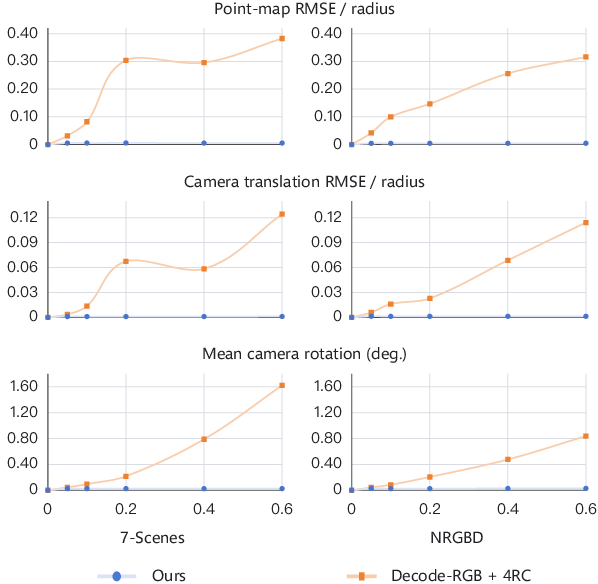
- Camera estimation is insufficiently evaluated in the generation setting. Camera ablations are reported on 7-Scenes and NRGBD, but generated-latent experiments do not provide quantitative camera pose, field-of-view, or trajectory accuracy against ground truth.
- The scope of dynamic content is unclear. It is not established whether the method handles topology changes, object-object interactions, articulated bodies, nonrigid deformation, fluid motion, particle effects, transparency, reflections, or highly dynamic backgrounds reliably.
- Longer and higher-resolution sequences are not examined. The paper does not report memory, runtime, accuracy, or temporal degradation as the number of frames, spatial resolution, or token count increases.
- The output representation may limit scene fidelity. Dense point maps and predicted rays may be inadequate for occlusion reasoning, topology changes, thin structures, transparency, appearance modeling, and physically renderable dynamic surfaces; comparisons with dynamic Gaussians, meshes, neural fields, or hybrid representations are absent.
- The contribution of the pretrained 4RC decoder is not fully disentangled from L4AR. Although component ablations remove alignment and attention modules, the paper does not compare against a newly trained latent-to-4D decoder, alternative pretrained reconstructors, or different decoder initializations to determine how much performance derives from the 4RC prior.
- The alignment module’s capacity and inductive bias are underexplored. Only fixed trilinear resampling followed by a 3D convolution is evaluated; learned resampling, cross-attention, deformable alignment, multiscale alignment, and nonlinear latent translators may offer better cross-representation mappings.
- The method is trained on only 1,143 reconstruction clips. The impact of reconstruction-data scale, domain composition, annotation quality, and dataset diversity is not studied, leaving open whether the approach remains effective with substantially more or less 4D supervision.
- The reconstruction training data may not represent open-domain generated content. The paper does not report domain-overlap analysis between the six training datasets and Text4D-200/I4D-200, so the extent of true out-of-distribution generalization is uncertain.
- The effect of freezing the video generators and VAE is not systematically tested. It remains unknown whether limited joint adaptation, VAE-specific adapters, or generator-side LoRA tuning could improve geometry without sacrificing cross-generator reuse.
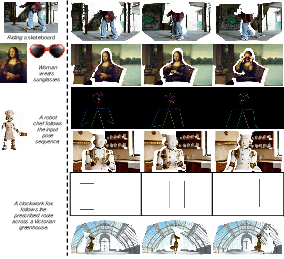
- Transfer across conditioning regimes is demonstrated only narrowly. Text-to-video and image-to-video are tested, while the broader claims about motion, appearance, pose, trajectory, manipulation, and navigation controls are qualitative and do not measure condition adherence or control accuracy.
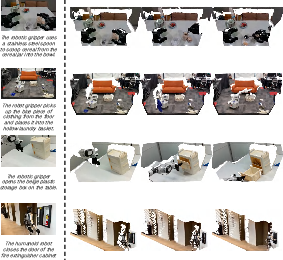
- Action and navigation examples do not establish physical correctness. The paper explicitly presents these demonstrations as interface-compatibility evidence, leaving unresolved whether the reconstructed worlds support collision checking, planning, manipulation, locomotion, or physically plausible state transitions.
- The influence of prompt and image-conditioning quality is not quantified. Sensitivity to ambiguous prompts, contradictory text-image conditions, low-quality input images, unusual compositions, and out-of-distribution semantics remains unknown.
- The residual sensitivity experiment covers only a restricted perturbation. Projecting a near-terminal residual into a width-null space does not test arbitrary latent corruption, different diffusion timesteps, generator-specific errors, or shifts in latent normalization; broader robustness testing is needed.
- The causal benefit of bypassing RGB is not fully isolated. The matched-latent comparisons show an advantage over selected RGB reconstruction cascades, but do not distinguish whether improvements arise from avoiding RGB decoding, from the L4AR architecture, from decoder initialization, or from differences in preprocessing and optimization.
- Baseline comparisons are incomplete across native 4D generation methods. The evaluation includes selected generate-then-reconstruct and one native Image-to-4D baseline, but lacks broad, controlled comparisons with recent text-to-4D, image-to-4D, joint RGB-geometry, and optimization-based methods under matched compute and sampling conditions.
- Compute and efficiency trade-offs are not reported. The paper does not provide inference latency, GPU memory, parameter counts, training cost, or comparisons with RGB cascades, making it difficult to assess whether direct latent lifting is practically more efficient.
- Performance variability across random seeds is not reported. Since both video generation and 4D prediction can be stochastic, repeated generations per condition are needed to estimate variance, failure rates, and reliability rather than reporting primarily aggregate scores.
- Failure cases are insufficiently characterized. The qualitative discussion emphasizes successful examples but does not provide a systematic taxonomy of catastrophic failures, such as camera-geometry entanglement, missing objects, duplicated limbs, temporal identity swaps, or inconsistent world coordinates.
- Human evaluation may be affected by presentation and evaluator bias. The study uses 50 participants and 50 sampled cases per benchmark, but details about participant expertise, platform, pairwise randomization, inter-rater agreement, statistical testing, and whether raters could identify the method are not fully established in the main text.
- The relationship between perceptual preference and downstream utility is unknown. Higher DINO scores and human preference may not translate into better novel-view rendering, editing, simulation, tracking, or embodied-agent performance; task-based evaluations are needed.
- Calibration and uncertainty estimates are not validated. The model predicts confidence values, but the paper does not test whether these confidences identify unreliable depth, rays, cameras, or regions under distribution shift.
- Metric scale and coordinate consistency under generation are unresolved. The paper predicts world-space geometry, but does not analyze scale ambiguity, coordinate-frame drift, camera-motion/scene-motion disentanglement, or consistency across independently generated sequences.
- The method’s applicability to multiple subjects and full scenes is unclear. Experiments and examples do not establish whether it can reconstruct crowded scenes, multiple interacting objects, large environments, or backgrounds with independent motion.
- Reproducibility is limited by missing implementation and benchmark details in the provided text. Important information such as exact preprocessing, latent extraction conventions, training schedules, sampling settings, benchmark prompts, failure filtering, and full ablation configurations is deferred to an appendix that is not included here.
Practical Applications
Immediate Applications
- Virtual production and previsualization — media, advertising, and game development
- Convert a text prompt or reference image into a dynamic 4D scene containing time-varying geometry and camera motion. Artists could use this for rapid storyboarding, blocking, set exploration, and early-stage animation before commissioning full 3D assets.
- A practical workflow would be: generate a video with a compatible text-to-video or image-to-video model → pass its terminal latent directly to Latent-to-4D → export point maps, camera trajectories, or dynamic geometry to a DCC, game engine, or VR authoring tool.
- Feasibility dependencies: the video generator must share the evaluated VAE convention; generated objects may require artist cleanup, topology conversion, texture generation, and scale correction. The paper demonstrates plausibility and completeness, not production-grade metric accuracy.
- Rapid creation of assets for games, VR, AR, and immersive experiences — creative software
- Use text-, image-, pose-, trajectory-, and camera-conditioned generation to create animated objects, characters, or environmental elements that can be inspected from novel viewpoints.
- Potential products include a plug-in for Blender, Unreal Engine, Unity, or WebXR that generates an editable dynamic point cloud or Gaussian representation from a prompt or image.
- Feasibility dependencies: downstream engines must support the predicted 4D representation or provide reliable conversion to meshes, Gaussians, NeRFs, or animation rigs. Temporal consistency and physical validity may be insufficient for direct gameplay or safety-critical immersive applications.
- Interactive 3D content prototyping — design and product teams
- Designers could explore dynamic product concepts, architectural interiors, retail displays, or spatial interfaces from natural-language descriptions and reference images.
- The shared-latent interface allows organizations to substitute compatible video generators without retraining the 4D decoder, enabling model comparison and vendor/model switching.
- Feasibility dependencies: the organization must maintain compatible VAE scaling, tensor layout, compression, and latent shapes. Outputs should be treated as exploratory prototypes rather than engineering-accurate CAD models.
- Single-video dynamic scene reconstruction — robotics and computer vision tooling
- Apply the model to recorded RGB videos to estimate per-frame cameras and world-space dynamic point maps. This can support rapid scene inspection, motion visualization, and dataset annotation.
- A deployable workflow could use a mobile phone, body camera, or robot camera to capture a sequence, encode it with the frozen VAE, and reconstruct a viewable 4D scene without a separate RGB decoding and re-encoding stage.
- Feasibility dependencies: the training data consist of approximately 1,143 reconstruction clips, so performance may degrade for unusual environments, severe occlusion, fast motion, nonrigid deformation, or unfamiliar camera models. Metric calibration and uncertainty estimates should be validated before operational use.
- Preliminary robot and navigation simulation — robotics and embodied AI
- The paper’s compatibility with navigation, manipulation, motion, and trajectory controls suggests a workflow for generating candidate dynamic environments or object motions for simulation and policy-development pipelines.
- Generated 4D scenes could provide visual scenarios for perception testing, synthetic data generation, or exploratory robot planning.
- Feasibility dependencies: the paper explicitly shows interface compatibility rather than successful actions or physically correct dynamics. Collision geometry, object masses, contact constraints, affordances, and action outcomes must be added or verified independently.
- Research and education platforms for 4D vision — academia
- Researchers can use the method as a modular baseline for studying video-latent representations, dynamic reconstruction, camera estimation, and cross-model transfer.
- In teaching, an interactive notebook could demonstrate the distinction between RGB-based reconstruction and direct latent-to-geometry prediction, including ablations of 3D convolution, frame-wise attention, and global attention.
- Feasibility dependencies: access to compatible video diffusion models and substantial GPU memory is likely required. The reported DINO-based scores are projection-based proxies and should not be presented as definitive geometric reconstruction accuracy.
- Benchmarking and model-selection workflows — AI engineering
- Because one downstream checkpoint can consume latents from multiple compatible DiTs, teams can evaluate different text-to-video and image-to-video generators while holding the 4D decoding pathway constant.
- This can reduce duplicated geometry-supervised training and support regression testing for condition fidelity, geometry completeness, and temporal stability.
- Feasibility dependencies: transfer is established only within a common-VAE family and across the evaluated models. New latent distributions, model families, or VAE revisions may require calibration or retraining.
- Personal and consumer 3D creation — daily life
- A user could turn a photograph, short video, or textual idea into a navigable animated scene for digital scrapbooks, social media, virtual rooms, avatars, or hobbyist 3D printing previews.
- The direct latent pathway may reduce latency and visual artifacts relative to decoding a video and then reconstructing it from RGB.
- Feasibility dependencies: consumer deployment requires model compression, privacy-preserving inference, robust handling of faces and personal spaces, and clear labeling that generated geometry may be incomplete or inaccurate.
Long-Term Applications
- Production-grade virtual worlds and digital twins — entertainment, architecture, retail, and manufacturing
- Scale the method from short generated clips to persistent, editable 4D environments with semantic object identities, physically meaningful coordinates, textures, collision surfaces, and long-duration temporal consistency.
- Potential products include prompt-driven digital-twin authoring systems for facilities, stores, event spaces, or film sets.
- Dependencies: substantially larger and more diverse 4D supervision, reliable metric calibration, scene persistence, object-level decomposition, topology or Gaussian editing, and validation against real-world measurements. Current results do not establish engineering-grade accuracy.
- Robot learning in generated 4D environments — robotics and embodied intelligence
- Use controllable text/image-to-4D generation to create large families of environments, object trajectories, manipulation scenes, and navigation conditions for training and stress-testing policies.
- A future workflow could combine latent-to-4D generation with a physics engine, semantic annotations, and a simulator to produce perception-and-action training episodes.
- Dependencies: generated motion must become physically plausible and controllable; the system needs action-conditioned state transitions, contact dynamics, uncertainty modeling, and domain-randomization strategies. The paper’s action-conditioned demonstrations do not show action success or physical correctness.
- Synthetic data generation for autonomous vehicles and mobile robots — transportation
- Generate dynamic road, warehouse, household, or outdoor scenes with controllable viewpoints, trajectories, and moving agents, then render labeled depth, geometry, camera poses, and optical-flow-like supervision.
- This could reduce the cost of collecting rare events and support safety-oriented evaluation.
- Dependencies: strict validation against real sensor distributions, accurate long-range geometry, realistic agent behavior, sensor simulation, coverage of rare but safety-critical cases, and safeguards against synthetic-data bias.
- Spatial computing and persistent AR — AR/VR and human-computer interaction
- Generate or reconstruct dynamic world models that users can explore from arbitrary viewpoints, enabling AR scene editing, virtual telepresence, mixed-reality storytelling, and persistent digital annotations.
- Latent-level conditioning could allow users to change appearance, motion, camera trajectory, or scene content while preserving a shared 4D representation.
- Dependencies: low-latency inference, multi-user synchronization, stable world coordinates, occlusion handling, real-time tracking, and perceptual quality under head motion. Temporal drift and inaccurate geometry could cause unacceptable AR registration errors.
- Telepresence and remote inspection — healthcare, industrial operations, and emergency response
- Convert captured or generated video into dynamic 3D scenes for remote viewing, training, incident review, or inspection of inaccessible locations.
- In healthcare, the technology could eventually support visualization of motion-rich anatomy or procedural environments, but it should initially be limited to non-diagnostic visualization and simulation.
- Dependencies: privacy and consent, secure data handling, domain-specific validation, calibrated measurements, regulatory approval, and human oversight. The current benchmarks do not justify clinical diagnosis, surgical navigation, or safety-critical inspection.
- Dynamic scene search and content indexing — software and information retrieval
- Store generated or reconstructed 4D representations as searchable objects, allowing queries such as “find scenes containing a person lifting a box from a left-facing camera” or retrieval by motion, viewpoint, geometry, or trajectory.
- The latent-to-4D pathway could serve as a standardized preprocessing stage for video archives and simulation repositories.
- Dependencies: semantic labeling, robust identity and action tracking, interoperable 4D formats, privacy controls, and evaluation beyond appearance-dependent DINO metrics.
- General-purpose latent interfaces for multimodal generative systems — AI research and infrastructure
- Extend the central design principle beyond 4D reconstruction: frozen generative models could expose terminal latents to downstream modules for depth, scene flow, articulated pose, affordance prediction, or world-model state estimation.
- This could produce a reusable “latent adapter” ecosystem in which one generative backbone supports multiple perception and simulation tasks.
- Dependencies: better understanding of latent semantics, distribution alignment between observed and generated latents, robustness across VAE families, standardized interfaces, and methods for detecting when a latent is outside the adapter’s training distribution.
- Policy and standards for generative spatial media — public policy and governance
- The method’s ability to generate navigable dynamic scenes creates a need for provenance metadata, disclosure of synthetic geometry, benchmarks for spatial fidelity, and standards for interoperable 4D assets.
- Policymakers and standards bodies could require provenance and confidence indicators for generated environments used in public communication, training, or simulation.
- Dependencies: consensus on measurement standards, watermarking or provenance mechanisms that survive format conversion, privacy regulation, copyright analysis for generated scenes, and sector-specific risk assessments.
Glossary
- 4D generation: Synthesis of dynamic three-dimensional scenes whose geometry changes over time. “4D generation synthesizes dynamic 3D scenes from conditions such as text or images.”
- 4D reconstruction: Recovery of time-varying three-dimensional geometry and motion from visual observations. “Feed-forward 4D reconstructors provide reusable geometric reasoning by predicting dynamic point maps, scene flow, trajectories, or dense motion from RGB videos”
- 4D representation: A structured representation encoding spatial geometry together with temporal change. “direct prediction of explicit 4D representations”
- Attention: A neural mechanism that weights relationships among tokens or features to integrate contextual information. “refining it through frame-wise and global spatiotemporal attention.”
- Camera trajectory: The sequence of camera poses describing viewpoint movement over time. “This representation captures both time-varying geometry and the camera trajectory required to render the scene from novel viewpoints.”
- Cascaded model: A pipeline in which the output of one model is passed to another model for a subsequent task. “matched Wan+4RC cascades”
- Common-VAE setting: An experimental setting in which different models use the same variational autoencoder and associated latent conventions. “within the evaluated common-VAE setting.”
- Compression convention: The agreed method by which data are spatially or temporally compressed and represented in a latent tensor. “share the VAE checkpoint, latent normalization, tensor layout, and compression convention”
- Conditional DiT: A diffusion transformer whose generation is guided by an input condition such as text or an image. “We instead keep compatible conditional DiTs and their shared VAE frozen”
- DINO-F1: An F1-style similarity metric based on DINO visual features, combining precision-like matching and recall-like coverage. “Latent-to-4D surpasses matched Wan+4RC cascades in projection-based DINO-F1”
- Diffusion transformer (DiT): A transformer architecture used to predict denoising transformations in diffusion-based generation. “models that share the same VAE checkpoint, latent normalization, layout, and compression convention produce final denoised latents in a common representation space.”
- Dynamic geometry: Three-dimensional shape that varies across time. “the same pathway aligns either source, refines it with pretrained 4D latent, and decodes cameras and dynamic geometry.”
- Dynamic point map: A sequence of spatial maps whose points describe changing scene geometry over time. “Feed-forward 4D reconstructors provide reusable geometric reasoning by predicting dynamic point maps”
- Embodied intelligence: Intelligent behavior grounded in an agent’s physical interaction with an environment. “simulation, navigation, and embodied intelligence.”
- Feed-forward reconstruction: Reconstruction performed directly by a trained model in a single forward inference process rather than by per-scene optimization. “The second is integrated feed-forward generation”
- Field of view: The angular extent of a scene visible to a camera. “a 9D pose--field-of-view parameterization.”
- Frame-wise attention: Attention applied independently within each video frame to model spatial relationships. “frame-wise attention reshapes them to and consolidates spatial structure within each frame”
- Gaussian representation: A scene representation using parameterized Gaussian primitives to model geometry, appearance, and often motion. “an object-centric dynamic NeRF or Gaussian representation”
- Generate-then-reconstruct: A method that first generates visual observations and then reconstructs a geometric scene from them. “The first paradigm is generate-then-reconstruct”
- Global attention: Attention that connects tokens across all spatial locations and temporal frames. “global attention operates on to exchange information across all spatial locations and time steps.”
- Latent space: A learned internal representation in which data are encoded as compact feature vectors or tensors. “A natural candidate for such an interface is the VAE latent space shared by compatible video generators.”
- LoRA: Low-Rank Adaptation, a parameter-efficient method that trains low-rank updates while leaving base model weights fixed. “adapting the refinement hierarchy with rank-16 LoRA”
- Metric 4D accuracy: Accuracy measured in physical or world-coordinate units for dynamic three-dimensional geometry. “projection-based evaluation does not establish metric accuracy for generated scenes.”
- Motion decoder: A neural component that decodes latent features into representations of movement or temporal change. “the video generators, VAE, original Transformer weights, camera and time tokens, motion decoder, and tracking head remain frozen.”
- Neural radiance field (NeRF): A neural representation that models a scene as a continuous function predicting density and view-dependent color. “optimize an object-centric dynamic NeRF or Gaussian representation separately for each output”
- Novel viewpoint: A camera perspective different from the observations used to generate or reconstruct a scene. “Such outputs can be viewed and manipulated from novel viewpoints”
- Off-axis camera: A camera positioned away from the principal or original viewing direction. “We render each predicted point sequence from two off-axis cameras”
- Out-of-distribution: Describing inputs that differ substantially from the distribution used to train a model. “these encoders must interpret potentially out-of-distribution generated frames.”
- Posterior-mean latent: The mean of the latent probability distribution produced by a variational encoder, used as a deterministic latent representation. “the VAE encoder provides the posterior-mean latent”
- Projection-based metric: An evaluation measure computed by projecting a three-dimensional prediction into one or more image views. “On Text4D-200 and I4D-200, Latent-to-4D surpasses matched Wan+4RC cascades in projection-based DINO-F1”
- Ray parameterization: A representation of a viewing ray using its origin and direction. “Following the decoder's ray parameterization, the corresponding world-space point is recovered”
- Scene flow: A field describing the three-dimensional motion of scene points over time. “predicting dynamic point maps, scene flow, trajectories, or dense motion from RGB videos”
- Self-attention: An attention operation in which tokens compute relationships with other tokens from the same input sequence. “a hierarchical refinement module that combines frame-wise and global spatiotemporal self-attention.”
- Spatiotemporal grid: A tensor arrangement indexing features across both spatial positions and time. “their spatiotemporal grids and feature spaces are not aligned.”
- Spatiotemporal refinement: The process of improving a representation by incorporating information across spatial and temporal dimensions. “factorizes the direct mapping into alignment, spatiotemporal refinement, and structured 4D decoding”
- Surface-normal loss: A training loss that penalizes disagreement between predicted and reference surface orientations. “a surface-normal loss.”
- Temporal stability: Consistency of reconstructed geometry and appearance across successive frames. “human raters for geometry, temporal stability, and overall quality.”
- Token grid: An ordered spatial or spatiotemporal arrangement of learned feature tokens used by a neural network. “aligning a video latent with the token grid of a pretrained 4D decoder”
- Variational autoencoder (VAE): A generative model that encodes data into a probabilistic latent distribution and decodes latent samples back into data. “The former suffers from distribution mismatch and error propagation, whereas the latter ties 4D prediction to a specific generator”
- World-space geometry: Geometry expressed in a shared global coordinate system rather than in camera-relative coordinates. “a decoder initialized from a pretrained reconstructor predicts cameras and dynamic world-space geometry.”
- World-space point: A three-dimensional point represented in the global coordinate system of the scene. “world-space points and a surface-normal loss.”