Emotion2Skill: Model-Internal Emotion Signals for Adaptive Skill Selection and Evolution
Abstract: Skill-based LLM agents select reusable procedures from an external library to solve complex tasks, yet their routing decisions rely entirely on text-level signals such as task descriptions, verbal reflections, and experience-derived rules, while the model's own internal representational state remains unobserved. Recent interpretability work has shown that LLMs maintain linear emotion representations that causally influence behavior; however, these representations have been exploited only for post-hoc analysis or direct output steering, and have not been used to inform agent-level decision-making. We propose Emotion2Skill, a framework that extracts LLM-internal emotion vectors and incorporates them into both skill selection and skill evolution. At each decision step, a 27-dimensional emotion state is extracted from the residual stream and mapped to a confidence-gated summary injected into the routing prompt. Beyond online selection, emotion trajectories are analyzed for abrupt internal-state shifts to pinpoint problematic skill invocations, guiding targeted SOP rewriting that replaces the coarse binary outcome signal of prior methods. On WebShop and ALFWorld, Emotion2Skill with Qwen3-8B improves over the Zero-Shot baseline by +26.9% success rate and +25.5% average success respectively, outperforming all baselines on both benchmarks with consistent gains on Qwen3-14B. Co-activation analysis further reveals semantically coherent emotion--skill pairings, confirming that the routing improvements reflect meaningful internal-state signals rather than opaque statistical correlations. These results establish LLM-internal emotion representations as an effective decision-level signal for orchestrating agent skill systems, extending their utility beyond interpretability and output steering. The code is available at https://github.com/BoHan-LIN04/Emotion2Skill.
Paper Prompts
Sign up for free to create and run prompts on this paper.
Top Community Prompts
Explain it Like I'm 14
1. What is this paper about?
This paper introduces Emotion2Skill, a way to help AI agents choose the right tool or procedure when solving difficult tasks.
LLMs, such as ChatGPT-like systems, can use a library of skills. A skill is a reusable set of instructions, or a “standard operating procedure” (SOP). For example, an AI shopping agent might have skills for:
- Searching for a product
- Rewriting a search query
- Comparing prices
- Confirming a purchase
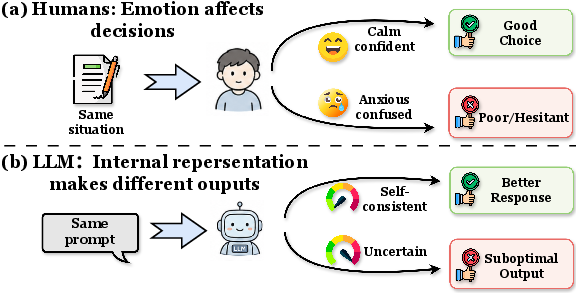
Usually, the AI chooses a skill by looking only at the words in the task and the information it has seen. The researchers ask whether the AI’s hidden internal signals—similar to signals related to confusion, confidence, curiosity, or frustration—could also help it make better choices.
The important point is that the paper does not claim that AI has feelings like a human. Instead, it studies mathematical patterns inside the model that are connected to emotion-related concepts.
2. What questions are the researchers asking?
The paper focuses on several main questions:
- Can an AI’s hidden internal information reveal emotion-related states? For example, can the system’s internal activity suggest that it is confused or uncertain?
- Can these internal signals help the AI choose skills more effectively? The researchers want to know whether the AI should use one skill when it seems confident and another when it seems confused.
- Can these signals help improve skills over time? If the AI’s internal state suddenly changes during a task, could that help researchers find the exact moment when something went wrong?
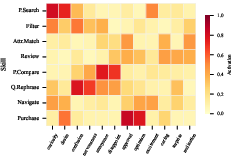
- Do the emotion–skill connections make sense? For example, does “curiosity” often appear when the AI searches for a product, and does “confusion” appear when it needs to rewrite a search query?
3. How did the researchers approach the problem?
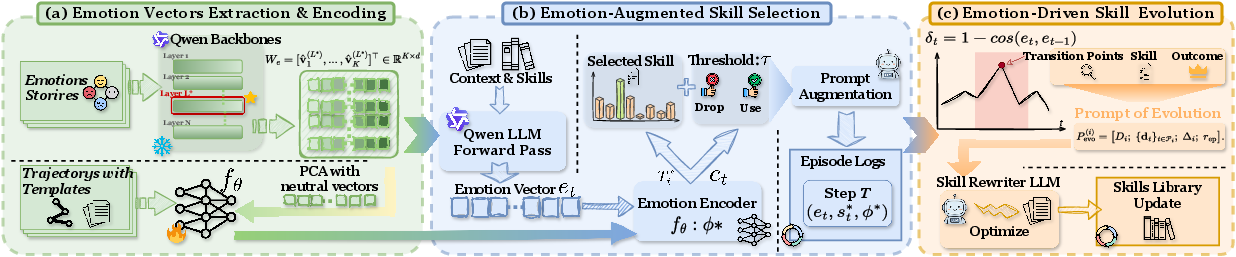
Finding emotion-related patterns inside the model
The researchers examined the model’s residual stream. This is a collection of numbers passed through the different layers of a LLM as it reads and processes text. It can be imagined as a long-running internal message board where different parts of the model store and update information.
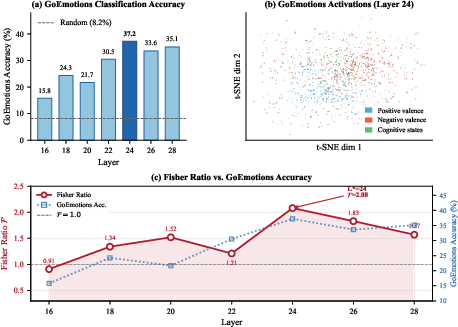
They created examples involving 27 emotion categories, based on the GoEmotions dataset. These categories include emotions such as joy, anger, sadness, confusion, curiosity, and nervousness.
By comparing the model’s internal activity for different emotional examples, they found directions in the model’s mathematical space that were associated with each emotion. In simple terms, they looked for patterns like:
“When the model processes text about curiosity, which numbers inside the model tend to change in a similar way?”
This produced a 27-number emotion vector at each decision point. Each number represented the strength of one emotion-related signal.
Turning numbers into useful descriptions
Numbers alone are difficult for a LLM to use in a prompt. Therefore, the researchers trained a small neural network called an emotion encoder.
The encoder changed the 27-number vector into:
- A short natural-language description, such as a state involving confusion or curiosity
- A confidence score showing how useful or reliable the signal seemed
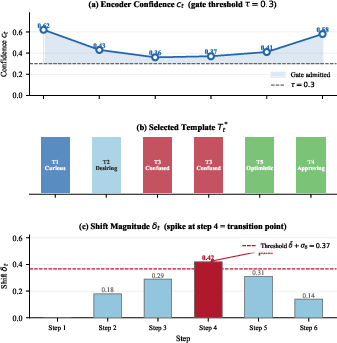
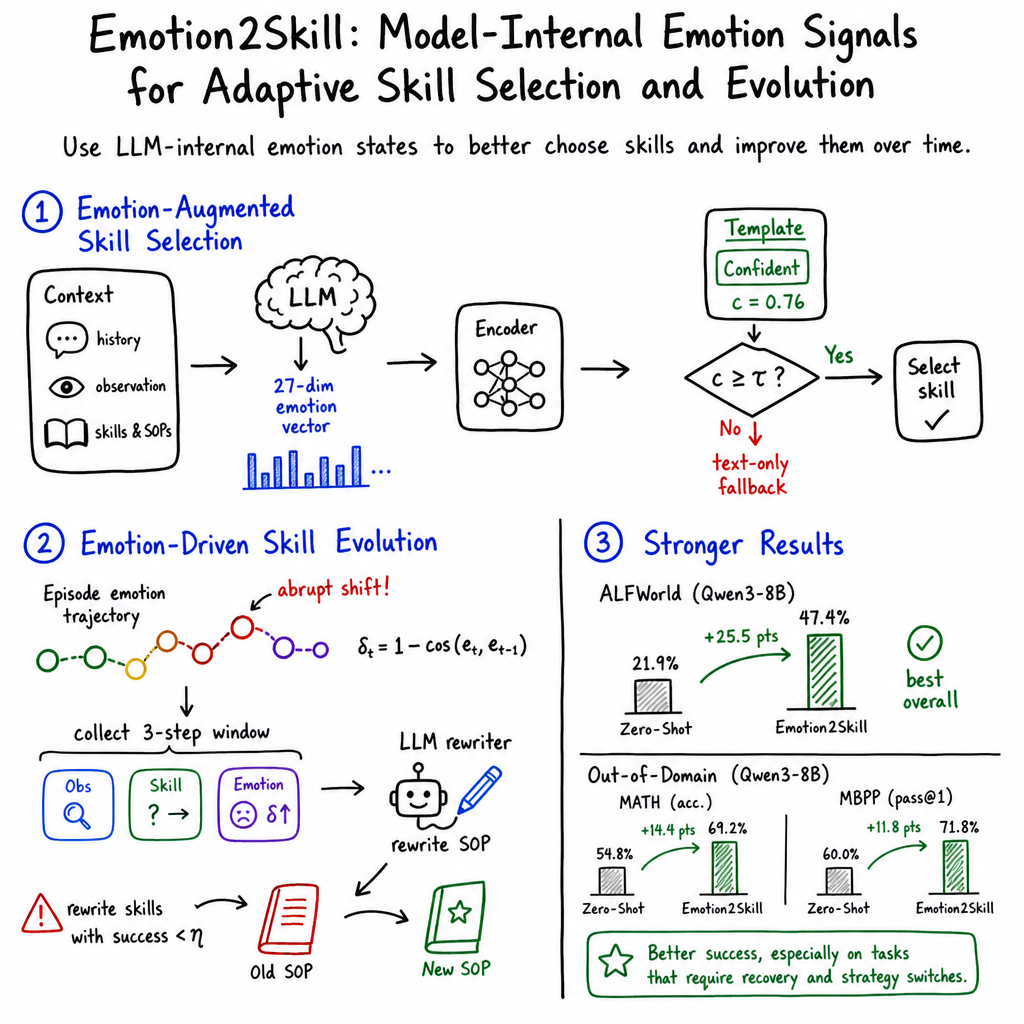
The system used a confidence gate. If the confidence was too low, it ignored the emotion information and used the normal text-based method. This is similar to a student saying, “I am not sure about this clue, so I will not rely on it.”
Using emotion signals to choose skills
At every decision step, the AI received:
- The task instructions
- The conversation and observations so far
- The available skills
- The emotion summary, when its confidence was high enough
The AI then selected the skill that seemed most appropriate.
For instance:
- A curiosity-like signal might support a product-search skill.
- A confusion-like signal might support a query-rewriting skill.
- An annoyance or disappointment signal might suggest comparing prices again.
Using emotion changes to improve skills
The researchers also tracked the emotion vector throughout an entire task. They looked for sudden changes between one step and the next.
A large sudden change might mean that the AI encountered a problem, such as:
- An action failing
- An instruction being misunderstood
- The AI becoming uncertain about what to do next
These moments were given to a rewriting system, which used them to improve the relevant skill instructions. This is more detailed than simply recording whether the whole task ended in success or failure.
An analogy is the difference between saying:
“The student failed the test”
and saying:
“The student became confused while solving question 7 because the instructions were unclear.”
The second explanation is more useful for improving future performance.
4. What did the researchers find?
The researchers tested Emotion2Skill on two interactive tasks:
- WebShop: an AI must search for and buy products on a website.
- ALFWorld: an AI must complete household tasks in a text-based environment, such as finding, cleaning, heating, or cooling objects.
They tested two versions of the Qwen3 LLM: Qwen3-8B and Qwen3-14B. The numbers refer roughly to the size of the models.
Better task performance
According to the paper, Emotion2Skill performed better than the basic Zero-Shot system.
For Qwen3-8B:
- On ALFWorld, average success increased from 21.9% to 47.4%.
- On WebShop, success increased from 2.8% to 29.7%.
The paper also reports that Emotion2Skill performed better overall than the other tested systems, including ReAct, Reflexion, ExpeL, and MASA.
The method also improved performance with the larger Qwen3-14B model:
- ALFWorld success increased from 23.4% to 52.3%.
- WebShop success increased from 9.4% to 30.7%.
Biggest improvements when the AI was uncertain
The largest improvements appeared in tasks that required the AI to recover from mistakes or change strategies.
For example, on one ALFWorld task called Heat, the Qwen3-8B system improved from 9.6% success to 56.9%. The researchers believe the internal signals helped the AI notice uncertainty or confusion before the problem was obvious in the written observations.
All major parts of the system helped
The researchers performed ablation studies. This means they removed one part of the system at a time to see what happened.
They found that performance dropped when they removed:
- The special method for extracting emotion signals
- The emotion encoder
- The emotion-based skill-improvement process
This suggests that the full system worked better than simply adding a few emotion words to the prompt.
Emotion–skill connections were often understandable
The researchers found several patterns that appeared meaningful:
| Emotion-related signals | Skill often connected with them |
|---|---|
| Curiosity and desire | Searching for a product |
| Confusion and nervousness | Rewriting a search query |
| Approval and optimism | Confirming a purchase |
| Annoyance and disappointment | Comparing prices |
An evaluation found that about 76.5% of sampled emotion–skill pairings were judged semantically reasonable. This supports the idea that the system was using useful internal information rather than completely random correlations.
The method also worked in other areas
The researchers tested the approach on:
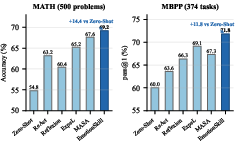
- MATH, a collection of mathematical problems
- MBPP, a collection of programming tasks
Emotion2Skill improved performance compared with the basic system:
- MATH accuracy rose from 54.8% to 69.2%
- MBPP pass rate rose from 60.0% to 71.8%
This suggests that the internal signals may be useful beyond shopping and household tasks.
5. Why are these results important?
Most systems choose skills using only visible information, such as the task description or previous written messages. But an AI may have important information inside its hidden processing that is not written down.
Emotion2Skill tries to make some of that hidden information available to the skill-selection process. It is like allowing a pilot’s instruments to help with decisions, rather than relying only on what can be seen through the window.
The method could help AI agents:
- Notice confusion earlier
- Recover from mistakes more effectively
- Choose different strategies when a task becomes difficult
- Improve their instructions by identifying exactly where failures begin
- Make decisions using both outside information and internal signals
Conclusion and possible impact
The paper argues that emotion-related patterns inside LLMs can be useful for more than studying or controlling the model’s answers. They can also help an AI agent decide which skill to use and when to change that skill.
If the results hold up in further research, future AI assistants could become better at long, complicated tasks. They might recognize when their current plan is not working and switch to a more suitable procedure before failing completely.
However, the system still has limitations. The “emotions” are mathematical representations, not proof that the AI experiences emotions. The experiments were also carried out on particular models and benchmarks, so more testing is needed in real-world situations.
Overall, Emotion2Skill presents a new idea: an AI’s hidden internal state may contain useful clues about how it should act, and those clues can help it become a more flexible and reliable problem solver.
Knowledge Gaps
The paper leaves the following knowledge gaps, limitations, and open questions unresolved:
- Causal contribution to routing is not directly established. The study shows performance gains after injecting emotion summaries, but does not intervene on individual emotion dimensions or perform counterfactual routing tests to demonstrate that the emotion signals themselves cause better skill choices.
- The emotion vectors may encode uncertainty, difficulty, or textual artifacts rather than emotion. The paper does not disentangle affective information from task difficulty, linguistic style, prompt position, tokenization effects, or generic confidence signals.
- The claim that emotion is a causal proxy for internal decision state is under-validated. Causal evidence from prior interpretability work is cited, but the paper does not establish that the extracted vectors causally represent the agent’s decision state in WebShop, ALFWorld, MATH, or MBPP.
- The encoder’s training targets are potentially circular and weakly grounded. It is trained using baseline skill selections and episode outcomes, so it may learn correlations with the baseline policy or task labels rather than a generally useful mapping from internal states to routing decisions.
- The confidence score is not calibrated or independently validated. The paper does not report calibration metrics, reliability curves, or whether low-confidence states actually correspond to less informative or less accurate routing signals.
- The choice of the 0.3 confidence threshold is insufficiently justified. Threshold sensitivity is tested only at a few values and on the Qwen3-8B setting; the optimal threshold may vary across models, tasks, skill libraries, and distributions.
- The fixed 27-category GoEmotions representation may be incomplete for agent decision-making. The study does not examine whether appraisal dimensions, valence-arousal representations, domain-specific states, or non-emotional latent features would provide stronger routing signals.
- Emotion extraction is not tested under distribution shift. The same extractor is reused across domains, but robustness to different prompts, languages, interaction styles, environments, or adversarially phrased inputs remains unknown.
- Layer and token-position choices may be overfit. The extraction layer is selected using GoEmotions classification accuracy, while the inference representation is taken from a specific assistant-delimiter position; alternative layers, token positions, pooling methods, and multi-layer combinations are not systematically compared.
- The reported GoEmotions validation is limited by the hit-any metric. Because a prediction is counted as correct when it matches any human label, the 37.2% and 39.4% accuracies may overstate fine-grained emotion identification and are not directly comparable to standard single-label or multilabel metrics.
- The extraction procedure’s sensitivity to the synthetic stories is unexplored. The paper does not assess how the choice, diversity, length, authorship, or number of generated emotion stories affects the learned directions.
- The role of PCA denoising is not isolated. No ablation evaluates how many principal components are removed or whether PCA improves routing because it removes stylistic information, useful task information, or accidental artifacts.
- The encoder architecture and template bank are underexplored. The paper does not compare the 3-layer MLP and 12 templates with simpler regressors, continuous numerical summaries, learned textual descriptions, or larger and task-specific template banks.
- Prompt-format effects are not separated from emotion effects. Adding extra text, a confidence value, and a structured template may improve performance through prompt engineering or increased context, independently of the underlying emotion representation.
- The confidence value’s usefulness is not independently measured. It is injected as text, but the paper does not compare it with random confidence values, calibrated uncertainty estimates, model token probabilities, entropy, or verbalized confidence.
- The routing mechanism is evaluated mainly against relatively limited baselines. Comparisons do not include stronger modern retrieval, learned router, reranking, reinforcement-learning, activation-based, uncertainty-based, or hybrid emotion-plus-reward methods.
- The complementarity with external reward or similarity signals remains untested. The paper explicitly leaves combinations with skill-optimization and reinforcement-learning approaches to future work, so it is unclear whether emotion signals provide additive gains or redundant information.
- The benefits of selection and evolution are not fully disentangled over time. The reported ablations remove components, but the paper does not provide learning curves or factorial experiments that quantify the separate and interactive effects of emotion-based online selection and emotion-based SOP rewriting.
- Emotion-driven evolution may not reliably identify the cause of failure. A large cosine shift can reflect a benign strategy change, a new observation, or normal generation variability rather than a defective skill invocation; causal validation of transition points is absent.
- The one-standard-deviation transition criterion is arbitrary. The paper does not compare it with fixed thresholds, robust statistics, temporal smoothing, change-point detection, or task-aware attribution methods.
- The evolution procedure may amplify spurious correlations or cause skill drift. Repeatedly rewriting skills based on noisy internal-state transitions could degrade previously successful behavior, but regression tests, rollback mechanisms, and library stability analyses are not reported.
- The effect of skill-library size and composition is unknown. Experiments use relatively small libraries, and the paper does not test whether emotion-based routing scales to dozens or hundreds of skills, overlapping SOPs, missing skills, or dynamically changing libraries.
- The method’s computational and latency costs are not quantified. The paper does not report additional forward-pass cost, memory use, encoder overhead, prompt-length increase, evolution cost, or end-to-end inference latency relative to text-only agents.
- Statistical evidence is limited. Main results are averaged over only three runs, and uncertainty estimates, significance tests, confidence intervals, per-seed results, and episode-level variance are not comprehensively reported.
- The benchmark coverage is narrow. WebShop and ALFWorld provide only two interactive environments, while MATH and MBPP provide limited evidence for generalization; broader domains, longer horizons, multimodal settings, and real-world interaction are not evaluated.
- Generalization experiments may not isolate domain transfer. MATH and MBPP use newly constructed skill libraries and different task procedures, but the paper does not clarify whether the libraries, prompts, demonstrations, and router configuration were independently designed without task-specific tuning.
- The reported co-activation patterns do not prove semantic routing. Correlation between emotion activations and selected skills may arise because both are driven by the same observations or task stages; controlled analyses and counterfactual tests are needed.
- The GPT-4o coherence evaluation introduces an unexamined judge bias. The semantic-consistency score depends on an automated evaluator, with only a 50-event human subset, and the annotation protocol, class balance, and inter-rater reliability are not described in sufficient detail.
- Failure cases are not analyzed in depth. The paper does not characterize when emotion augmentation harms performance, which emotion dimensions are misleading, or whether failures differ across task types, model sizes, or successful versus unsuccessful episodes.
- Robustness to prompt injection and adversarial manipulation is unknown. Since emotion summaries are converted into natural-language prompt content, malicious observations, skills, or generated states might manipulate routing through the emotion channel.
- The method’s safety implications are unexplored. Emotion signals may reinforce frustration, overconfidence, or other undesirable behaviors, yet no evaluation examines harmful actions, refusal behavior, bias, or reliability in safety-critical tasks.
- Cross-model and cross-family portability remains unresolved. Results are restricted to Qwen3-8B and Qwen3-14B; it is unknown whether the extraction procedure, layer scaling, templates, and encoder transfer to other architectures or independently trained models.
- The relationship between internal emotion representations and human emotions is not established. Mapping residual directions to GoEmotions labels does not show that the model experiences or uses emotions in a human-like manner, and the paper does not examine whether anthropomorphic labels improve or distort interpretation.
- The proposed future closed-loop learning direction is not implemented. The framework currently transfers emotion information to skills in one direction; whether executed skills can reliably update, calibrate, or improve emotion representations remains an open question.
Practical Applications
Here is an analysis of the practical, real-world applications of the "Emotion2Skill" paper, with specific actionable use cases categorized by immediacy and sector. Each application notes dependencies and assumptions that could affect feasibility.
Immediate Applications
The following use cases leverage methods or findings from Emotion2Skill that can be deployed today, given the availability of compatible LLMs and access to their internal representations:
- Enhanced LLM-Based Interactive Agents
- Context: Using Emotion2Skill, agents can select and evolve procedural “skills” not just from environmental cues, but also from their own model-internal emotion vectors.
- Use Cases:
- E-commerce platforms (e.g., product recommendation chatbots, virtual shopping assistants) can route customer queries through a more adaptive skill selection, improving user satisfaction and conversion rates.
- Service robotics (e.g., household robots, delivery bots) can better recover from errors or user confusion by recognizing their own internal signals of uncertainty or frustration.
- Virtual tutors or teaching assistants can adapt explanations or exercises in real-time based on detected internal states of confusion, curiosity, or confidence.
- Assumptions/Dependencies: Requires the ability to extract and encode LLM internal residual activations; relies on accurate mapping from emotion signals to actionable skill selection. Performance is dependent on LLM version and compatibility (tested on Qwen3-8B/14B).
- Diagnostics for Skill Library Maintenance
- Context: Emotion trajectories can localize exactly where (which episode steps) an agent’s skill failed, enabling targeted SOP (Standard Operating Procedure) updates.
- Use Cases:
- Developers and ML engineers can use emotion-based diagnostics to perform more precise debugging and iterative improvement of agent skills, going beyond coarse binary success/failure logs.
- Version control systems for agent skill libraries can integrate emotion-based diagnostics to highlight segments needing revision.
- Assumptions/Dependencies: Assumes developers can access and interpret emotion diagnostics; frameworks must support emotion extraction and episode-logging.
- Skill Selection Algorithms for General-Purpose LLM Agents
- Context: Emotion2Skill’s algorithms can be immediately adapted and incorporated into other LLM agent platforms (e.g., open-world games, research-oriented agent prototypes).
- Use Cases:
- Academic benchmarks and competitions involving LLM-based agents can integrate emotion-augmented skill selection to improve task success rates and agent robustness.
- Automation workflows (e.g., process automation bots) can adapt skill routing during execution based on their internal state, potentially reducing task failure rates.
- Assumptions/Dependencies: Availability of an agent architecture with modular, callable skills; technical support for pipeline modification and LLM internal access.
- Out-of-Domain Transfer to Other Reasoning Tasks
- Context: Emotion2Skill demonstrated gains on MATH and MBPP (coding) tasks, suggesting broader applicability beyond interactive agents.
- Use Cases:
- Educational AI tools (for mathematics or programming) can use internal emotion signals to adaptively break down or rephrase student queries, improving problem-solving experiences.
- Coding assistants can leverage internal signals of confusion or hesitation to self-route code generation, decompose reasoning steps, or even ask clarifying follow-up questions.
- Assumptions/Dependencies: Downstream task environments must support modular skills; emotion extractors should be validated for new LLMs/domains.
Long-Term Applications
The following use cases require further research, scaling, or ecosystem development before practical deployment:
- Closed-Loop Affective Agent Systems
- Context: The paper proposes future work on “closed-loop” systems where skill performance feedback shapes the agent’s own internal emotion state, enabling mutual adaptation.
- Potential Use Cases:
- Advanced collaborative robots that adjust not just skills but also internal affective states in response to success, failure, and external feedback—facilitating more “human-like” adaptive learning.
- Next-gen digital companions (mental health assistants, therapists) whose service delivery dynamically adjusts both “skills” and underlying affective traits—improving long-term engagement and empathy.
- Assumptions/Dependencies: Requires theoretical advances and engineering solutions for bidirectional emotion–skill adaptation; robust real-time extraction and updating of internal emotion states—possibly challenging in production LLMs.
- Emotion-Aware Policy Design and Decision Transparency
- Context: Emotion2Skill’s use of interpretable emotion-state summaries may be harnessed to make AI decision processes more transparent and auditable by humans.
- Potential Use Cases:
- Regulatory or compliance frameworks could mandate that AI agents report emotion-based rationales for critical skill choices, boosting trust and interpretability.
- Emergency/autonomous decision-making in finance, healthcare, or critical infrastructure, where human supervisors could monitor or override AI actions based on flagged internal affective states.
- Assumptions/Dependencies: Adoption would require acceptance of emotion-signal interpretations as valid proxies for decision states; standardization of interfaces for extracting and reporting such signals; further validation for safety-critical contexts.
- Domain-Specific Skill Routing for High-Stakes Environments
- Context: Emotion2Skill principles could, with adaptation, improve LLM-based decision support in domains involving high uncertainty and risk.
- Potential Use Cases:
- Medical diagnostic or triage assistants dynamically escalating or rerouting ambiguous cases based on internal confidence/frustration signals.
- Semi-autonomous vehicles or drones recognizing when their own “confidence” or “confusion” warrants requesting human operator intervention or switching to safer operation modes.
- Assumptions/Dependencies: High bar for reliability and validation; regulatory and ethical considerations; may require hybrid architectures combining LLMs with symbolic planners or sensors.
- Toolkits for Emotion-Driven Agent Training and Benchmarking
- Context: Generalizing and standardizing emotion extraction, encoding, and routing toolkits for the broader community.
- Potential Use Cases:
- Open-source software libraries enabling drop-in emotion-to-skill pipelines for arbitrary LLM agents, with established benchmarks and visualization dashboards for emotion/skill trajectories.
- Large-scale community benchmarks facilitating competition and comparison between emotion-augmented agents across domains.
- Assumptions/Dependencies: Requires broad LLM support for internal state extraction (may not be available on closed/proprietary API models); standardization and community adoption.
Summary Table
| Application Domain | Immediate / Long-Term | Sector(s) | Key Dependencies |
|---|---|---|---|
| Enhanced Interactive Agents | Immediate | E-commerce, Robotics, EdTech | LLM internal access, skill library |
| Skill Maintenance/Debugging | Immediate | Software, MLOps | Logging infra, dev access |
| Benchmarks/Agent Research | Immediate | Academia, Automation | Agent frameworks, LLM hooks |
| EdTech Tools (MATH/MBPP) | Immediate | Education, Coding | Modular skills, LLM access |
| Closed-Loop Affective Agents | Long-Term | Robotics, Companions | Bidirectional emotion updating |
| Decision Transparency/Policy | Long-Term | AI Policy, Finance, Health | Interpretability protocols |
| High-Stakes Domain Routing | Long-Term | Healthcare, AV, Industry | Regulatory validation, hybrid systems |
| Emotion-Driven Toolkits/Benchmarks | Long-Term | Research, Platforms | LLM ecosystem, open-source infra |
Note: All applications presuppose availability of LLMs supporting internal activation access (not always possible for proprietary APIs), and successful emotion direction extraction (currently demonstrated on Qwen3). Effectiveness relies on emotion–decision causality holding in the target domain.
Glossary
- Affective state: An internal emotional condition that influences perception, judgment, or behavior. “human decisions are shaped not only by external stimuli but also by internal affective states”
- Agentically relevant behavior: Behavior that directly affects an autonomous agent’s actions or task performance. “causally influence agentically relevant behaviors”
- Activation space: The mathematical space formed by neural activation vectors. “high-level semantic concepts as linear directions in activation space”
- Ablation study: An experiment that removes or changes components of a system to measure their individual contributions. “Ablation studies verify that every module brings non-redundant effectiveness”
- Appraisal vector: A vector representation of evaluative dimensions involved in emotional appraisal. “We adopt these categorical directions rather than appraisal vectors”
- Auxiliary context: Additional information supplied to a model alongside its primary input. “serves as auxiliary context that makes the agent's latent state explicit”
- Backbone model: The primary pretrained model on which an experimental system is built. “all methods are reproduced on both Qwen3-8B and Qwen3-14B”
- Causal proxy: An observable representation used as an indirect indicator of a causally influential internal variable. “emotion vectors as a causal proxy for the agent's latent decision state”
- Causal steering: Deliberately modifying internal model representations to change model behavior. “causally steered to alter model behavior”
- Cohen’s kappa: A statistic measuring agreement between annotators beyond agreement expected by chance. “Cohen's vs.\ human annotation on a 50-event subset”
- Confidence gating: A mechanism that uses a confidence threshold to decide whether information should be provided to a model. “When , is omitted from the prompt entirely (confidence gating)”
- Contrastive averaging: A representation-extraction method that derives a concept direction by comparing concept-specific averages with a broader average. “We extract emotion directions from the agent model following the contrastive-averaging procedure”
- Contrastive loss: A learning objective that brings related representations closer and separates unrelated representations. “The objective combines a supervised-contrastive loss”
- Cosine distance: A distance measure based on the angular difference between two vectors. “This quantity measures the cosine distance between consecutive emotion states”
- Cosine similarity: A measure of the angular alignment between two vectors. “classify each example by assigning it to the emotion direction with the highest cosine similarity”
- Cross-entropy: A loss function that measures the difference between a target probability distribution and a model’s predicted distribution. “minimizes the cross-entropy over prototype similarities”
- Decision-level signal: Information used directly to guide an agent’s choice among actions or procedures. “as an effective decision-level signal for orchestrating agent skill systems”
- Discriminability ratio: A statistical measure of how well groups can be distinguished relative to within-group variation. “Fisher discriminability ratio peaks at layer~24”
- Emotion trajectory: The sequence of emotion representations recorded across the steps of an episode. “Let denote the emotion trajectory of a completed episode”
- Encoder: A model component that transforms an input representation into another representation or output. “We therefore introduce a lightweight emotion encoder ”
- Experiential learning: Learning from accumulated interaction episodes or experience-derived lessons. “and experiential learning”
- Fisher ratio: A measure comparing between-class variance with within-class variance. “Fisher's ratio $\mathcal{F}{=}\sigma^2_{\text{between}/\sigma^2_{\text{within}$ peaks at layer~24”
- Forward pass: The computation performed when an input is propagated through a neural network to produce activations. “A forward pass through each story yields activations”
- GoEmotions taxonomy: A dataset-based classification scheme containing 27 fine-grained emotion categories. “the 27-category GoEmotions taxonomy”
- Hidden-state feature: An attribute encoded in a neural network’s internal activations but not directly exposed as text. “Unlike generic hidden-state features”
- Intrinsic skill representation: An internal representation of a skill used by an agent, rather than a textual description alone. “hierarchical reinforcement learning over intrinsic skill representations”
- Latent decision state: An unobserved internal state that summarizes information relevant to an agent’s decision. “makes the agent's latent state explicit”
- Layer sweep: An evaluation across multiple neural-network layers to identify the layer producing the best results. “a separate sweep over ”
- Linear representation: A concept encoded as a direction or linear structure in a model’s activation space. “LLMs maintain linear emotion representations”
- Long-horizon task: A task requiring many sequential actions or decisions before completion. “solve complex, long-horizon interactive tasks”
- Mechanistic interpretability: The study of how specific internal model components and representations produce behavior. “concurrent mechanistic studies further show that such emotion structure”
- Mean pooling: Combining multiple token representations by averaging them into one representation. “We mean-pool over tokens past an initial prefix”
- Multi-label classification: Classification in which an example may belong to multiple categories simultaneously. “Because GoEmotions is multi-label”
- On-policy self-distillation: Training a model using outputs or supervision generated from its own current policy. “applies on-policy self-distillation for dense skill-level supervision”
- PCA-based denoising: Noise reduction using principal component analysis to remove dominant, unwanted variation. “a PCA-based denoising step projects out the top principal components”
- Pass@1: The proportion of programming tasks solved by the first generated answer. “metric: per-type and average Success\%” and “pass@1”
- Post-hoc analysis: Analysis performed after a model has generated outputs, without influencing the original process. “exploited only for post-hoc analysis”
- Principal component analysis (PCA): A dimensionality-reduction technique that identifies directions explaining the greatest variance in data. “the top principal components of emotionally neutral activations”
- Prototype: A learned representative vector associated with a class or template. “each template is associated with a learnable prototype ”
- Residual stream: The sequence of hidden activations passed through the residual connections of a transformer. “emotion representations encoded in the model's own residual stream”
- Representation geometry: The spatial and relational structure of vectors in a learned representation space. “exploit the full 27-dimensional geometry”
- Reward hacking: Behavior in which an agent exploits imperfections in a reward function rather than accomplishing the intended goal. “agentically relevant outputs such as reward-hacking and sycophancy rates”
- Skill evolution: The process of revising or improving reusable procedures based on task experience. “we propose Emotion2Skill, a framework that leverages emotion vectors for both skill selection and skill evolution”
- Skill routing: Selecting an appropriate reusable procedure for the current task state. “where they optimize skill routing through external reward or similarity feedback”
- SOP (standard operating procedure): A structured, reusable description of the steps for carrying out a procedure. “each skill is a reusable procedure described by a natural-language SOP ”
- Supervised-contrastive learning: Contrastive learning that uses labels to define which examples should have similar representations. “a supervised-contrastive loss”
- t-SNE: A nonlinear dimensionality-reduction method used to visualize high-dimensional data in a low-dimensional space. “Figure~\ref{fig:preliminary}b visualizes GoEmotions test activations at layer~24 via t-SNE”
- Trajectory distillation: Converting information from an agent’s execution trajectory into reusable knowledge or skills. “trajectory distillation”
- Valence-arousal subspace: A representation space describing emotion using positivity/negativity and activation/intensity dimensions. “or valence-arousal subspaces”
- Zero-shot baseline: A system evaluated without task-specific examples or additional training. “improves over the Zero-Shot baseline”
Collections
Sign up for free to add this paper to one or more collections.