- The paper presents a novel skill-centric approach that leverages intervention units to capture state–action–outcome patterns for improved emotional support.
- It employs manual and LLM-based annotations to construct over 17k Intervention Units and refines skills via simulation, achieving substantial performance gains such as a +12.06% accuracy boost and doubled success counts.
- The approach utilizes a closed-loop, multi-profile evolutionary framework to ensure adaptive, interpretable, and robust support across diverse conversational scenarios.
ESC-Skills: A Skill-Centric Framework for Self-Evolving Emotional Support Conversation Agents
Traditional ESC systems, predominantly LLM-based, largely adopt end-to-end generation or strategy-guided frameworks, resulting in limited interpretability and poor support for systematic behavioral improvement. Crucially, existing paradigms insufficiently capture the causal relationship between specific support interventions and a seeker's subsequent emotional state. The ESC-Skills framework departs from pure generation-centric approaches by explicitly modeling localized support interactions as Intervention Units (IUs), systematically structuring state–action–outcome triplets that encode pre-intervention seeker state, intervention action, and post-intervention emotional trajectory.
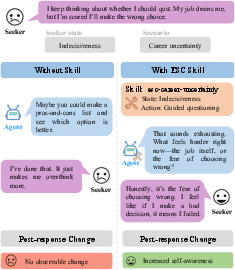
Figure 1: The impact of scenario-aware skill selection versus generic response generation, illustrating superior emotional improvement via explicit skill invocation.
ESC-Skills Bank Construction
The skill induction pipeline uses manually and LLM-annotated ESC and FailedESConv dialogue corpora. Each utterance is annotated with dialogue-level scenario, fine-grained seeker states (15 total), support actions (17 total, extending ESConv strategies), and post-intervention response-change labels (14 total). From these, over 17k Intervention Units are extracted, with pivotal emotional transitions classified as key IUs.
Skill prototypes are induced by grouping key IUs across (seeker state, support action) tuples, filtering out ineffective patterns. Semantic clustering merges compatible prototypes into recurring counseling scenarios (e.g., resistance handling, grief), yielding operational skills represented as SKILL.md documents per cluster. Each skill comprises structured metadata, activation conditions, recommended actions, failure modes, and representative examples.
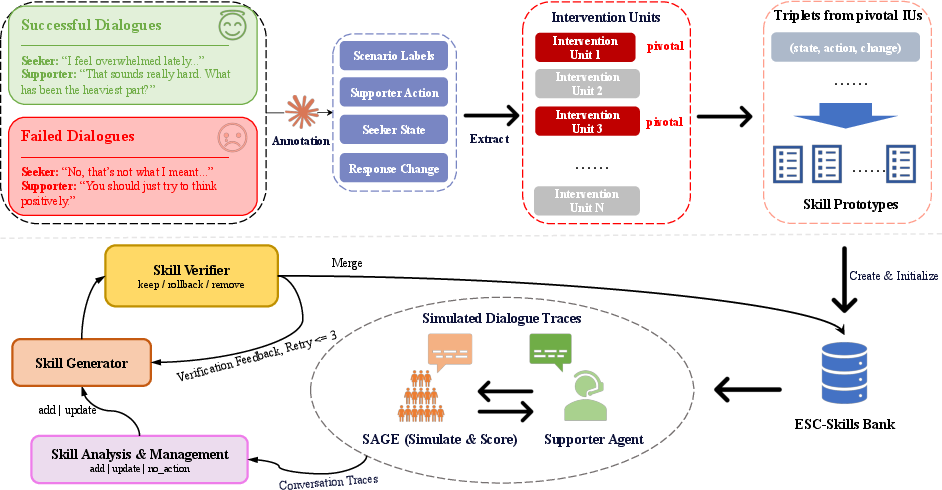
Figure 2: The ESC-Skills Bank induction (upper) and multi-profile self-evolutionary refinement loop (lower), detailing skill extraction, aggregation, and closed-loop improvement.
Multi-Profile Evolutionary Skill Refinement
To address skill brittleness and scenario-dependent failure, ESC-Skills employs a multi-profile simulation framework. Agent–seeker interactions across 500 RLVER-based profiles are conducted under SAGE, with annotated emotion scores and internal seeker thoughts as fine-grained evaluative signals. Claude-Opus analyzes conversation traces to diagnose skill gaps, recommend updates, and propose new skills. Evolutionary refinement involves generation–verification loops: updated and new skills are synthesized via LLM, then evaluated in challenging simulations; acceptance requires verifiable performance improvement (strict emotion score increases, success-state attainment). The iterative evolution yields a refined Skill Bank (B⋆, 34 skills), exceeding the static induction artifacts both in robustness and generality.
Experimental Evaluation and Ablation
Comprehensive benchmarks on ESConv (response-level) and SAGE (dialogue-level, 100 profiles) are conducted across diverse LLM backbones (Qwen3.6-Plus, GPT-5.4-Global, Gemini-3.1-Flash, Claude variants). Metrics include strategy prediction accuracy, BLEU, ROUGE, METEOR, BERTScore; SAGE metrics comprise average sentient score, success/failure counts, and emotional grade distribution.
ESC-Skills consistently outperforms No-Skill and baseline skill frameworks (Self-Generated, CoT-Guided, SkillCreator, HumanCurated), achieving significant gains in accuracy (e.g., +12.06% for Qwen3.6-Plus), response similarity, and dialogue-level outcomes (e.g., 31 vs 13 successful dialogues for Qwen3.6-Plus). Notably, static skills occasionally degrade dynamic performance due to rigid intervention patterns; only via simulation-based verification does the final bank realize substantial long-horizon improvements.
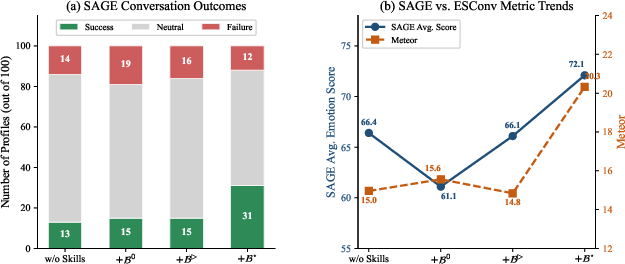
Figure 3: Ablation study on SAGE, showing skill bank evolution more than doubling success counts and reducing failures; METEOR lifts parallel SAGE gains.
Mechanistic Details: Intervention Units and Skill Structure
Intervention Units are formalized as IUt=(st,at,st+1). Each SKILL.md document operationalizes intervention prototypes via YAML frontmatter (metadata, version, category), scenario and state mapping, step-wise response construction protocols, anti-pattern libraries, and explicit edge-case management. Orchestration skills (e.g., esc-strategy-switching) implement dynamic strategy transitions to prevent stagnation (empathy-to-advice, crisis override).
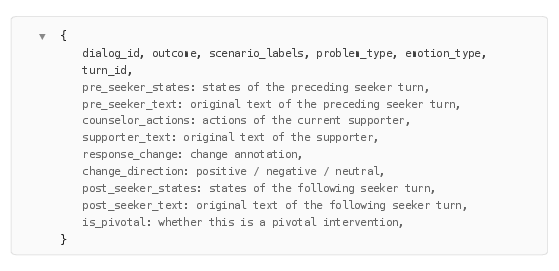
Figure 4: Anatomy of an IU, detailing turn-level context, emotional state, intervention action, and observed post-intervention outcome.
Human and LLM-Based Evaluation
Additional evaluation via GPT-Judge and human expert annotation confirms automatic metrics: ESC-Skills yields improved empathy, helpfulness, and overall response quality on Likert scales, with substantial inter-annotator agreement. Noteworthy, skill-induced improvements are consistent across weak and strong LLM agents.
Implications and Future Directions
ESC-Skills advances interpretability and controllability in ESC via explicit, modular skill encapsulation, facilitating transfer across model backbones and minimizing fine-tuning requirements. Practically, robust skill banks enable safer, more adaptive support in variable conversational scenarios, especially in high-risk or clinical contexts when combined with human oversight and dedicated safety classifiers.
Theoretically, the generation–verification refinement pipeline introduces a blueprint for agentic skill evolution in settings devoid of deterministic success signals. Skill-centric frameworks offer modularity, facilitating domain adaptation and extension to multilingual or broader supportive dialogue tasks.
Future developments may involve real-world user studies, deployment in low-resource models, adaptive skill complexity scaling, and continuous online evolution with safe update procedures and expert-in-the-loop validation.
Conclusion
ESC-Skills demonstrates that explicit, self-evolving skill banks—induced from annotated, outcome-driven intervention units and refined via closed-loop simulation—yield interpretable, robust, and adaptive emotional support agents. Its modular pipeline and simulation-driven verification provide generalizable methodologies for skill evolution across diverse LLM architectures, representing a significant shift towards skill-oriented agent design in ESC and allied domains.
Reference: "ESC-Skills: Discovering and Self-Evolving Skills for Emotional Support Conversations" (2605.27908)