Hunyuan3D-Buffalo 1.0: A Unified Multimodal Model for Scalable 3D Generation, Understanding, and Editing
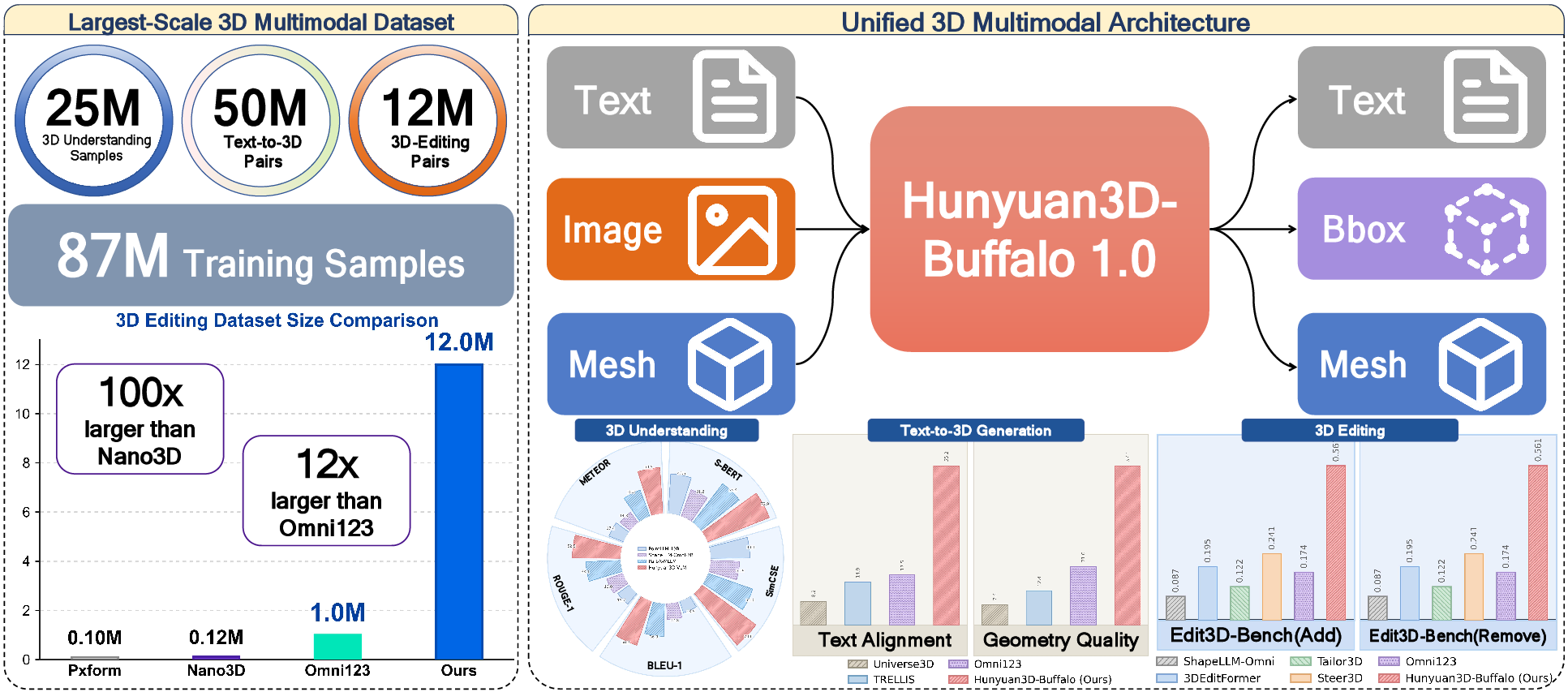
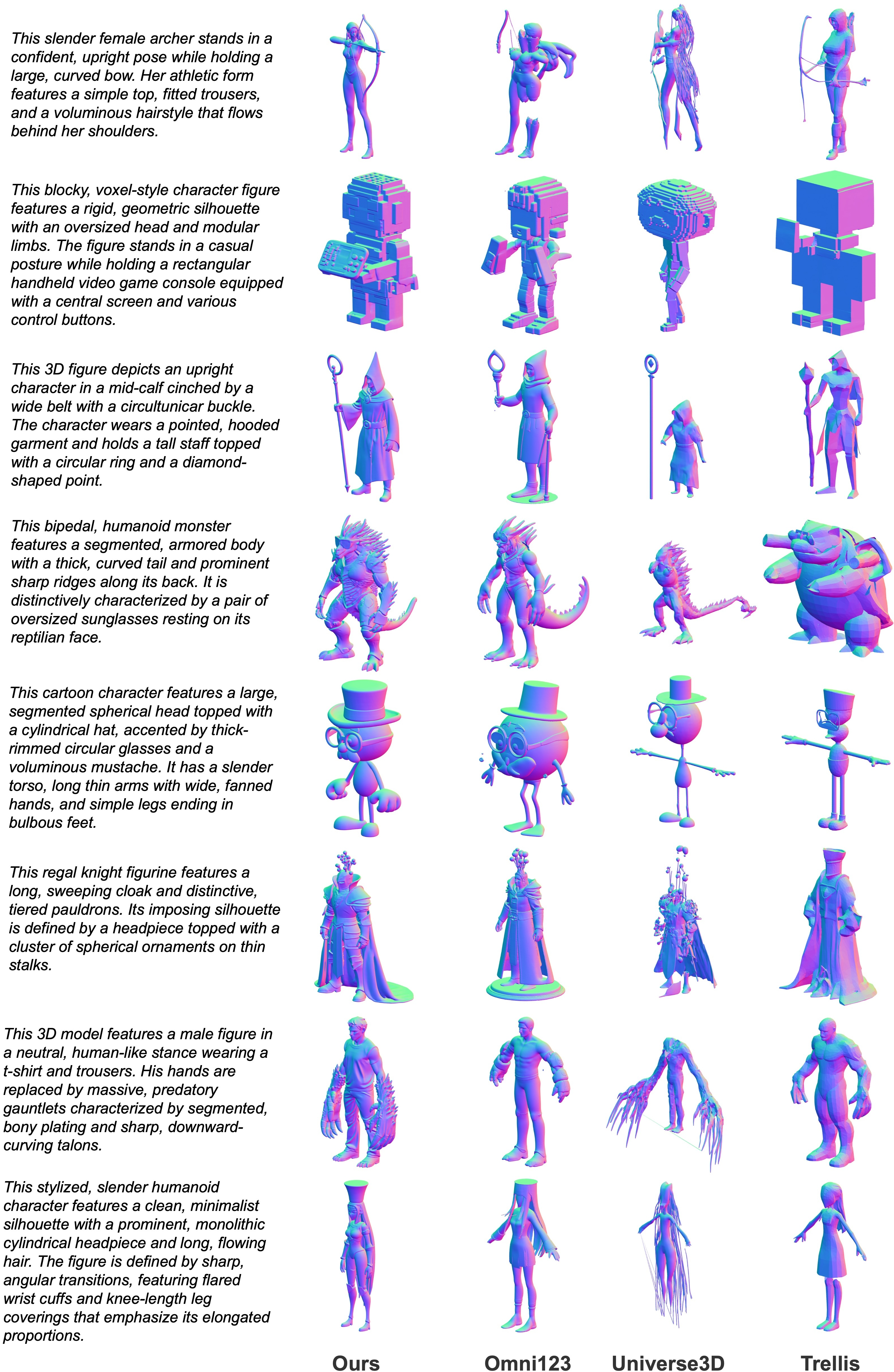
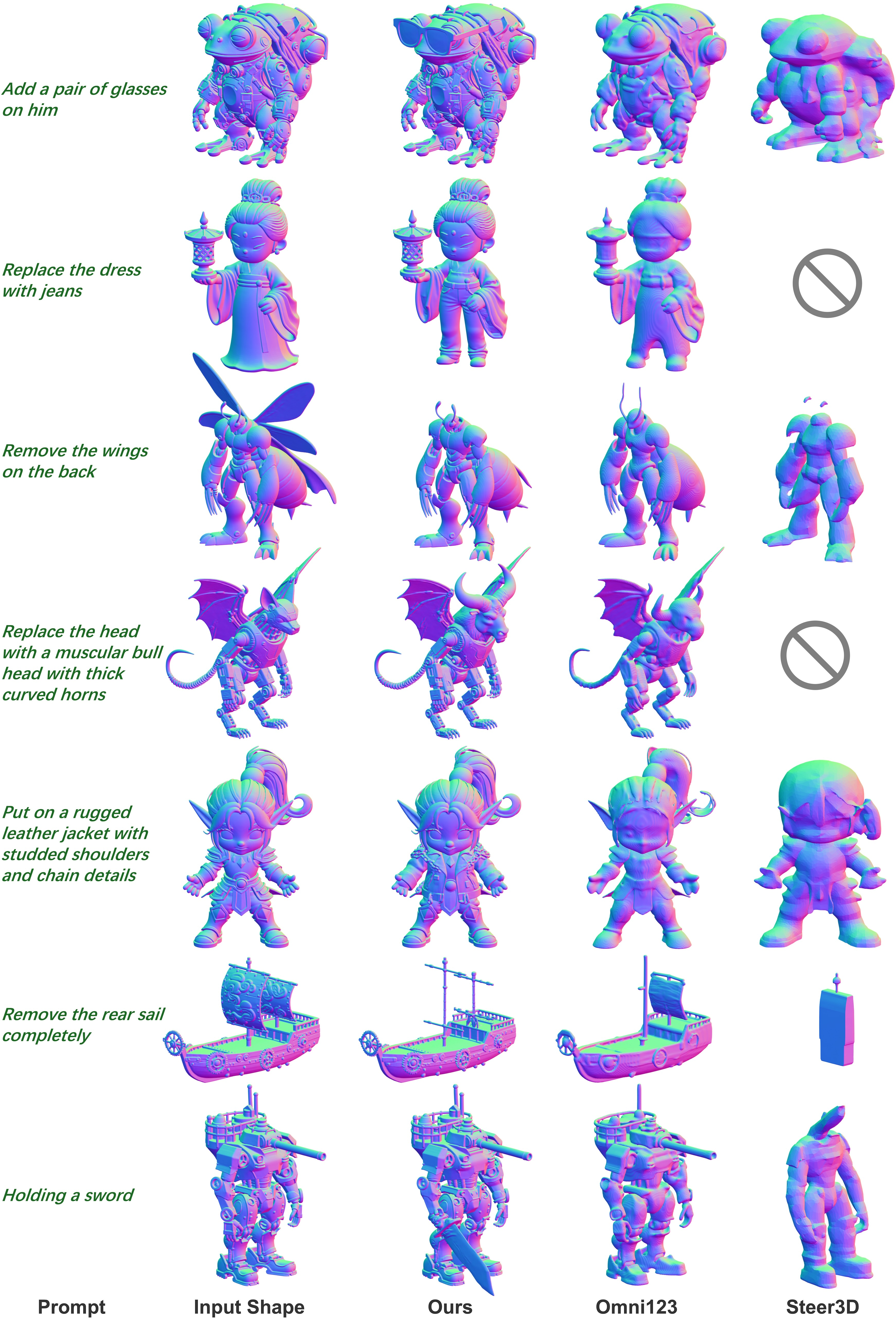
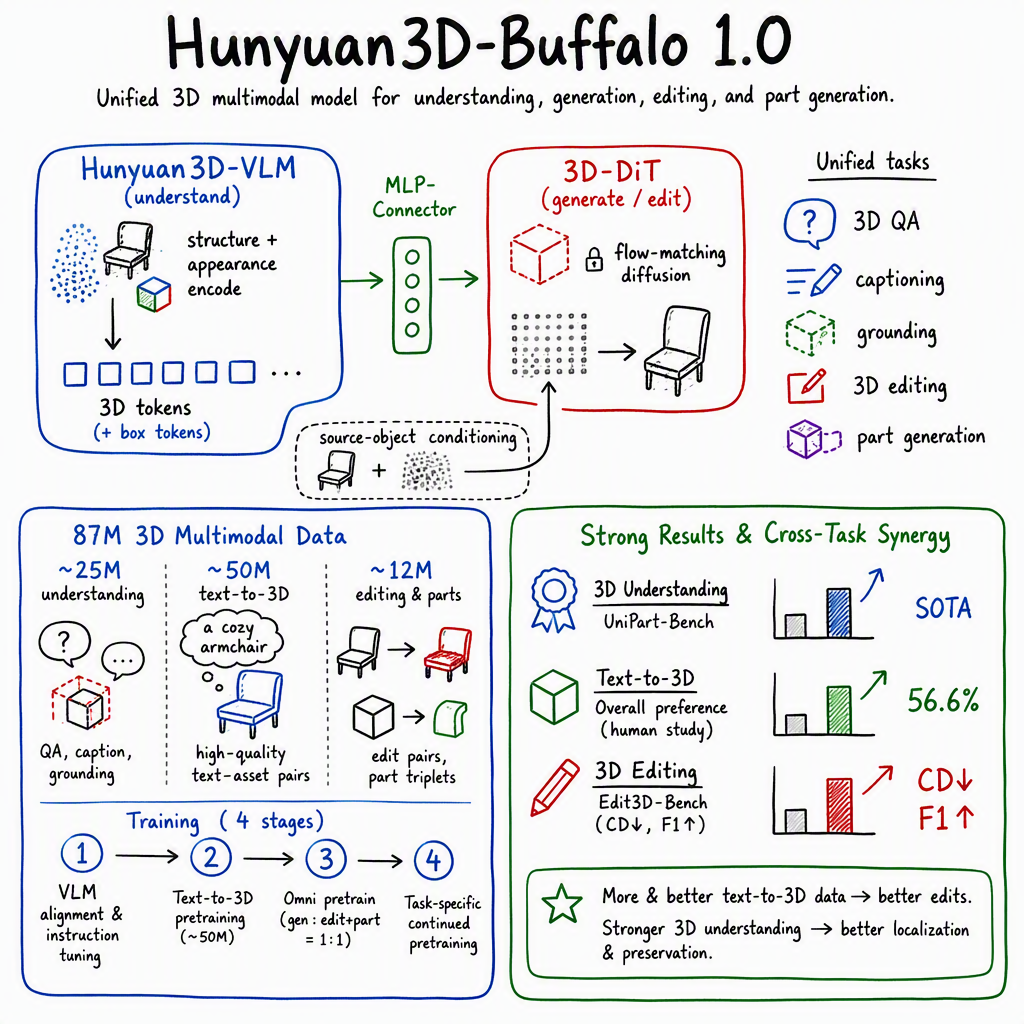
Abstract: Recent advances in image generation have demonstrated the potential of unified multimodal models that integrate understanding, generation, and editing. However, unified 3D modeling remains constrained by scarce multimodal data, particularly the lack of large-scale and geometrically consistent editing data. To address this limitation, we propose Hunyuan3D-Buffalo 1.0, a unified framework supporting 3D understanding, text-to-3D generation, instruction-guided 3D editing, and text-grounded part generation within a single architecture. To enable scalable training, we construct an 87M-scale 3D multimodal corpus, comprising 25M understanding samples, 50M text-to-3D pairs, and 12M editing pairs generated using Nano3D-v2. Architecturally, the framework combines Hunyuan3D-VLM for semantic, structural, and spatial understanding with Hunyuan3D DiT for high-fidelity 3D synthesis. The VLM provides multimodal semantic conditions for generation, while editing and part generation additionally condition the diffusion process on the source object representation to preserve its overall structure and unedited regions. Extensive experiments show that Hunyuan3D-Buffalo 1.0 achieves state-of-the-art or leading performance on text-to-3D generation and 3D editing benchmarks, while exhibiting strong understanding and part-generation capabilities. Our analysis further shows that both generation and understanding improve editing, demonstrating the effectiveness of unified 3D multimodal training. Project Page: https://tencent-hunyuan.github.io/Hunyuan3D-Buffalo1.0/

Paper Prompts
Sign up for free to create and run prompts on this paper using GPT-5.
Top Community Prompts
Explain it Like I'm 14
Plain-language summary of “Hunyuan3D-Buffalo 1.0: A Unified Multimodal Model for Scalable 3D Generation, Understanding, and Editing”
1) What is this paper about?
This paper introduces Hunyuan3D-Buffalo 1.0, an AI system that can do four things with 3D objects in one place:
- Understand 3D objects (describe them, answer questions, find parts)
- Create new 3D objects from text
- Edit existing 3D objects based on instructions
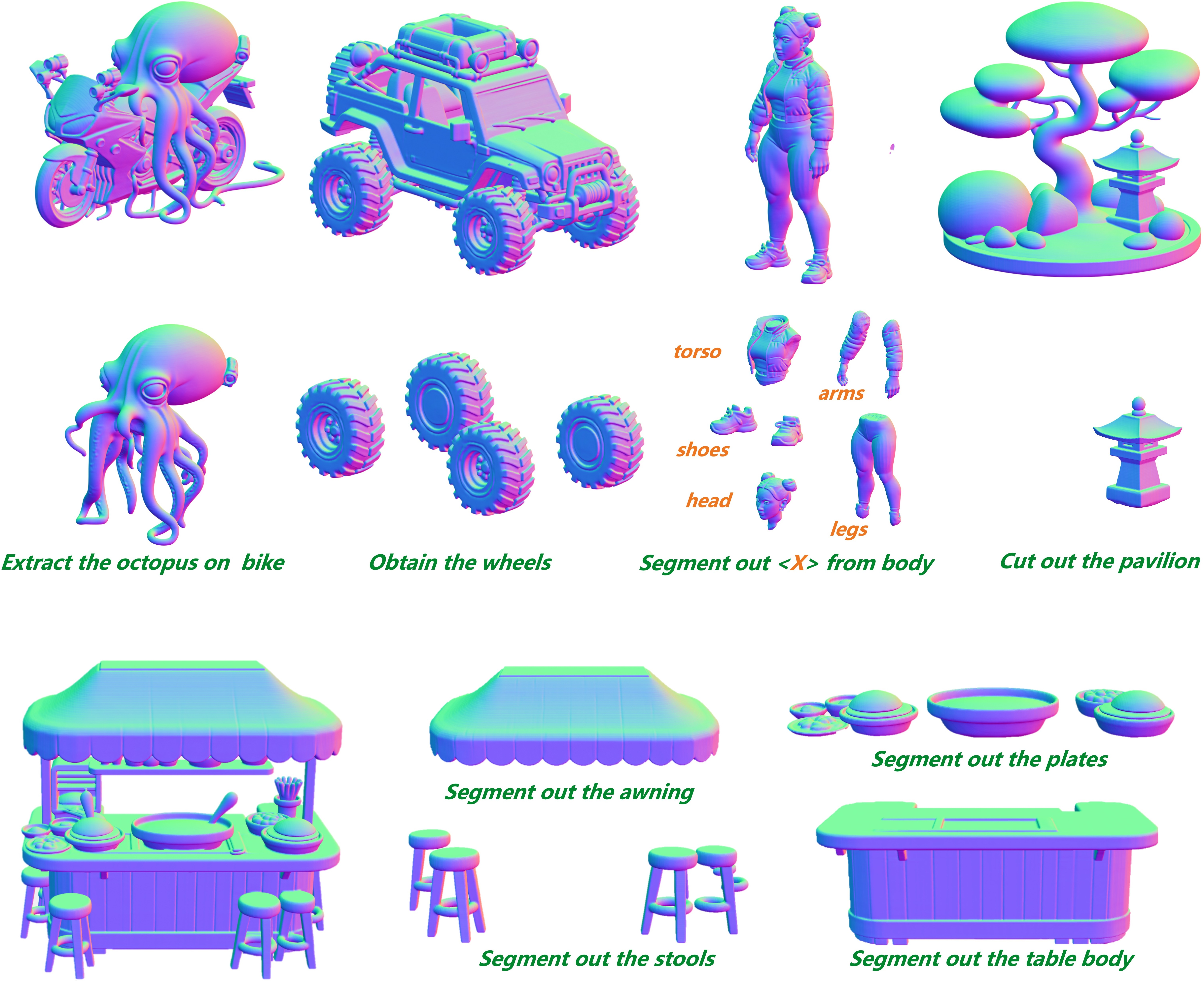
- Generate or remove specific parts of a 3D object (like “add wings” or “remove wheels”)
In short, it’s a single tool that reads, makes, and edits 3D models—all guided by natural language.
2) What questions does it try to answer?
The paper asks:
- Can one model handle many different 3D tasks at once (understanding, generating, and editing)?
- If we train everything together, do the skills help each other? For example, does being good at making 3D shapes help with editing them?
- How can we get enough high-quality training data, especially for 3D editing, which is usually hard to collect?
3) How did they do it? (Methods in simple terms)
The authors built two big pieces and taught them to work together, then created a massive dataset to train them.
Here are the main ideas, explained simply:
- 3D object: A digital model that has shape and sometimes color/texture.
- Point cloud: A set of points in 3D space that outlines an object—like dots forming a statue.
- Bounding box: A 3D rectangle that neatly wraps around a part of the object, like a clear box around a wheel.
- Voxels: 3D “pixels” (tiny cubes) used to represent volume.
- Diffusion model: A generator that starts from random noise and slowly “cleans it up” into a realistic object—like sharpening a blurry image until it looks real.
- Autoregressive model: A model that writes things step-by-step, like finishing a sentence one word at a time.
- VLM (Vision-LLM): A model that understands images/3D and text together.
What they built:
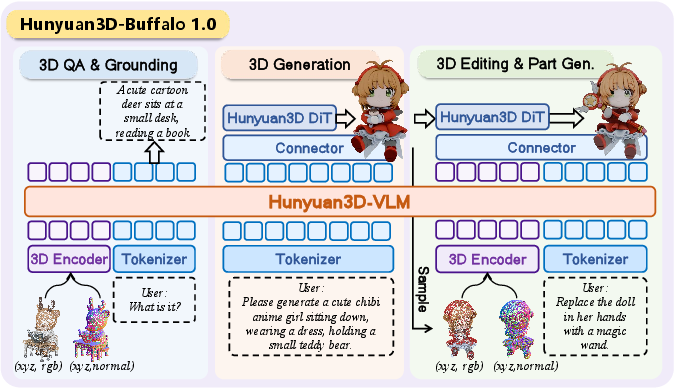
- Hunyuan3D-VLM: The “brain” that understands 3D shapes and language. It can describe objects, find parts, and follow editing instructions.
- Hunyuan3D DiT (Diffusion Transformer): The “artist” that actually creates or edits 3D objects in high quality.
- A small connector: Helps the brain’s ideas guide the artist’s hands, so understanding turns into accurate 3D results.
How they got enough data:
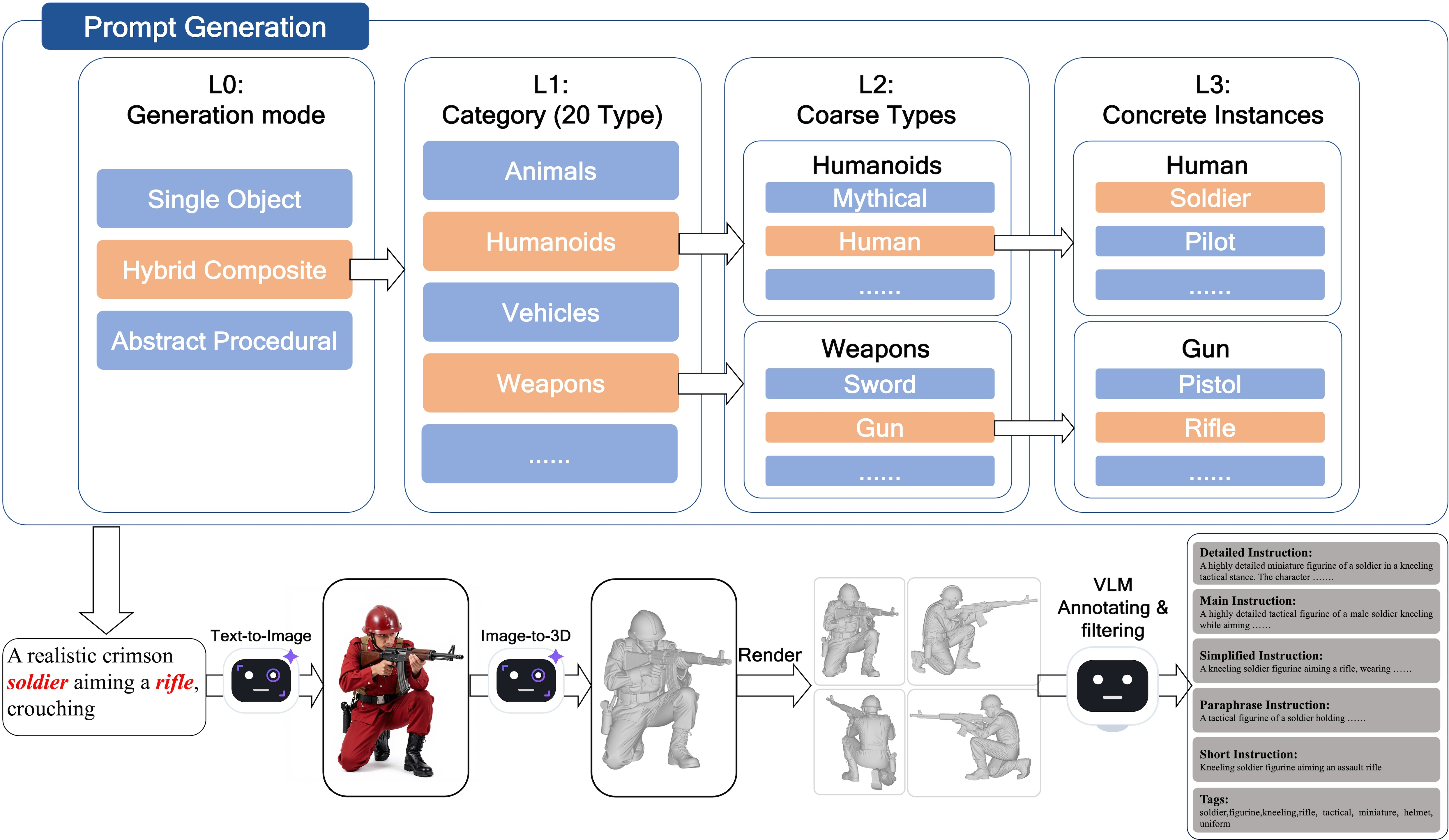
- They built a huge 3D dataset with about 87 million examples:
- 25M for understanding (descriptions, questions, part finding)
- 50M for text-to-3D (prompts matched to 3D objects)
- 12M for editing (original object, instruction, edited object)
How they produced so much good editing data:
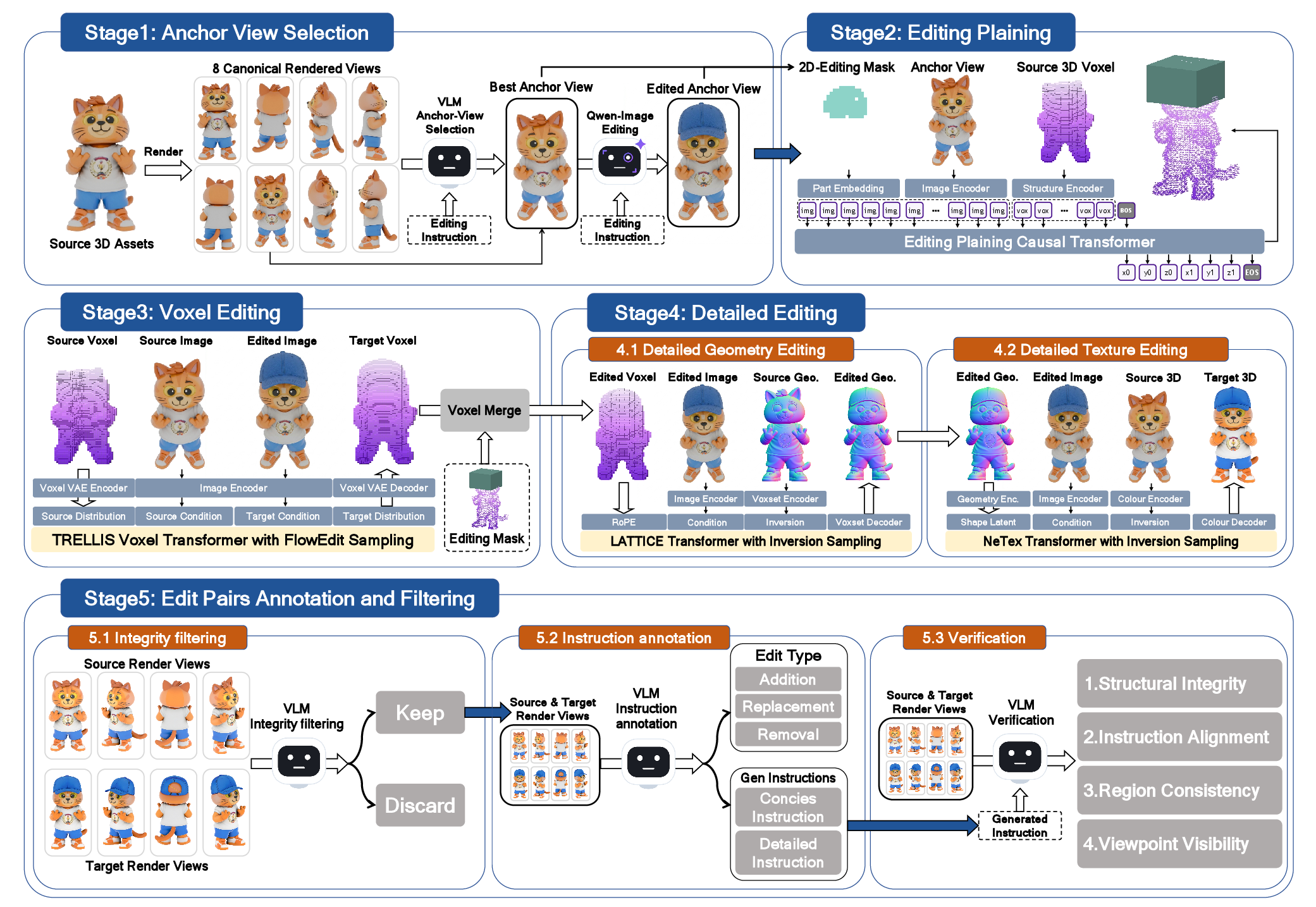
- They created an automated pipeline called Nano3D-v2. Think of it like a careful, multi-step editor: 1) Anchor view: Pick the best camera angle to see the change clearly. 2) Find the edit area: From a 2D difference, predict the exact 3D region (a tight 3D box) to change. 3) Voxel editing: Only modify voxels inside that box to avoid breaking the rest of the object. 4) Fine details: Sharpen geometry and fix textures so edges look clean and natural. 5) Check quality: Use AI to verify the edit is correct, the rest stayed the same, and the result looks solid.
- This makes edits consistent in 3D and avoids random changes elsewhere.
How they trained the model:
- Stage 1: Teach the brain (VLM) to understand 3D and language together (describe, answer, find parts, write precise edit instructions).
- Stage 2: Teach text-to-3D generation at scale, so the artist can make many kinds of shapes.
- Stage 3: Mix all tasks (generation, editing, part generation) so the model learns them together.
- Stage 4: Fine-tune each task, with a bit of extra generation mixed in to keep quality high.
Special trick for editing and parts:
- When editing, the model sees both the instruction and the original object. This helps it keep unedited areas unchanged while precisely modifying the target part.
4) What did they find, and why is it important?
Main results:
- The model performs at or near the best on popular tests for making 3D objects from text and for editing 3D objects.
- It’s strong at understanding 3D too: describing objects, answering questions, and grounding parts.
- It can generate parts based on text (“make only the wings”), without a separate, special pipeline.
Two big takeaways about training everything together:
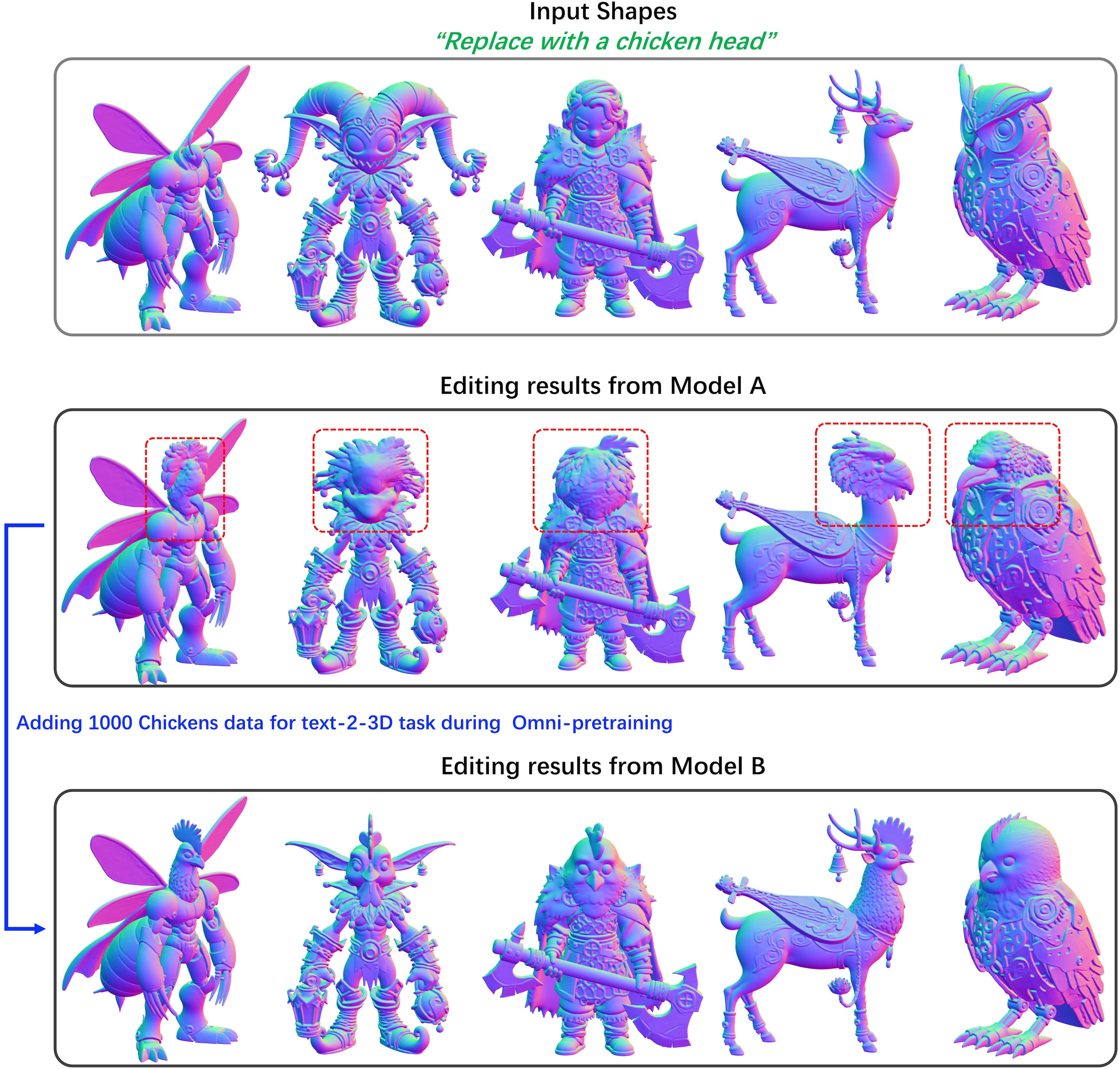
- Better text-to-3D generation leads to better editing. If the model is great at making shapes, it’s also better at fixing or adding parts naturally.
- Better 3D understanding leads to better editing. If it can locate the right part and understand instructions clearly, the edits are cleaner and more accurate.
Why that matters:
- It proves that unifying tasks isn’t just convenient—it actually makes each task stronger.
5) What’s the impact?
This work could:
- Speed up 3D creation for games, movies, VR/AR, and product design. Designers can type what they want and get high-quality 3D models or edits quickly.
- Make precise edits without breaking the rest of the object, which is a common pain point in 3D workflows.
- Lower the barrier for learning 3D modeling. People can use plain language to build and adjust objects.
- Inspire future AI systems that unify understanding and generation across even more 3D tasks (like scenes or physics-aware models).
In short, Hunyuan3D-Buffalo 1.0 shows that one well-trained model can understand, create, and edit 3D objects at scale—and that teaching these skills together makes them all better.
Knowledge Gaps
Knowledge gaps, limitations, and open questions
Below is a consolidated list of concrete gaps that remain unresolved and could guide future research:
- Data transparency and reproducibility: licenses, provenance, and release plans for the 87M-sample corpus (in-house assets, generated assets, editing pairs, VLM annotations) are not specified, limiting independent verification and reuse.
- Heavy reliance on proprietary VLMs (e.g., Gemini, Qwen-Image) for captioning, planning, filtering, and verification introduces opaque biases and error modes; no audits or calibration studies are reported.
- Missing training details (model sizes, compute budgets, optimization hyperparameters, batch schedules, token counts) impede reproducibility at scale.
- 3D representation ambiguity: the exact generative latent space and final asset format (mesh vs. SDF/voxel vs. Gaussian, UV layout, watertightness guarantees) for 3D-DiT outputs are not fully specified, complicating comparison and downstream integration.
- Editing Planning model supervision is unclear: how ground-truth 3D boxes are obtained for training from 2D diffs and source voxels, and how its 3D localization accuracy is quantitatively evaluated.
- Axis-aligned, discretized box tokens (128 bins) limit localization precision and orientation; support for rotated boxes, free-form masks, or mesh-level regions remains unexplored.
- Edit taxonomy in data and annotation is constrained to Addition/Replacement/Removal; handling of deformation, rescaling, reposing, articulation, boolean ops, boolean-preserving topology edits, and constraint-based edits is unaddressed.
- Texture- or material-only edits: editing instructions intentionally ignore color/material/lighting; it is unclear how well the unified model performs on purely appearance edits or mixed geometry–appearance edits.
- Source-object conditioning trade-offs are not ablated: how conditioning strength impacts preservation of unedited regions vs. capacity for large structural changes, and how to adaptively schedule it per edit.
- Generalization to full scenes (multi-object, layout, backgrounds) and scene-level consistency is not evaluated; the pipeline largely targets single objects.
- Physical plausibility, articulation, and functional constraints (contacts, joints, motion ranges, stability, mass properties) are not modeled or measured; integration with physics simulators is absent.
- Robustness to occlusions, tiny parts, and view-dependence is uncertain; anchor-view selection and 8 canonical views may bias data toward frontally visible edits.
- Multi-round interactive editing with the model (beyond the data engine) is not benchmarked for stability, drift, or error accumulation across many steps/turns.
- Editing evaluation lacks concrete metrics for identity preservation and non-edited region integrity (e.g., local Chamfer/EMD on frozen regions, perceptual similarity, mesh-level diffs) and lacks human preference studies.
- Claimed cross-task synergies (generation→editing, understanding→editing) are not causally isolated; controlled ablations to separate effects of data scale, architecture, and curricula are missing.
- Safety and content moderation policies (e.g., for weapons, sensitive humanoid content, IP/trademarked items) are unspecified; failure modes and safeguards are not discussed.
- Efficiency/latency: inference speed, memory footprint, and throughput for generation and editing (including LATTICE/NaTex refinement stages) are not reported; suitability for real-time or interactive editing is unclear.
- Scalability to production-quality assets: control of polygon count, manifold guarantees, self-intersections, UV layout quality, PBR material compliance, and export to standard DCC/game-engine pipelines is not evaluated.
- Open-vocabulary part generation consistency across instances is not measured; how object-specific vocabularies align globally and how ambiguity/synonymy is handled remain open.
- Dataset biases from the hierarchical prompt taxonomy and category weighting (e.g., over-representation of certain styles/categories; cultural/geographic skew) are not analyzed.
- Filtering choices (e.g., keeping only geometry_quality ≥ 10) may discard useful “hard” or mid-quality examples; the impact on robustness and generalization is untested.
- Visibility bias: filtering out pairs where edits are not visible in canonical views may limit learning of occluded or back-facing edits.
- Uncertainty estimation and calibration are absent for grounding and editing predictions; confidence-aware interfaces and selective editing are not explored.
- Scale and units: real-world size consistency, absolute measurements, and metric-aware generation/editing are not enforced or reported.
- Multimodal conditioning scope is limited to text, images, and 3D point clouds; constraints from sketches, CAD constraints (e.g., assemblies), audio, or tactile cues remain unexplored.
- VLM frozen after Stage 1: benefits and risks of end-to-end co-training (VLM + DiT) or selective unfreezing to improve synergy and reduce connector bottlenecks are not examined.
- Part removal/editing post-process: guarantees of watertightness, hole filling, and clean stitching at part boundaries (beyond a 7-voxel alpha band) are not systematically evaluated.
- Cross-dataset generalization and OOD robustness (e.g., to unseen categories, extreme styles, sparse/noisy scans, sketches) are not tested.
- Robustness to ambiguous, compositional, or adversarial instructions is not characterized; mechanisms for instruction disambiguation or refusal are absent.
- Impact of anchor-view selection errors on final edit quality and on the learned localization module is not quantified; alternatives (multi-anchor or view-agnostic planning) are not compared.
Practical Applications
Immediate Applications
The following applications can be deployed now by leveraging Hunyuan3D-Buffalo 1.0’s unified text-to-3D generation, instruction-guided editing, text-grounded part generation, and 3D understanding (QA, captioning, grounding), plus the Nano3D‑v2 data engine and 3D-aware VLM.
- Natural-language 3D asset creation and iteration for media production
- Sectors: gaming, VFX/film, AR/VR, advertising
- What: Generate hero objects from text; make localized edits (“add a visor,” “shorten the barrel”) while preserving identity and unedited regions; multi-round edit history for rapid iterations
- Tools/products/workflows: Blender/Unreal/Unity/Maya plugins (“3D Edit Copilot”), prompt-to-GLB/USDZ export, batched variant generation for A/B exploration
- Assumptions/dependencies: Model/API access; external components (e.g., LATTICE, NaTex) available; mesh quality acceptable for DCC ingestion; human-in-the-loop QC for final shots
- E-commerce product digitization and configurators
- Sectors: retail, consumer electronics, furniture, apparel accessories
- What: Turn marketing copy into baseline 3D product assets; generate color/material/part variants; create 360 renders and glTF/USDZ packs for PDPs; text-grounded part swaps for configurable SKUs
- Tools/products/workflows: “Catalog Auto-Builder” pipeline; prompt-conditioned batch rendering; auto-packaging to marketplace formats
- Assumptions/dependencies: Realistic texture fidelity via NaTex; brand/legal approvals; scale and true-to-spec geometry are approximate (not CAD-precise)
- 3D asset quality assurance, captioning, and labeling
- Sectors: 3D content studios, marketplaces, datasets, MLOps
- What: Use the VLM to generate multi-tier captions, integrity checks, geometry-quality scores, and part-level bounding boxes; automate dataset curation and asset QC gates
- Tools/products/workflows: Labeling UIs with auto-suggestions, batch integrity filtering, edit-outcome verification steps reused from Nano3D‑v2
- Assumptions/dependencies: VLM reliability; human verification for edge cases and high-stakes assets
- Synthetic data factory for perception and vision research
- Sectors: robotics, autonomy, academic ML, AR perception
- What: Mass-generate multi-view renders, depth, masks, and part boxes from editable 3D assets to train/benchmark 2D/3D perception models; procedurally apply controlled edits to create labeled distributions
- Tools/products/workflows: “Render-at-Scale” service built on the 87M corpus and Nano3D‑v2; domain randomization of geometry and textures
- Assumptions/dependencies: Domain gap to target sensors/environments; licensing of base content; compute and storage costs
- Open-vocabulary part segmentation and kitbashing
- Sectors: game asset production, modding communities, education
- What: Segment or remove language-referred parts (“isolate the wheels,” “remove the handle”) and generate missing parts consistent with context; assemble macro-part libraries
- Tools/products/workflows: “PartGen SDK” for part discovery, extraction, replacement, and recombination
- Assumptions/dependencies: Semantics occasionally noisy; mechanical constraints not enforced; part watertightness may require post-processing
- Early-stage industrial design ideation
- Sectors: product design, automotive concepting, consumer goods
- What: Rapidly explore form factors and style variants via text-to-3D; apply localized geometry edits per instruction; produce review-ready concept meshes and renders
- Tools/products/workflows: “Concept Sprint” workflows bridging Figma/Adobe → prompt → mesh → quick render
- Assumptions/dependencies: Not CAD-accurate; lacks tolerance/fit/DFM constraints; human designers remain central
- Search and retrieval over 3D libraries using natural language
- Sectors: asset marketplaces, internal content libraries, PLM/PDM
- What: Query by object semantics and parts (“find vehicles with detachable wings,” “chairs with armrests that can be removed”); ground results with part boxes
- Tools/products/workflows: Embedding-based 3D/part retrieval index powered by Hunyuan3D‑VLM features
- Assumptions/dependencies: Library ingestion and vector indexing; metadata harmonization
- 3D content moderation and IP/safety review
- Sectors: marketplaces, UGC platforms, enterprise governance
- What: VLM-assisted checks for prohibited content, violent/NSFW geometry, and near-duplicate/IP-adjacent shapes; verify edits preserve unedited regions
- Tools/products/workflows: Pre-publish moderation pipeline; provenance logs for edits derived from Nano3D‑v2’s verification
- Assumptions/dependencies: Legal policy definitions; false positive/negative handling; watermark/provenance standards
- XR/UGC creation for social and daily use
- Sectors: social apps, hobbyist 3D printing, tabletop gaming
- What: Users generate/edit avatars, props, miniatures by text; export to printable or AR-ready formats
- Tools/products/workflows: Mobile/web front-ends; “TTRPG Mini Maker” kits; glTF/USDZ one-click export
- Assumptions/dependencies: Printability and manifold checks; scale units; platform ToS for generated content
- Academic benchmarking of unified 3D multimodal learning
- Sectors: academia, open-source research
- What: Study cross-task synergies (generation/understanding → better editing), evaluate on UniPart-Bench and editing benchmarks, replicate the 87M-scale data engine
- Tools/products/workflows: Reusable instruction-tuning recipes; ablations on source-object conditioning and VLM-to-DiT connectors
- Assumptions/dependencies: Availability of weights/data or comparable substitutes; compute budgets
- Automated instruction refinement for editing tasks
- Sectors: internal studio tooling, dataset construction
- What: Convert coarse user prompts into precise, geometry-grounded edit instructions; auto-annotate edit outcome descriptions
- Tools/products/workflows: Instruction-synthesis module from the 3D VLM; edit pair packaging pipeline
- Assumptions/dependencies: VLM fidelity; editor acceptance criteria
- Enterprise rendering and packaging automation
- Sectors: e-commerce, marketing ops
- What: Auto-generate canonical multi-view renders and standardized asset packages (GLB/USDZ/USDC) at scale with quality gates
- Tools/products/workflows: “AR Commerce Packager” using geometry-quality scoring and integrity filters
- Assumptions/dependencies: Render farm or cloud GPUs; content rights; format conformance
Long-Term Applications
These opportunities likely require further research, scaling, integration with domain constraints, or rigorous validation before broad deployment.
- CAD-accurate, simulation-ready 3D generation and editing
- Sectors: manufacturing, robotics, AEC, automotive
- What: Generate/edit geometry with real units, tolerances, material/assembly constraints, and watertight solids compatible with CAD/CAE/CFD
- Tools/products/workflows: Constraint-aware generative CAD; STEP/SolidWorks/Onshape bridges; physics/FEA-in-the-loop training
- Assumptions/dependencies: Differentiable constraint engines; unit/scale grounding; robust topology guarantees
- Scene-level world building with animation and physics
- Sectors: gaming, VFX, virtual production, simulation
- What: Compose multi-object scenes with articulated rigs, animate per instruction, and ensure inter-object and physics plausibility
- Tools/products/workflows: Multi-asset diffusion with rig/IK integration; physical priors; scene graphs as conditions
- Assumptions/dependencies: Rigging-aware generation; temporal consistency; scalable scene datasets
- Digital twins from multimodal inputs with editable parts
- Sectors: retail, logistics, facilities management, AEC
- What: Fuse text, images, scans to build editable, part-aware twins of equipment/spaces for maintenance, training, and what-if edits
- Tools/products/workflows: Multimodal fusion (text+image+point cloud) into DiT; continuous sync with IoT/scan updates
- Assumptions/dependencies: Accurate sensor calibration; metric fidelity; long-horizon update consistency
- Real-time on-device 3D understanding/editing for robotics
- Sectors: warehousing, household robotics, manufacturing
- What: Open-vocab part detection and edit simulation for grasp/assembly planning; rapid synthetic augmentation of edge models
- Tools/products/workflows: Quantized/lightweight VLM+DiT variants; ROS integrations; streaming point-cloud adapters
- Assumptions/dependencies: Low-latency inference; robustness to sensor noise; safety certifications
- Personalized AR try-on and fit-accurate asset generation
- Sectors: fashion, eyewear, footwear, furniture-at-home AR
- What: Generate/edit 3D items that fit user-specific scans and environments; maintain editability of parts (e.g., straps, lenses)
- Tools/products/workflows: Body/room scanning pipelines; fit constraints in the generative loop
- Assumptions/dependencies: Privacy-preserving data handling; accurate anthropometrics/room-scale geometry
- Medical and biomedical 3D content generation
- Sectors: healthcare, medical education, surgical planning
- What: Anatomy-accurate, patient-specific models with editable regions for planning/simulation and instruction-grounded annotations
- Tools/products/workflows: DICOM/segmentation-to-3D pipelines; regulatory-grade validation toolchains
- Assumptions/dependencies: High anatomical fidelity; clinical validation; regulatory approvals and data governance
- Autonomous design agents for multi-step 3D workflows
- Sectors: creative tooling, enterprise design ops
- What: Agents that chain anchor-view selection, localization, editing, verification, and packaging end-to-end with minimal human input
- Tools/products/workflows: Tool-augmented LLM orchestrators around Buffalo + Nano3D‑v2 modules; measurable “design KPIs”
- Assumptions/dependencies: Reliable tool APIs; safety/guardrails; provenance and rollback
- End-to-end enterprise catalog automation
- Sectors: retail, marketplaces, PLM/PIM
- What: From PIM text → 3D asset → variant expansion → renders → AR kit → moderation → publish, with closed-loop metrics
- Tools/products/workflows: “CatalogOps” pipelines; integration with PIM/DAM/CDN
- Assumptions/dependencies: System integration, governance, human review for premium listings
- Cultural heritage restoration and curation
- Sectors: museums, conservation, education
- What: Hypothesize missing parts, simulate restorations non-destructively, and generate pedagogical 3D narratives
- Tools/products/workflows: Provenance-aware edit logs; side-by-side pre/post visualizations; curator-in-the-loop review
- Assumptions/dependencies: Ethical guidelines; authenticity standards; uncertainty quantification
- Standardization, provenance, and policy for 3D generative content
- Sectors: policy/regulation, platforms, enterprise governance
- What: 3D model cards, edit provenance chains, watermarking/signing for meshes/textures, dataset documentation for synthetic 3D
- Tools/products/workflows: C2PA-like standards extended to 3D; auditing dashboards; risk/impact assessments
- Assumptions/dependencies: Cross-industry consensus; interoperable metadata standards; legal frameworks
- Edge/XR deployment of unified 3D MLLMs
- Sectors: consumer XR, industrial AR, training
- What: On-device part grounding and lightweight edits for heads-up workflows and AR authoring
- Tools/products/workflows: Distilled/quantized Buffalo variants; streaming connectors to cloud DiT when needed
- Assumptions/dependencies: Efficient model compression; battery/thermal limits; privacy-by-design
Notes on dependencies and feasibility across applications
- Model and data availability: Some components (Hunyuan3D‑2.1, TRELLIS, LATTICE, NaTex, VLMs like Qwen/Gemini) are external; access, licensing, and version compatibility affect feasibility.
- Compute and throughput: Diffusion-based 3D synthesis/editing and large-scale rendering demand substantial GPU resources; batching and caching strategies matter for production.
- Quality guarantees: Outputs are high-fidelity but not engineering-grade; watertightness, manifold correctness, and true-to-spec dimensions may require downstream repair or CAD remastering.
- Safety and IP: Content moderation, provenance tracking, and rights management are essential; policies should cover synthetic-asset disclosure and derivative/IP adjacency.
- Human-in-the-loop: For professional pipelines (film, enterprise retail, healthcare), expert review remains necessary for accuracy, brand alignment, and compliance.
Glossary
- 3D grounding: Linking language references to exact regions in 3D by predicting spatial locations or boxes. "3D grounding: localizing referred parts or regions in an object, with answers expressed as quantized axis-aligned bounding boxes via <boxs>/<boxe> token sequences."
- Agent-based: Using automated agents/toolchains to construct or edit data at scale. "an agent-based 3D editing data construction algorithm"
- Alpha blending: A weighted blending technique using transparency (alpha) to smoothly combine boundaries. "alpha blending within a 7-voxel band"
- Anchor view: The most informative viewpoint selected to guide or evaluate an edit. "Stage 1: Anchor View Selection."
- Autoregressive modeling: Sequence modeling that generates outputs one token at a time conditioned on previous tokens. "a unified 3D multimodal framework that combines autoregressive modeling with diffusion-based 3D generation"
- Autoregressive Transformer: A Transformer trained with next-token prediction to produce sequential outputs. "train an autoregressive Transformer to predict the corresponding 3D editing region."
- Axis-aligned bounding box (AABB): A 3D box aligned with coordinate axes used to localize objects or parts. "axis-aligned bounding boxes via <boxs>/<boxe> token sequences."
- Box delimiters: Special tokens that mark the start and end of serialized bounding box coordinates. "<boxs> and <boxe> act as box delimiters,"
- Cross-attention: An attention mechanism that conditions generation on external context features. "condition the denoiser through cross-attention."
- Denoiser: The network in diffusion models that predicts noise or velocities during the denoising steps. "into the 3D-DiT, where the resulting per-token features condition the denoiser through cross-attention."
- Diffusion process: The iterative noising/denoising procedure used to synthesize data in diffusion models. "condition the diffusion process on the source object representation"
- Diffusion Transformer (DiT): A Transformer architecture used as the backbone for diffusion-based generation. "3D-DiT (initialized from Hunyuan3D-2.1)"
- Edit-instruction synthesis: Turning a coarse user request into a precise, executable edit command grounded in geometry. "Edit-instruction synthesis: given the source point cloud and an original, often coarse editing request, producing a precise, executable editing instruction grounded in the object's geometry."
- Flow-based generative models: Models that learn invertible flows to transform simple distributions into complex data. "autoregressive or flow-based generative models,"
- Flow matching: A training objective that learns a velocity field to transport a prior to the data distribution. "flow-matching objective that predicts the velocity field transporting a Gaussian prior"
- FlowEdit: A latent/voxel-space editing operation that applies learned flows for localized edits. "perform voxel-level FlowEdit."
- Gaussian prior: The standard normal distribution used as the starting point in diffusion/flow-based generation. "transporting a Gaussian prior to the target 3D latent distribution."
- Inversion-based inpainting: Recovering latent codes from given content and filling missing regions consistently. "performs inversion-based inpainting."
- LATTICE: A Transformer model used for sub-voxel geometry refinement of edited 3D assets. "We therefore employ LATTICE~\cite{lai2025lattice} for sub-voxel geometry refinement."
- MLP-Connector: A small multilayer perceptron that projects VLM features into the DiT conditioning space. "a lightweight MLP-Connector aligns VLM hidden states with the DiT's conditional space,"
- Multi-view consistency: Maintaining coherent geometry/appearance across different rendered viewpoints. "improve generation efficiency and multi-view consistency,"
- Multi-view rendering: Rendering an asset from multiple canonical camera viewpoints. "multi-view rendering;"
- NaTex: A Transformer for native texture editing via inversion-based inpainting. "We further employ NaTex~\cite{lai2025natex} for native texture editing."
- Nano3D-v2: A scalable pipeline for constructing geometrically consistent 3D editing pairs. "Nano3D-v2 addresses these shortcomings"
- Q-Former: A query-based Transformer module that compresses variable-length visual tokens. "tokens are further compressed by a Q-Former"
- Quantized coordinate tokens: Discrete tokens that encode bounding box coordinates for 3D grounding. "128 discrete coordinate tokens, from <box-0> to <box-127>, represent quantized coordinate values"
- Score Distillation Sampling (SDS): An optimization method that distills guidance from a 2D diffusion model into 3D assets. "using Score Distillation Sampling (SDS) or pretrained 2D diffusion priors"
- Self-attention: An attention mechanism that relates positions within the same sequence or tensor. "as input to the 3D-DiT's self-attention layers."
- Sub-voxel: Finer-than-voxel resolution used to refine geometry beyond the base grid. "sub-voxel geometry refinement."
- VecSet encoder: An encoder that converts sets of geometric/appearance vectors (e.g., point features) into latent tokens. "latent tokens with a VecSet encoder."
- Vision-LLM (VLM): A model that jointly processes visual and textual inputs for understanding or conditioning generation. "vision-LLM (Gemini, via an internal endpoint)"
- Voxel Transformer: A Transformer that operates over voxel grids for volumetric 3D processing. "we employ the voxel Transformer from TRELLIS"
- VQVAE: A vector-quantized variational autoencoder that turns images into discrete tokens. "with VQVAE~\cite{van2017neural}"
- Zero-shot transfer: Applying learned capabilities to new tasks or domains without additional training. "yields strong zero-shot transfer,"
Collections
Sign up for free to add this paper to one or more collections.

