Ego2Robot: Scalable Robot Data Synthesis from Egocentric Human Data
Abstract: Learning generalizable robot manipulation policies requires large-scale and diverse demonstration data. Egocentric human manipulation videos offer rich scene and task diversity, and prior work has shown that retargeting and rendering such videos into robot-format data can yield effective per-task policies at small scale. However, whether this approach can provide pretraining benefits for vision-language-action models at scale remains unexplored. We present \textbf{Ego2Robot}, a scalable pipeline that converts egocentric human manipulation videos into robot training data through action retargeting, robot-arm visual synthesis, and multi-level quality curation. Ego2Robot supports both curated datasets and in-the-wild videos, producing 18,561 hours of robot training data spanning 15 robot morphologies, making it the largest ego-to-robot dataset to date. To evaluate generalization, we extend RoboTwin2.0 with disentangled perturbation axes covering visual appearance, scene layout, embodiment morphology, and task semantics. Experiments show that joint pretraining on Ego2Robot-synthesized and robot data consistently improves out-of-distribution generalization across multiple perturbation types, with benefits validated on real-robot deployment. Project page: https://www-ye.github.io/ego2robot_blog/

Paper Prompts
Sign up for free to create and run prompts on this paper using GPT-5.
Top Community Prompts
Explain it Like I'm 14
Overview
This paper is about teaching robots to use their arms and hands better by learning from human videos. Instead of collecting tons of hard-to-get robot demonstrations, the authors turn first-person human videos (the kind filmed from someone’s head or chest) into robot training data. They built a big, automatic “video-to-robot” pipeline called Ego2Robot and showed that mixing this synthetic robot data with real robot data helps robots handle new, unfamiliar situations.
What were they trying to figure out?
In simple terms, they asked:
- Can we turn huge amounts of “what a person sees while doing a task” videos into useful robot training examples?
- If we do this at large scale, will robots get better at handling new scenes, lighting, objects, and even different robot bodies?
- Which kinds of improvements are biggest: dealing with tricky visuals, different room setups, switching robot arms, or understanding varied instructions?
How did they do it?
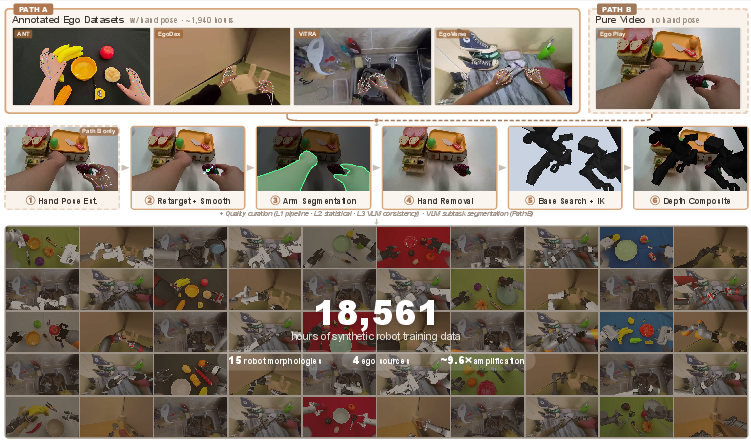
The team created a three-step pipeline that transforms human videos into robot-friendly training clips. Think of it like turning a cooking video filmed with a GoPro into a lesson a robot can learn from.
Here’s the process, explained with everyday ideas:
- Step 1: Action alignment (mapping hands to robot moves)
- Analogy: Imagine tracing a person’s hand moves and turning them into “where a robot gripper should go and how wide it should open.”
- The pipeline detects the 3D positions of the person’s fingers and wrist over time, then converts that into smooth robot end-effector actions (the end-effector is just the “hand” of the robot arm).
- They also slow down the fast human motions so they feel more like normal robot speeds.
- Step 2: Visual alignment (replacing the person’s arm with a robot arm)
- Analogy: Like photoshopping—erase the human arm and draw a robot arm in its place, from the same camera view.
- First, they segment (cut out) the human arms in the video.
- Then they “inpaint” the background so it looks like the person’s arm was never there.
- Next, they figure out where to “place” a robot body so its arm can actually reach the same path the human hand followed. They test lots of base positions and pick the one that works best for that robot type.
- Finally, they render the robot arm into the video, making sure it looks properly in front of or behind objects using depth (which object is closer to the camera).
- Step 3: Quality checks (keeping only good training examples)
- They automatically filter out frames where the robot can’t reach, where motions are too jerky, or where the visuals don’t match the task.
- A vision-LLM also checks if the robot’s actions match the original intent (e.g., “put the block in the drawer”).
Extra details that matter:
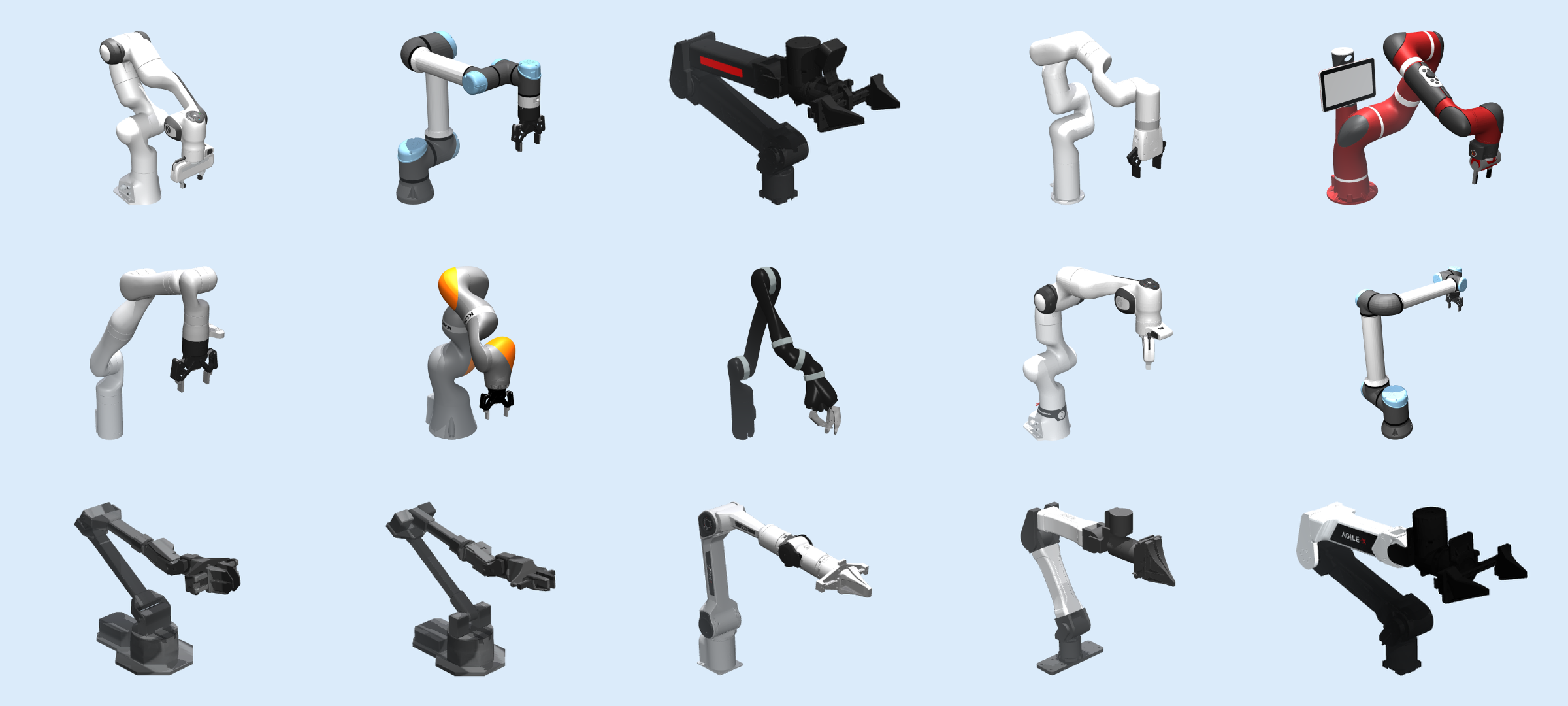
- They did this for 15 different robot arm designs (“morphologies”), so the same human video can produce 15 parallel robot training clips.
- They used both curated datasets and random “in-the-wild” videos, ending up with 18,561 hours of robot training data—the largest of this kind to date.
- They describe actions relative to the camera view. Think “move left by what I see on screen,” which helps combine data from many different cameras and robot types without complicated calibration.
What did they find?
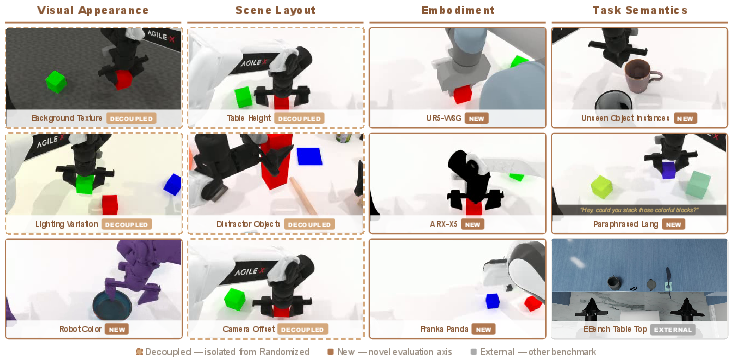
They trained and tested robot models to see how well they generalize. To be fair and specific, they expanded an evaluation benchmark so they could test different kinds of “surprises” separately:
- Visual appearance: new backgrounds, lighting changes, even changing the robot’s color.
- Scene layout: table height changes, extra clutter, small camera shifts.
- Embodiment: switching to different robot arms.
- Task semantics: new object instances and paraphrased instructions (same meaning, different words).
Main takeaways:
- Mixing the synthetic Ego2Robot data with real robot data makes robots more robust overall than using real robot data alone.
- The biggest improvements were in:
- Visual changes (backgrounds, lighting, robot color): because the internet-scale human videos cover lots of looks and scenes.
- Switching robot arms (embodiment): because the pipeline generates data for 15 different robot bodies.
- Task semantics (new objects; reworded instructions): because human videos include varied objects and language.
- Scene/layout changes (like table height or camera offset) improved moderately—still helpful, just not as dramatic.
- On a separate test with a camera angle closer to human head-height, models that used Ego2Robot data did even better—suggesting ego-style visuals transfer well.
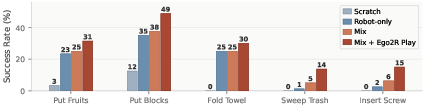
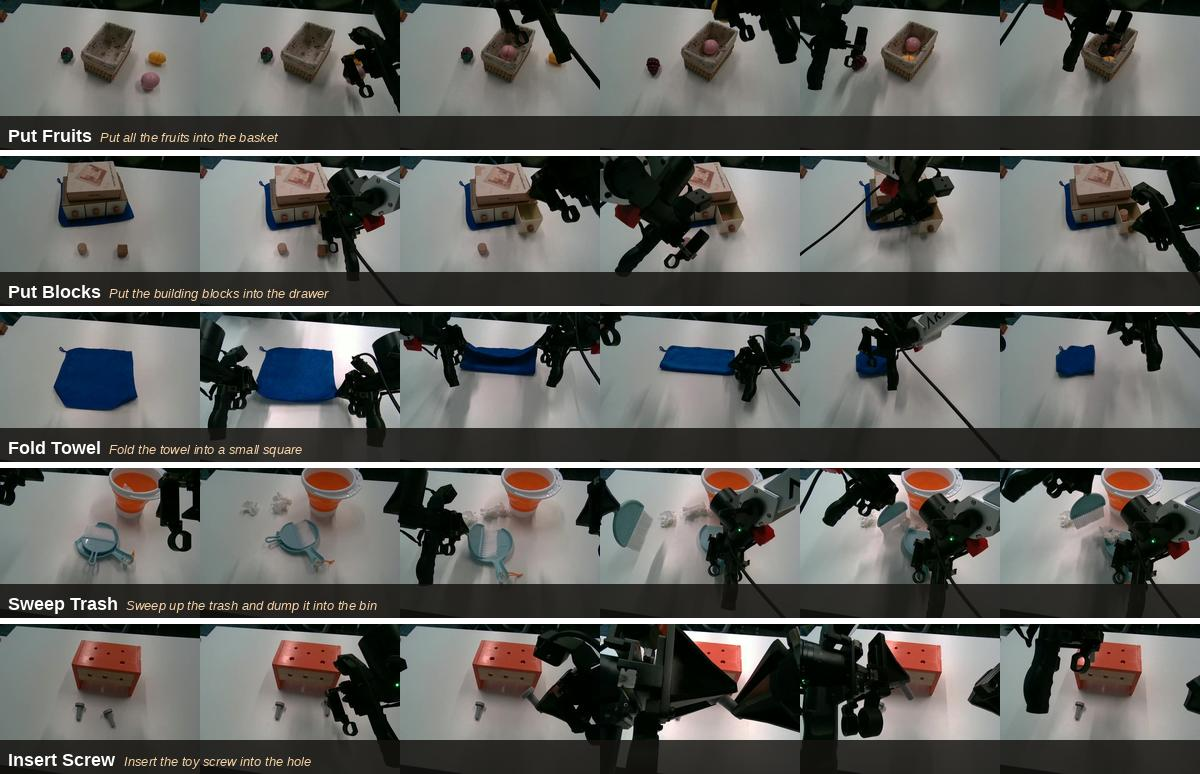
- Real robot tests showed that adding a bit of pipeline-generated “ego play” from the real workspace boosted success on multi-step tasks like putting blocks in a drawer or inserting a screw.
Why is this important?
- Collecting real robot demonstrations is slow and expensive. Human first-person videos are everywhere and cover many scenes and objects. Turning them into robot training data unlocks a massive, low-cost resource.
- By carefully aligning actions and visuals—and filtering for quality—the pipeline makes this human video data actually usable for robots.
- This approach helps robots handle “out-of-distribution” surprises: new looks, new rooms, new robot arms, and rephrased instructions. That’s key for real-world reliability.
What could this change in the future?
- Robots could be trained using widely available human videos, reducing the need for expensive robot-specific recording setups.
- Homes, factories, and labs could more quickly adapt robots to new tasks or new robot arms.
- With further improvements—like better hand-to-finger mapping for more dexterous hands, or even more realistic rendering—this method could teach robots increasingly fine-grained skills.
In short, Ego2Robot shows that turning first-person human videos into large-scale robot training data is practical and useful. When combined with real robot data, it makes robots more adaptable and ready for the unexpected.
Knowledge Gaps
Knowledge gaps, limitations, and open questions
Below is a single, consolidated list of concrete gaps and unresolved questions that future work could address.
- Camera calibration for rendering: The pipeline composites robots into ego videos without detailing how camera intrinsics/extrinsics are obtained or validated for Internet videos; how to robustly estimate and verify camera parameters for accurate projection remains unclear.
- Monocular depth reliability: Depth-aware compositing often relies on monocular depth for in-the-wild videos, but the scale ambiguity and occlusion errors are unquantified; the impact of depth errors on downstream policy learning has not been measured or mitigated.
- Lighting, shadows, and reflections: Composited robots lack physically correct shadows/reflections and consistent global illumination; whether physically based or generative relighting would reduce the visual domain gap is not tested.
- Inpainting artifacts: The frequency, types, and downstream effects of video inpainting artifacts (e.g., missing edges around hands, temporal flicker) are unreported; no perceptual or human realism audit is provided.
- Base pose search realism: The base placement optimization ignores real-world constraints (table edges, walls, occluders, base footprint, mounting fixtures); how to ensure placements are realizable on physical setups is not addressed.
- Environment-aware IK: IK feasibility is checked per keyframe without environment collision checking or contact reasoning; the absence of obstacle-aware IK and motion planning may produce visually plausible yet physically infeasible trajectories.
- Dynamics and actuation limits: The pipeline validates kinematics but not dynamics (joint velocity/acceleration/torque limits, payloads); the rate of dynamic infeasibility and its effect on learning are unknown.
- Contact and grasp stability: Retargeting maps thumb–finger distance to gripper width with no contact state or force modeling; how to incorporate tactile/force priors or learned grasp stability into synthesis is open.
- Dexterous hands and non-parallel grippers: The approach is limited to parallel-jaw grippers; extending retargeting/rendering to multi-finger/dexterous hands and tool-use primitives is unaddressed.
- Bimanual interactions: Egocentric videos commonly involve two hands, but the pipeline does not model bimanual retargeting or coordinated dual-arm policies; how to extend to two-hand scenes is an open question.
- Grasp-type diversity: The simple orientation heuristic may not capture lateral grasps, pinch vs power grasps, or in-hand reorientation; systematic failure analysis by grasp taxonomy is missing.
- Hand-pose estimation noise: Path B depends on WiLoR and DynHaMR; the error distribution (pose, scale, temporal drift) and its propagation to action trajectories are not quantified or corrected.
- Action speed alignment: Speed alignment is done via per-source frame subsampling; whether learned time-warping or adaptive temporal alignment could better match robot execution statistics is untested.
- Camera-frame action representation limits: Camera-relative EEF actions assume a fixed camera during execution; how the representation behaves when the camera moves (head-mounted, mobile bases) is not evaluated.
- Lack of robot-state conditioning: Policies are not explicitly conditioned on embodiment or kinematics; whether including compact embodiment tokens or proprioceptive summaries would improve cross-robot transfer is unexplored.
- Instruction–action alignment quality: Subtask segmentation and language descriptions rely on a VLM without reported accuracy; the prevalence of misalignment between text and action and its impact on learning are unknown.
- Curation reliability: The L3 VLM-based semantic audit is not benchmarked against human judgments; thresholds, false-positive/negative rates, and inter-source bias are not reported.
- Dataset governance and licensing: It is unclear whether in-the-wild ego videos permit redistribution and derivative synthesis; privacy, consent, and copyright handling for large-scale internet sources are not discussed.
- Data card and failure statistics: No dataset card with per-source coverage, morphology balance, failure rates (segmentation, depth, IK, rendering), or known failure modes is provided.
- Scale vs compute: All pretraining settings see the same number of samples (fixed steps), preventing analysis of scaling laws; how performance grows with more synthesized data and proportionally increased compute is unknown.
- Architecture dependence: Results are shown for one VLA backbone (Qwen3.5-4B + DiT); whether gains transfer to other backbones, tokenizers, or action decoders is not tested.
- Baselines against alternative augmentation: There is no head-to-head comparison with strong robot-only augmentation pipelines (e.g., RoviAug, Mirage), simulation generators (MimicGen, RoboCasa), or modern human-video pretraining (e.g., VIP/R3M-style adapters).
- Compositional generalization: The benchmark decouples axes but does not test extreme compositional shifts (e.g., simultaneous large camera offset + unseen objects + color shift); whether gains persist under compounded perturbations is unknown.
- Semantic/task breadth: Evaluation focuses on tabletop manipulation; transfer to deformables, liquids, fine-assembly, tool use, or long-horizon, multi-stage tasks remains untested.
- Real-robot external validity: Real-world evaluation uses a single platform (ARX ACone) and five tasks with 20 demonstrations each; generality across robots, sensors, controllers, and workplaces is unvalidated.
- Cross-embodiment anomalies: Franka transfer remains very low despite inclusion among morphologies; the root causes (action representation, kinematics mismatch, controller differences) are not diagnosed.
- Controller/interface assumptions: Mapping camera-frame actions to robot-specific controllers (IK, impedance, rate control) and the effect of control frequency/latency on performance are not analyzed.
- Viewpoint bias: EBench improvements may reflect a closer match to egocentric viewpoints; systematic study of viewpoint mismatch and methods to decorrelate egocentric biases are missing.
- Object and scene bias: The ego sources may overrepresent certain homes/cultures/objects; distributional biases and their fairness implications for deployment are unmeasured.
- Negative transfer: Some settings degrade (e.g., embodiment UR5/Franka in certain mixes); conditions under which synthesized data hurts performance and strategies to mitigate negative transfer are not characterized.
- Data mixing strategies: Only coarse mixture ratios (1:3, 1:1, 3:1) are explored; curriculum learning, morphology-aware sampling, and uncertainty-aware mixing policies are unexplored.
- Quality of camera parameters in released data: The paper claims to include “camera parameters,” but for internet videos they are typically unknown; how these were estimated and their accuracy are not documented.
- Shadow/occlusion ordering errors: Depth-ordering compositing can misplace robot behind foreground hands/objects; robust handling of near-field occlusions (e.g., with layered depth/NeRFs) is not studied.
- Object pose and contact labels: The dataset lacks object state/contact annotations that could enable richer objectives (contact-aware imitation, affordance supervision); methods to auto-annotate them are an open path.
- Safety and physical feasibility checks: There is no safety screening (sharp tools, humans in scene) or physical feasibility verification beyond IK; incorporating safety filters and real-world constraints during synthesis is unaddressed.
- Reproducibility details: Compute/time cost for producing 18,561 hours, per-stage throughput, and resource requirements are not reported, limiting replication and adoption.
Practical Applications
Immediate Applications
Below are concrete, deployable uses that can be built now by leveraging the paper’s pipeline, dataset, and evaluation methodology.
- Synthetic robot data engine to boost VLA pretraining robustness
- Sectors: robotics R&D, manufacturing, logistics/warehousing, retail automation
- Tools/products/workflows:
- Pretraining pipeline that mixes Ego2Robot-synthesized data with existing robot datasets (e.g., DROID, AgibotWorld) to improve OOD generalization
- “Camera-frame EEF action” adapters to unify heterogeneous data sources during training
- Ready-to-use multi-morphology robot renders for 15 arms to diversify embodiment exposure
- Assumptions/dependencies:
- Access to compute for large-scale pretraining
- License/rights to use source egocentric videos
- Gains depend on task/viewpoint similarity and a small amount of in-domain finetuning data
- Cold-start dataset generation for new robot morphologies
- Sectors: robotics platforms/OEMs, system integrators
- Tools/products/workflows:
- Base-pose search + IK feasibility checks to auto-place a new arm in scenes and render robot-consistent training data
- Per-morphology data packs (Franka, UR5e, Kinova Gen3, xArm7, Sawyer, etc.) synthesized from the same ego videos
- Assumptions/dependencies:
- Kinematic/URDF models available; camera intrinsics/extrinsics if using real deployment cameras
- Parallel-gripper mapping fits the target end-effector (dexterous hands need extensions)
- Teach-by-filming for small businesses and homes
- Sectors: service/home robotics, SMEs (cafés, workshops), facilities maintenance
- Tools/products/workflows:
- Quick “record-and-train” workflow: capture several minutes of phone/headcam videos, run through Ego2Robot to generate arm-specific demos, then finetune a generalist policy
- Packaged as “Ego2Robot Studio” desktop/SaaS with guided capture, auto-segmentation, and curation dashboards
- Assumptions/dependencies:
- Clear user consent and privacy handling; scenes must be inpaintable and depth-estimable
- A handful of teleop demos still recommended for final tuning and safety validation
- Robustness benchmarking and CI for robot stacks
- Sectors: robotics software, QA, academia
- Tools/products/workflows:
- Adopt disentangled RoboTwin2.0 protocol (visual/scene/embodiment/task axes) as a continuous-integration (CI) test suite
- Scorecards tracking per-axis regressions to guide data collection/augmentation
- Assumptions/dependencies:
- Access to RoboTwin/Isaac-style simulation and evaluation harness
- Mapping from internal tasks to benchmark equivalents
- Synthetic augmentation for existing robot datasets
- Sectors: foundation model teams, applied ML/robotics labs
- Tools/products/workflows:
- Convert curated egocentric corpora (EgoDex, ViTRA, EgoVerse, in-house) into robot-format data to complement limited teleop trajectories, especially for visual and semantic robustness
- Assumptions/dependencies:
- Quality curation (IK, collision, VLM-audited intent consistency) to avoid label noise
- Speed alignment to match robot actuation dynamics
- Software components for training pipelines
- Sectors: software tooling, simulation
- Tools/products/workflows:
- ROS 2/Isaac extensions for camera-frame EEF deltas
- MuJoCo-based base-pose optimizer + IK batch solvers
- SAM/ProPainter-based hand removal and depth-aware compositing scripts
- Assumptions/dependencies:
- GPU video processing stack; valid depth sources or reliable monocular depth estimation
- Privacy and dataset governance tooling
- Sectors: policy/compliance teams in robotics companies, dataset providers
- Tools/products/workflows:
- VLM-based semantic audits for intent consistency and sensitive-content detection
- Dataset cards noting egocentric collection context, consent, and known biases
- Assumptions/dependencies:
- Organizational policy for consent management, data retention, and redaction
- Jurisdictional compliance (e.g., GDPR/CCPA) for human-subject data
- Education and training materials
- Sectors: higher education, vocational robotics programs
- Tools/products/workflows:
- Course labs that let students synthesize multi-morphology data and evaluate policies under decomposed OOD axes
- Assumptions/dependencies:
- Access to GPUs and simulation; simplified subsets of the pipeline for coursework
Long-Term Applications
These opportunities are enabled by the paper’s core ideas but require further research, scaling, or engineering before wide deployment.
- Internet-scale pretraining for generalist manipulation robots
- Sectors: home/service robotics, industrial assistants
- Tools/products/workflows:
- Continuous ingestion of global egocentric video corpora; automated retargeting and multi-embodiment rendering to pretrain VLA backbones
- Periodic finetuning on small, site-specific demos for reliable deployment
- Assumptions/dependencies:
- Robust consent, licensing, and privacy-preserving data pipelines (e.g., federated/DP training)
- Stronger rendering/inpainting and depth for artifact-free visuals at scale
- On-device lifelong learning from AR glasses
- Sectors: consumer robotics, assistive tech
- Tools/products/workflows:
- Users teach a personal robot by wearing AR glasses; on-device hand pose, action retargeting, and local finetuning with federated updates
- Assumptions/dependencies:
- Efficient, low-latency inference and training on edge hardware
- Reliable online hand/body pose under motion and occlusion
- Dexterous and whole-body retargeting
- Sectors: humanoids, surgical/medical robotics, advanced manufacturing
- Tools/products/workflows:
- Extending the action alignment from parallel grippers to multi-finger hands and multi-contact (palming, tool use), and from arms to full-body manipulation
- Assumptions/dependencies:
- Accurate finger articulation estimation and force/torque targets
- Richer action spaces and safety-constrained optimization
- Mobile manipulation and autonomous base placement
- Sectors: logistics, field robotics, retail
- Tools/products/workflows:
- Extend base-pose search to plan mobile base approaches and re-posing in clutter; integrate with SLAM and task-and-motion planning
- Assumptions/dependencies:
- Real-time feasibility checks and collision-safe navigation
- Robust perception in dynamic, crowded environments
- Cross-domain skill transfer from expert POV video
- Sectors: healthcare (surgery assistance), agriculture (precision picking), construction (tool operation), energy (plant maintenance)
- Tools/products/workflows:
- Convert expert headcam procedures into robot-readable training curricula; verify via domain simulators before supervised deployment
- Assumptions/dependencies:
- High-precision pose/depth capture; domain-specific safety and regulation
- Human-in-the-loop verification and fail-safe execution policies
- Regulatory benchmarking and certification frameworks
- Sectors: standards bodies, safety certification, public sector procurement
- Tools/products/workflows:
- Adopt decomposed OOD axes (visual/scene/embodiment/task) as auditable robustness criteria for manipulation systems
- Assumptions/dependencies:
- Community consensus on task suites and pass/fail thresholds
- Transparent reporting of training data sources and composition
- Generative rendering for photo-real data synthesis
- Sectors: simulation, content creation for robotics
- Tools/products/workflows:
- Replace inpainting with diffusion/NeRF-based, physics- and lighting-consistent compositing to further close the sim2real gap
- Assumptions/dependencies:
- Stable, fast generative pipelines with depth and contact reasoning
- Procedures to avoid synthetic artifacts that mislead policies
- Data marketplaces and ecosystem services
- Sectors: data platforms, integrators
- Tools/products/workflows:
- Curated, license-compliant egocentric-to-robot datasets by sector and morphology; API access for pretraining jobs
- Assumptions/dependencies:
- Standardized licenses, revenue sharing with original content creators
- Provenance tracking and bias audits
- Rare-event and edge-case mining
- Sectors: reliability engineering, safety
- Tools/products/workflows:
- VLM-aided search over vast ego corpora to surface unusual manipulations (transparent objects, deformables) for targeted augmentation
- Assumptions/dependencies:
- Accurate semantic search and verification; scalable labeling tools
- Workforce upskilling via “record-to-robot” tools
- Sectors: SMEs, vocational training
- Tools/products/workflows:
- Tooling that lets skilled workers record tasks and produce deployable robot skills without coding; scenario libraries and sharing hubs
- Assumptions/dependencies:
- Simple capture kits; guardrails that prevent unsafe extrapolations
- Organizational change management and acceptance
Notes on Feasibility and Risks Across Applications
- Technical dependencies: high-quality hand pose estimation, reliable monocular depth, and artifact-free inpainting/compositing; robust IK and collision checking.
- Domain gap caveats: current mapping targets parallel grippers; dexterous or whole-body skills need further research.
- Data governance: permissions for human-subject video, privacy redaction, and transparent dataset documentation are essential.
- Safety: all deployments should include human-in-the-loop validation, conservative control limits, and task-specific risk assessments.
Glossary
- Action retargeting: Mapping human hand motions into robot-compatible action trajectories. "We present Ego2Robot, a scalable pipeline that converts egocentric human manipulation videos into robot training data through action retargeting, robot-arm visual synthesis, and multi-level quality curation."
- Camera-frame relative end-effector (EEF) actions: Representing robot actions in the camera’s coordinate frame to unify heterogeneous data. "Camera-frame relative EEF actions express end-effector displacements in the observer's coordinate frame, naturally unifying data from different camera setups and robot morphologies."
- Depth-aware compositing: Layering rendered robots into scenes using depth to preserve correct occlusions. "Depth-Aware Compositing."
- Diffusion Transformer (DiT): A transformer-based diffusion model used to predict action sequences. "a Diffusion Transformer (DiT) action head."
- Disentangled evaluation protocol: An assessment method that isolates different distribution shifts for granular analysis. "we further introduce a disentangled evaluation protocol built on RoboTwin2.0"
- Ego-to-robot domain gap: The distribution shift between human egocentric video data and robot data. "our work extends augmentation to the substantially larger ego-to-robot domain gap, leveraging egocentric human videos to synthesize training data for 15 robot morphologies and systematically evaluating generalization across multiple perturbation axes."
- Egocentric: First-person viewpoint capturing scenes as observed by the camera wearer. "Egocentric human videos offer a compelling alternative."
- Embodiment: The specific physical form and kinematics of an agent (human or robot). "due to the substantial gap between human and robot embodiments."
- End-effector (EEF): The terminal tool or gripper of a robot arm that interacts with the environment. "with initial end-effector poses aligned via IK to ensure consistent starting conditions."
- Inverse kinematics (IK): Computing joint configurations that realize a desired end-effector pose. "IK is solved frame-by-frame in MuJoCo."
- Isaac Sim: NVIDIA’s physics-based simulation platform for robotics. "in Isaac Sim with a higher-mounted head camera closer to the egocentric perspective."
- Kinematically feasible: Satisfying a robot’s joint and reach constraints for a motion to be achievable. "such that the retargeted trajectory remains kinematically feasible for the target robot morphology."
- MuJoCo: A physics engine used for robotics simulation and control. "and denotes an inverse kinematics solver in MuJoCo~\cite{todorov2012mujoco,Zakka_Mink_Python_inverse_2026}."
- Out-of-distribution (OOD) generalization: Robust performance on data that differs from the training distribution. "improves out-of-distribution generalization across multiple perturbation types,"
- Parallel gripper: A two-jaw gripper whose fingers move in parallel to grasp objects. "The action alignment stage converts hand poses into parallel-gripper end-effector trajectories through retargeting and temporal smoothing."
- Robot base pose: The fixed placement (position and orientation) of a robot’s base in the scene. "Robot Base Pose Search."
- Robot morphology: The structural configuration and kinematic layout of a robot. "spanning 15 robot morphologies,"
- Savitzky-Golay filtering: A smoothing filter that preserves signal features like peaks while reducing noise. "We apply Savitzky-Golay filtering to positions and widths,"
- SE(3): The Lie group of 3D rigid body transformations (rotation + translation). "We must find a base pose such that the retargeted trajectory remains kinematically feasible for the target robot morphology."
- SLERP: Spherical linear interpolation; smoothly interpolates between rotations. "and Gaussian-weighted SLERP to orientations,"
- Teleoperation: Controlling a robot remotely by a human operator. "Compared with robot teleoperation, human hand interactions can be collected at massive scale across diverse objects, environments, and task variations"
- Tool center point (TCP): The reference point on the end-effector used to define its pose. "The tool center point (TCP) and gripper opening width are:"
- Video inpainting: Filling in missing or masked regions in video frames to reconstruct content. "ProPainter performs temporally consistent video inpainting to remove the human arms and reconstruct the background."
- Vision-LLM (VLM): A model that processes and reasons over both visual and textual inputs. "a vision-LLM~\cite{qwen35blog} audits synthesized videos for semantic consistency between rendered robot actions and original manipulation intents."
- Vision-language-action (VLA) models: Models that integrate perception and language to produce robot actions. "Recent vision-language-action (VLA) models~\cite{zitkovich2023rt,kim2024openvla,black2024pi_0,intelligence2025pi05,bjorck2025gr00t} have demonstrated impressive progress in robot manipulation through large-scale robot demonstration pretraining."
- Zero-shot cross-embodiment evaluation: Testing transfer performance on unseen robot bodies without additional training. "for zero-shot cross-embodiment evaluation,"
Collections
Sign up for free to add this paper to one or more collections.

