EgoInfinity: A Web-Scale 4D Hand-Object Interaction Data Engine for Any-View Robot Retargeting and Video-to-Action Robot Learning
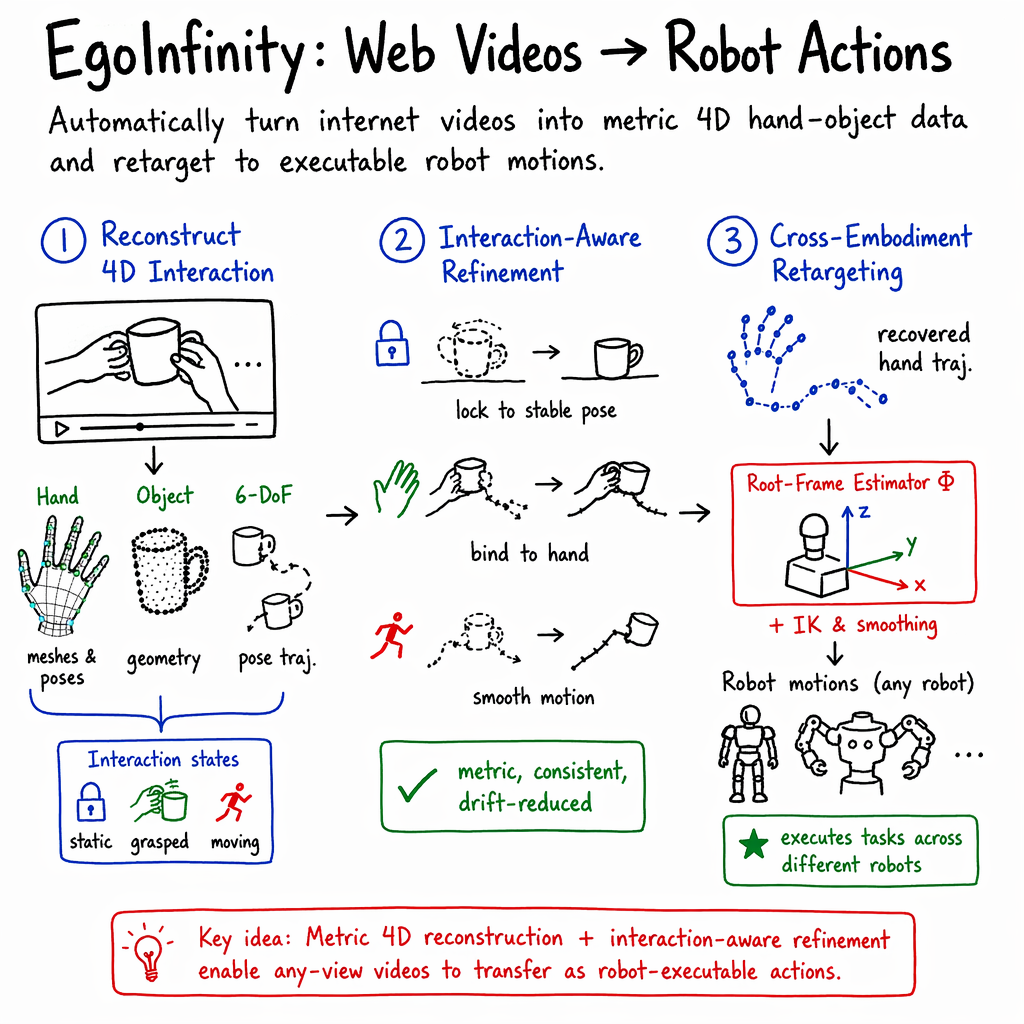
Abstract: Internet videos constitute the largest reservoir of embodied human manipulation knowledge, yet converting arbitrary RGB footage into actionable robot training data remains a major bottleneck. Existing lab- or factory-collected datasets are narrow in scale and diversity, limiting open-world robot learning. Instead of proposing a static dataset, we introduce EgoInfinity, a universal 4D hand-object interaction data engine that enables web-scale data generation for robot retargeting and learning. EgoInfinity is a modular engine integrating perception, segmentation, reconstruction, interaction-aware refinement, and retargeting to automate this traditionally unscalable video-to-action problem without human-in-the-loop annotation. Its modular design lets the engine continuously benefit from advances in any incorporated component. With EgoInfinity, in-the-wild human manipulation videos are lifted into agent-agnostic, metric 4D hand-object representations, including hand trajectories, 6-DoF object poses, and contact-relevant states. Rather than naively connecting standalone components, EgoInfinity combines cross-module metric calibration with interaction-aware refinement to improve physical reliability, reducing drift and contact inconsistencies common in pure visual reconstruction. We further propose a novel motion retargeter that compiles the recovered 3D hand motions into executable joint trajectories for diverse robot morphologies, enabling video-to-action retargeting on any robot from arbitrary viewpoints and shot sizes (e.g., the human body is only partially visible). We validate EgoInfinity across perception fidelity, kinematic feasibility, contact consistency, cross-embodiment generalization, and real-robot skill acquisition (e.g., grasping, cutting, wiping, and pouring), demonstrating a scalable bridge from internet videos to executable robot behavior for open-world robot learning.
Paper Prompts
Sign up for free to create and run prompts on this paper using GPT-5.
Top Community Prompts
Explain it Like I'm 14
A simple guide to “EgoInfinity: A Web‑Scale 4D Hand‑Object Interaction Data Engine for Any‑View Robot Retargeting and Video‑to‑Action Robot Learning”
Overview: What is this paper about?
This paper shows how robots can learn useful hand actions (like grasping, pouring, cutting, or wiping) by watching ordinary internet videos, the same way you might learn a recipe from a YouTube clip. The authors built a system called EgoInfinity that turns regular videos (just RGB, like your phone camera) into detailed, robot-ready “recipes” for motion: where the hands move, what object is being handled, and how they move together over time.
“4D” here means 3D space plus time (so, how shapes move). “Robot retargeting” means taking motions done by a human in a video and converting them into motions a very different robot body can actually perform.
Key goals, in everyday terms
The paper aims to:
- Automatically extract hand and object movements from huge numbers of everyday videos without humans labeling anything.
- Turn those movements into accurate, real‑world 3D paths (with real sizes, like centimeters).
- Figure out which object in the video is being used and how it moves.
- Convert the human hand motions into commands that different kinds of robots (with different shapes and joints) can execute.
- Show that these converted motions work in practice, both in simulation and on real robots.
How does EgoInfinity work? (Methods explained simply)
Think of EgoInfinity as a factory line that cleans up and converts raw video into a motion plan a robot can follow. It’s made of several “stations” (modules). Here’s the idea using simple analogies:
- Finding the hands: Like face recognition but for hands, it detects hand shapes in each frame and tracks how the hands move through the video.
- Finding depth and scale: The system estimates how far things are from the camera and how big they really are. “Metric” means the sizes match the real world, not just pixels.
- Finding the object: It reads the video description (for example “pouring milk”), uses open‑vocabulary detectors to spot the likely object (e.g., “milk carton”), outlines it in each frame, and builds its 3D shape if possible.
- Tracking hand and object together: It keeps track of the object’s 3D position and the hands’ 3D positions and orientations over time. “6‑DoF” means 3 positions (left/right, up/down, forward/back) plus 3 rotations (tilt, turn, roll).
- Interaction-aware refinement: The system doesn’t just look at pixels; it also guesses what’s happening:
- STATIC: object isn’t moving,
- GRASPED: object is in the hand,
- MOVING: object is being moved.
- It uses these labels to fix common video problems like drift (when tracking slowly slides off) or occlusion (when the hand blocks the object). For example, if the object is grasped, it ties the object to the hand so they move together.
- Egocentric reframing: Many videos show the scene from different angles. EgoInfinity re-renders the recovered 3D scene as if a camera were looking over the hands, so different videos end up with a consistent “first‑person‑like” view focused on the action.
- Retargeting to robots: Humans and robots have different bodies. Instead of copying the human’s exact arm motion, EgoInfinity extracts the important part—the hand’s path—and then:
- Estimates the robot’s “root frame” (think of it as choosing the robot’s reference body point so the motion makes sense).
- Uses inverse kinematics (IK)—like figuring out which joint angles put the robot’s hand at the right place and orientation—to produce smooth, executable joint motions.
- This retargeter is designed to behave consistently even if the camera angle changes, and it’s trained in simulation for each robot type.
What did they find, and why does it matter?
Here are the main takeaways from their tests:
- It scales to web video: The system can process large “in‑the‑wild” video collections (like clips from the Action100M dataset) and automatically produce 4D hand‑object data—no special sensors, no gloves, no human labels.
- Better physical consistency: By aligning all modules to the same real‑world scale and using interaction-aware rules (STATIC/GRASPED/MOVING), the system reduces common reconstruction errors like object drift or hands slipping off the object in 3D.
- Works across different robots: The same human video motions were converted into executable motions for very different robots (e.g., a Unitree G1 humanoid, NASA’s Robonaut2, dual‑arm Frankas). The motions respected each robot’s limits and stayed smooth and feasible.
- Real-robot demos: They showed the approach working on actual hardware—learning a dexterous-hand grasping policy and executing skills like cutting, pouring, and wiping—proving that video‑to‑action is possible beyond simulation.
- Open, modular, and upgradable: Because EgoInfinity is built from swappable parts (hand tracking, depth, object detection, etc.), it can automatically benefit as each underlying vision module gets better in the future.
This matters because it opens the door to training “generalist” robots from the massive library of human how‑to videos online, instead of relying only on small, expensive lab datasets.
What’s the bigger impact? (Implications)
If robots can reliably learn from everyday videos:
- We can teach robots many more tasks without expensive sensors, labels, or carefully staged data collection.
- Robots could learn practical household or workplace skills (like picking up items, pouring, or wiping) by watching the same kinds of tutorials people watch.
- Researchers can build larger, more diverse training sets, making robots more adaptable in the real world.
The authors also discuss limits. For now, EgoInfinity works best with mostly still cameras (not shaky, head‑mounted footage), and it doesn’t track ultra‑precise finger forces or touch. Some tasks needing fine fingertip placement or tactile feedback still require more than video. Also, the retargeter is trained per robot, so each new robot may need its own quick setup.
Overall, EgoInfinity is a big step toward turning everyday human videos into usable training material for many different robots, helping close the gap between “watching” and “doing.”
Knowledge Gaps
Below is a single, consolidated list of concrete knowledge gaps, limitations, and open questions that remain unresolved by the paper; each item is phrased to guide actionable future research.
- Relaxing the approximately static-camera assumption: how to robustly handle strong egomotion, hand-held or head-mounted videos via SLAM-aware depth, online bundle adjustment, or video-IMU fusion at web scale.
- Quantifying metric accuracy end-to-end: missing systematic evaluation of absolute scale, camera intrinsics, gravity estimation, and accumulated drift across diverse scenes and video qualities.
- Robustness to common video artifacts: unclear performance under motion blur, rolling shutter, zooms, defocus, low light, compression artifacts, and variable frame rates.
- Open-vocabulary object discovery reliability: how to resolve LLM text-extraction errors, ambiguous prompts, and false positives/negatives from SAM-3/SAM-2 in cluttered scenes or with multiple similar objects.
- Handling hard visual cases: transparent/reflective/textureless objects, thin tools, deformable objects (cloth, bags), liquids, and specular/occluded surfaces that break monocular depth and mesh reconstruction.
- Multi-object and tool-mediated interaction: representing and tracking concurrent objects, tool-object-contact chains (e.g., spatula-pan-food), and role changes (tool becomes target) across time.
- Occlusion and hand-object disentanglement: principled methods to maintain stable object pose when hands fully wrap objects or when severe occlusion violates point-cloud assumptions.
- Interaction-aware refinement validation: lack of quantitative ablation vs. state-blind tracking and vs. physics-based constraints; brittleness of hand-crafted thresholds across frame rates and domains.
- Contact-grounding fidelity: no metric or benchmark for fingertip/object contact accuracy, contact timing, slip/no-slip, or force consistency; how to recover/estimate these from RGB and propagate to retargeting.
- Incorporating tactile or haptic priors: how to fuse tactile predictors (e.g., from video-only tactile estimation) or learned force models to improve contact geometry and stability.
- Object orientation canonicalization: reliability of SAM-3D canonical frames for functionally critical tasks (e.g., pouring); methods to disambiguate symmetries and align functional axes.
- Plane and environment constraints: leveraging table-plane detection and scene surfaces to regularize poses and reduce drift; collision-aware object/hand trajectory refinement.
- Long-horizon temporal structure: segmentation of multi-step tasks, reusable subskills, and cross-clip temporal correspondences; scaling beyond short clips to sustained activities.
- Egocentric re-rendering utility: empirical evidence that the synthesized egocentric reframing improves downstream learning and transfer vs. raw exocentric views; sensitivity to camera placement hyperparameters.
- Uncertainty quantification: absent uncertainty estimates for hand pose, object pose, and root-frame hypotheses; how to propagate uncertainty into IK, collision checking, and policy learning.
- Failure diagnosis and auto-recovery: systematic taxonomies of failure modes (module-wise) and self-correction loops (e.g., re-detect, reinitialize, or switch trackers) without human intervention.
- Scalability and throughput: concrete profiling of web-scale processing cost (GPU hours/clip), memory, and failure rates; scheduling and caching strategies to make 105–106 clip processing practical.
- Domain generalization: cross-corpus validation beyond Action100M-style content (e.g., non-English, different cultures/environments, body cams) and robustness to dataset shift.
- Ground-truth benchmarking: absence of standardized benchmarks with partial ground truth (e.g., multi-view lab subsets) to measure pose/contact accuracy and state classification precision/recall.
- Learned vs. heuristic state classification: exploring learned interaction-state models (with self-supervision or weak labels) to replace hand-tuned thresholds and improve cross-domain robustness.
- Closed-loop physical consistency: integrating lightweight physics priors (rigidity, quasi-static constraints, contact complementarity) or differentiable simulators to refine trajectories beyond visual cues.
- Retargeter generality: reducing robot-specific retraining by learning a universal or conditional root estimator across morphologies; zero-shot generalization to new kinematic trees.
- Constraint-rich retargeting: adding collision avoidance, joint torque/velocity/acceleration limits, compliance/impedance control, and environment-aware constraints to IK and post-processing.
- Bimanual coordination fidelity: quantifying relative-hand pose/phase accuracy and hand-hand/object synchronization in retargeted dual-arm executions; handling asymmetric reach and base motion.
- Mobile manipulation: extending root-frame estimation to include base pose for mobile manipulators; coupling navigation and manipulation from video-only cues.
- Sim-to-real gap for root estimation: assessing how simulation-trained root estimators transfer across real video noise distributions and unseen kinematics; strategies for domain randomization/adaptation.
- Finger posture transfer: systematic mapping from MANO to diverse robot hands (DoF mismatch, joint coupling, contact objectives) with guaranteed grasp stability.
- Policy learning impact: controlled studies comparing policies trained with EgoInfinity outputs vs. curated datasets on success rates, sample efficiency, and robustness; ablations on data volume and quality.
- Task success evaluation on real robots: large-scale, quantitative execution metrics (success/failure, time, regrasp rate) across tasks/objects rather than qualitative demos.
- Ambiguity and intent inference: resolving which object is “task-relevant” when multiple are present and inferring high-level goals from weak video-language cues for better motion selection.
- Ethical, legal, and privacy considerations: licensing/compliance for internet videos, consent issues, and mechanisms for respecting content restrictions while building web-scale robot datasets.
- Reproducibility of module choices: sensitivity analysis and ablations over alternative modules (depth, hand, segmentation, pose tracking) to quantify the benefit of cross-module metric calibration.
- Self-improving engine: mechanisms to iteratively fine-tune modules using engine outputs (e.g., pseudo-labeling, consistency training) and to detect when such bootstrapping harms physical fidelity.
Practical Applications
Practical Applications Derived from the Paper
Below is a structured set of actionable, real-world applications that follow directly from the paper’s findings and systems (the EgoInfinity data engine and the cross-embodiment retargeter). Each item names likely sectors, potential tools/products/workflows, and key assumptions/dependencies that affect feasibility.
Immediate Applications
- Web-to-robot skill mining for service and industrial robots
- Sectors: Robotics, manufacturing, hospitality, retail, facilities/cleaning
- What: Use the EgoInfinity pipeline to convert “how-to” or tutorial videos (e.g., wiping, pouring, cutting) into executable joint trajectories for existing robot arms and humanoids. Rapidly prototype skill libraries without costly teleoperation or motion capture.
- Tools/products/workflows:
- “Video-to-ROS2 exporter” (EgoInfinity outputs to ROS control stacks; trajectory and contact-state topics)
- “Skill-miner” CI pipeline that periodically processes curated playlists (e.g., YouTube cooking/cleaning tutorials) into candidate skills; human-in-the-loop sanity checks via the provided 3D browser viewer
- Integration with existing policy learners (e.g., grasping policy seeding as demonstrated for LEAP hand)
- Assumptions/dependencies:
- Static or near-static camera videos; limited occlusion
- Robot-specific retargeter models trained in MuJoCo; accurate URDFs and kinematic limits
- Safety wrappers (geofencing, force/impedance control) due to coarse contact accuracy and no tactile sensing
- Content licensing/permissions for video ingestion
- Low-cost dataset generation and augmentation for robot learning
- Sectors: Academia, robotics R&D, software (ML tooling)
- What: Auto-generate metric 4D hand-object interaction (HOI) data (hand trajectories, 6-DoF object poses, interaction states) to pretrain or regularize policies and VLA models; complement lab datasets with open-world variability.
- Tools/products/workflows:
- “EgoInfinity Data Engine” as a service (local or cloud) for batch processing large corpora
- Plug-ins for training pipelines (e.g., RT-X or imitation learning frameworks) to consume 4D HOI outputs as priors or auxiliary losses
- Browser server for data inspection, failure triage, and curation of high-quality clips
- Assumptions/dependencies:
- Compute budget and compatibility with upstream models (WILOR, MOGE-2, FLOW3R, SAM2/3, SAM3D, FoundationPose++)
- Module upgrades may change distributions; pin versions for reproducibility
- Quality depends on object visibility and semantic detection reliability
- Cross-embodiment motion retargeting for heterogeneous fleets
- Sectors: Robotics (manufacturers, integrators), education
- What: Compile the same human hand motions into executable joint trajectories for different robot morphologies (humanoids, dual-arm manipulators, dexterous hands).
- Tools/products/workflows:
- “Retargeting SDK” with robot-specific root estimators and IK stacks (Unitree G1, Robonaut2, Franka FR3 templates)
- Classroom/demo kits: import a public video and deploy a retargeted motion on a lab robot to teach kinematics, IK, and embodiment differences
- Assumptions/dependencies:
- Per-robot root estimator requires training/calibration; generalization drops for unseen embodiments
- Functional transfer preserves task-relevant hand motion but not exact human posture; unsuitable for micrometer-precision assembly without refinement
- Interactive 4D HOI annotation and curation tool
- Sectors: Academia, ML tooling, dataset providers
- What: Use the provided web viewer to quickly triage, visualize, and download 4D reconstructions; build curated benchmarks focused on categories (e.g., “container,” “tool,” “food”).
- Tools/products/workflows:
- “Browser-based 4D HOI Lab” with search, visualization, and export (point clouds, trajectories, meshes, state labels)
- Semi-automated QA (sanity checks, outlier removal, interaction-state summaries)
- Assumptions/dependencies:
- Curators should enforce quality gates (e.g., clip-level stability, pose drift thresholds)
- Licensing and privacy review for public distribution of processed content
- Egocentric re-rendering for standardizing training views
- Sectors: Robotics, education, software (preprocessing)
- What: Convert diverse exocentric source videos into consistent egocentric views via rigid 3D reframing, improving downstream learning without generative editing.
- Tools/products/workflows:
- “Ego-view renderer” module to produce standardized inputs for imitation/RL and for human review
- Assumptions/dependencies:
- Requires stable gravity and camera calibration; works best with near-static source viewpoints
- Policy seeding with interaction-aware priors
- Sectors: Robotics
- What: Use extracted wrist/finger trajectories and coarse grasp states to initialize policies for grasping and simple manipulation, reducing data collection overhead (as shown for LEAP grasping).
- Tools/products/workflows:
- “Trajectory-to-policy” initializer (IL/RL with motion priors; curriculum from static→moving→grasped)
- Assumptions/dependencies:
- Coarse contact; add safety and tactile-free robust grasps or complement with small real data for fine-tuning
- Early-stage pilots in hospitality and facilities maintenance
- Sectors: Hospitality, facilities/cleaning
- What: Deploy robots on low-risk tasks (wiping tables, pouring dispensers, simple object placement) learned from web videos and refined on-site.
- Tools/products/workflows:
- Site-specific calibration, workspace mapping, validation runs supervised by operators
- Assumptions/dependencies:
- Strong procedural safety; conservative velocities/forces; human oversight during rollout
- Education and outreach in robotics
- Sectors: Education
- What: Course modules where students pick an online clip, process it through EgoInfinity, and deploy retargeted motions; lessons on perception, geometry, IK, and policy learning.
- Tools/products/workflows:
- Turnkey teaching notebooks and lab assignments using the browser server and ROS integration
- Assumptions/dependencies:
- Access to modest compute and at least one compatible robot or simulator
- Governance pilots for responsible web-scale data use
- Sectors: Policy, legal/compliance in organizations
- What: Establish internal processes for data provenance, licensing, and consent when mining public videos for robotic training; evaluate safety implications of video-to-action pipelines.
- Tools/products/workflows:
- Data protection impact assessments (DPIA), content licensing agreements, opt-out mechanisms
- Assumptions/dependencies:
- Jurisdiction-specific IP/privacy law; platform ToS; organizational risk tolerance
Long-Term Applications
- Generalist home robots trained from web-scale videos
- Sectors: Consumer robotics, smart home
- What: Large, diverse video-derived 4D HOI corpora enable broad manipulation skills (kitchen, laundry, tidying) with cross-embodiment retargeting to different home robots.
- Tools/products/workflows:
- Continual skill-mining pipelines; on-device personalization from a user’s recorded demonstrations
- Assumptions/dependencies:
- Relaxing static-camera constraint (SLAM-aware geometry), improved contact fidelity, tactile sensing, robust safety and certification for domestic deployment
- Procedure learning for healthcare support tasks
- Sectors: Healthcare
- What: Learn non-invasive, high-compliance tasks (surface sanitation, supply handling, instrument tray prep) from instructional videos; longer term, sterile workflows and assistive routines.
- Tools/products/workflows:
- Hospital-grade safety stacks, sterile-environment compliance, human-in-the-loop validation
- Assumptions/dependencies:
- Regulatory clearance, higher precision and contact safety, domain-specific data (clinical settings, moving cameras, PPE occlusions)
- Flexible manufacturing from operator videos
- Sectors: Manufacturing, electronics assembly
- What: Convert expert operator videos into robot-executable procedures for low-volume/high-mix manufacturing.
- Tools/products/workflows:
- Factory-specific calibration, CAD/scene priors, force/torque sensing integrated with the pipeline
- Assumptions/dependencies:
- Fine-grained contact alignment, exact timing, moving/first-person cameras; strong SLAM and tactile integration; robust failure recovery
- Logistics and retail backroom automation from training clips
- Sectors: Logistics, retail
- What: Learn shelf-stocking, bin picking, packing routines from training or SOP videos; personalize to store layouts.
- Tools/products/workflows:
- Store-internal video corpora (licensed), environment mapping, perception of SKU variations
- Assumptions/dependencies:
- Dynamic scenes, mobile manipulation, continuous re-localization; reliable open-vocabulary detection in clutter
- Energy and field maintenance skill transfer
- Sectors: Energy, utilities
- What: Learn inspection and maintenance procedures (e.g., valve operations, panel resets) from technician videos.
- Tools/products/workflows:
- Ruggedized mobile manipulators, outdoor SLAM, tool-use generalization
- Assumptions/dependencies:
- Moving cameras (body/bodycam), adverse conditions, long-horizon tasks; safety-critical certification
- Marketplace for robot skills distilled from creator content
- Sectors: Software platforms, creator economy, robotics
- What: Platforms where creators upload task videos and receive revenue shares from robot skill packages derived from their content.
- Tools/products/workflows:
- Licensing, verification, automatic retargeting to popular robot models, quality/safety certification layers
- Assumptions/dependencies:
- Standardized skill descriptors/APIs, legal frameworks for derivative robotic behaviors, platform governance
- Foundation library of 4D hand-object interactions for cross-domain research
- Sectors: Academia, AR/VR, prosthetics
- What: A universal 4D HOI repository to study manipulation, design prosthetic control priors, and develop realistic AR/VR hand-object interactions.
- Tools/products/workflows:
- Research benchmarks, haptics/biomechanics integration, synthetic-to-real sim bridges
- Assumptions/dependencies:
- Higher fidelity contact models, biomechanical consistency, broader taxonomies of tools/objects
- On-device private video-to-skill conversion for end-users
- Sectors: Consumer robotics, privacy tech
- What: Users securely record a short demo of a new household task; the robot derives and stores a private, personalized skill locally.
- Tools/products/workflows:
- Efficient on-device versions of the pipeline (quantized modules), local SLAM, local retargeter
- Assumptions/dependencies:
- Hardware acceleration, energy-efficient inference, robust failure fallback and undo mechanisms
- Regulatory and standards development for video-to-action robotics
- Sectors: Policy, standards bodies
- What: Certification protocols for data provenance, physical safety, and evaluation of learned manipulation from public data.
- Tools/products/workflows:
- Standardized benchmarks for kinematic feasibility, contact safety, drift, and cross-embodiment generalization
- Assumptions/dependencies:
- Multi-stakeholder alignment (manufacturers, platforms, regulators), incident reporting and auditing frameworks
Notes on cross-cutting dependencies and risks:
- Current system assumptions: near-static cameras; partial hands/arms visible; coarse contact fidelity; no tactile sensing; robot-specific retargeter training.
- Technical debt and upgrades: accuracy improves as upstream perception/reconstruction models (e.g., SAM3D, monocular metric depth, gravity estimation) advance; the modular design supports drop-in replacement.
- Safety: functional retargeting is not exact imitation; add force limits, collision monitoring, and human supervision for new skills.
- Legal/ethical: ensure licensing/ToS compliance; mitigate privacy risks; maintain data provenance.
- Bias and coverage: tasks common online may overrepresent certain environments/objects; complement with targeted data collection for missing domains.
Glossary
- 4D hand-object representation: A spatiotemporal 3D representation of hands and objects over time for manipulation analysis and transfer. "yielding a metric, agent-agnostic 4D hand-object representation for downstream cross-embodiment retargeting and policy learning."
- 6-DoF: Six degrees of freedom describing a rigid object’s pose (3D position and 3D orientation). "including hand trajectories, 6-DoF object poses, and"
- Agent-agnostic: Independent of the specific body or robot performing the motion, enabling reuse across embodiments. "EGOINFINITY instead exposes an agent-agnostic 4D manipulation representation and performs functional retargeting"
- Cross-embodiment retargeting: Transferring motions across different robot (or human) body designs while preserving task functionality. "for downstream cross-embodiment retargeting and policy learning."
- Equivariant (SE(3)-equivariant): A model property where outputs transform predictably under rigid transformations of the inputs. "We design + to be SE(3)-equivariant: if the input trajectories are rigidly transformed, or the camera frame changes, the predicted root frame transforms accordingly."
- Exo-to-ego conversion: Reframing exocentric video into an egocentric viewpoint using recovered 3D geometry. "exo-to-ego conversion is performed as a rigid coordinate reframing in recovered 3D space rather than as 2D generative video translation."
- Flow matching: A generative modeling approach that learns vector fields to map simple distributions to complex target distributions. "we formulate root-frame prediction as flow-matching conditional generation"
- Geodesic orientation error: The minimal angular difference between two rotations measured on the rotation manifold. "Pos./Ori. Error: mean hand position (l2, cm) and orientation (geodesic, °) error between IK target and achieved pose."
- Gram-Schmidt orthogonalization: A process to construct an orthonormal basis from vectors, here used to form a rotation matrix. "The rotation head decodes two vector outputs into "R" E SO(3) via Gram-Schmidt orthogonalization."
- Gravity vector: The estimated direction of gravity in the scene for physically consistent orientation. "and GEOCALIB [33] to estimate the gravity vector \"g.\""
- Hysteresis: A system behavior where thresholds differ for state transitions to avoid flicker, often implemented via a Schmitt trigger. "yielding a hysteresis-stable binary motion signal mt"
- Inverse kinematics (IK): Computing joint configurations that realize desired end-effector poses. "Candidates are scored by IK convergence, residual tracking error, manipulability, joint-limit margin, and smoothness"
- Kinematic root frame: A reference frame (e.g., torso) relative to which limb motions are represented for retargeting. "we use a neural network ?(.) to estimate a shared kinematic root frame, e.g., a humanoid torso frame."
- MANO: A parametric 3D hand model that encodes pose and shape for mesh reconstruction. "We use WILOR [26] to estimate MANO hand parameters [42]"
- Manipulability: A measure of how easily a robot can move its end-effector in different directions given its configuration. "Candidates are scored by IK convergence, residual tracking error, manipulability, joint-limit margin, and smoothness"
- Median Absolute Deviation (MAD) filter: A robust statistics method for outlier rejection based on median deviations. "after a MAD outlier filter (Sec. A.5) we take the inlier mean"
- Monocular metric geometry: Recovering scene geometry (with absolute scale) from a single RGB camera. "monocular metric geometry [27, 28]"
- MuJoCo: A physics engine for simulation-based control and motion generation. "The network is trained entirely in MuJoCo simulation [48], without real-world supervision."
- Null-space regularization: Stabilizing IK by penalizing motions in directions that do not affect the end-effector task. "tracked frame-by-frame with warm starts and null-space regularization."
- Optical flow: The per-pixel motion field between video frames used to infer movement. "from MEMFOF [32] optical flow and hand keypoints"
- Ornstein-Uhlenbeck random walk: A mean-reverting stochastic process used to generate smooth trajectory control points. "smooth control points are generated by an Ornstein-Uhlenbeck random walk biased toward this anchor"
- Perspective-n-Point (PnP): Estimating camera pose from 2D-3D correspondences; here used in object tracking pipelines. "optical-flow/PnP tracking [32]"
- Point cloud: A set of 3D points representing object surfaces reconstructed from depth and masks. "The engine outputs metric hand states, object point clouds and meshes, 6-DoF object pose trajectories"
- Retargeting (functional retargeting): Converting recovered human hand motions into feasible robot motions while preserving task function. "Our goal is functional retargeting: preserving task-relevant hand motion without mimicking precise human body or arm motion."
- SAM-2: A video object tracking component (from the Segment Anything family) used to propagate masks. "then propagate the detected mask through the segment using SAM-2 [29]"
- SAM-3: An open-vocabulary detector (from the Segment Anything family) used for target-object discovery. "We use the video description as a semantic prompt for SAM-3 [30] detection"
- SAM-3D: A method to reconstruct 3D object meshes from images/masks. "SAM-3D [31] reconstructs the object mesh Mº."
- Savitzky–Golay filter: A smoothing filter that preserves shape features like peaks while denoising signals. "A Savitzky-Golay filter (window 7, order 2) smooths Az within the segment"
- Schmitt trigger: A hysteresis-based thresholding mechanism to stabilize binary decisions against noise. "and pass it through a Schmitt trigger (Sec. A.5) with thresholds"
- SE(3): The Lie group of 3D rigid transformations (rotations and translations). "We design + to be SE(3)-equivariant"
- SLAM: Simultaneous Localization and Mapping; here referenced as a future integration for dynamic-camera videos. "as SLAM-aware depth models mature"
- SLERP: Spherical linear interpolation for smooth interpolation between rotations. "using linear interpolation for translation and SLERP for rotation."
- SO(3): The Lie group of 3D rotations. "The rotation head decodes two vector outputs into \"R\" E SO(3) via Gram-Schmidt orthogonalization."
- Vector Neuron (VN) layers: Neural layers operating on 3D vectors that maintain rotation equivariance. "We implement this mapping with Vector Neuron (VN) layers [46]"
- Warm-started position-only IK: Initializing IK with a previous solution and solving for positions (not orientations) to improve stability. "converted to joint-space knots with warm-started position-only IK"
Collections
Sign up for free to add this paper to one or more collections.

