Why Does Action Chunking Improve Behavioral Cloning Performance in Robotic Control?
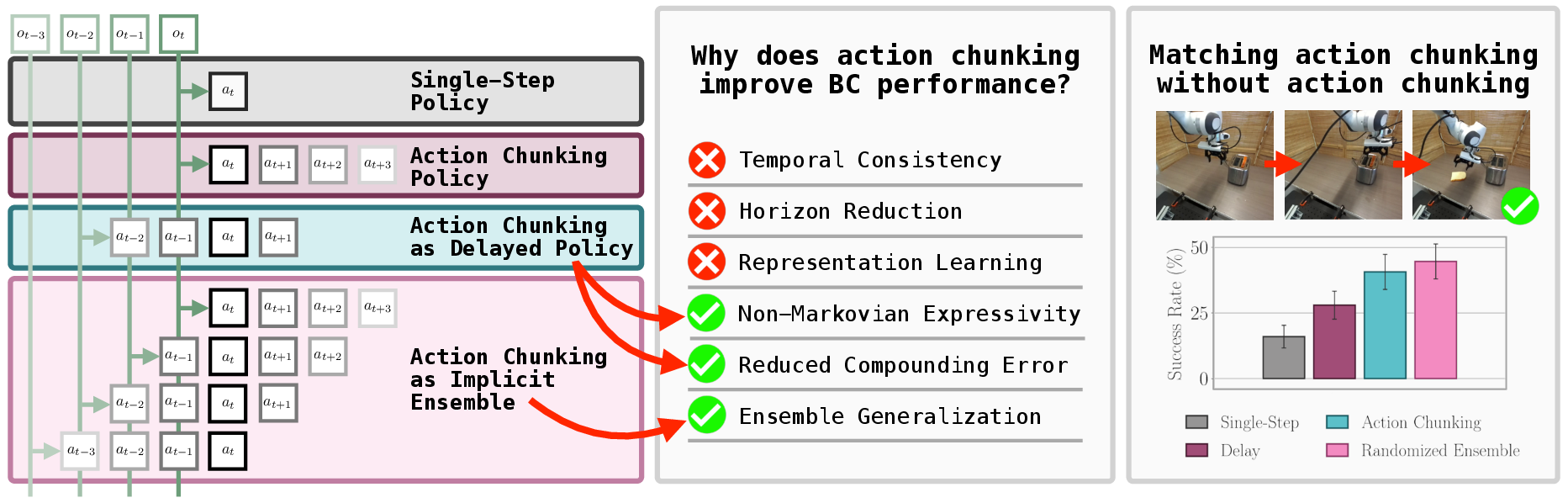
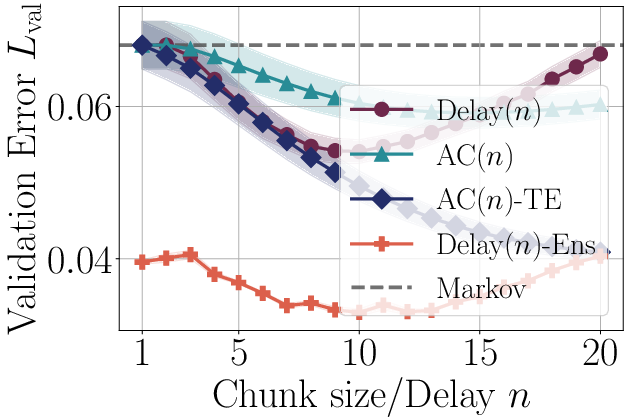
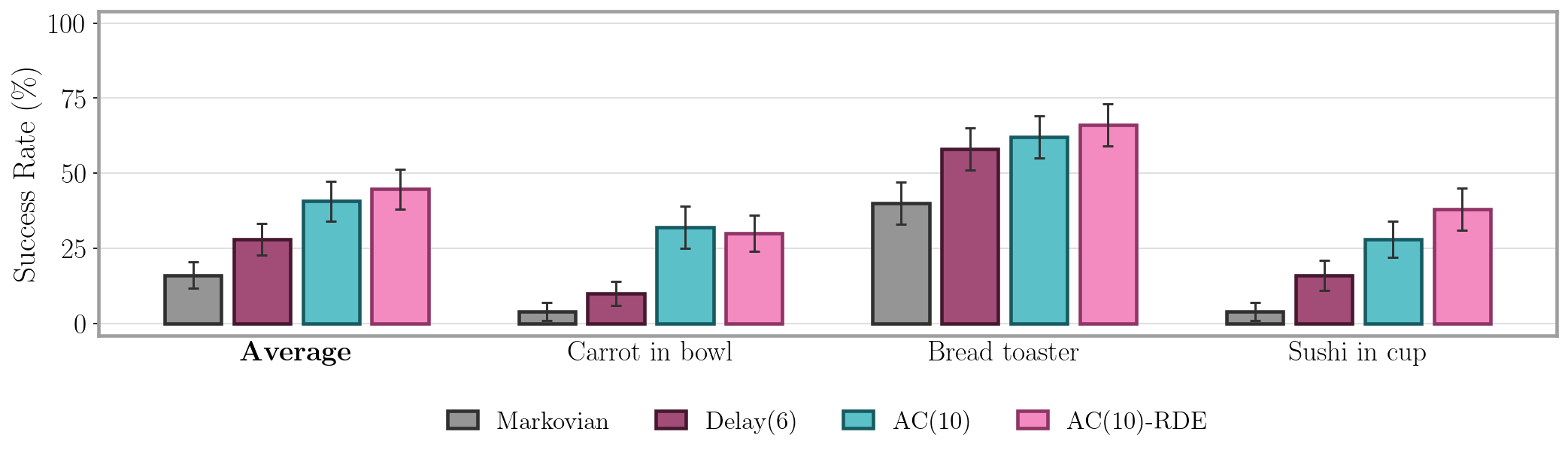
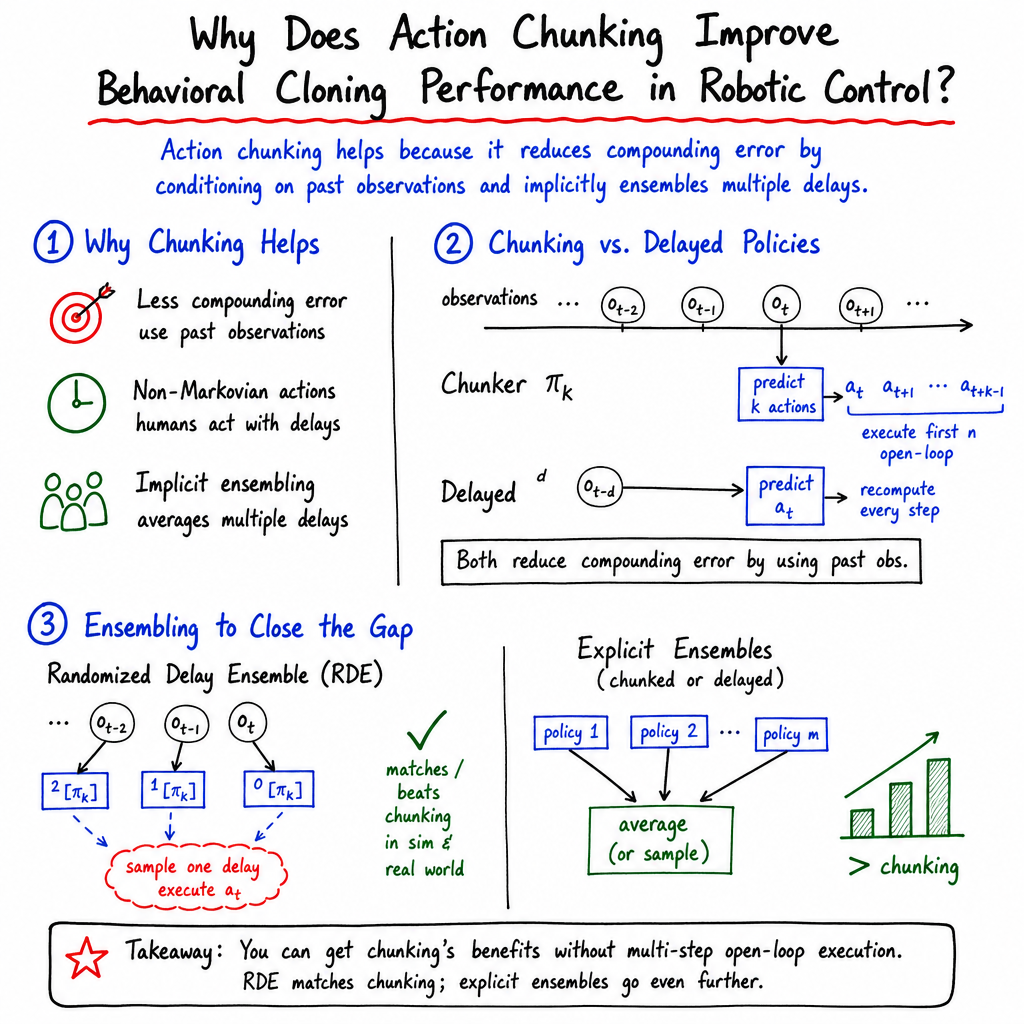
Abstract: Action chunking---predicting and executing multiple actions instead of a single action---has proven to be a critical component for learning effective robotic control policies. However, our precise understanding of why action chunking improves performance has remained limited. In this work we seek to close this gap. Through rigorous experimental evaluations in both simulated and real-world settings, we show that existing hypotheses for the success of action chunking---temporal consistency, horizon reduction, and representation learning---fail to explain the success of action chunking. Instead, we find that action chunking benefits from greater non-Markovian expressivity and reduced compounding error compared to Markovian policies, but, in many settings of interest, these effects can be fully captured by delayed policies, which at each step predict a single action based on the observation steps in the past. We then show that there exists an additional benefit of action chunking that we refer to as implicit ensembling. In particular, by learning a diversity of temporal relationships (that is, ), action-chunked policies exhibit behavior matching that of a model ensemble, increasing their robustness and generalization ability over policies that only learn a single temporal relationship. Building on these insights, we show that in simulated and real-world robotic control settings, we can match the performance of action chunking without action chunking---by deploying an action chunking policy as an ensemble of policies with randomized delays. Furthermore, we propose a policy class that amplifies the benefits of action chunking by explicitly instantiating an ensemble, and which we show significantly improves over the performance of action chunking in many domains.
Paper Prompts
Sign up for free to create and run prompts on this paper.
Top Community Prompts
Explain it Like I'm 14
1. What is the paper about?
This paper asks a simple but important question:
Why do robots often perform better when they predict several actions at once instead of predicting one action at a time?
For example, instead of telling a robot:
“Move your hand a little to the left.”
the robot predicts a short sequence:
“Move left, move forward, lower the arm, and close the gripper.”
This method is called action chunking. It is widely used in modern robot-learning systems, but researchers have not fully understood why it works so well.
The paper studies this question using robot simulations and real robots.
2. What questions did the researchers investigate?
The researchers examined three common explanations for why action chunking helps:
- Temporal consistency: Perhaps action chunking helps robots copy the smooth, connected movements humans make.
- Horizon reduction: Perhaps predicting several actions at once makes the task shorter and reduces mistakes that build up over time.
- Representation learning: Perhaps training on action sequences helps the robot understand what it sees more effectively.
The researchers also asked:
- Could a robot get the same benefits by predicting one action at a time using an older observation?
- Does action chunking work partly like an ensemble, which is a group of slightly different models working together?
- Can robots perform even better by deliberately using several models or several time delays?
3. How did the researchers study the problem?
Behavioral cloning
The paper uses behavioral cloning, a way of teaching robots by showing them demonstrations.
For example, a human might demonstrate how to open a drawer. The training system records:
- what the robot sees, such as camera images;
- what action the robot takes, such as moving its arm.
The robot then learns to copy the human’s actions, much like a student learning by watching an expert.
Comparing different types of policies
A robot’s decision-making program is called a policy. The researchers compared several kinds of policies:
- Single-step policy: Predicts one new action from the current observation.
- Action-chunking policy: Predicts a sequence of actions from the current observation.
- Delayed policy: Predicts one action at a time, but uses an observation from a few moments earlier.
A delayed policy may seem unusual. Imagine asking:
“Based on what you saw two seconds ago, what should you do now?”
This can actually help because older observations may come from a situation that is more similar to the examples used during training.
Experiments and benchmarks
The researchers trained robot policies and tested them on:
- Libero, a simulated robot benchmark with many tasks;
- Robomimic, another robot-learning benchmark;
- real-world robot manipulation tasks.
They measured:
- Success rate: How often the robot completed a task;
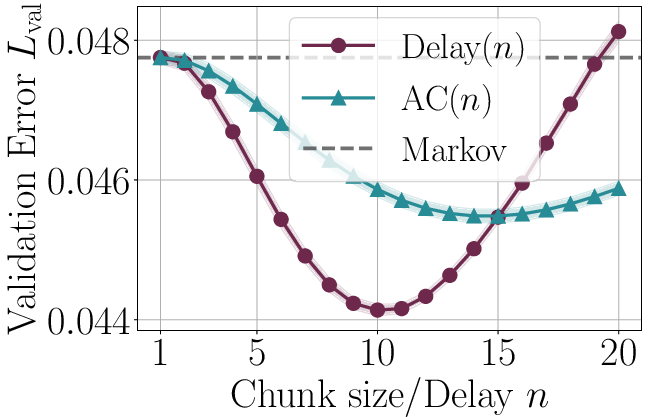
- Prediction error: How different the robot’s predicted actions were from the human demonstrator’s actions.
They also used mathematical analysis to understand how errors can grow as a robot takes more and more actions. This is called compounding error: a small mistake early in a task can cause larger mistakes later.
4. What did the researchers find?
Action chunking is not mainly useful because movements are smooth
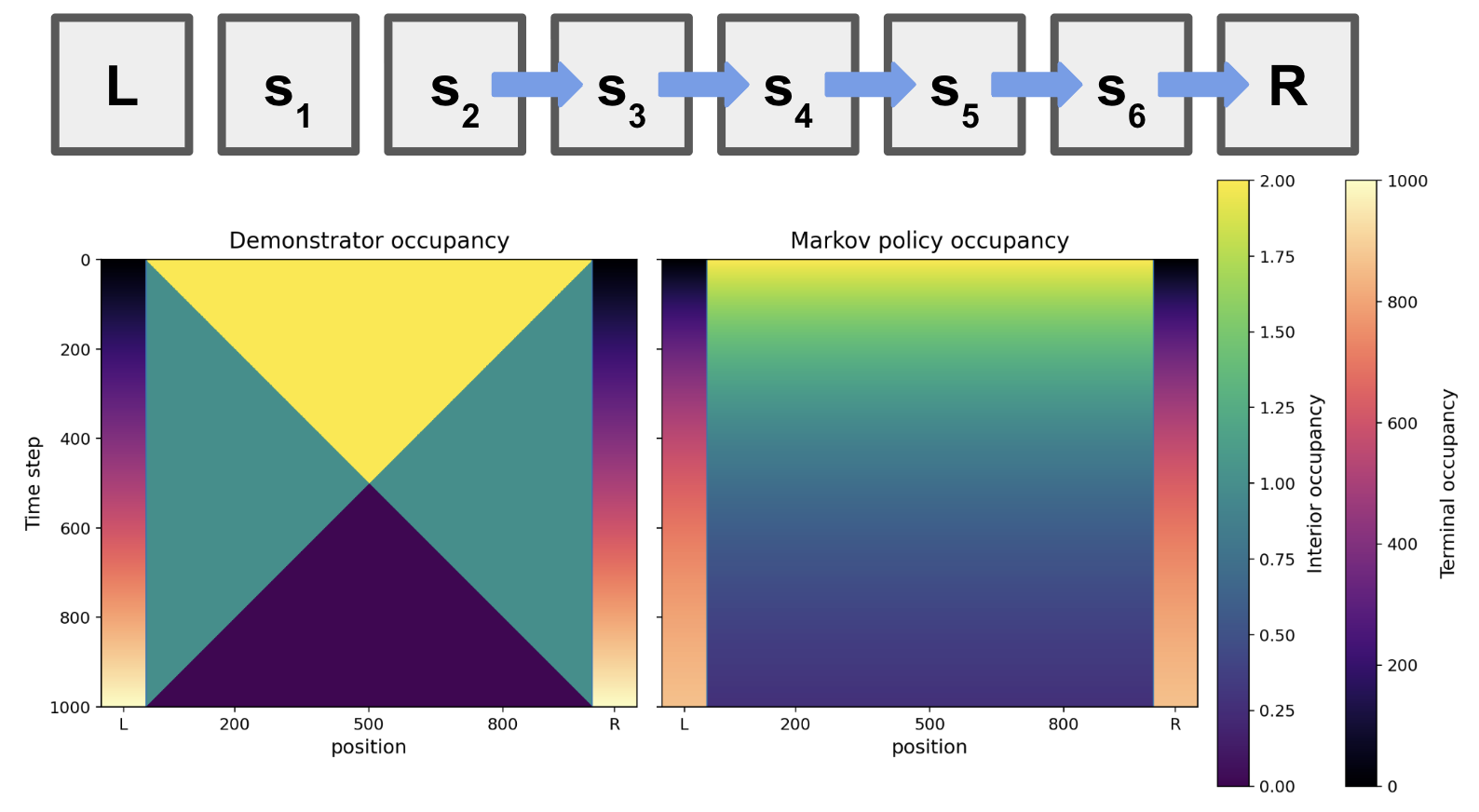
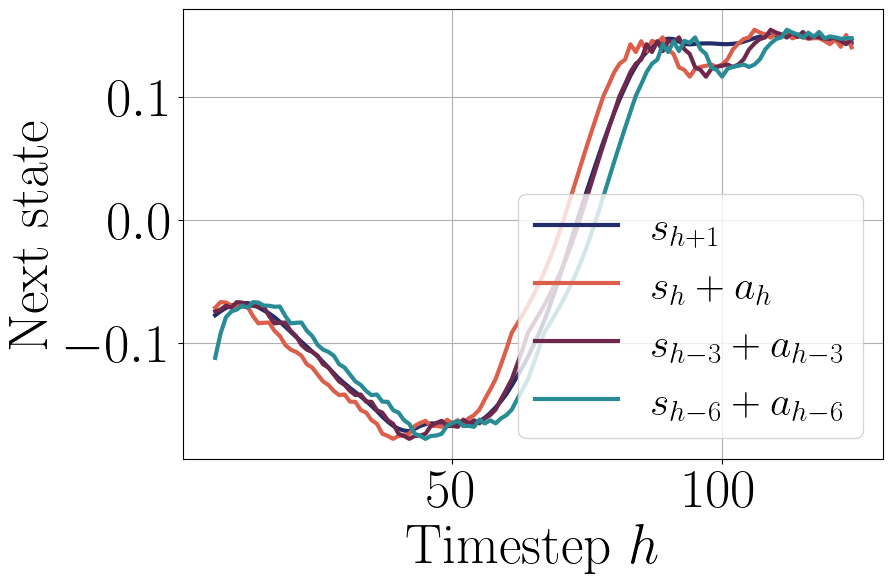
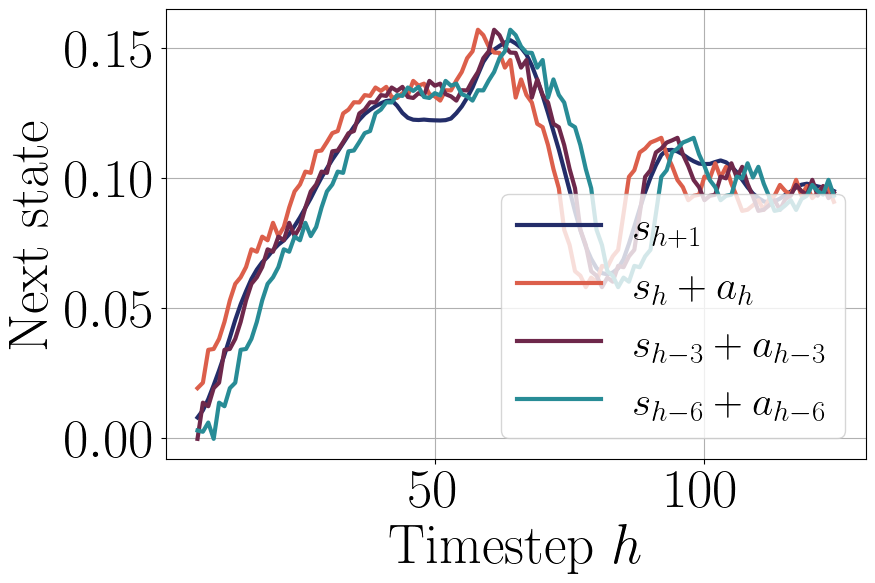
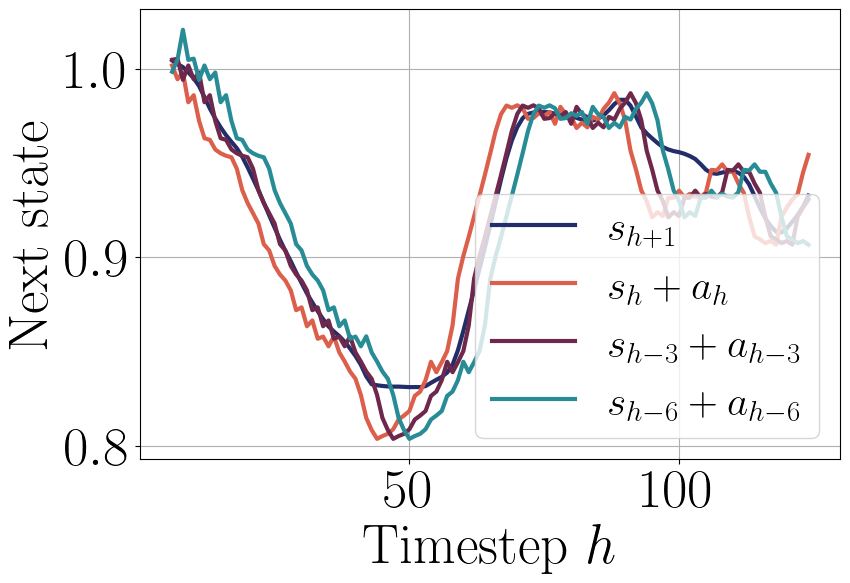
The researchers found that humans do show behavior that depends on earlier events, not just what is happening at the exact current moment. This is called non-Markovian behavior.
For example, when opening a drawer, a person may pause for a moment after grabbing the handle before pulling. The current image alone may not explain the pause. The robot may need to remember what happened a few moments earlier.
However, the researchers found that a delayed policy could usually capture this behavior just as well as action chunking. Therefore:
Action chunking does not need to produce smooth action sequences in order to work well.
Delayed policies can often match action chunking
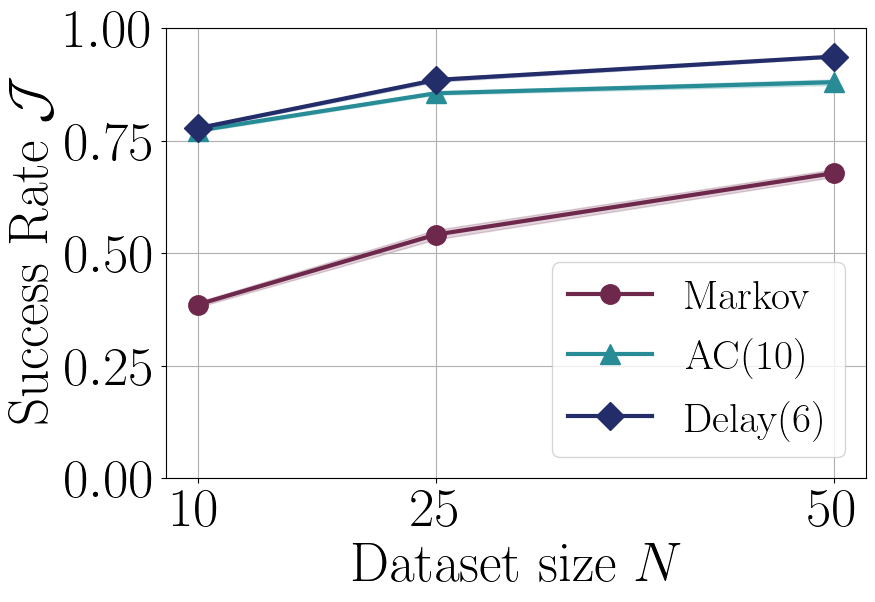
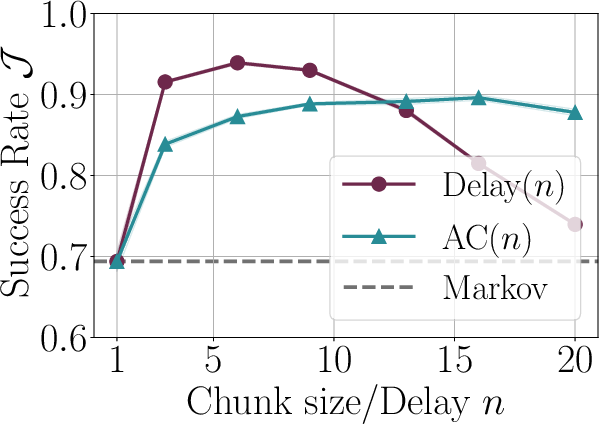
In many Libero tasks, a policy that predicted one action from an earlier observation performed as well as, or better than, a normal action-chunking policy.
This means the robot often does not need to predict a whole sequence at once. It can instead:
- look at an earlier observation;
- predict one action;
- repeat this process at every time step.
This approach can capture useful information about the recent past while still allowing the robot to update its decision frequently.
Action chunking helps reduce compounding errors
The researchers confirmed that action chunking can reduce the way mistakes build up during a task.
But they found that the main reason is not simply that action chunking makes the task appear shorter. Instead, action-chunking policies often predict later actions using earlier observations.
Earlier observations are usually closer to the situations seen during training. Therefore, the robot’s predictions may be more reliable.
For example, suppose a robot makes a small mistake while moving toward a cup. If it keeps making decisions based only on its current, slightly incorrect position, the mistake may grow. Using an earlier observation can sometimes keep the robot’s behavior closer to the demonstrated path.
Importantly, delayed policies can provide much of the same protection against compounding errors.
The representation-learning explanation is only partly correct
Training on action chunks did help the robot learn useful internal information in some cases, especially for predicting the first few actions.
However, delayed policies trained directly to predict actions from earlier observations achieved similar benefits. This suggests that action chunking itself is not essential for improving the robot’s internal representations.
Action-chunking policies behave like ensembles
This was the paper’s most important additional finding.
An action-chunking policy learns many relationships at the same time. For example, it learns how to predict an action from:
- the current observation;
- the observation one step earlier;
- the observation two steps earlier;
- and so on.
This is similar to having several slightly different experts make predictions.
An ensemble combines predictions from multiple models or viewpoints. Ensembles are often more reliable because one model’s mistake may be balanced by another model’s better prediction.
The researchers argue that action chunking creates an implicit ensemble. The ensemble is “implicit” because the robot does not appear to use several separate models, but the different time relationships inside the action-chunking policy act like multiple predictors.
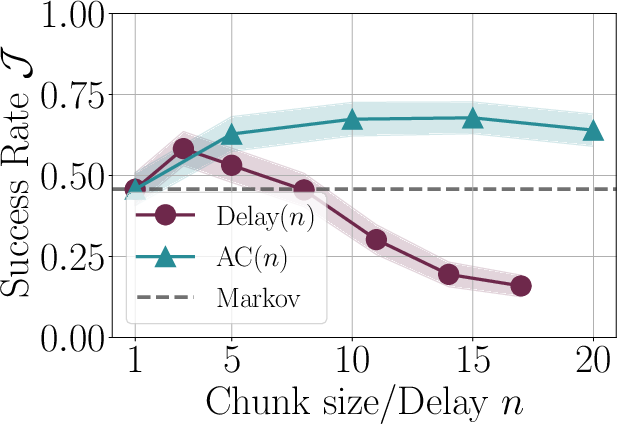
This helps explain why delayed policies sometimes failed to match action chunking, especially on the Robomimic tasks. A single delayed policy uses only one time relationship, while action chunking can use many.
Randomized delays can reproduce action chunking
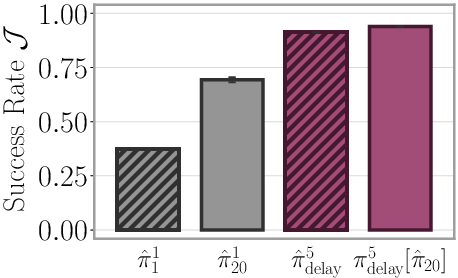
The researchers found that they could often match the performance of action chunking without actually executing action chunks.
Their method used an action-chunking policy as if it were a collection of delayed policies. The system randomly selected different delays and combined their predictions.
This allowed the robot to benefit from:
- using older observations;
- reducing compounding errors;
- combining several different predictions.
Explicit ensembles can perform even better
Finally, the researchers trained ensembles more deliberately. Instead of relying only on the hidden ensemble effect inside action chunking, they created several delayed policies and combined their actions.
In many tasks, these explicit ensembles performed better than ordinary action chunking.
5. Why are these results important?
The paper changes how researchers should think about action chunking.
Before this work, people often believed that action chunking worked mainly because it:
- made actions smoother;
- shortened the task;
- or improved the robot’s learned visual representations.
The paper argues that these explanations are incomplete.
Instead, action chunking appears to help because of three main effects:
- It can represent behavior that depends on the past.
- It can reduce the growth of mistakes by using earlier observations.
- It acts like an ensemble of several predictors, improving reliability and generalization.
The third effect—implicit ensembling—can be especially important when a single delayed policy is not enough.
6. What could this mean for the future?
The findings suggest that robot designers do not always need to use traditional action chunking. They may be able to build simpler or more flexible systems using:
- delayed policies;
- several policies with different delays;
- randomized delays;
- explicit ensembles of robot-control models.
These approaches could make robots more accurate and robust, especially when they face situations that are slightly different from their training examples.
They might also help robots react more quickly. A robot that executes a long action chunk without checking its surroundings may be slow to respond if something changes. Delayed or ensemble-based methods can allow the robot to update its actions more often while keeping many of the advantages of action chunking.
In short, the paper shows that action chunking is useful, but the exact act of executing a long sequence is not always necessary. Understanding the hidden reasons why it works may lead to robot systems that are more reliable, responsive, and powerful.
Knowledge Gaps
Knowledge gaps, limitations, and open questions
- The paper does not establish how broadly its conclusions generalize beyond the evaluated benchmarks (
Libero,Robomimic) and a limited set of real-world robotic manipulation tasks. - The real-world experiments are not described in the provided text in sufficient detail to determine how many robots, tasks, environments, operators, demonstrations, and hardware configurations were evaluated.
- It remains unclear whether the proposed mechanisms apply to long-horizon tasks involving navigation, locomotion, dynamic contact, whole-body control, or highly reactive interaction rather than tabletop manipulation.
- The study does not systematically evaluate action chunking under strongly stochastic, rapidly changing, or adversarial environments where stale observations may be especially harmful.
- The theoretical analysis relies on restrictive assumptions, including deterministic dynamics, Lipschitz transition and reward functions, and bounded distributional prediction error; the implications for discontinuous contacts, mode switches, collisions, and stochastic dynamics remain unresolved.
- The paper does not provide a general criterion for predicting when delayed policies will match action-chunked policies and when implicit ensembling will provide a decisive advantage.
- The relationship between the optimal delay, chunk size, execution horizon, control frequency, observation latency, and task-specific dynamics is not formally characterized.
- The experiments appear to select delays and chunk sizes empirically, leaving open how these parameters should be chosen without extensive validation rollouts.
- The proposed explanation of implicit ensembling remains partly conjectural: the paper demonstrates performance similarities but does not formally derive when temporally indexed predictors are sufficiently diverse or statistically complementary to yield ensemble gains.
- The paper does not disentangle the benefits of implicit ensembling from other differences between action-chunked and delayed policies, such as parameter sharing, correlated prediction errors, sampling procedures, output dimensionality, or optimization dynamics.
- It remains unclear whether the ensemble effect depends on the specific diffusion-policy architecture, noise schedule, conditioning mechanism, or action parameterization used in the experiments.
- The claim that diffusion policies exhibit little meaningful multimodality is based on the authors’ observed models and may not hold for tasks with multiple valid grasps, trajectories, or recovery strategies.
- The validation metric is based on mean-action MSE and explicitly does not capture multimodality; the paper does not establish whether its conclusions hold under likelihood-based, calibration-based, distributional, or task-aware prediction metrics.
- The connection between offline validation error and closed-loop success remains incompletely explained, particularly for tasks where similar prediction errors lead to very different failure probabilities.
- The study does not quantify how demonstrations’ quality, diversity, consistency, pauses, reaction times, or operator-specific habits affect the apparent non-Markovianity and the relative value of action chunking.
- It is unclear whether the observed delayed relationships reflect genuine temporal dependence in human behavior or artifacts caused by observation aliasing, camera delays, trajectory alignment, control latency, or correlations induced by the data-collection process.
- The paper does not compare delayed policies against stronger history-based alternatives, such as recurrent policies, transformers with truncated histories, state estimators, belief-state policies, or explicit latent-phase models, using equally controlled training and capacity budgets.
- The poor performance of full history-conditioned policies is attributed to sample complexity, but this explanation is not isolated experimentally from architectural, optimization, context-length, or regularization effects.
- The analysis does not investigate whether timestep conditioning, phase estimation, or explicit task-progress variables could reproduce the same benefits as delayed observations.
- The paper does not examine how observation noise, missing observations, asynchronous sensing, or variable camera latency affect delayed policies and temporal ensembles.
- The robustness benefits of randomized-delay deployment are not theoretically characterized, including how randomization changes stability, variance, responsiveness, and failure recovery.
- The appropriate distribution over randomized delays is left unspecified; uniform or other choices are not compared systematically, and no method is given for learning an optimal delay distribution.
- The paper does not determine whether averaging actions is appropriate for nonlinear action spaces, constrained controls, rotations, gripper states, contact forces, or discrete action components.
- The proposed explicit ensemble increases computational and memory costs, but the paper does not report a systematic accuracy–latency–throughput–energy comparison against standard action chunking.
- It remains unclear whether the explicit ensemble’s gains persist when ensemble members share most parameters, use fewer samples, or are distilled into a single policy.
- The study does not evaluate ensemble calibration, uncertainty estimation, failure detection, or selective intervention, despite attributing robustness gains to ensembling.
- The paper does not test whether temporal ensembles improve performance under distribution shift in object appearance, lighting, camera pose, robot embodiment, scene geometry, or task instructions.
- The source of the ensemble diversity is not isolated: it is unclear whether diversity arises primarily from different observation delays, different diffusion samples, different initializations, different training subsets, or correlations among these factors.
- The analysis does not investigate whether temporal ensemble members produce correlated errors during irreversible actions or near decision boundaries, where averaging may fail to improve robustness.
- The paper does not assess how action chunking and delayed policies behave when demonstrations contain recovery behaviors, failed attempts, corrections, or multiple heterogeneous strategies rather than only successful trajectories.
- The theoretical results provide bounds and constructed examples but do not yield quantitative predictions that are directly validated across the reported tasks.
- The lower-bound and upper-bound analyses do not address partial observability in a substantive way, even though the general problem formulation allows it; the role of belief-state uncertainty remains open.
- The paper does not establish whether its conclusions depend on matching train and test initial-state distributions, an assumption used in the compounding-error intuition.
- The impact of action-space scaling, normalization, control discretization, and actuator saturation on the reported MSE comparisons and ensemble averaging is not analyzed.
- The study does not compare the proposed methods with adaptive alternatives that select chunk length or execution horizon online based on uncertainty, contact events, or estimated task progress.
- The authors do not investigate whether action chunking’s benefits change during different phases of an episode, such as free-space motion, grasp acquisition, manipulation, and recovery.
- The reproducibility of the results is uncertain because the provided text omits detailed hyperparameters, compute budgets, model capacities, training schedules, delay-selection procedures, and statistical significance tests for several comparisons.
- The paper leaves open whether the same mechanisms explain the success of action chunking in reinforcement-learning fine-tuning, offline reinforcement learning, or interactive imitation learning, rather than supervised behavioral cloning alone.
- The interaction between action chunking, temporal consistency regularization, diffusion sampling strategies, and test-time smoothing methods is not systematically evaluated.
- The proposed framework does not address how to combine temporal ensembling with safety constraints, collision avoidance, model-predictive control, or hard action feasibility requirements.
- It remains unresolved whether explicit ensembles genuinely improve worst-case task reliability or only increase average success across tasks; per-task failure distributions and tail-risk metrics are not fully analyzed.
Practical Applications
Immediate Applications
- Replace or complement action chunking with delayed-policy inference in robotic behavioral cloning — Robotics/software; deployable now. Train a policy to predict the current action from an observation captured a few steps earlier, such as , rather than always predicting and executing a full action sequence. The paper finds that delayed policies can match or exceed action-chunked policies on many Libero tasks while recomputing actions at every timestep. Potential workflow: collect demonstrations → train a diffusion, autoregressive, or flow-based policy with delayed observation/action pairs → evaluate several delays on a validation set → deploy the best delay with a safety controller. Dependencies: the task must tolerate delayed information; camera latency, robot control frequency, and observation buffering must be stable; the relevant delay must be selected empirically.
- Improve existing action-chunked robot policies through delay-aware deployment — Robotics and industrial automation; deployable now. Existing action-chunking models need not be retrained immediately. A deployed model can generate a chunk from an earlier observation and use the action corresponding to the desired delay. This can preserve the benefits of conditioning on less-compounded, earlier states while maintaining frequent control updates. Potential products: a delay-aware inference wrapper for policies such as diffusion policies, vision-language-action models, or transformer controllers. Dependencies: the model must produce sufficiently calibrated actions for different positions within the chunk; the robot must maintain a consistent action/observation clock.
- Add temporal ensembling to robot controllers — Robotics; deployable now. At each timestep, retain recent predictions generated from prior observations, align them to the current timestep, and average or otherwise aggregate the predictions. The paper reports that this temporal ensemble can reduce prediction error and approximate the benefits of a separately trained ensemble. Potential workflow: maintain a rolling prediction buffer → align predictions by execution time → average action vectors, optionally with confidence or safety weighting → send the aggregate to the low-level controller. Dependencies: averaging is most appropriate for compatible continuous action spaces; abrupt or multimodal actions may require clustering, voting, or mixture-based aggregation rather than a simple mean.
- Use randomized-delay inference as a low-cost robustness method — Robotics and embedded AI; deployable now. Sample different delays at inference time and aggregate or alternate the corresponding predictions. This leverages the multiple temporal relationships learned by an action-chunked policy and can approximate an explicit model ensemble without training multiple independent networks. Potential tools: configurable delay schedulers, randomized-delay policy wrappers, and ensemble-style inference APIs for robot learning systems. Dependencies: randomization must not introduce excessive action jitter; the delay distribution should be constrained by task dynamics, actuator bandwidth, and collision-safety requirements.
- Reduce compounding errors in imitation-learning controllers — Robotics, autonomous systems, and software agents; deployable now. When small supervised-learning errors push a system away from the demonstration distribution, conditioning on earlier observations can make predictions more stable because those observations are less affected by accumulated rollout error. This suggests incorporating delayed inputs or temporal ensembles into controllers for manipulation, navigation, and other sequential control tasks. Dependencies: the paper’s strongest theoretical justification assumes deterministic or smooth dynamics, Lipschitz-like behavior, and sufficiently accurate delayed predictions. Highly discontinuous systems may not benefit and could become unsafe under stale observations.
- Use decision-boundary diagnostics during policy development — Robotics research and engineering; deployable now. Evaluate action-prediction error around pauses, grasp transitions, direction changes, contact events, and other points where human demonstrators temporarily maintain a state before switching behavior. Such regions are likely to expose failures of purely Markovian policies. Potential workflow: segment demonstrations around contact or transition events → compare Markovian, delayed, and chunked predictions → inspect rollout divergence specifically at these boundaries → tune delay, chunk size, or temporal aggregation. Dependencies: event detection or reliable timestep alignment is needed; validation error alone is insufficient because the paper explicitly distinguishes prediction error from task success.
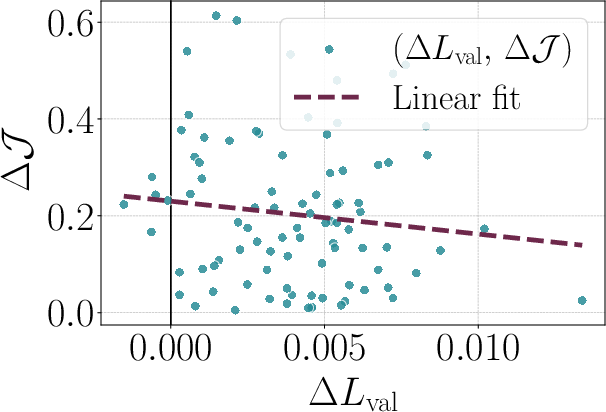
- Benchmark policy architectures using success rate rather than validation loss alone — Academia and industrial model selection; deployable now. The results show that lower action-prediction MSE does not necessarily imply higher task success, and that the best delay can vary across tasks. Evaluation pipelines should therefore compare Markovian, delayed, action-chunked, and ensemble variants using rollout success, recovery behavior, latency, and safety—not only supervised loss. Dependencies: representative demonstrations, multiple random seeds, realistic closed-loop evaluation, and task-specific safety metrics are required.
- Improve robot control under inference-latency constraints — Robotics hardware and edge deployment; deployable now. Delayed-policy and temporal-ensemble strategies provide ways to use already-computed predictions when vision or model inference is slow. A controller can continue operating from a rolling buffer of predictions while new observations are processed. Dependencies: the latency must be bounded and predictable; emergency stopping and low-level feedback control should remain independent of the learned policy.
- Apply the method to existing generalist or vision-language-action policies through fine-tuning — General-purpose robotics; deployable now in controlled settings. The paper indicates that delayed execution can also work with modern VLA-style policies. Fine-tuning such models with delayed observation/action relationships could improve robustness without requiring a fully new architecture. Dependencies: sufficient task-specific demonstrations, compatible action-token or continuous-action representations, and validation on the target robot rather than relying solely on benchmark transfer.
Long-Term Applications
- Develop explicit ensembles of delayed policies for high-reliability robotics — Robotics, warehouse automation, healthcare robotics, and aerospace; requires further scaling. Train several delayed policies with different random initializations, delays, data subsets, or temporal features, then aggregate their actions. The paper reports that explicit delayed ensembles can outperform standard action chunking in several settings. Potential products: ensemble-based manipulation controllers, uncertainty-aware grasping systems, and redundant policies for safety-critical operations. Dependencies: increased training and inference cost, an aggregation rule appropriate to multimodal actions, and methods for converting ensemble disagreement into safe fallback behavior.
- Create uncertainty-aware robot policies based on temporal disagreement — Robotics and autonomous systems; long-term. Differences among predictions based on , , and earlier observations can serve as an operational signal of ambiguity, distribution shift, contact uncertainty, or impending failure. A controller could slow down, request a new observation, switch to a conservative policy, or trigger human intervention when temporal predictions disagree strongly. Dependencies: disagreement must be calibrated against actual failure probability; temporal disagreement can also arise from legitimate rapid motion and should not automatically be treated as danger.
- Design adaptive delay and chunk-length controllers — Robotics, autonomous vehicles, drones, and process control; long-term. Rather than using a fixed delay or chunk size, future systems could select them according to motion speed, contact state, visual uncertainty, task phase, or ensemble disagreement. Short delays would support reactivity during contact, while longer delays could improve stability during predictable motion. Dependencies: reliable real-time state and uncertainty estimation, formal safety constraints, and policies capable of switching temporal modes without causing discontinuities.
- Build temporal-ensemble architectures directly into policy training — Machine learning and robotics research; long-term. Instead of obtaining ensembling only as a side effect of predicting action chunks, models could explicitly learn multiple temporal relationships and combine them with learned, state-dependent weights. This may preserve the generalization benefits of ensembling while reducing unnecessary open-loop execution. Potential innovations: multi-delay transformer heads, temporal mixture-of-experts models, learned aggregation networks, and diffusion policies with delay-conditioned denoising. Dependencies: controlling model size and training complexity; preventing correlated ensemble members from providing only nominal diversity; handling multimodal demonstrations.
- Extend the findings to partially observed navigation and autonomous driving — Autonomous vehicles, drones, and mobile robots; long-term. Delayed observations may encode useful information about trajectory intent, driver behavior, object motion, and system dynamics. Temporal ensembles could combine predictions from different points in an observation history to improve robustness under occlusion or sensor noise. Dependencies: unlike many manipulation benchmarks, these domains contain fast-moving agents and non-smooth events. Delayed observations may be harmful unless combined with explicit state estimation, prediction of moving objects, and strict safety guarantees.
- Apply temporal ensembling to human–robot collaboration and assistive robots — Healthcare, rehabilitation, eldercare, and collaborative manufacturing; long-term. Human actions are often non-Markovian: pauses, hesitations, corrections, and preparatory movements may signal future intent. Policies trained on delayed observations and ensembles of temporal relationships could better anticipate these behaviors while reducing inappropriate reactions to momentary observations. Dependencies: high safety and privacy requirements, diverse human behavior, robust intent estimation, and extensive testing with real users. A system must not interpret every pause as a fixed-duration action.
- Improve imitation-learning datasets and annotation workflows — Academia, robotics laboratories, and industrial data operations; long-term. Demonstration datasets could record synchronized observation history, action timestamps, sensor latency, contact events, pauses, and decision boundaries. This would support systematic training of delayed and ensemble policies rather than treating each observation/action pair as independent. Dependencies: accurate synchronization, sufficient demonstrations across task variations, and annotation standards for transitions and failures. The paper’s findings are based largely on successful demonstrations, so datasets must also represent recovery and failure behavior.
- Develop theory and diagnostics for when delayed policies are safe or effective — Control theory and machine learning research; long-term. The paper motivates formal criteria based on smooth dynamics, Lipschitz behavior, delayed prediction error, horizon, and observation distribution shift. Future work could produce automated task-level tests that determine whether a system should use Markovian, delayed, chunked, or ensemble control. Dependencies: the current theoretical results rely on restrictive assumptions, including deterministic or smooth dynamics and bounded prediction error. Real robots introduce stochasticity, actuator saturation, perception failures, and non-Lipschitz contact dynamics.
- Use temporal ensembles as a general sequence-modeling technique beyond robotics — Software agents, time-series forecasting, finance, energy, and operations research; long-term and exploratory. The central idea—combine predictors conditioned on different temporal offsets—could inspire robust forecasting systems for demand, prices, energy load, or software-agent actions. For example, a forecasting service could aggregate models using recent and slightly older context to reduce sensitivity to transient noise or distribution shift. Dependencies: the paper directly validates the method for robotic behavioral cloning, not finance, energy, or general forecasting. Applications in these sectors would require domain-specific evidence, appropriate loss functions, causal analysis, and safeguards against temporal leakage.
- Create policy-development tooling that automatically searches temporal relationships — Robotics platforms and academic infrastructure; long-term. A model-selection system could train or evaluate multiple delays, chunk lengths, execution horizons, and aggregation schemes, then select configurations using closed-loop success, robustness, latency, and safety. This would turn the paper’s empirical insight into a repeatable engineering workflow. Dependencies: exhaustive search can be computationally expensive; validation tasks must reflect deployment conditions, and automated selection should not optimize benchmark success at the expense of rare but severe failures.
Glossary
- Action chunking: Predicting and executing a sequence of actions rather than one action at a time. “Action chunking---predicting and executing multiple actions instead of a single action---has proven to be a critical component for learning effective robotic control policies.”
- Action chunk: A sequence of actions predicted from one observation. “Here the prediction target is referred to as the action chunk.”
- Action prediction MSE: Mean-squared error between predicted and demonstrated actions. “We consider the action prediction MSE on 20^nn \in [20]$.” - **Autoregressive transformer**: A transformer model that generates outputs sequentially, conditioning each prediction on previous outputs. “usually either an autoregressive transformer~\cite{kim2024openvla,pertsch2025fast} or diffusion/flow model” - **Behavioral cloning**: Supervised imitation learning in which a policy learns to reproduce demonstrator actions. “Behavioral cloning is a standard approach to learning from demonstrations that trains a policy via supervised learning to mimic the actions present in$.”
- Compounding error: The accumulation of small prediction errors across successive control steps. “Action chunking benefits from greater non-Markovian expressivity and reduced compounding error compared to Markovian policies”
- Conditional distribution: The probability distribution of one variable given another variable or set of variables. “action chunking models the conditional distribution of sequences of actions”
- Control-theoretic: Relating to the mathematical analysis and design of dynamical control systems. “which seek to obtain a theoretical understanding for why action chunking helps, largely from a control-theoretic perspective.”
- Decision boundary: A point at which a policy must transition between qualitatively different behaviors or actions. “We refer to this point as the decision boundary---in order to complete the task, the robot must ``decide'' at this point to transition from motion in one direction to motion in another direction.”
- Demonstrator distribution: The probability distribution describing the actions and trajectories produced by an expert or human demonstrator. “and aim to model the full demonstrator distribution.”
- Diffusion model: A generative model that learns to produce data by reversing a gradual noising process. “for all experiments we parameterize d_{20,i}, but from different random initializations.”
- Ensemble-based method: A method that combines predictions from multiple models to improve accuracy or robustness. “inherits many of the benefits of ensemble-based methods”
- Exponential weighting: Combining predictions with weights that change exponentially, often strongly emphasizing or suppressing particular terms. “previous works apply an exponential weighting, significantly downweighting the contributions of more recent timesteps”
- Fully observed: Describing an environment in which the agent has access to the complete relevant state. “the majority of our conclusions also hold in Markovian ... and fully observed settings.”
- Generalization error: The error made by a model on unseen data or situations. “such approaches can achieve lower generalization error than the average error across ensemble members”
- Generative model: A model that learns a probability distribution and can generate new samples from it. “modern approaches to BC in robotics typically parameterize with a generative model”
- History-conditioned policy: A policy whose action depends on a sequence of prior observations rather than only the current observation. “a history-conditioned policy, e.g. modeling , may be necessary.”
- Horizon reduction: Decreasing the effective number of control decisions required to complete a task. “A second hypothesis commonly proposed in the literature is that action chunking reduces the effective horizon of the environment”
- Implicit ensembling: Ensemble-like behavior arising without explicitly training or deploying separate models. “We identify an additional mechanism driving action chunking's improved performance, which we refer to as implicit ensembling”
- In-distribution: Belonging to the distribution of data on which a model was trained. “they are more in-distribution---than later states”
- Inductive benefit: An improvement resulting from how a learning method structures or biases the representations it learns. “The final hypothesis we evaluate is whether action chunking has representational benefits.”
- Lipschitz: Satisfying a bound that limits how rapidly a function can change as its input changes. “ is 1-Lipschitz in both state and action.”
- Markovian policy: A policy whose action depends only on the current state or observation, not on earlier history. “In particular, in the simplest, Markovian case, behavioral cloning flattens the training dataset into pairs”
- Mean-squared error (MSE): The average squared difference between predicted and target values. “computed as mean-squared error (MSE) of mean actions sampled from the policy”
- Multi-modality: The presence of multiple distinct modes or likely behaviors in a probability distribution. “While this notion of error does not capture multi-modality”
- Mutual information: A measure of the statistical dependence between two random variables. “we would expect the mutual information between and to be at least as large as the mutual information between and ”
- Non-Markovian: Depending on information from prior states, observations, or actions beyond the current one. “The demonstrator may be non-Markovian, meaning that it may condition on the full history of observations.”
- Open-loop: Executing a planned sequence without using new feedback during its execution. “Action-chunked policies typically sample and execute either part or all of open-loop”
- Partially observed: Describing an environment in which the agent receives incomplete information about its underlying state. “We consider interaction with a potentially non-Markovian, partially observed environment”
- Population validation error: Expected predictive loss under the demonstrator’s trajectory distribution. “the population validation error under the demonstrator's trajectory distribution”
- Receding-horizon policy: A policy that repeatedly plans over a future action horizon but executes only the first action before replanning. “typically these works learned receding-horizon policies”
- Representation learning: Learning useful internal features or representations directly from data. “Action chunking serves as an auxiliary loss in policy training, improving representation learning and generalization”
- Robotic manipulation: Robotic interaction involving physical handling or movement of objects. “simulated and real-world robotic manipulation settings”
- Smooth dynamics: System dynamics that change gradually with respect to states and actions. “While these results rely on the assumption that dynamics are smooth”
- Supervised learning loss: An objective measuring the discrepancy between model predictions and labeled training examples. “the supervised learning loss ”
- Temporal consistency: Stability or correlation of predicted actions across successive timesteps. “Action-chunked policies can better represent the temporally correlated behaviors exhibited by human demonstrators”
- Temporal ensemble: An ensemble formed by combining predictions generated at different times for the same action. “First, we consider the temporal ensemble induced by .”
- Transition kernel: A probability distribution describing the next state given the current history and action. “$P : \cH \times \cA \rightarrow \triangle_{\cS}$ is the transition kernel for histories $\cH$”
- Validation error: A measure of a model’s predictive discrepancy on held-out data. “Throughout this work, we consider validation error---computed as mean-squared error (MSE) of mean actions sampled from the policy”
- Vision-language-action (VLA) policy: A policy that maps visual and linguistic inputs to robot actions. “resulting in generalist vision-language-action (VLA) policies capable of performing a wide variety of tasks”
- Wasserstein-1 metric: A distance between probability distributions based on the minimum cost of transporting probability mass between them. “for the Wasserstein-1 metric”
- World model: A learned model of an environment’s dynamics used for planning or decision-making. “or using a world model to adaptively switch between action chunks at test-time”