InfiniSplat: Implicit Gaussian Decoding for Large-Baseline Monocular View Synthesis
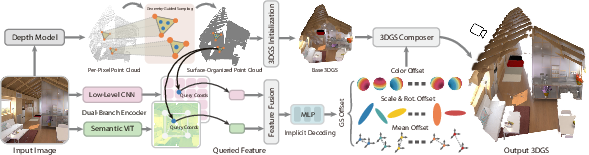
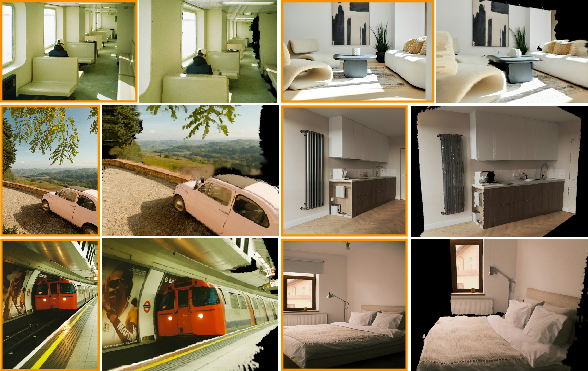
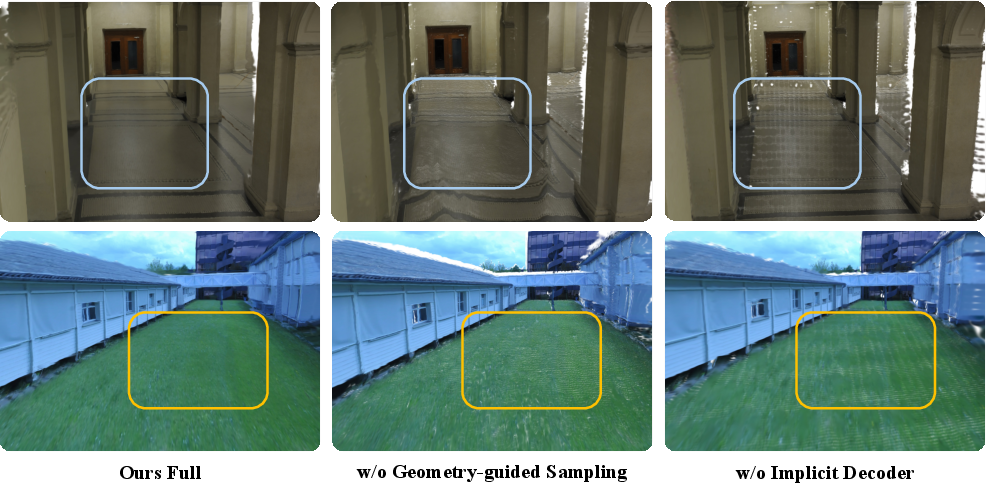
Abstract: Single-image feed-forward 3D Gaussian Splatting (3DGS) aims to directly generate a renderable 3D scene representation from one input image, avoiding the cost of multi-view capture and per-scene optimization. However, existing methods are often constrained by a pixel-aligned representation, where Gaussians are predicted from fixed image-grid locations. Such pixel-aligned primitives can produce promising nearby-view renderings, but they remain weakly coupled to underlying scene surfaces and struggle to preserve coherent structures under large viewpoint shifts. We present InfiniSplat, a feed-forward single-image 3DGS framework that moves from a pixel-aligned representation toward a surface-aligned representation. InfiniSplat constructs this representation by first using geometry-guided sampling to place 2D supports according to depth-induced local surface structure, and then applying a query-conditioned implicit decoder to predict Gaussian attributes from the image features queried at these supports. By grounding support locations in geometry while decoupling Gaussian prediction from fixed pixel centers, InfiniSplat produces Gaussian layouts that better follow scene surfaces and reduce scattered primitives caused by grid discretization. Across multiple cross-dataset NVS evaluations, InfiniSplat achieves state-of-the-art performance compared with single-image feed-forward baselines, and demonstrates zero-shot generalization from Hypersim indoor synthetic training to complex open-world scenes. Project page: https://zju3dv.github.io/InfiniSplat.

Paper Prompts
Sign up for free to create and run prompts on this paper using GPT-5.
Top Community Prompts
Explain it Like I'm 14
InfiniSplat: Turning One Photo into a 3D Scene You Can Look Around
What is this paper about?
This paper shows how to take a single photo and quickly build a 3D version of the scene so you can look at it from new angles, almost like moving your head in VR. The method is called InfiniSplat. It uses lots of tiny, soft “paint blobs” in 3D space (called 3D Gaussians) to represent the scene and render new views in real time.
What questions are the researchers trying to answer?
The authors ask:
- Why do many one-photo 3D methods look good only near the original camera spot but fall apart (with cracks or warped shapes) when you move the camera far away?
- Can we arrange those 3D “blobs” so they actually cling to the real surfaces in the scene (walls, floors, objects) instead of just sitting at fixed pixel positions?
- Can we do all of this fast, in a single forward pass of a neural network, without slow per-scene tuning?
How does their method work? (In simple terms)
Think of building a 3D scene as covering objects with lots of small, semi-transparent stickers that have color, size, and orientation. If you place the stickers smartly, from any viewpoint they blend into a realistic image.
InfiniSplat changes where and how those stickers are placed:
- The problem with older methods:
- They often place one 3D sticker per pixel (“pixel-aligned”). This is okay near the input view, but when you move far to the side, the stickers don’t line up with the true surfaces, so things tear or float.
- InfiniSplat’s two big ideas:
- First, a depth predictor guesses how far each pixel is from the camera. Imagine it as a rough 3D sketch of the scene.
- Using that depth, the method “spreads” more stickers over big or slanted surfaces (like a long wall) and fewer where it’s not needed—so the stickers follow the scene’s shape instead of a rigid pixel grid.
- This creates “supports,” which are 2D points chosen because they likely sit on real surfaces.
- 2) Implicit Gaussian decoding (adjusting each sticker so it fits perfectly)
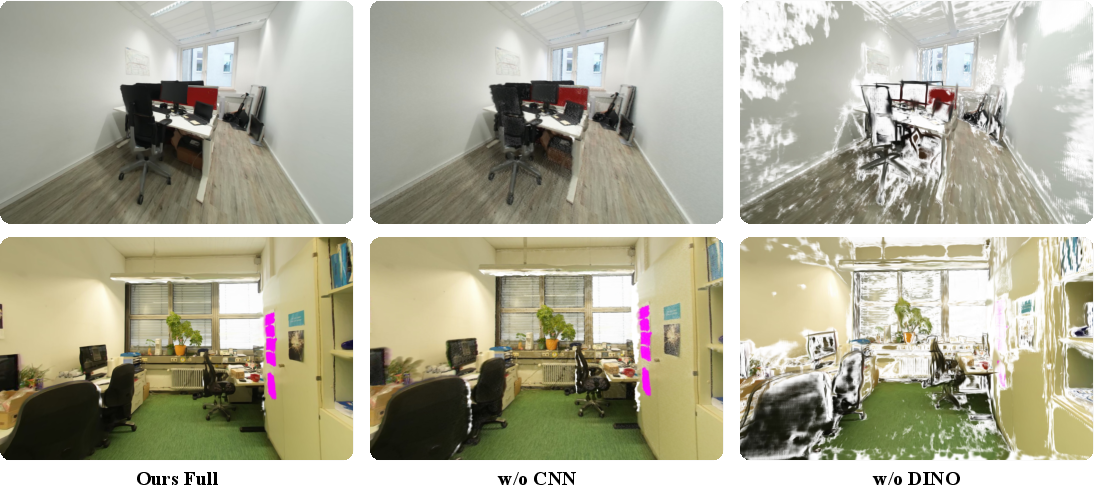
- For each support, the model looks up image features (think: clues about texture and meaning) from two sources:
- A DINO branch (captures higher-level, semantic clues: “this looks like a wall or a chair”).
- A CNN branch (captures fine details like edges and textures).
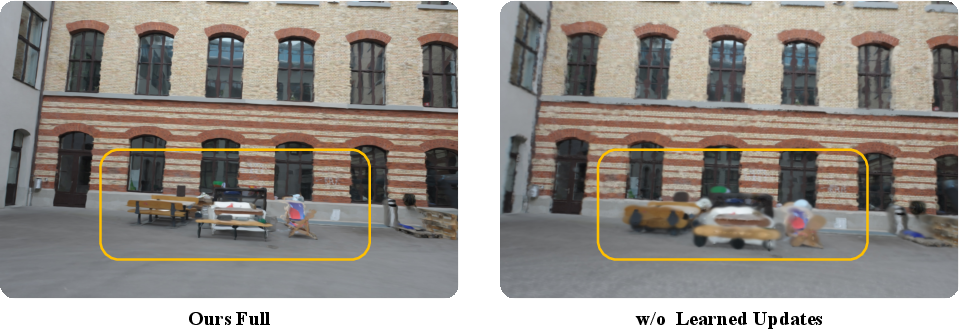
- A small network then uses these clues to tweak each sticker’s 3D position, size, rotation, color, and transparency—just enough to make it line up with the real surface and look right from new views.
Why this helps:
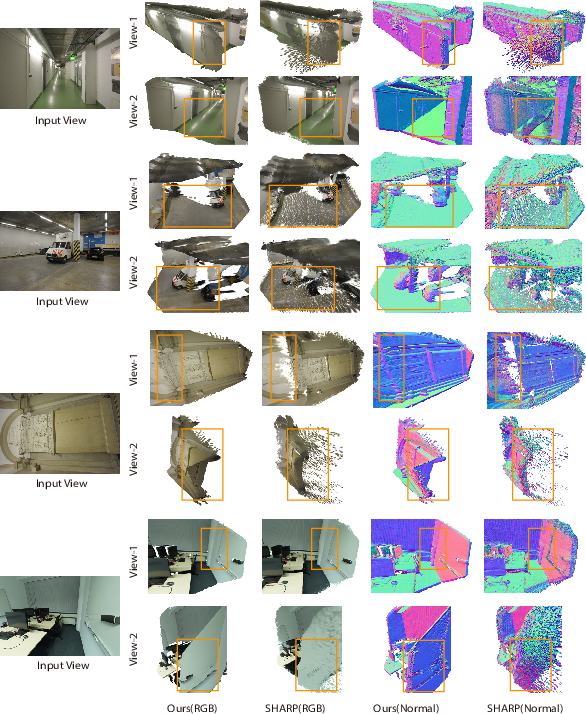
- By choosing where to put stickers based on surface shape (not just pixel centers) and then fine-tuning them with local image clues, neighboring stickers stick together to form smooth surfaces. This reduces cracks, floating fragments, and warped geometry when the viewpoint changes a lot.
What did they find?
Across several challenging datasets (indoor and outdoor), and even in “zero-shot” tests where the model wasn’t trained on those scenes:
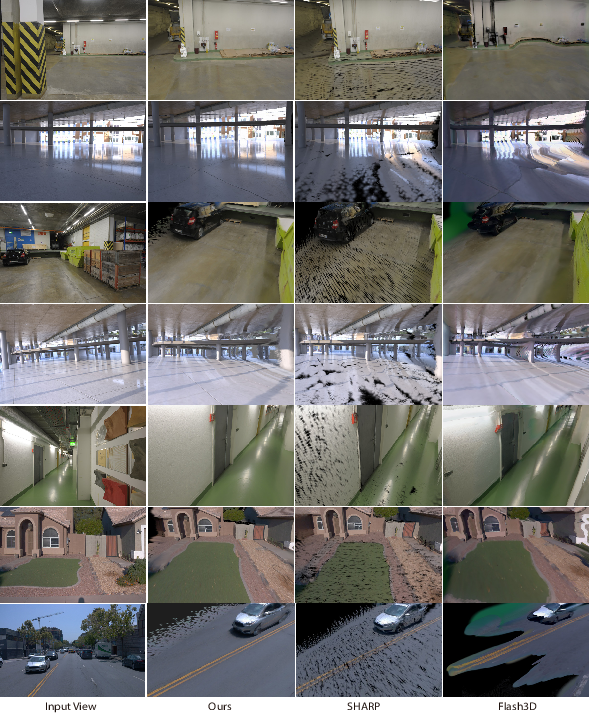
- InfiniSplat produced sharper, more stable images from new viewpoints than strong baselines like SHARP and Flash3D.
- It especially improved large viewpoint changes (big side moves), keeping walls, floors, and object edges coherent with fewer holes or tears.
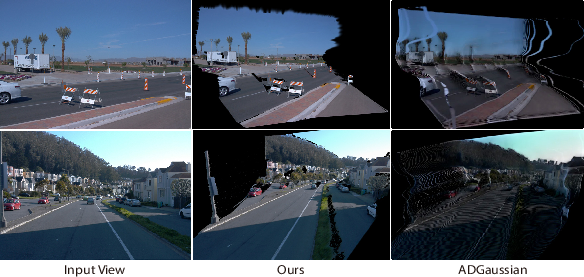
- The version that also uses a few LiDAR depth points (when available) gets even better results, but the main RGB-only version already sets a new bar.
- The method generalized well to “in-the-wild” photos (not just clean lab datasets).
Why the metrics matter (PSNR, SSIM, LPIPS):
- PSNR and SSIM: higher is better; they measure how close the rendered image is to the ground truth.
- LPIPS: lower is better; it measures perceived visual differences.
- InfiniSplat consistently had better scores, meaning images looked more accurate and more natural.
Why is this important?
- Practical use: With just one photo, you can enable head movement in AR/VR, interactive photo browsing, and cool camera moves on phones—without scanning the scene from many angles.
- Reliability: Instead of collapsing under big camera moves, InfiniSplat keeps surfaces intact, which feels much more realistic.
- Speed: It creates an explicit 3D representation (those Gaussians) in one forward pass, so rendering new views is real-time.
What could this lead to?
- Better experiences in mobile AR, virtual tours, and creative tools that turn photos into explorable spaces.
- Stronger building blocks for future 3D perception systems that need both speed and stability from minimal input.
- A shift in single-image 3D methods from “pixel-aligned” to “surface-aligned,” which seems key for handling large viewpoint changes without breaking the scene.
In short: InfiniSplat teaches the model to place and adjust 3D “paint blobs” where the real surfaces are, not just at pixel spots. That simple shift makes single-photo 3D a lot more reliable when you move the camera around.
Knowledge Gaps
Knowledge gaps, limitations, and open questions
Below is a single, consolidated list of concrete gaps and open problems that remain unresolved and could guide future research:
- Reliance on frozen monocular geometry priors: no analysis of how errors in the depth/intrinsics predicted by Φ_geo propagate to support sampling, Gaussian placement, and final render quality.
- Intrinsics estimation robustness: absence of evaluation under unknown/incorrect camera intrinsics, lens distortion, rolling shutter, or wide-FOV/fisheye optics that commonly break monocular assumptions.
- Depth prior sensitivity: no stress tests across different monocular depth backbones, calibration domains, or confidence/uncertainty maps, nor mechanisms to attenuate unreliable geometry in sampling/decoding.
- Bounded update limits: unclear whether the implicit decoder’s bounded residual updates can recover from large depth/intrinsics errors or severe occlusion boundaries; no study of failure regimes as λxy, λz, and attribute update scales vary.
- Non-differentiable or non-learned support sampling: geometry-guided sampling is fixed (area-weighted triangles) and not trained end-to-end; no exploration of learned/differentiable support policies that adapt density to semantic difficulty, texture, or uncertainty.
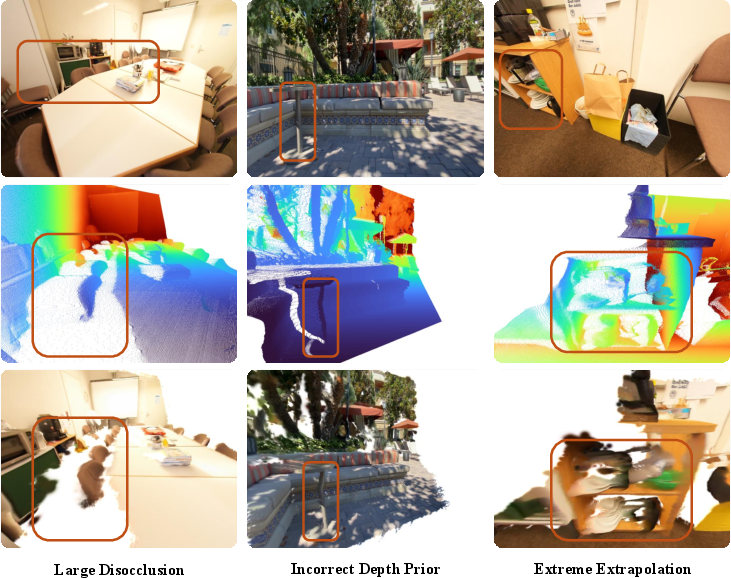
- Occlusion- and boundary-aware sampling: no explicit treatment of sampling near depth discontinuities, thin structures, or disocclusions; heuristics are used to discard triangles but lack a principled boundary model.
- Disocclusion handling: no explicit module or loss to hallucinate unseen content; fidelity in newly visible regions is not quantified or compared.
- Appearance modeling limits: Gaussians appear to use view-independent color (no SH or neural appearance fields); behavior on specular, transparent, or glossy surfaces is neither modeled nor evaluated.
- Lack of geometric supervision and metrics: normals are only visualized; no quantitative geometry metrics (e.g., depth error, normal deviation, multi-view consistency, point-cloud/mesh alignment).
- Domain shift and training data: models are trained solely on Hypersim (synthetic) yet deployed on diverse real scenes; no systematic domain adaptation strategies or analyses beyond aggregate PSNR/SSIM/LPIPS.
- Baseline-size breakdown: although source–target pairs are bucketed by camera baseline, no per-bucket metric reporting to quantify performance degradation with increasing viewpoint shift.
- Scene-type breakdown: no stratified evaluation by indoor/outdoor, texture richness, clutter level, or lighting/reflectance variability to pinpoint strengths/weaknesses.
- Efficiency and scalability: no reporting of inference latency, render FPS, memory footprint, number of output Gaussians, or scaling behavior with image resolution and support count.
- Compactness and pruning: no methods or results on Gaussian sparsification, pruning, or compression to trade off quality vs. memory/render speed, especially given 1.5M sampled supports per image.
- Sensitivity to support count and distribution: no ablation on the number/density of sampled supports, triangle area weighting, or alternative allocation strategies (e.g., curvature- or uncertainty-aware).
- End-to-end refinement of geometry: Φ_geo is frozen; no exploration of joint training to refine depth/intrinsics from rendering losses, geometric priors, or self-supervision.
- Confidence-aware decoding: the decoder does not explicitly account for geometric/feature uncertainty; no mechanisms to weight updates or supports by predicted confidence.
- Temporal and trajectory consistency: no evaluation of flicker/temporal coherence along continuous camera paths, despite the intended use for interactive browsing.
- Dynamic scenes and non-rigid motion: the method and evaluations assume static scenes; behavior and potential extensions to dynamic settings remain unexplored.
- LiDAR-conditioned robustness: no analysis of sensitivity to LiDAR sparsity, outliers, noise statistics, or spatial distribution; no comparison across different sensor types or prompt sampling strategies.
- Pose requirements for deployment: the approach presumes known target poses for rendering; no discussion of coupling with pose prediction/trajectory planning in practical AR/VR pipelines.
- Failure mode characterization: limited qualitative failures; no taxonomy or quantitative analysis for thin structures, repetitive textures, textureless regions, or extreme lighting.
- Loss design: supervision relies on RGB and VGG-perceptual terms; no exploration of geometry-aware losses (normal/edge/occlusion consistency), silhouette constraints, or adversarial/perceptual priors for disoccluded regions.
- Hierarchical/coarse-to-fine decoding: no investigation of multi-scale or hierarchical supports/decoders that could improve large-scene coverage and efficiency.
- Comparative breadth: comparisons largely focus on feed-forward 3DGS or image-to-image NVS; limited benchmarking against recent explicit-neural or mesh-centric single-view methods with strong geometry priors.
- Reproducibility of key hyperparameters: several critical settings (e.g., depth discontinuity thresholds, update scales, activations per attribute) are under-specified and not ablated, hindering transferability.
Practical Applications
Immediate Applications
The following applications can be deployed with today’s tooling and reasonable engineering effort, leveraging InfiniSplat’s feed-forward, single-image 3D Gaussian Splatting with geometry-guided support sampling and implicit Gaussian decoding.
- Spatial photos and parallax-enabled media for consumer apps
- Sector: Software, AR/VR, Mobile
- What: Convert a single photo into an interactive 3D scene that supports head-motion parallax and viewpoint shifts (e.g., “move-your-phone” effect in galleries, social feeds, or photo apps).
- Tools/products/workflows: Mobile SDK or WebAssembly/WebGPU module that takes a photo → runs DINO/CNN feature extraction + monocular depth → produces a 3DGS asset → real-time Gaussian renderer for playback.
- Assumptions/dependencies: Accurate monocular depth prior (e.g., DepthPro); decent input resolution; mild view-dependent effects; on-device acceleration or cloud inference for ViT-L features.
- Real estate and AEC marketing from single photos
- Sector: Real estate, Architecture/Construction, Marketing
- What: Make listing photos navigable with coherent large-baseline parallax (hallways, rooms, facades) without full multi-view capture.
- Tools/products/workflows: CMS plugin that batch-processes images into 3DGS viewers; optional LiDAR-conditioned variant on iPhones/iPads for higher fidelity.
- Assumptions/dependencies: Indoor scenes and planar regions (walls/floors) benefit most; reflective/transparent surfaces remain challenging; disclosure that geometry is approximate.
- E-commerce product pages with 3D previews from one image
- Sector: Retail/E-commerce
- What: Provide interactive near-3D previews when only a catalog image is available, improving engagement over flat images.
- Tools/products/workflows: Server-side pipeline to generate 3DGS assets from hero images; inline WebGL/WebGPU Gaussian renderer.
- Assumptions/dependencies: Best for semi-rigid, moderately textured objects; object-centric performance may require minor tuning since the paper’s focus is scene-level NVS.
- Video conferencing and virtual backgrounds with true parallax
- Sector: Software, AR/VR, Communications
- What: Create 3D backgrounds from a single frame so camera tilt or user head motion yields natural perspective changes.
- Tools/products/workflows: Real-time inference module integrated into conferencing apps; caching of Gaussian assets per room.
- Assumptions/dependencies: Lighting/view-dependent effects not fully modeled; small to moderate viewpoint changes recommended.
- News, documentary, and archival photo enrichment
- Sector: Media/Journalism, GLAM (Galleries, Libraries, Archives, Museums)
- What: Turn historic or single-view reportage images into navigable 3D experiences for exhibits or explainer content.
- Tools/products/workflows: Curatorial tool to process archives → publish lightweight web viewers; editorial watermarking and disclaimers.
- Assumptions/dependencies: Geometry is plausible but not ground truth; policies should disclose synthetic viewpoint generation.
- Robotics and autonomous systems data augmentation
- Sector: Robotics, Automotive
- What: Synthesize novel views from single frames to augment training data for perception (detection/segmentation) under viewpoint variation.
- Tools/products/workflows: Offline augmentation step in data pipelines; render label projections or use self-training with consistency across synthesized views.
- Assumptions/dependencies: Not for safety-critical ground truth; relies on domain match between training and deployment; occlusion/reflectance ambiguities persist.
- Rapid site inspection and pre-visualization from drone or handheld photos
- Sector: Inspection, Construction, Field Services
- What: Get quick 3D previews of structures from one or few photos when full photogrammetry is not practical; LiDAR-conditioned variant improves reliability.
- Tools/products/workflows: Field app that runs InfiniSplat-LiDAR with sparse depth prompts; viewer for supervisors to inspect surfaces.
- Assumptions/dependencies: Sparse depth availability (phone LiDAR, rangefinder) boosts stability; results remain approximate for measurements.
- Game and VFX look-dev from reference stills
- Sector: Entertainment, Game Development, VFX
- What: Block out scenes from a single reference for scouting and camera planning; convert Gaussians to meshes via Gaussian-to-mesh tools for downstream editing.
- Tools/products/workflows: DCC/engine plugins (Unreal/Unity) → import 3DGS → optional surfel meshing → artist cleanup; rapid previz.
- Assumptions/dependencies: Requires converters for Gaussian splats to meshes; materials are approximations.
- Education and remote learning content
- Sector: Education
- What: Create interactive 3D explorations of scientific or historical scenes from textbook images to improve spatial understanding.
- Tools/products/workflows: LMS integration with a web-based 3DGS viewer; instructor tools to annotate regions.
- Assumptions/dependencies: Accuracy caveats for scientific measurement; best for visualization and engagement.
- Academic baselines and diagnostic tools for geometry and NVS research
- Sector: Academia
- What: Use InfiniSplat as a strong single-image NVS baseline; render normals/surfaces to diagnose monocular geometry priors; probe generalization across datasets.
- Tools/products/workflows: Reproducible evaluation scripts; ablation harness; integration with depth/normal estimation benchmarks.
- Assumptions/dependencies: Access to pretrained depth/feature backbones; compute for ViT-L features.
- Web SDKs for 3D-from-1-image embedding
- Sector: Software/Developer Tools
- What: Provide a turnkey library to drop a single image and get a shareable, interactive 3D viewer.
- Tools/products/workflows: WebGPU/GL renderer; serverless inference or local WebNN/WebGPU acceleration where available.
- Assumptions/dependencies: Browser GPU support; model quantization/pruning for performance.
Long-Term Applications
These applications are plausible but require further research, scaling, domain adaptation, or safety validation before broad deployment.
- AR cloud anchoring and instant scene localization from one photo
- Sector: AR Cloud, Mapping
- What: Use surface-aligned Gaussians as immediate local anchors for AR content placement from a single capture.
- Tools/products/workflows: On-device fast inference → anchor surfaces → fuse with SLAM when available.
- Assumptions/dependencies: Robust intrinsics/extrinsics estimation; drift reduction via multi-frame fusion; handling dynamic scenes.
- Occlusion reasoning and side-view synthesis for ADAS/AV
- Sector: Automotive
- What: Generate plausible side views to assist perception modules in anticipating occlusions or planning.
- Tools/products/workflows: Auxiliary perception channel for simulation and training; uncertainty-aware rendering.
- Assumptions/dependencies: Strict reliability constraints; calibrated uncertainty estimates; likely needs multi-sensor conditioning (LiDAR, radar).
- Large-scale 3D maps and digital twins from sparse imagery
- Sector: Geospatial, Smart Cities, AEC
- What: Fill spatial gaps in city-scale capture using single-image reconstructions that are stitched into broader twins.
- Tools/products/workflows: Graph-based fusion of many single-image 3DGS assets; consistency checks; later meshing.
- Assumptions/dependencies: Global alignment and scale normalization; consistency enforcement across scenes; domain shifts (weather, time-of-day).
- Real-time on-device single-shot capture for AR glasses
- Sector: AR Hardware
- What: Enable “instant 3D” scene scaffolds for interaction and UI placement using monocular glasses cameras.
- Tools/products/workflows: Distilled/quantized InfiniSplat; hardware acceleration; incremental updates as the user moves.
- Assumptions/dependencies: Tight compute and power budgets; privacy and on-device processing constraints.
- Forensic triage and public safety scene reconstruction
- Sector: Public Safety, Forensics
- What: Quickly approximate scene layout from a single incident photo for situational awareness or briefing.
- Tools/products/workflows: Analyst console that visualizes plausible viewpoints; overlays with uncertainty heatmaps.
- Assumptions/dependencies: Strong disclaimers; cannot replace surveyed evidence; bias and failure modes must be documented.
- Medical and industrial training simulators from reference stills
- Sector: Education/Training (Medical, Industrial)
- What: Build simulated practice environments from limited photographic documentation (e.g., labs, control rooms).
- Tools/products/workflows: Authoring tools that convert manuals/photographs to navigable scenes; optional mesh export.
- Assumptions/dependencies: Content fidelity may be insufficient for procedural accuracy; requires domain adaptation.
- Multi-photo/lightweight SLAM fusion for high-fidelity assets
- Sector: Software, Robotics
- What: Combine InfiniSplat reconstructions across a short video or sparse photos to consolidate a consistent, surface-aligned 3DGS or mesh.
- Tools/products/workflows: Factor-graph optimization across supports; joint refinement of Gaussians; photometric/geometric consistency losses.
- Assumptions/dependencies: Robust pose estimation; temporal consistency; scalable optimization.
- Standardization of 3D Gaussian pipelines in browsers and engines
- Sector: Software Standards, Web
- What: Establish common formats and APIs for 3DGS assets and real-time rendering across WebGPU, Unreal, Unity.
- Tools/products/workflows: Open specifications, converters (GS ↔ mesh), compression codecs.
- Assumptions/dependencies: Community consensus; long-tail device compatibility; IP/licensing for pretrained backbones.
- Ethical guidelines and provenance for synthetic viewpoints
- Sector: Policy, Media
- What: Disclosure standards and content provenance (C2PA) tags for images or videos rendered from single-image 3D reconstructions.
- Tools/products/workflows: Automatic provenance metadata injection in renderers; UI labels indicating “synthetic viewpoint.”
- Assumptions/dependencies: Publisher adoption; alignment with platform policies; user education.
- Photorealistic relighting and material-aware synthesis
- Sector: VFX, Digital Content Creation
- What: Extend the pipeline with BRDF/material estimation to support relighting and consistent shading.
- Tools/products/workflows: Joint Gaussian + material decoding; differentiable relighting; editing UIs.
- Assumptions/dependencies: Additional supervision or priors; handling specular/transparent materials; compute costs.
Notes on Feasibility and Key Dependencies
- Core technical dependencies
- Monocular depth prior quality (e.g., DepthPro) and, where available, sparse depth prompts (InfiniSplat-LiDAR).
- Accurate or estimated camera intrinsics; errors degrade geometry alignment.
- Compute constraints: DINOv3 ViT-L and dense support sampling are heavy; production requires distillation, quantization, or cloud inference.
- Rendering stack: real-time 3DGS rasterizers (native, engine plugins, WebGPU).
- Known limitations affecting deployment
- Ambiguities from single-view reconstruction (occlusions, reflectance, thin structures).
- View-dependent effects and complex lighting not explicitly modeled.
- Safety-critical uses require uncertainty estimates and human-in-the-loop review.
- Legal/ethical considerations
- Privacy and IP of input imagery; user consent for 3D reconstructions of private spaces.
- Provenance and disclosure for synthetic viewpoints to mitigate misinformation risks.
These applications stem directly from InfiniSplat’s contributions: geometry-guided, surface-aligned Gaussian placement; query-conditioned implicit decoding; strong zero-shot generalization; and the ability to render coherent large-baseline novel views from a single image in a feed-forward pass.
Glossary
- 3D Gaussian Splatting (3DGS): A rendering paradigm that represents scenes with anisotropic 3D Gaussians that are splatted and composited for fast, high-quality view synthesis. "Single-image feed-forward 3D Gaussian Splatting (3DGS) aims to directly generate a renderable 3D scene representation from one input image, avoiding the cost of multi-view capture and per-scene optimization."
- ADGaussian: A LiDAR/sparse-depth conditioned single-image 3DGS baseline used for comparison. "ADGaussian is a single-image feed-forward 3DGS baseline with source depth input."
- AdamW: An optimizer that decouples weight decay from gradient-based updates for better generalization. "using AdamW, with a learning rate of "
- area-weighted sampling: A strategy that allocates samples proportionally to local 3D surface area to better cover slanted or large surfaces. "we perform area-weighted sampling within the corresponding 2D pixel-grid regions."
- back-projection: The mapping from pixel coordinates and depth to 3D points using camera intrinsics. "and denote the back-projection function defined by the estimated intrinsics ."
- base Gaussian: An initial Gaussian primitive (position/color/other defaults) placed at a sampled support before learned updates. "Each sampled query coordinate is finally initialized as a base Gaussian."
- bilinear grid sampling: Differentiable interpolation used to fetch feature values at sub-pixel coordinates. "the decoder uses bilinear grid sampling to query the two types of features:"
- camera frustum: The pyramid-shaped volume of space visible to a camera; used here to select evaluation pairs. "we require the source-target camera frustum overlap to be greater than "
- camera intrinsics: The internal parameters of a camera (e.g., focal length, principal point) used for projection. "and and denote the intrinsics and camera pose of the target view, respectively."
- channel-wise gated fusion: A per-channel weighting mechanism that adaptively blends semantic and appearance features. "and then use channel-wise gated fusion to adaptively balance semantic context and local appearance detail:"
- cross-dataset: An evaluation or training setup that spans different datasets to test generalization. "Across multiple cross-dataset NVS evaluations, InfiniSplat achieves state-of-the-art performance compared with single-image feed-forward baselines,"
- DepthPro: A pretrained monocular depth estimation model used to provide geometric priors. "Given a dense depth map predicted by a pretrained monocular depth estimation model, e.g., DepthPro~\cite{bochkovskiy2025depth},"
- DINO: A self-supervised ViT feature extractor providing high-level semantic image features. "Concretely, InfiniSplat employs a dual-branch encoder to build an expressive image feature space, where a DINO branch provides semantic representations and a CNN branch captures local texture cues."
- DINOv3 ViT-L/16: A specific Vision Transformer backbone variant used for the semantic feature branch. "The image branch uses a DINOv3 ViT-L/16 backbone~\citep{simeoni2025dinov3}"
- frustum-visible mask: An image-space mask delimiting pixels that are visible within the target camera’s frustum. "into a complete frustum-visible mask."
- Gaussian composer: The module that applies predicted parameter updates to base Gaussians to produce final primitives. "The Gaussian composer then applies this update to the corresponding base Gaussian to obtain the final Gaussian primitive."
- Gaussian primitives: Individual 3D Gaussian elements (position, scale, rotation, color, opacity) composing the scene. "Gaussian primitives are generated from fixed image-grid locations,"
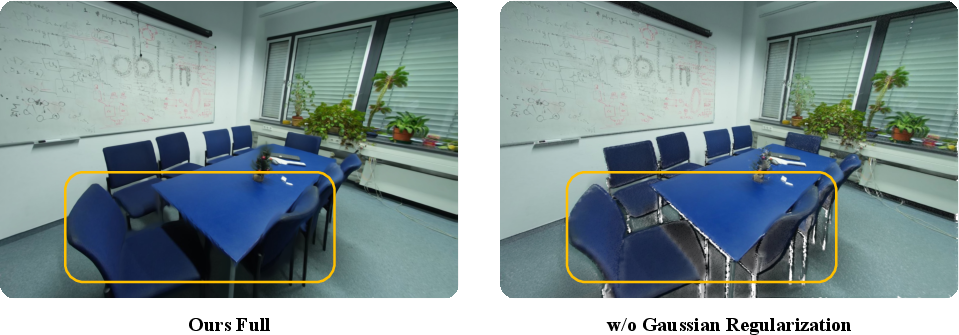
- Gaussian regularization: Loss terms that constrain Gaussian attributes (e.g., scales, opacity) to valid, smooth ranges. "we use Gaussian regularization to stabilize Gaussian attributes."
- Gaussian renderer: A differentiable renderer that composites 3D Gaussians to synthesize images. "where denotes the Gaussian renderer,"
- geometry-guided sampling: Support sampling driven by predicted depth/geometry to align Gaussians with surfaces. "Geometry-guided sampling uses pretrained monocular geometric priors to place 2D supports according to local surface structure,"
- Gram matrix: A matrix of feature inner products used to match texture statistics in perceptual/style losses. "and denotes the corresponding feature Gram matrix."
- Gram-matrix distance: A perceptual term encouraging similarity of feature correlations between images. "This perceptual loss combines a feature-space distance and a Gram-matrix distance;"
- grid discretization: Artifacts or limitations arising from restricting operations to a fixed pixel lattice. "reduce scattered primitives caused by grid discretization."
- Implicit Gaussian decoding: Predicting Gaussian parameters via an implicit function conditioned on query features rather than fixed pixels. "Implicit Gaussian decoding for single-image 3DGS."
- implicit neural representations: Functions that map continuous coordinates to signal values, queried at arbitrary locations. "Implicit neural representations model signals as functions over query locations"
- learnable query tokens: Trainable tokens that aggregate features and decode a compact set of Gaussians in query-based architectures. "by using learnable query tokens to aggregate multi-view features and decode a small set of essential Gaussians."
- LiDAR: A laser-based sensor providing depth measurements used as geometric prompts. "InfiniSplat-LiDAR additionally receives a sparse depth or LiDAR prompt"
- LiDAR prompt: Sparse depth samples from LiDAR used to condition monocular depth estimation. "InfiniSplat-LiDAR additionally receives a sparse depth or LiDAR prompt"
- LPIPS: A learned perceptual metric that measures visual similarity based on deep features. "PSNR and SSIM measure reconstruction fidelity, while LPIPS measures perceptual similarity."
- morphological operations: Image-space operators (e.g., dilation/erosion) used to refine masks. "refined using simple image-space morphological operations"
- monocular depth estimation: Predicting per-pixel depth from a single RGB image. "Given a dense depth map predicted by a pretrained monocular depth estimation model,"
- monocular geometric priors: Geometry cues (e.g., depth) inferred from a single image used to guide sampling. "Geometry-guided sampling uses pretrained monocular geometric priors to place 2D supports"
- multiplane image representations: Layered planar representations used for view synthesis and scene geometry approximation. "layered depth images, or multiplane image representations"
- normal map: An image encoding surface normals, useful for inspecting geometric coherence. "InfiniSplat produces cleaner normal maps and more coherent surface organization than SHARP,"
- novel view synthesis (NVS): Generating images of a scene from unseen camera viewpoints. "have substantially improved the rendering efficiency and visual quality of novel view synthesis (NVS)."
- patch tokens: Tokenized image patches from a ViT used as feature representations. "The DINO feature map is obtained by reshaping the final-layer patch tokens"
- perceptual loss: A loss leveraging deep features (and optionally Gram matrices) to match perceptual qualities. "Rendering supervision includes an RGB reconstruction loss and a perceptual loss following SHARP~\citep{mescheder2025sharp}:"
- per-scene optimization: Scene-specific iterative fitting typically required by traditional methods. "or require time-consuming per-scene optimization."
- pixel-aligned representation: A scheme where outputs are tied to fixed image-grid locations, limiting geometric flexibility. "existing methods are often constrained by a pixel-aligned representation,"
- PSNR: Peak Signal-to-Noise Ratio; a fidelity metric measuring reconstructed image accuracy. "PSNR and SSIM measure reconstruction fidelity, while LPIPS measures perceptual similarity."
- quaternion: A 4D rotation representation used to parametrize 3D Gaussian orientation. "quaternion rotation"
- query-conditioned implicit decoding: Implicit prediction of parameters conditioned on features queried at arbitrary support locations. "We formulate Gaussian attribute prediction as query-conditioned implicit decoding over sampled supports and queried image features."
- SHARP: A single-image feed-forward 3DGS baseline emphasizing sharp nearby views. "Representative methods such as SHARP achieve strong nearby-view sharpness,"
- SSIM: Structural Similarity Index; a perceptual fidelity metric focused on structure and contrast. "PSNR and SSIM measure reconstruction fidelity, while LPIPS measures perceptual similarity."
- support (2D supports): Sampled 2D query locations that anchor Gaussian initialization and decoding. "it samples 2D supports and initializes base Gaussians beyond the fixed pixel lattice."
- surface-aligned representation: A representation whose elements follow scene surfaces rather than the image grid. "moves from a pixel-aligned representation toward a surface-aligned representation."
- Vision Transformer (ViT): A transformer-based image encoder operating on patch tokens. "The image branch uses a DINOv3 ViT-L/16 backbone"
- VGG: A convolutional network used to extract deep features for perceptual loss. " is the frozen VGG feature at layer , and denotes the corresponding feature Gram matrix."
- zero-shot generalization: Performing well on unseen datasets or domains without additional training. "and demonstrates zero-shot generalization from Hypersim indoor synthetic training to complex open-world scenes."
Collections
Sign up for free to add this paper to one or more collections.

