Bridging Compute- and Data-Optimal Pretraining
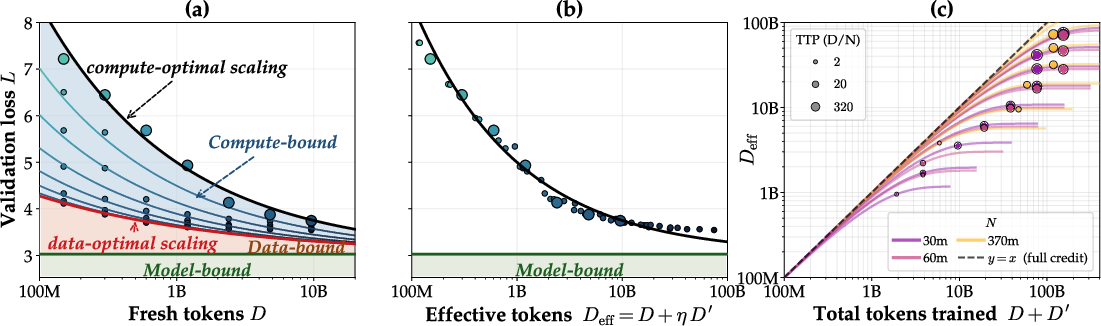
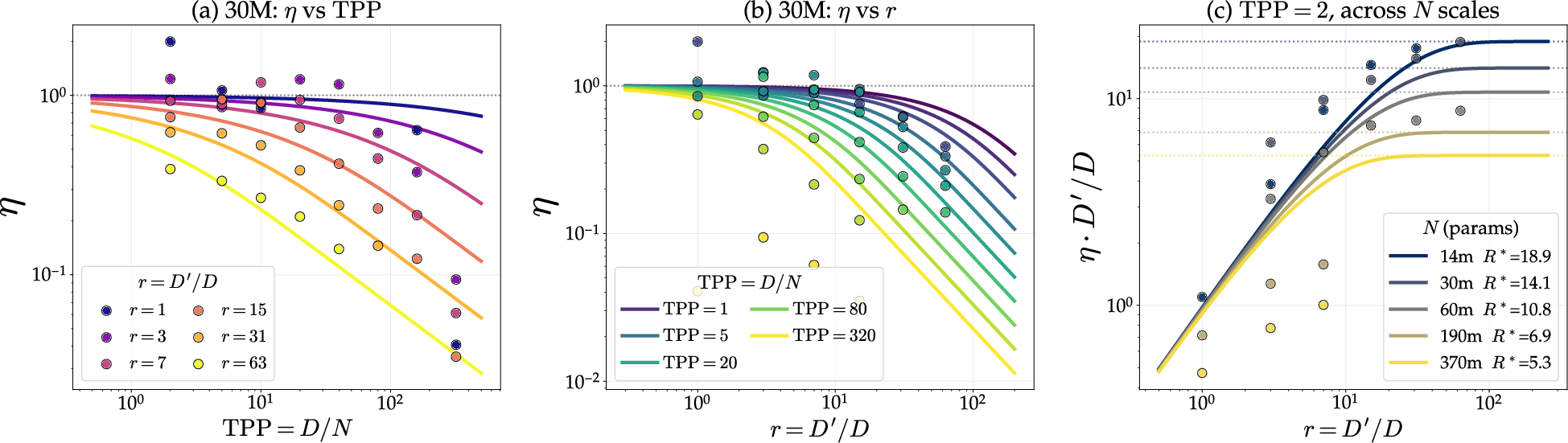
Abstract: Classical compute-optimal scaling laws assume an unbounded supply of fresh pretraining data, yet pretraining is increasingly entering a regime in which compute grows faster than the availability of high-quality data. We propose Compute-Data (CD) scaling laws, a unified framework that bridges compute-optimal scaling, where data scales freely with compute, and data-optimal scaling, where the corpus is fixed while compute can grow without bound. CD scaling extends classical scaling laws by introducing a token-effectiveness function, $η$, which quantifies the value of a derived token-produced, for example, through multi-epoch repetition or paraphrasing-relative to a fresh token, ranging from a perfect substitute to having no value. We fit $η$ for two data-expansion strategies, multi-epoch repetition and paraphrasing, across model sizes from 14M to 600M parameters using the Dolma-3 corpus. We find that token effectiveness is far from constant: it depends jointly on model size, the tokens-per-parameter ratio, and the amount of derived data, and it saturates as the corpus is expanded. The functional form of $η$ implies diminishing returns when substituting compute for data as either model size or data availability increases. It also partitions training into three operational regimes---compute-bound, data-bound, and model-bound---and shows that classical compute-optimal allocation is suboptimal across most practically relevant settings.


Paper Prompts
Sign up for free to create and run prompts on this paper using GPT-5.
Top Community Prompts
Explain it Like I'm 14
What this paper is about
This paper looks at a practical problem in training large AI models: we can keep buying more computer power (compute), but high‑quality new text to train on (data) is limited. The authors create a simple way to predict how much extra learning you can get by spending more compute on the same data—for example by rereading it many times or rephrasing it—versus finding truly new text.
The simple questions the paper asks
- If you have a model of a given size and a fixed pile of text, how much can more training on that same text still improve the model?
- When is it better to get more new data, to use more compute on the old data, or to build a bigger model?
- Which “data expansion” strategy works better—rereading the data (multi‑epoch training) or rephrasing it (paraphrasing)—and how much should you do?
Key ideas and terms (in plain language)
- Compute: How much “study time” the model gets (GPU hours, training steps, etc.).
- Data (fresh tokens): New, never‑seen text examples—like brand‑new practice questions.
- Derived data: Extra text made from your existing data, such as rereading the same text (repetition) or rewording it (paraphrasing). Think of these as “old questions in new clothes.”
- Model size (N): How big the model is (how many parameters)—roughly, how much “brain” it has.
- Token effectiveness (η): A “exchange rate” that says how valuable one derived token is compared to one fresh token. If η = 1, a rephrased/repeated token is as good as a brand‑new one; if η = 0, it adds no value.
How the researchers studied it
The authors propose a “Compute‑Data (CD) scaling law” that extends classic scaling laws (which assume you always have unlimited new data). Their law predicts model loss (how wrong the model is) based on:
- model size N,
- fresh data D,
- derived data D′ (from rereading or paraphrasing),
- and an effectiveness function η that converts D′ into “fresh‑data equivalents.”
In everyday terms: they ask, “How many ‘real’ tokens are all these repeats or paraphrases actually worth?”
What they did, in short:
- Trained many models from small (14 million) to medium (600 million) parameters.
- Used a large web text collection (Dolma‑3) as the source of fresh data.
- Added extra training either by:
- rereading the same data for more epochs, or
- paraphrasing documents into different styles (like Q&A, math/wiki, FAQ, tables) and training on those.
- Measured how validation loss changed and “fit” η so their formula matched what they observed.
- Checked how well the law predicts results across sizes and strategies, and whether lower loss still means better scores on real benchmarks.
What they discovered (and why it matters)
Here are the main findings, explained simply:
- Extra training on the same data helps—but with diminishing returns.
- As you repeat or paraphrase more and more, the benefit levels off (it saturates). No matter how much you reread or rephrase, there’s a ceiling to how much you can squeeze out of the same text.
- Bigger models gain less from repeats/paraphrases.
- The “exchange rate” η drops as models get larger and as you already have more data per parameter. In other words, the larger or better‑fed the model is, the less it learns from derived data.
- Training breaks into three clear regimes:
- Compute‑bound: You’re limited by not training long enough. Spend more compute (e.g., more epochs) and you’ll still improve.
- Data‑bound: You’ve basically exhausted what repeats/paraphrases can give. You need fresh data to get better.
- Model‑bound: Even with lots of data and compute, the model has hit its size limit. You need a bigger model to improve.
- The CD scaling law matches real training and unifies two extremes:
- If you have unlimited fresh data (classic assumption), it reduces to the old “compute‑optimal” recipe.
- If you fix data and keep spending compute (the new reality), it predicts how low the loss can go and when you’ll hit the ceiling.
- Practical guidance for training:
- The popular “4‑epoch” rule of thumb only makes sense for medium models near the classic data budget. As models and data budgets grow, the recommended number of extra epochs goes down.
- Paraphrasing helps small models and small data budgets most. For larger models or big data budgets, repeating data tends to work better, and paraphrasing becomes much less useful.
- Beyond a certain scale (roughly multi‑billion‑parameter models and big data budgets), paraphrasing brings very little.
- Better loss still predicts better downstream performance.
- Whether you improved by fresh data, repeats, or paraphrases, a lower validation loss still lines up with better scores on tasks. So loss remains a good single “thermometer” for capability.
Why this is important
- It reflects today’s reality: compute is growing faster than high‑quality data. This framework tells you what extra training on the same data can realistically buy you.
- It helps you avoid waste: you can tell whether you should spend money on more GPUs (compute), on collecting new data, or on building a bigger model.
- It gives clear training recipes: when to stop repeating, when (and whether) to paraphrase, and how to split your budget between data and compute.
Bottom line
The paper introduces a simple, useful way to predict the payoff of “training longer on the same data” by treating repeats and paraphrases as partial substitutes for new data. The key is η, the token effectiveness “exchange rate,” which falls as models and data grow and which guarantees diminishing returns. With this, the authors map out:
- when you’re compute‑bound, data‑bound, or model‑bound,
- how far extra compute on old data can take you,
- and which expansion strategy to use—and for how long—before you should switch to getting new data or building a bigger model.
Knowledge Gaps
Knowledge gaps, limitations, and open questions
Below is a concise, actionable list of what remains missing, uncertain, or unexplored in the paper’s framework, experiments, and claims.
- Generalization beyond the tested scale
- No empirical validation above 600M parameters, yet several recommendations extrapolate to multi-billion-parameter regimes (e.g., “paraphrasing becomes ineffective for N ≥ 7B”); requires direct large-scale runs to test whether continues to shrink with N and whether crossover boundaries persist.
- Unclear whether the fitted and forms remain predictive for very long-context models, MoE architectures, or alternative optimizers/schedules.
- Corpus dependence and external validity
- All results are on Dolma-3; it is unknown whether the learned and transfer to other corpora (code-heavy, math/formal, multilingual, domain-specialized, highly curated or noisy).
- The sensitivity of / to corpus quality, deduplication thresholds, tokenization scheme, and document-length distributions is not characterized.
- No analysis of cross-domain training (e.g., mixture-of-domains) where derived tokens may have domain-dependent value.
- Limited coverage of data-expansion strategies
- Only multi-epoch repetition and paraphrasing are evaluated; effectiveness functions for self-distillation, synthetic structured data, retrieval-augmented generation, curriculum-based augmentation, and mixtures thereof are not measured.
- Unexplored: whether combining strategies yields super-additive effects on (e.g., paraphrasing + repetition, or paraphrasing + distillation).
- Modeling assumptions in the effectiveness function
- The chosen form (implying ) rules out regimes where repeated training eventually harms validation loss; separate overfitting/instability dynamics (as discussed in concurrent work) are not modeled.
- The power-law is only empirically motivated; no theoretical justification explains why or when the exponents should take the fitted values or how they depend on corpus statistics.
- Ablations of functional forms are reported primarily for repetition; parity of validation (and best-fitting forms) for paraphrasing is not shown with the same rigor.
- Treatment of compute and cost accounting
- FLOPs for paraphrase generation are excluded; recommendations may be optimistic when end-to-end compute (data generation + training) is the binding constraint. A compute-inclusive Pareto frontier is needed.
- The compute model ignores variations from sequence length changes, optimizer state, activation checkpointing, I/O bottlenecks, and data-pipeline overheads; real-world deviations could alter the inferred Pareto frontier.
- Hyperparameter and training-protocol sensitivity
- Only learning rate and weight decay are tuned; batch size, sequence length (fixed at 4096), warmup/decay schedule, gradient clipping, and data-ordering/shuffling may change and but are not explored.
- No analysis of how curriculum schedules, dynamic mixing ratios, or targeted selection of documents to paraphrase influence the effectiveness of derived tokens.
- Paraphrasing design space and quality control
- Only one paraphraser (SmolLM2-1.7B-Instruct) and a fixed 4-style mixture are used; the impact of paraphraser quality, temperature, style diversity, prompt engineering, and quality filtering on is unknown.
- No measurement of semantic diversity/novelty (e.g., n-gram overlap, embedding diversity) versus effectiveness; unclear which content properties most strongly drive .
- Empirical scope and robustness
- Results rely on nested subsets of D and a single held-out validation set; robustness to different subsampling strategies, random seeds, and alternative validation sets is not reported.
- Confidence intervals are obtained via resampling runs, but variability due to stochastic training (initialization, data order) is not explicitly quantified.
- The fit admits when the 1-epoch baseline is misspecified; no corrective modeling or diagnostics ensure stays interpretable.
- Downstream evaluation coverage
- Downstream metrics emphasize validation BPB and a limited accuracy set; instruction-following, safety/harms, tool use, long-context tasks, and multilingual/cross-domain generalization are not assessed.
- Recasting some benchmarks as LM tasks may mask differences in capability that appear only under accuracy- or interaction-based evaluation.
- Three-regime picture and Pareto frontier validation
- The empirical compute–data Pareto frontier is shown for small models (e.g., N=30M); it is unclear whether the same frontier geometry holds across larger N, different corpora, and other expansion strategies.
- Boundaries between compute-bound, data-bound, and model-bound regimes are inferred from the fit; direct stress tests near boundaries (e.g., targeted sweeps to confirm transition points) are missing.
- Practical recommendations and policy implications
- “4-epoch rule” revisions and strategy-switch boundaries are extrapolated; without large-scale confirmations, operational guidance may misallocate compute/data at production scales.
- No treatment of data governance, licensing, or contamination risks for paraphrased derivatives; effectiveness might conflict with compliance constraints, which would reshape optimal allocations.
- Path to predictive, corpus-aware
- The proposed future direction—predicting from corpus statistics—is not prototyped. Concrete models linking measurable data properties (diversity, redundancy, perplexity distributions) to / remain an open research program.
- Negative or adversarial effects
- Potential negative transfer from low-quality or stylistically biased paraphrases is not investigated; the framework assumes non-negative returns that merely saturate.
- Stability and catastrophic overfitting in extreme repetition (beyond the tested r range) remain untested; whether can become effectively negative in practice is unknown.
Practical Applications
Immediate Applications
The following applications can be deployed now by leveraging the paper’s CD-scaling laws, token effectiveness function η, and the derived saturation ceiling R* to optimize training decisions, budgets, and workflows.
- AI training budget planner and allocation optimizer — Sectors: software, cloud/compute, finance — Tool/Product: “CD-Optimizer” that fits η/R* on small pilot runs and outputs the compute–data Pareto frontier, optimal split across fresh data D vs. derived data D′, and expected loss vs. cost; integrates with cost models (GPU hours, data procurement, synthetic generation). — Assumptions/Dependencies: Requires a reliable 1-epoch scaling-law fit; generalization strongest for small-to-medium models (14M–600M) and Dolma-like corpora; paraphrasing-generation cost often excluded in paper but should be counted in practice.
- Strategy selector for data expansion (repetition vs. paraphrasing) — Sectors: software/LLM labs, open-source — Tool/Product: “Auto-Expander” module that picks multi-epoch repetition or paraphrasing per (N, D/N), using thresholds derived in the paper (e.g., paraphrasing preferred for N ≲ 600M and sub-Chinchilla budgets; repetition dominates at larger N and D/N; 4-epoch rule holds mainly near ~3B models at ~1× Chinchilla; paraphrasing becomes ineffective for N ≥ 7B or ≥ 4× Chinchilla). — Assumptions/Dependencies: Recommendations are fitted on Dolma-3 and OLMo3; paraphrase quality depends on the style mixture and paraphraser model; may vary across domains and languages.
- In-run regime detection and early-stopping — Sectors: software/MLOps, energy — Workflow: Monitor validation loss against the predicted CD curve to classify runs as compute-bound, data-bound, or model-bound; auto-stop or switch strategy as soon as R* saturation nears; prevents wasteful epochs when D′ offers diminishing returns. — Assumptions/Dependencies: Requires reliable, frequent validation; assumes validation BPB correlates with downstream capability (as observed).
- Evaluation cost reduction via validation-loss gating — Sectors: software, academia — Workflow: Use validation BPB as a sufficient statistic to forecast downstream metrics (LM-based BPB and accuracy tasks collapsed onto a single curve in the paper), reducing full benchmark sweeps to milestone checks only. — Assumptions/Dependencies: Holds across studied scales and strategies; may be less predictive for out-of-domain evaluations or safety/alignment metrics.
- Data procurement vs. compute trade-off guidance — Sectors: finance/operations, data vendors — Workflow: Quantify ROI of buying/licensing more fresh data D versus spending more compute on D′ (repetition or paraphrasing); prioritize data acquisition in regimes where R* is small and CD-law predicts minimal gains from D′. — Assumptions/Dependencies: Accurate cost models for data licensing and compute; legal/ethical constraints on derived data must be considered.
- Cloud capacity planning and scheduling — Sectors: cloud/compute, energy — Tool/Product: Scheduler plugin that queues jobs based on marginal loss reduction per GPU-hour predicted by CD-scaling; throttles jobs detected as data- or model-bound to free capacity. — Assumptions/Dependencies: Needs historical fits per corpus/model family; sensitive to architectural shifts.
- Academic experiment design and grant planning — Sectors: academia — Workflow: Fit η/R* on small models (e.g., 14M–30M) to forecast larger-scale outcomes (paper shows clean transfer up to ~20× size), enabling low-cost feasibility studies and principled compute/data budgeting in proposals. — Assumptions/Dependencies: Cross-scale extrapolation validated up to 600M; extrapolation beyond that is more uncertain.
- Open-source training playbooks for hobbyists and SMEs — Sectors: daily life/open-source, SMBs — Product/Workflow: Community guides that specify when to use multi-epoch repetition vs. paraphrasing, suggested epoch counts, paraphrase-style mixtures, and stop criteria to reach ~90% of R* without overspending. — Assumptions/Dependencies: Requires accessible paraphrase tools; tasks and languages beyond English may shift η.
- Training dashboards with “fresh-equivalent tokens” — Sectors: software/MLOps — Tool/Product: Metric conversion of D′ to η·D′ (fresh-equivalent tokens) and cumulative D_eff = D + η·D′; surfaced in dashboards to contextualize progress and set realistic targets. — Assumptions/Dependencies: η estimates must be continually updated as r = D′/D increases.
- Sustainability reporting and internal governance — Sectors: policy (corporate), energy — Workflow: Use CD-law to avoid overshooting into data- or model-bound regimes; include “marginal capability per kWh” in sustainability dashboards to justify compute usage. — Assumptions/Dependencies: Requires org-level tracking of energy per run and alignment between capability targets and validation loss.
Long-Term Applications
These applications require further scaling, generalization across domains/architectures, or additional research (e.g., predicting η from corpus statistics, more data-expansion strategies).
- Multi-strategy expansion orchestrator (repetition, paraphrasing, distillation, structured synthesis) — Sectors: software/LLM labs, education, enterprise AI — Tool/Product: Controller that allocates budget across multiple D′ sources online to maximize η and R* under cost constraints; switches strategies as the run transitions between compute-, data-, and model-bound regimes. — Assumptions/Dependencies: Requires unified η models for distillation, synthetic structured data, and combinations; robust online estimation of η during training.
- η prediction from corpus statistics — Sectors: software, data vendors, academia — Tool/Product: “η-Profiler” that estimates η and R* using dataset cards (diversity, n-gram overlap, perplexity histograms, dedup scores), enabling pre-commit budgeting before any training. — Assumptions/Dependencies: Strong research needed to map statistics to η across domains and languages; may depend on tokenizer, architecture, and pretraining objective.
- Cross-domain CD-scaling (vision, speech, multimodal, code, robotics) — Sectors: robotics, healthcare, media, autonomous systems — Product/Workflow: Apply CD-law to plan sim-vs-real data collection (robotics), synthetic vs. de-identified data (healthcare), or augmentation vs. fresh footage (media); optimize collection pipelines and synthetic generation investments. — Assumptions/Dependencies: Must re-derive η and R* per modality/task; safety and privacy constraints are central (especially healthcare).
- Enterprise “CD-optimized training” cloud service — Sectors: cloud/compute, enterprise AI — Product: Managed service that fits scaling laws for a client’s corpus/model family, recommends optimal N–D–D′ and runs training to target loss at lowest cost/carbon. — Assumptions/Dependencies: Requires robust transfer of η across architectures, automated hyperparameter tuning, and trustworthy extrapolation to larger N.
- Dynamic in-run policy controller — Sectors: MLOps, cloud — Product: RL or bandit-based controller that continuously rebalances compute between model updates and data expansion (e.g., paraphrase passes or teacher sampling), aiming for steepest descent on the CD loss surface. — Assumptions/Dependencies: Online, low-variance estimates of gradients on the CD surface; safe switching without destabilizing optimization.
- Marketplaces priced by “fresh-equivalent tokens” — Sectors: data economy, finance — Product: Data/synthetic-data marketplaces quoting η-adjusted value (fresh equivalents) and uncertainty intervals for different buyers/models; facilitates rational pricing and procurement. — Assumptions/Dependencies: Standardized reporting of η/R*, dataset provenance/licensing clarity, and independent auditing.
- Governance and public policy design — Sectors: policy, environment/energy — Workflow: Use CD-law evidence to target public funding toward high-η data creation/curation rather than raw compute; set environmental reporting standards that reference diminishing returns in data- or model-bound regimes. — Assumptions/Dependencies: Consensus that validation loss correlates with societal benefit; appropriate safeguards for data rights and privacy.
- Hardware/software co-design for CD regimes — Sectors: semiconductors, systems software — Product: Training stacks optimized for high-epoch efficiency when compute-bound (e.g., improved caching/prefetch, memory locality) and fast data ingestion when data-bound; elastic schedulers that match regime dynamics. — Assumptions/Dependencies: Stable CD-regime detection signals; workload characterization across architectures.
- Quality-raising data curation to boost η — Sectors: data tooling, content platforms — Product/Workflow: Deduplication, error correction, contamination filtering, and targeted selection to increase token effectiveness; “η-boosters” that raise the saturation ceiling R* without adding fresh tokens. — Assumptions/Dependencies: Need causal evidence that curation shifts η/R* and generalizes across models; risk of overfitting to validation.
- Legal and licensing frameworks for derived data — Sectors: policy, legal, media — Workflow: Clarify IP status and permissible use of paraphrased/rephrased data and distilled outputs; standard licenses that reflect η-adjusted value. — Assumptions/Dependencies: Evolving jurisprudence on synthetic/derived data; international harmonization challenges.
- Education and standardization — Sectors: education, standards bodies — Product: Curricula and reporting standards that include η, R*, and regime classification in model cards and scaling-law papers; reproducibility checklists for CD fits and confidence intervals. — Assumptions/Dependencies: Community adoption and tooling support; agreement on evaluation protocols.
- Cost-to-capability forecasters for regulated sectors — Sectors: healthcare, finance, public sector — Product: Planners that forecast capability gains per dollar under data-constrained, privacy-compliant regimes (e.g., de-identified clinical text with synthetic expansion), guiding safe and efficient deployment. — Assumptions/Dependencies: Domain-specific η models; strict compliance, audit trails, and bias/safety evaluations beyond validation loss.
Notes on feasibility across applications:
- Generalization: Results are empirically grounded on Dolma-3 and OLMo3 (14M–600M). Extrapolations to larger models (≥7B) and other corpora/architectures require validation.
- Method coverage: Paper fits η for repetition and paraphrasing; other strategies (distillation, structured synthesis) need integration.
- Cost accounting: Paraphrasing-generation compute was excluded in training compute; production tools should include it.
- Hyperparameters: Only LR and weight decay were swept; other choices (batch size, sequence length) may affect η.
- Legal/ethical: Derived data use may have IP/privacy implications; domain-specific constraints apply (e.g., healthcare).
- Reliability: Validation loss correlates with downstream performance in the study; task/domain shifts may weaken this link.
Glossary
- AdamW: A variant of the Adam optimizer that decouples weight decay from the gradient-based update to improve generalization. "AdamW~\citep{adamw} and cosine learning-rate decay."
- bits-per-byte (BPB): A compression-style metric for language modeling that measures the average negative log-likelihood per byte, used as a loss-like proxy across tasks. "average BPB on benchmarks recast as language-modeling tasks (GSM8K, TriviaQA, HumanEval, etc.)."
- Chinchilla scaling law: A classical empirical law relating loss to model size and fresh data that prescribes compute-optimal allocation under abundant data. "The classical Chinchilla scaling law is"
- Compute-Data (CD) scaling law: A scaling framework that extends Chinchilla by incorporating derived tokens via an effectiveness function to bridge compute- and data-optimal regimes. "compute--data (CD) scaling law that shares the constants :"
- compute-bound: A regime where increasing training compute (e.g., via more derived tokens) still reduces loss for fixed fresh data; compute is the limiting resource. "compute-bound, data-bound, and model-bound"
- compute-optimal scaling: The limit where fresh data is unbounded and compute is the bottleneck, corresponding to classic scaling law assumptions. "Classical compute-optimal scaling laws assume an unbounded supply of fresh pretraining data,"
- confidence interval (CI): A statistical range that quantifies uncertainty of fitted parameters; here obtained via bootstrap refitting. "We also use 95\% confidence intervals (CIs) to quantify uncertainty in the fitted parameters."
- cosine learning-rate decay: A schedule that anneals the learning rate following a cosine curve without restarts. "AdamW~\citep{adamw} and cosine learning-rate decay."
- data-bound: A regime where additional derived data has saturated and only fresh data can further reduce loss. "compute-bound, data-bound, and model-bound"
- data-optimal scaling: The limit where the fresh-data corpus is fixed and compute grows unbounded, defining the best achievable loss on that corpus. "Data-optimal scaling describes the opposite limit, where D\ is fixed and compute is unbounded"
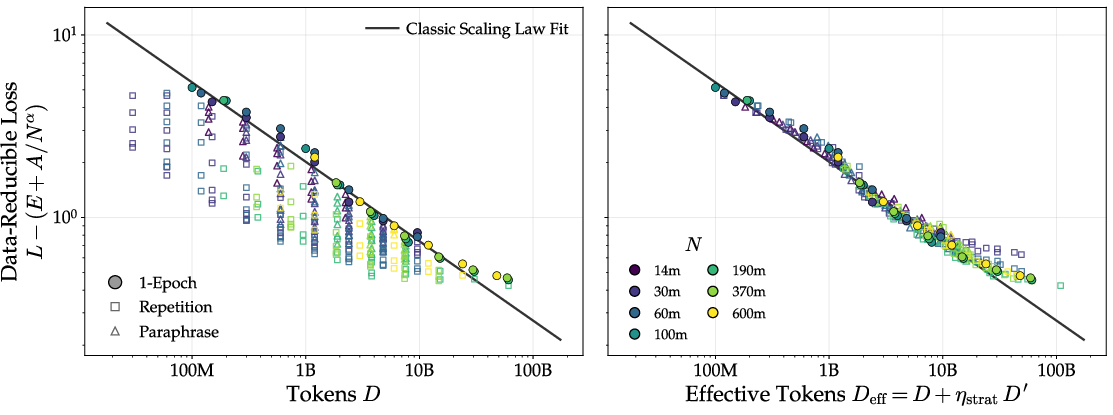
- data-reducible loss: The portion of total loss attributable to finite data, obtained by subtracting the model-size floor from total loss. "Data-reducible loss across model sizes and training settings ($1$-epoch, repetition, and paraphrase)."
- expansion ratio r: The relative amount of derived data to fresh data, measuring how aggressively the dataset is expanded. "the expansion ratio "
- Huber loss: A robust loss function less sensitive to outliers than squared error, used here when fitting scaling parameters. "we use a Huber loss on the residuals of "
- leave-one-out (LOO) RMSE: Evaluation that fits on all but one data point and reports root mean squared error on the held-out point, repeated across points. "reporting leave-one-out (LOO) RMSE on under the same fitting procedure."
- model-bound: A regime where both compute and data gains have saturated and the model size limits further progress. "model-bound floor "
- multi-epoch repetition: A data-expansion strategy that repeats the original corpus for additional epochs to trade compute for data scarcity. "multi-epoch repetition, paraphrasing, or distillation"
- paraphrasing: A data-augmentation strategy that rephrases documents to create semantically similar but surface-distinct training tokens. "Paraphrasing (i.e., augmentation)~\citep{maini_rephrasing_2024, kang_demystifying_2025}: rephrase each document in D\ using SmolLM2-1.7B-Instruct as the paraphrasing model~\citep{allal2025smollm2smolgoesbig},"
- Pareto frontier: The set of allocations where no resource (compute or data) can be increased alone without worsening loss; defines optimal trade-offs. "compute-optimal Pareto frontier."
- RMSE: Root mean squared error, used to summarize prediction residuals of the fitted scaling laws. "We report RMSE and per-parameter confidence intervals in \Cref{tab:fit_results} as well."
- saturation ceiling R*: The maximum fresh-equivalent tokens derivable from a fixed corpus via expansion; determines the asymptotic benefit of derived data. " can be interpreted as the saturation ceiling: the maximum number of fresh-equivalent tokens a corpus of size D\ can yield through data expansion, expressed as a multiple of D."
- self-distillation: A two-phase training approach where a model generates synthetic data used to further train a student model on the same domain. "Self-distillation: a two-phase teacher-student approach where we train the model on D, generate additional synthetic data D' unconditionally, and train student on "
- steepest descent: A local optimization method that follows the gradient direction of fastest loss decrease, used here to trace the empirical Pareto path. "via steepest descent on the empirical surface."
- teacher–student scaling law: A law that allocates compute optimally between teacher and student models in distillation settings. "\citet{busbridge_distillation_2025} establish a teacher--student scaling law that allocates compute optimally between training the teacher and the student."
- token effectiveness function: A function η that measures how informative a derived token is relative to a fresh token, enabling equivalence mapping. "introduce a token effectiveness function that maps each derived token to a fresh-data equivalent."
- tokens-per-parameter ratio: Fresh tokens per model parameter, a normalized measure of data availability relative to capacity. "the tokens-per-parameter ratio "
- Zipf-distributed features: A heavy-tailed feature frequency distribution often observed in language, used in theoretical scaling analysis. "under strong convexity and power-law scaling under Zipf-distributed features."
- strong convexity: A property of loss landscapes guaranteeing curvature lower bounds, used in theoretical results about data reuse scaling. "under strong convexity and power-law scaling under Zipf-distributed features."
Collections
Sign up for free to add this paper to one or more collections.

