Thermally Activated Long-Range Entanglement from Non-Abelian Conservation Laws
Published 14 Jul 2026 in quant-ph and cond-mat.stat-mech | (2607.12710v1)
Abstract: Thermal noise ordinarily suppresses quantum entanglement. We show that a strong non-Abelian conservation law can convert local thermal fluctuations into an unbounded operational resource. For a broad class of finite-range SU(2)-invariant spin chains restricted to the global-singlet sector, an explicit representation-space protocol yields YN=21log2N+Oβ(1), and hence ED≥YN, throughout a finite high-temperature interval. Local thermal fluctuations produce subsystem spins j∼N, whose globally locked irreducible representations contain log2(2j+1)∼21log2N ebits. An exactly solvable dimer chain exhibits a sharper effect: its zero-temperature state is unentangled across the cut, whereas every fixed $T>0$ produces ED=21log2N+C(T)+o(1), with crossover scale T∗(N)∼Δ/lnN. Exact diagonalization of a nonintegrable chain is consistent with the predicted scaling. Thus heating can activate system-size-diverging distillable entanglement across a macroscopic bipartition when thermalization is confined by a non-Abelian conservation law.
The paper demonstrates that non-Abelian conservation laws induce thermal entanglement that grows logarithmically with system size in SU(2)-invariant spin chains.
It employs a representation-theoretic distillation protocol and high-temperature group-theoretic techniques, validated by both analytical models and numerical simulations.
The findings imply that strong symmetry constraints can transform thermal noise into a scalable resource for quantum information processing.
Thermally Activated Long-Range Entanglement from Non-Abelian Conservation Laws
Introduction and Context
The paper "Thermally Activated Long-Range Entanglement from Non-Abelian Conservation Laws" (2607.12710) addresses the interplay between non-Abelian symmetries and entanglement in thermal quantum systems. It challenges the prevailing understanding that thermal fluctuations typically suppress spatial entanglement: in most unconstrained settings, Gibbs states become separable or have bounded bipartite entanglement at finite temperature, and one-dimensional spin chains have finite entanglement across any bipartition for all T>0. The introduction of strong conservation laws, specifically non-Abelian symmetry constraints (notably SU(2) singlet sectors), is shown to dramatically alter the phenomenology, inducing system-size-diverging entanglement at finite temperature.
Main Results
The central result establishes that in a broad class of finite-range SU(2)-invariant spin chains, restricted to the global-singlet sector, thermal noise generates entanglement that grows logarithmically with system size. Explicitly, for chain size N, the standard-LOCC distillable entanglement across a macroscopic bipartition has the form YN=21log2N+Oβ(1) for temperatures within a finite high-temperature interval. This is realized via a representation-theoretic distillation protocol: the local thermal fluctuations generate subsystem total-spin quantum numbers j∼N, and the corresponding irreducible representations support ∼21log2N ebits. This magnitude is both a lower bound (achievable by explicit LOCC) and an operationally relevant amount of distillable entanglement.
This broad result is anchored by:
An analytical demonstration in an exactly solvable dimerized chain,
Numerical diagonalization in a nonintegrable chain (open J1--J2 model at J2/J1=0.37),
Rigorous high-temperature bounds using group representation theory and quantum belief propagation.
Mechanism and Representation-Space Protocol
The key mechanism is representation-space distillation, formalized as follows: under the global symmetry constraint, the Hilbert space on each side of the bipartition decomposes into a sum of irreducible representations SU(2)0 and SU(2)1. The global-singlet sector enforces matching of subsystem quantum numbers, and the entanglement is encoded in the unique maximally entangled singlet states SU(2)2 in SU(2)3.
A standard LOCC protocol (local measurement of SU(2)4, discarding multiplicities, and classical communication) attains an average of SU(2)5 ebits. The distribution SU(2)6 of local spins is governed by thermal fluctuations within the symmetry-constrained ensemble, and, crucially, the variance of SU(2)7 scales as SU(2)8 at high temperature, leading to the logarithmic divergence of SU(2)9.
Analytical Results: Exactly Solvable Dimer Chain
For the exactly solvable dimer model (a chain of SU(2)0 spin-SU(2)1 particles with SU(2)2 uncoupled dimers per half), the effect appears with stark clarity.
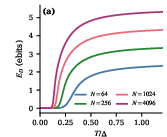
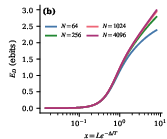
At zero temperature, the ground state is a direct product across the bipartition and carries zero entanglement. Any finite temperature (SU(2)3) immediately activates long-range entanglement, producing SU(2)4 ebits up to corrections SU(2)5 in SU(2)6 (with SU(2)7 a temperature-dependent offset). The crossover temperature, where entanglement appears, scales as SU(2)8, where SU(2)9 is the local dimer gap.
Figure 1: Entanglement behavior in the exactly solvable dimer chain: (a) At any fixed N0, entanglement grows as N1 increases; (b) Data collapse at low temperature versus N2 determines the crossover scale N3; (c) Asymptotic agreement with analytical scaling.
The derivation utilizes character integrals over N4, Gaussian approximations for large systems, and explicit tail bounds for N5.
Nonintegrable Chain and Numerical Verification
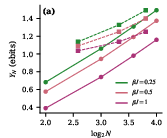
To test the robustness of thermally activated entanglement, the authors study an open N6--N7 spin chain. Exact diagonalization up to N8 in the global-singlet sector establishes that the key features persist:
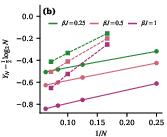
N9 increases along both parity subsequences.
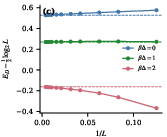
YN=21log2N+Oβ(1)0 shows bounded, parity-dependent drift, matching the theorem-predicted leading coefficient.
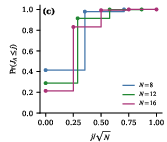
The probability distribution of half-chain spin YN=21log2N+Oβ(1)1 matches the predicted YN=21log2N+Oβ(1)2 width.
Figure 2: (a) YN=21log2N+Oβ(1)3 grows with system size for both parity subsequences; (b) The residual YN=21log2N+Oβ(1)4 is bounded and parity dependent; (c) Rescaled cumulative distributions confirm the YN=21log2N+Oβ(1)5 scaling of YN=21log2N+Oβ(1)6.
Analytical Techniques
The technical centerpiece is a high-temperature group-theoretic cluster expansion applied to the YN=21log2N+Oβ(1)7-twisted partition function, yielding uniform Gaussian tails near the central elements and exponential suppression elsewhere. For nontrivial models, quantum belief propagation is deployed to rigorously control the effect of cut interactions, showing stability of the large-YN=21log2N+Oβ(1)8 fluctuations and entanglement scaling under local perturbations.
Theoretical and Practical Implications
This work rigorously demonstrates that strong non-Abelian conservation laws turn thermal fluctuations, typically a source of local decoherence, into sources of system-size–dominant operational entanglement. Unlike Abelian constraints (which may sustain finite-size entanglement that vanishes in the thermodynamic limit), non-Abelian singlet constraints guarantee diverging entanglement. The mechanism is generic: for any compact semisimple group, logarithmic scaling is found with a universal coefficient governed by group-theoretic data: YN=21log2N+Oβ(1)9.
The implications are significant for quantum information processing in highly symmetric many-body systems, where thermal resources in symmetry sectors may be large enough for scalable entanglement distillation at high temperatures. This also motivates further studies into the intersection of symmetry-protected quantum resource theory and thermodynamics, and could inform protocols for entanglement generation in quantum materials, engineered spin systems, and potentially in high-energy physics contexts (e.g., black hole entropy and representation mixing).
Conclusion
This work establishes that thermalization, when confined by strong non-Abelian conservation laws, activates long-range, distillable entanglement at high temperature, in stark contrast to unconstrained or Abelian-constrained systems. The rigorous scaling laws, analytical protocols, and verification in both solvable and nonintegrable chains indicate a distinct thermal resource regime governed by group-theoretical structure. Future directions include extending these methods to higher-rank groups, higher dimensions, and studying consequences for quantum control in naturally or artificially symmetric materials.