- The paper establishes rigorous upper bounds on entanglement entropy for fixed-energy quantum states by mapping the problem to overlapping thermal subsystems.
- It demonstrates that reflection-symmetric and frustration-free systems exhibit area-law scaling through links between subsystem ground-state degeneracy and Schmidt rank.
- Numerical and analytical evidence from free fermion models and AKLT chains validate the proposed bounds and scaling laws for both gapped and gapless systems.
Weak Entanglement of Quantum Matter at Low Energies
Overview
The paper "Quantum matter is weakly entangled at low energies" (2604.14143) establishes rigorous upper bounds on the entanglement entropy of many-body quantum states with fixed energy expectation value for geometrically local Hamiltonians. Focusing on subsystems that comprise roughly half of the total system, the main result relates the maximum possible von Neumann and Rényi entanglement entropies to thermodynamic quantities, specifically the sum of thermal entropies in two fictitious subsystems at a temperature determined by the energy constraint. For frustration-free (FF) systems, these results directly link subsystem ground state degeneracies to Schmidt rank bounds, thereby proving area-law entanglement scaling independently of the spectral gap. The bounds are shown to be optimal up to subleading corrections for reflection-symmetric systems, and strong numerical and analytical evidence is provided for saturation in free fermion models and other physical settings.
Thermodynamic Mapping and Entanglement Bounds
The central technical innovation is the mapping of the entanglement maximization problem at fixed global energy to a classical thermodynamics problem. For a quantum system with finite-range interactions divided into subsystems A, B, and C such that A and C do not interact directly (see (Figure 1)), the von Neumann entropy of A for pure states with energy expectation E is upper bounded by half the sum of the thermal entropies of two overlapping fictitious systems (AB and BC) at temperature T∗, where B0 is set such that their energies sum to B1. This result generalizes to Rényi entropies for all indices.
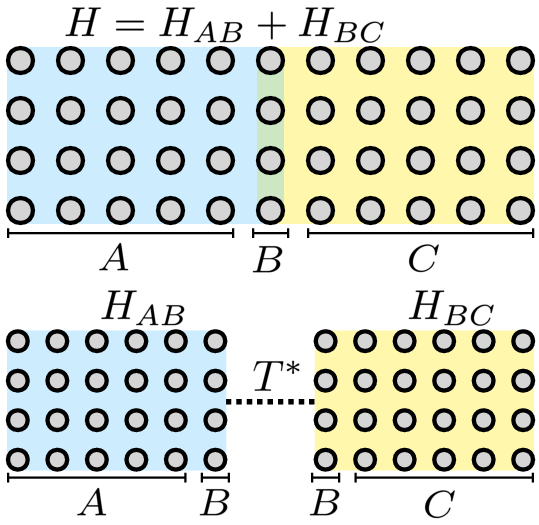
Figure 1: Upper bound on entanglement entropy: For a quantum system partitioned into B2, B3, B4 with B5 and B6 not interacting, the entanglement entropy of B7 at fixed energy B8 is upper bounded by the sum of thermal entropies of fictitious B9 and C0 systems plus an area-law correction.
Furthermore, the bounds remain tight for reflection-symmetric systems, where the optimal upper bound equals the lower bound up to boundary corrections, proved by construction of lower-bound states that exploit boundary field configurations (Figure 2).
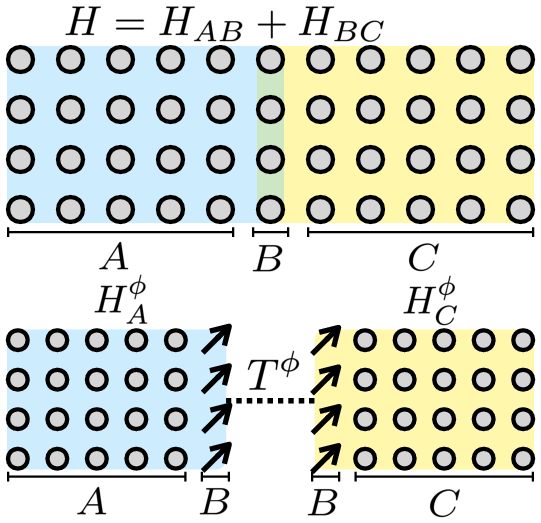
Figure 2: Lower bounds on maximum entanglement entropy in reflection-symmetric systems: Reflection symmetry enforces tightness of upper bounds on entanglement, as lower bounds derived from fixed boundary states converge to the same scaling.
Frustration-Free Systems and Area Laws
For FF Hamiltonians, the upper bound on ground-state Schmidt rank is set by the product of subsystem ground-state degeneracies, holding for both von Neumann and Rényi entropies and independently of the spectral gap. This analytical result implies that area-law entanglement in FF systems emerges whenever zero-temperature thermal entropies scale with the surface area rather than subsystem volume. The analysis is demonstrated concretely via examples such as AKLT and Motzkin chains, where subsystem Hamiltonians missing boundary terms exhibit exponential degeneracy growth with C1, guaranteeing area-law entanglement.
The construction applies directly to higher-dimensional FF systems, as exemplified by the division of a square lattice into C2, C3, C4 with local interactions (Figure 3).
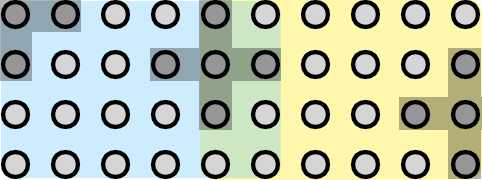
Figure 3: Division of the square lattice into C5, C6, C7 for an FF Hamiltonian; missing terms at the entanglement cut lead to surface-area scaling of ground-state degeneracies and, consequently, area-law entanglement.
Entanglement Scaling at Nonzero Energies
For systems with conventional thermodynamic properties, the scaling of entanglement entropy at energies above the ground state is controlled by the behavior of the low-temperature specific heat capacity C8. The effective temperature C9 associated with the upper bound decreases with system size for subextensive energies. The paper derives explicit asymptotic scalings for entanglement entropy as functions of energy, system size, and A0:
- Gapped Systems (A1): Entanglement at energy A2 above ground state is upper bounded by A3, i.e., nearly area-law scaling with a logarithmic correction.
- Gapless Systems (A4): Entanglement at energy A5 scales as A6, e.g., A7 for metals.
- Disordered Systems (A8): Volume-law scaling up to a logarithmic reduction, i.e., A9.
These scalings are visualized in (Figure 4), linking thermodynamic behavior to entanglement bounds.
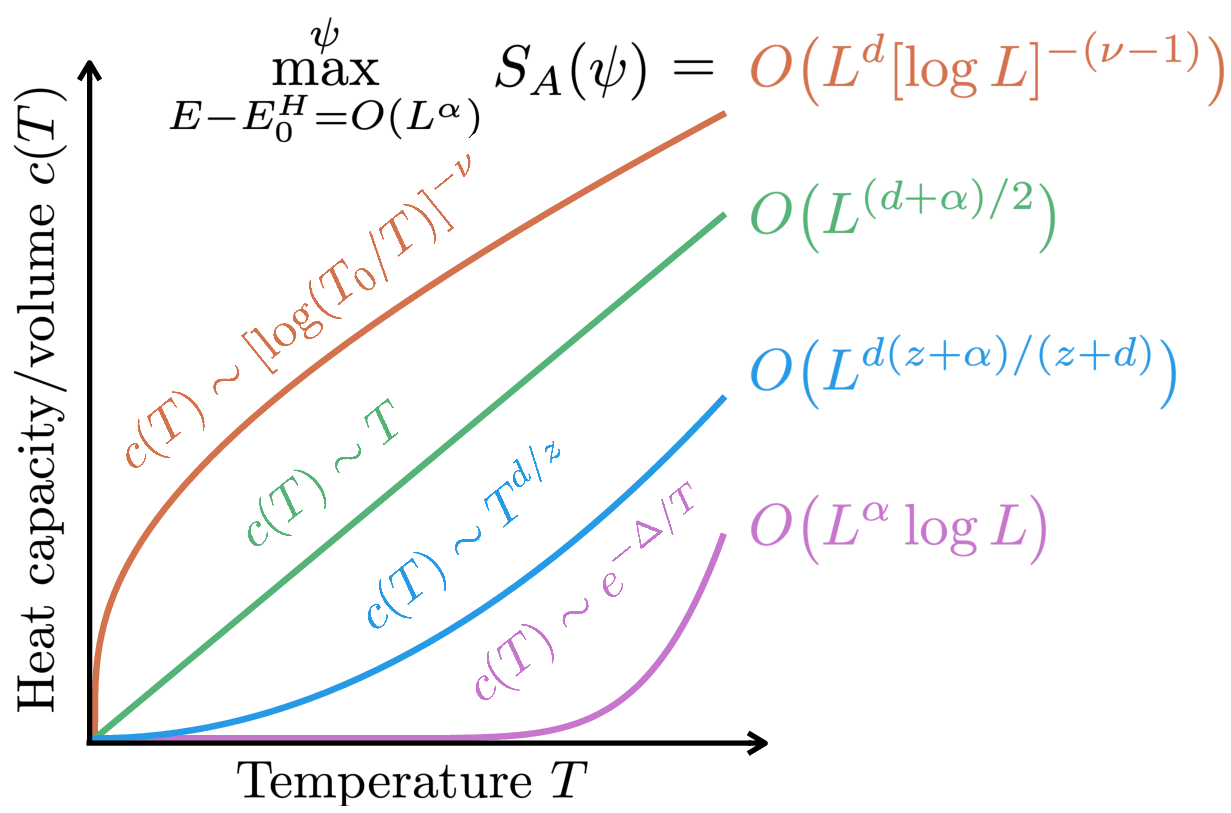
Figure 4: Relation between low-temperature specific heat C0 and the upper bounds on half-system entanglement entropy, for states at energy C1 above ground.
For extensive energies, the maximal entanglement is bounded by half the thermal entropy at the given energy, as saturated in chaotic eigenstates.
Numerical Evidence and Tightness of Bounds
The analytical scalings are validated numerically in free fermion systems, where maximal entanglement eigenstates at fixed subextensive energy display C2 scaling in C3 (Figure 5), consistent with predictions from thermal entropy bounds.
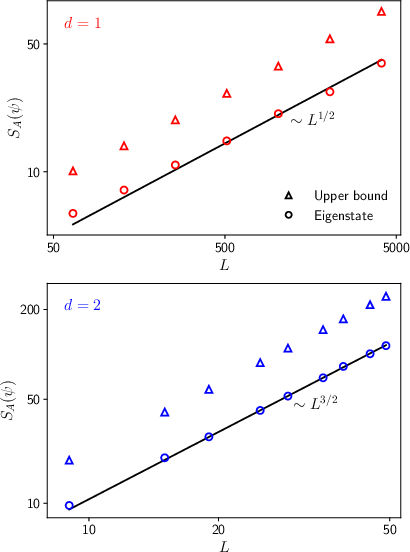
Figure 5: Comparison of upper bounds on entanglement (triangles) and eigenstate entanglement (circles) for free fermion systems in C4 and C5. Solid lines illustrate scaling C6, confirming tightness and optimality up to subleading corrections.
The paper further constructs lower bounds that match the upper bounds to leading order in C7 for reflection-symmetric geometries, demonstrating the optimality of the thermodynamic mapping.
Implications and Future Directions
The results formally connect thermodynamic properties of quantum matter (such as specific heat and ground-state degeneracy) to the maximal entanglement entropy achievable at fixed energy, for geometrically local systems. This establishes a direct constraint on simulation complexity for tensor network approaches and bounds on entanglement growth under Hamiltonian evolution. The independence from spectral gap in FF systems refines understanding of quantum computational complexity. The paper also links behavior of random eigenstates and pure states, providing a precise context for eigenstate thermalization in the low-energy regime.
The rigorous bounds derived raise several questions regarding simulation tractability for generic low-energy states, including the construction of states saturating the entanglement bound at energies C8 in C9 non-FF systems, and the role of quasiparticle configurational entropy. Investigating the dynamics of entanglement generation starting from low-energy states and its implications for physical observables remains relevant for future work.
Conclusion
This paper provides a comprehensive thermodynamic framework for bounding entanglement entropy in quantum matter at low energies. The mapping to overlapping fictitious thermal subsystems yields optimal, explicit, and universal scalings for entanglement, controlled by subsystem thermal entropy and ground-state degeneracy. The results have significant theoretical and practical implications for tensor network simulation, quantum complexity, and many-body dynamics, and delineate sharp constraints on entanglement growth for both FF and generic quantum systems.