- The paper demonstrates existence and factorization of the large-N master field, ensuring convergence of Wilson loop expectations in the strong-coupling regime.
- It develops a comprehensive 1/N local expansion using rooted master loop equations and duality methods, yielding exponential locality in observables.
- The research confirms an area-law decay for Wilson loops, providing a rigorous nonperturbative proof of confinement in heat-kernel lattice gauge theory.
Large-N Heat-Kernel Master Field on Zd at Strong Coupling
Introduction and Context
The study of the large-N limit in lattice gauge theory fundamentally underpins non-perturbative quantum gauge field theory. In the Yang–Mills context, analytic control of the large-N behavior of Wilson loop expectations is central to understanding phenomena such as confinement and the emergence of master field structures, particularly in the strong coupling regime. While classical results have been achieved for the Wilson action, rigorous analysis for the heat-kernel action—closely connected to continuum Yang–Mills measures and Brownian holonomy fields—has remained elusive in dimensions d≥3. This work provides a thorough solution for the large-N strong-coupling limit for lattice Yang–Mills theory with the heat-kernel action on Zd, d≥2, for gauge group U(N), demonstrating the existence of the master field, its $1/N$ expansion, and an associated area law.
The analysis leverages a universal duality formalism (Lemoine, 17 Apr 2026), producing a nonperturbative expansion via rooted master loop equations, local Fourier dualities, and detailed spin-network estimates. These methodologies generalize prior advances valid only for the Wilson action, incorporating harmonic-analytic aspects inherent to the heat-kernel measure.

Figure 1: Orientation convention for sublattices of Zd0 and Zd1 adopted for lattice and duality constructions.
Main Results: Existence, Expansion, and Confinement
Let Zd2 be a finite subcomplex, and consider the heat-kernel lattice gauge measure with structure group Zd3 and parametrization by heat time Zd4 with coupling Zd5. Denote normalized Wilson loop expectations by
Zd6
for a family Zd7 of loops in Zd8. The critical findings are:
- Existence and Factorization of the Master Field: For every fixed finite loop family Zd9 and N0 sufficiently large (strong coupling), the large-N1 limit exists and factorizes:
N2
where N3 is the master field functional.
- All-Orders N4 Local Expansion: The expectation admits a uniform-in-volume full topological expansion:
N5
where each coefficient N6 is exponentially local, and the expansion is valid in the infinite-volume limit.
- Area Law and Confinement: For sufficiently large N7,
N8
where N9 is the minimal lattice area filled by the loop N0, and N1 grows linearly with N2. For simple nontrivial loops, the boundary term can be absorbed:
N3
establishing area-law decay—rigorously confirming confinement in this strong-coupling regime.
Algebraic and Analytical Infrastructure
The resolution of these problems proceeds by extending the traditional loop equations approach to a setting where group Fourier analysis, stable representation theory, and intricate duality between topological and spectral observables become essential:
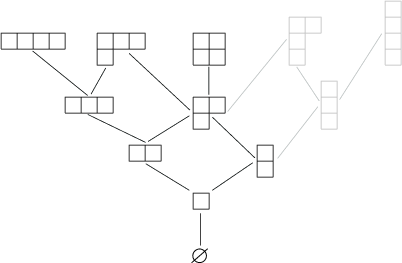
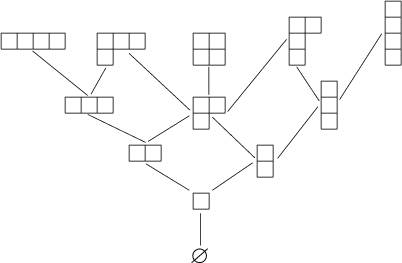
Figure 4: Left: Young graph; Right: 2-truncated Young graph capturing rank-limited partitions.
The Local Channel and Dual Incidence Graphs
A critical technical tool is the decomposition of topological coefficients into local channel sums on the dual incidence graph. After gauge-fixing a spanning tree, the remaining degrees of freedom can be systematically attributed to a bipartite network connecting non-tree edges and plaquettes, together with marked insertions for Wilson loops.
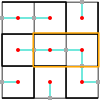
Figure 5: Dual incidence graph with Wilson loop insertion (in orange) in a finite d≥30.
The local channel representation expresses Wilson loop expectations as a sum over locally supported configurations (channels), each corresponding to a finite-dimensional network evaluation, distances from which define the decay rates in the polymer expansion.
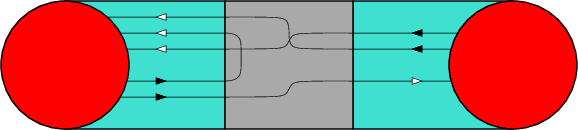
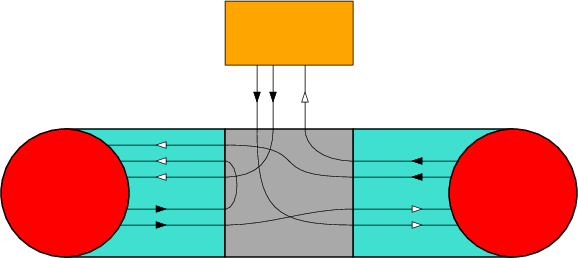
Figure 6: Local channel examples: left, without Wilson insertion; right, with Wilson loop support at a non-tree edge.
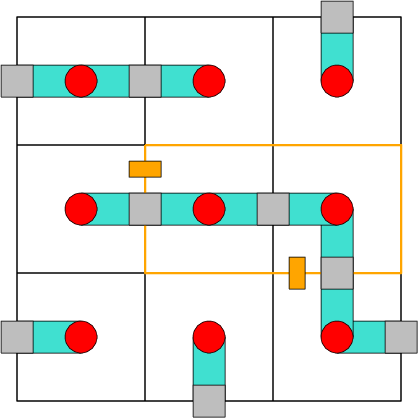
Figure 7: Local channel representation for the dual incidence graph in Figure 5, showing active incidence channels at the loop.
Rooted Master Loop Equation and Trajectory Expansion
The heart of the analytical resolution is the derivation and exploitation of a rooted master loop equation: a recursive, coefficientwise identity satisfied by Wilson loop observables with arbitrary local decorations. Rather than closing solely on loop observables (as in the Wilson case), this equation necessitates an extended observable space: the decorrelation arises only when one augments the space of observables with compactly supported local spectral decorations on plaquettes.
The solution takes the form of an order-truncated rooted trajectory expansion, alternately applying loop cut-and-join operators and local loop-plaquette transfer operators. Each step is controlled with strong-coupling (large d≥31) estimates, leading to absolute convergence. Key steps include:
- The peeling process for tree appendices on the dual incidence graph, systematically reducing the complexity of support.
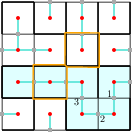
Figure 8: Dual incidence graph illustrating a sample peeling process—removal order of vacuum leaves is indicated.
- A precise classification of splittings and mergers occurring in the loop equations.
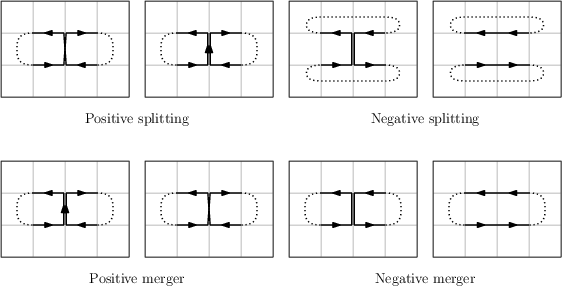
Figure 9: Diagrammatic representation of local splittings (left) and mergers (right) corresponding to local loop and channel updates.
Strong Coupling, Area Law, and Confinement
The area-law upper bound, central to demonstrating confinement, is achieved by integrating two critical observations: (i) every contributing rooted trajectory summand must furnish a plaquette filling of the Wilson loop with integer multiplicities (the central charge selection rule), and (ii) the exponential decay in the heat-kernel action penalizes the total representation mass. The minimal possible mass filling corresponds to the minimal lattice area spanning the loop, and thus the limiting master field exhibits strict exponential decay in the filled area, up to boundary effects that may be further absorbed for simple loops.
Theoretical and Practical Implications
The techniques developed yield a robust, locality-sensitive expansion for Wilson loop observables in heat-kernel lattice Yang–Mills at strong coupling, fundamentally generalizing the class of actions for which such results can be rigorously obtained in all dimensions d≥32. The established machinery is modular and action-agnostic at the level of channel expansions, and extension to other classical compact groups d≥33 is anticipated given the appropriate kernel estimates.
Practically, this establishes a rigorous foundation for master field computations in the continuum scaling limit, providing the analytical link between Brownian Yang–Mills and strong-coupling lattice discretizations. The area law addresses the confinement problem via precise, all-order control. Theoretically, the construction precludes, at this stage, the formulation of a full "gauge/string duality" in the normalized large-d≥34 heat-kernel context, due to the lack of a planar surface sum analogous to Wilson's case; the expansion here is over rooted strong-coupling histories rather than embedded string worldsheets.
In future work, this framework is poised to facilitate:
- Extension to the analysis of correlation functions and fluctuations beyond leading order,
- Applications to other central actions, including Villain-type and generalized heat kernels,
- Possible systematic construction of large-d≥35 continuum limits in higher-dimensional quantum gauge theories,
- Bridge to spin foam and spin network state-sum models underpinning quantum gravity and topological quantum field theory.
Conclusion
This paper provides a comprehensive, all-orders analytical description of the large-d≥36 strong coupling regime for heat-kernel lattice Yang–Mills theory on d≥37, including the explicit construction of the master field functional, its factorization, the all-orders d≥38 expansion, and rigorous area law for Wilson loops. The technical development—centered on local channel dualities, root-based cut-and-join expansions, and combinatorial harmonic analysis—opens extensive new directions for rigorous exploration of non-Abelian gauge theories and their continuum limits (2606.28945).