- The paper develops a QMC method that accurately computes symmetry-resolved entanglement in interacting many-body quantum systems.
- It leverages disorder operator measurements on replica manifolds to extract sector-specific entanglement scaling.
- Benchmarking with TFIM and Heisenberg models confirms universal scaling laws and the method’s scalability in various dimensions.
Detecting Symmetry-Resolved Entanglement via Quantum Monte Carlo: An Expert Analysis
Introduction and Motivation
The entanglement structure of many-body quantum states encodes nonlocal correlations that reveal far more than is accessible via local order parameters. Recent developments in symmetry-resolved entanglement entropies (SREEs) have enabled a sector-wise decomposition of entanglement according to conserved charges, providing both enhanced discrimination between quantum phases and more granular insight into criticality, topological order, and dynamics. However, calculating SREEs—especially in higher dimensions for generic, interacting systems—has been severely limited by the lack of scalable, unbiased numerical approaches.
The paper “Detecting Symmetry-Resolved Entanglement: A Quantum Monte Carlo Approach” (2604.02307) addresses this gap by developing a QMC methodology for computing SREEs, circumventing the scaling limitations of ED and tensor-network methods and leveraging the formalism of disorder (symmetry-twisted) operators on replica manifolds. The work provides both a general algorithmic framework and extensive benchmarking in canonical models, positioning the approach to enable future high-precision investigations in strongly correlated systems.
Framework for Symmetry-Resolved Entanglement
If a system possesses a global symmetry, the reduced density matrix ρA for a spatial region A can be block-diagonalized according to the eigenvalues q of a conserved charge QA. SREEs then quantify entanglement within each symmetry sector: Sn(q)=1−n1ln[Tr(ρA(q)n)],
where ρA(q) is the normalized RDM block for eigenvalue q.
The method links the nth charged moment
Zn(α)=Tr(ρAneiαQA)
to sector-projected traces by Fourier transformation. Thus, Zn(q)=Tr(ΠqρAn). The SREE can be reconstructed as
A0
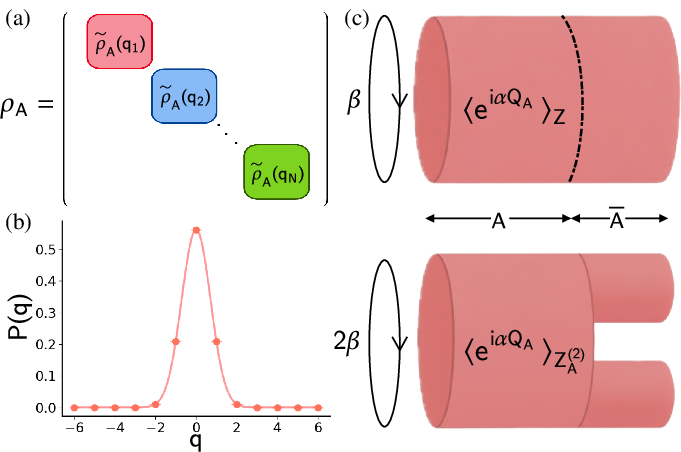
Figure 1: (a) Block-diagonal structure of A1 in the A2 eigenbasis; (b) Associated A3 distribution; (c) Geometry for measurement of disorder operators on single- and two-replica manifolds.
Methodological Implementation
The key technical insight is that A4 is accessible as a QMC expectation value of a nonlocal disorder operator A5 on an A6-replica (replica-glued) manifold. In practice, it suffices to perform QMC sampling in both the ordinary and the replica manifolds to extract the necessary expectation values. By scanning A7 (or, for discrete symmetry, evaluating the requisite points), one can reconstruct the full set of sector-resolved moments.
For abelian discrete symmetries such as A8, only two points need to be evaluated (A9), whereas for continuous symmetries (q0), a discrete Fourier transform is used over the spectrum of q1. This enables an efficient extraction of SREEs for arbitrary sector q2 in a single tour of large-scale QMC simulation.
Numerical Results and Benchmarking
1D and 2D Transverse Field Ising Model (TFIM)
The TFIM is examined at criticality (1D: q3; 2D: q4), focusing on the even and odd parity sectors of q5 symmetry. For 1D, the scaling of the disorder operator q6 in both single and double replica ensembles is predicted by CFT to have logarithmic corrections: q7
The prefactor extracted numerically, q8 (q9) and QA0 (QA1), matches the exact predictions to high precision.
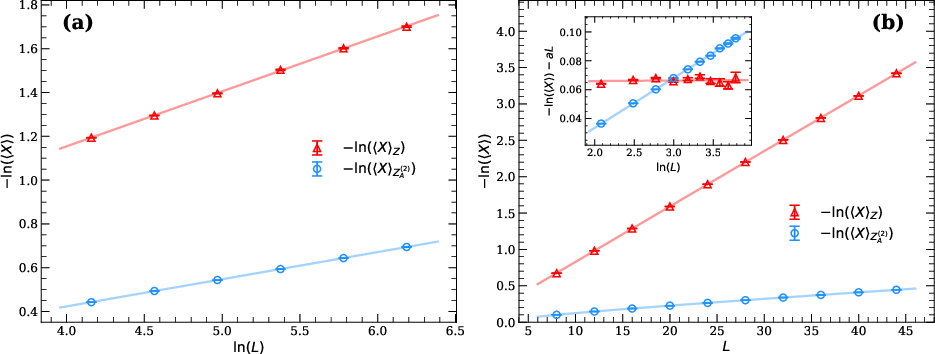
Figure 2: Scaling of QA2 in single- and two-replica ensembles for 1D and 2D TFIM, showing both area law and logarithmic corrections.
In 2D, the single-replica ensemble displays a pure area law, while the two-replica ensemble reveals a subleading logarithmic correction, indicating subtle contributions beyond what is captured by area-law scaling alone. The subtracted SREE QA3 converges to QA4, as expected from the equipartition theorem, but with significantly different rates in 1D versus 2D: whereas 2D reaches the asymptotic value at accessible QA5, the approach is logarithmically slow in 1D.
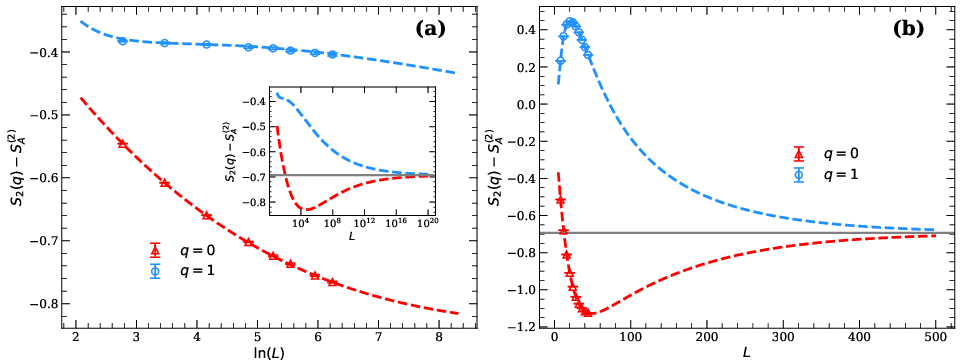
Figure 3: Subtracted SREE QA6 scaling in 1D and 2D TFIM across symmetry sectors, evidencing equipartition.
1D Heisenberg Chain and QA7 Symmetry
For the 1D spin-QA8 Heisenberg model, the QA9 symmetry sector Sn(q)=1−n1ln[Tr(ρA(q)n)],0 corresponds to the total Sn(q)=1−n1ln[Tr(ρA(q)n)],1 in the region Sn(q)=1−n1ln[Tr(ρA(q)n)],2. The disorder operator expectation values Sn(q)=1−n1ln[Tr(ρA(q)n)],3 are sampled, and discrete Fourier inversion yields the SREEs for each Sn(q)=1−n1ln[Tr(ρA(q)n)],4.
The scaling is governed by: Sn(q)=1−n1ln[Tr(ρA(q)n)],5
with the crucial subleading double-logarithmic term, in agreement with CFT predictions.
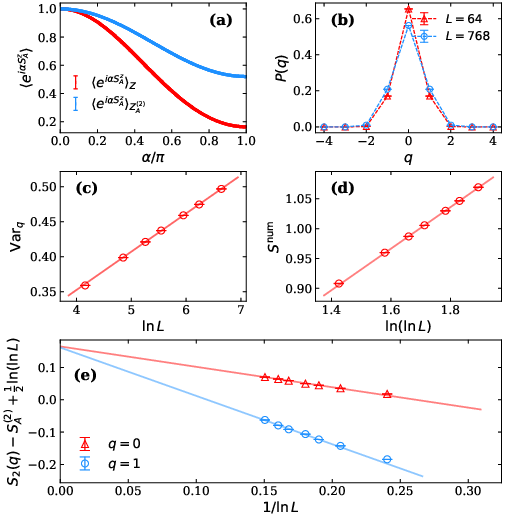
Figure 4: (a) Charged disorder operator measurements; (b) charge distribution Sn(q)=1−n1ln[Tr(ρA(q)n)],6; (c) logarithmic scaling of charge variance; (d) number entropy Sn(q)=1−n1ln[Tr(ρA(q)n)],7 vs. Sn(q)=1−n1ln[Tr(ρA(q)n)],8; (e) finite-size scaling collapse of corrected SREE for primary sectors.
Systematic QMC-ED benchmarking in both TFIM and Heisenberg models show essentially perfect agreement, affirming the absence of systematic bias.
Implications and Outlook
The methodology enables, for the first time, precise extraction of symmetry-resolved entanglement scaling in large-scale, interacting systems directly in the thermodynamic and continuum limits. This unlocks multiple directions:
- Non-Abelian Symmetries: Extension to irreducible representation-resolved entanglement in non-Abelian settings can clarify the distribution of entanglement contributions in, e.g., topologically ordered states or critical points with enhanced symmetry.
- Higher Dimensions & Exotic Phases: The approach is directly applicable to critical points with deconfined quantum criticality, topological order, or other non-Landau paradigms, to probe for sector selectivity and nontrivial SREE scaling.
- Experimental Probes: As symmetry-resolved entanglement becomes a measurable observable in quantum simulators, these advancements provide a direct bridge between field theory, numerics, and experiment.
Conclusion
By formulating SREE computation in terms of QMC-accessible disorder operators on replica manifolds and validating this method against analytic and ED results in canonical models, the paper "Detecting Symmetry-Resolved Entanglement: A Quantum Monte Carlo Approach" (2604.02307) establishes a new standard for unbiased, scalable SREE calculations in quantum many-body systems. The results confirm equipartition in 1D and 2D TFIM, reproduce universal subleading corrections in the 1D Heisenberg chain, and set the stage for comprehensive studies of symmetry-resolved entanglement in strongly correlated matter. The framework’s generality suggests it will play a pivotal role in elucidating the structure of entanglement across quantum phases and transitions in future theoretical and experimental explorations.