- The paper develops a Gram–Wishart–Stiefel formulation for N=2 matrix quantum mechanics by reparametrizing gauge invariants in terms of radial (Wishart eigenvalues) and angular (Stiefel) components.
- It demonstrates that non-polynomial completions of local transverse expansions reveal universal -2d scaling laws, clarifying the continuum limit and holonomy-induced dynamics.
- The methodology enables an exact separation of invariant measures and provides a blueprint for treating nonperturbative holonomy sectors in low-dimensional gauge and matrix quantum gravity models.
Overview and Context
The paper "Gram--Wishart--Stiefel formulation of the N=2, large--d gauge theory in 1D" (2607.08481) analyzes the endpoint formulation of the planar (N=2) sector for BFSS/BMN matrix quantum mechanics at large d. The focus is on recasting the lattice-regularized, gauge-invariant path integral into a parametrization inspired by multivariate statistics: endpoint degrees of freedom become Wishart eigenvalues (radial), while relative O(d)-orientations are encoded by Stiefel manifolds (angular). This formalism allows exact treatment of holonomy invariants and a direct examination of how holonomy-induced universalities—particularly the pivotal −2d law—arise in the continuum limit.
This analysis is situated within broader research on matrix quantum mechanics as a nonperturbative definition of quantum gravity and holography in one dimension, extending the classical program of reformulating matrix integrals in terms of invariant variables for integrability and large-N/large-d analysis, and addressing the challenges of nontrivial holonomy dynamics with nonperturbative tools.
Lattice Endpoint Reduction and Holonomy Invariants
Starting from the well-established lattice formulation of BFSS/BMN models, the endpoint reduction at d0 leads to a low-energy effective theory for two sets of d1-dimensional transverse vectors at the lattice endpoints:
d2
All gauge field degrees of freedom are fixed except the Polyakov loop holonomy, which enters via boundary conditions and the Haar measure. The essential collective observables are:
- Aligned invariant: d3,
- Transverse invariant: d4,
- Radius: d5.
The endpoint action after integrating out longitudinal and gauge fluctuations is
d6
with d7 the one-link holonomy-induced effective potential (involving Bessel functions), and d8 functions of the lattice parameters and gap equations.
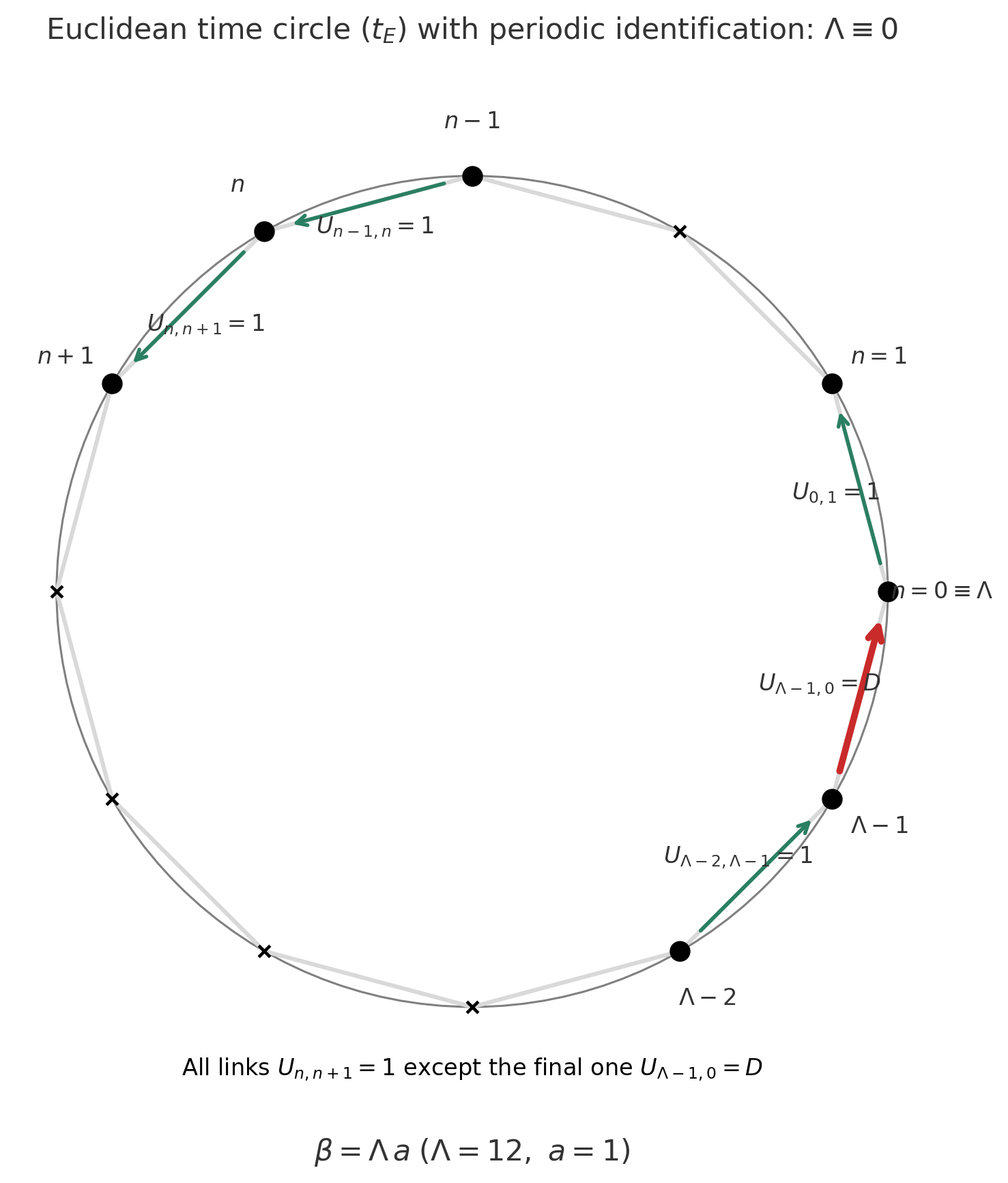
Figure 1: The static diagonal (Polyakov) gauge: all links are trivial except the closing holonomy, enabling reduction of the gauge integral to a single variable.
A central result is that in the low-temperature, large-d9 regime, the holonomy potential simplifies asymptotically to a universal linear form:
N=20
so the combined Gaussian-well plus holonomy exponent has its minimum at large N=21/alignment. The correct continuum limit is obtained not with the bare Gaussian but with a shifted mass after absorbing this linear alignment term.
The endpoint vectors are assembled into N=22 or N=23 matrices:
N=24
so that the Gram blocks encode all N=25 invariance:
- N=26 (rank N=27),
- N=28 (cross-Gram, encodes relative geometry).
The holonomy invariants decompose exactly:
N=29
with d0 as the transverse part. This decomposition enables a change of variables to the joint spectrum (Wishart eigenvalues) and angular sectors (Stiefel data/relative O(d1) orientation).
Under this change, the endpoint measure becomes a product of two Wishart-type (eigenvalue and angular) measures, and the mass and holonomy terms decouple radially and angularly at leading order.
The Holonomy Potential: Saddle Structure and Singular Channels
The exact holonomy potential, after endpoint reduction and diagonalization, is:
d2
so that on the aligned branch d3, d4, the potential can be locally expanded as:
d5
with d6 determined by a transcendental equation involving Bessel functions.
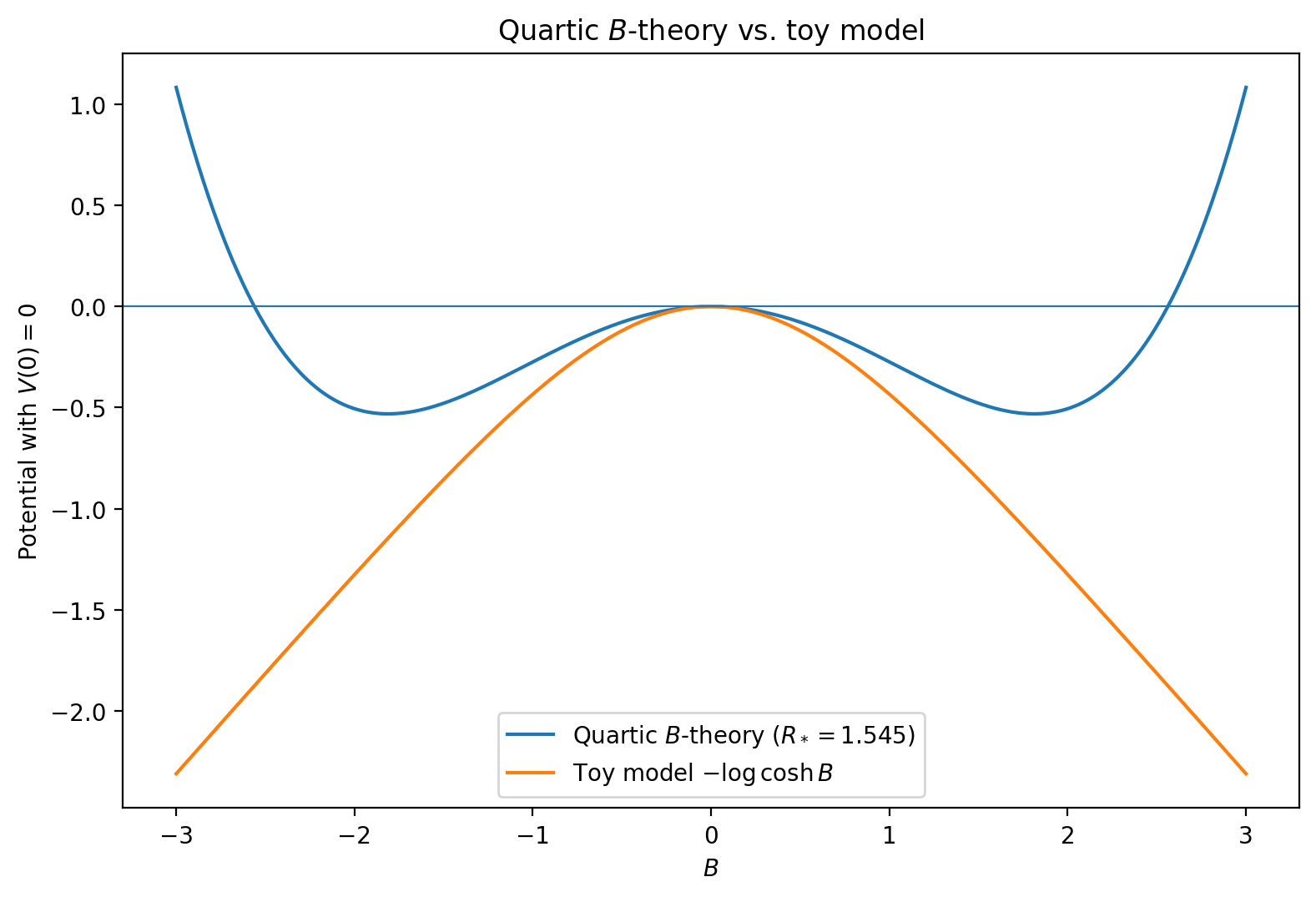
Figure 2: The toy versus the quadratic d7-potential. The non-polynomial toy model closely tracks the global and local behavior of the exact potential and captures the continuum singularity missed by polynomial truncations.
A crucial insight is that finite polynomial truncations of the transverse expansion (d8, d9, etc.) do not capture the necessary continuum singularity. An infinite-moment sum is needed—this is realized in the non-polynomial "toy model" N=20. Its Gaussian average exhibits a singularity at the critical value N=21, ensuring the N=22-channel survives the continuum limit:
N=23
The toy model, while only approximate for local coefficients, correctly reproduces the nontrivial continuum scaling and the essential N=24 mechanism.
Angular Integration and Bessel/HCIZ Kernel Structure
Upon reformulation, the remaining angular integrals over the relative O(N=25) (Stiefel) variable N=26 and the O(2) orientation N=27 can be performed, yielding a kernel depending on Bessel functions:
N=28
with N=29 and d0 encoding Frobenius and determinant data of the overlap. This analytic structure enables:
- Separation of radial (Wishart) and angular (Stiefel/HCIZ) contributions,
- Exact resummation of the leading linear d1 sector into a Bessel exponential,
- Explicit computation of the prefactor necessary to remove the doubled entropy of the naive Wishart product.
The pure d2 theory, which can be fully solved in the original Cartesian variables, confirms and normalizes the structure of this kernel: the angular average cancels one full Wishart entropy block, leaving the correct leading (single-block) scaling and the d3 law.
Non-Polynomial Completion and Continuum Limit
The main technical challenge addressed concerns the apparent breakdown of perturbativity in finite polynomial expansions. The non-polynomial completion of local transverse expansions (as captured by the toy model) exhibits a "flat" region, not at small d4, but at large d5 near the top of the allowed interval, where the sum d6 is approximately zero. This structure explains:
- Why the universal d7 channel is robust and persists irrespective of detailed local perturbative truncations,
- Why the continuum scaling is not governed by small d8 (local) data but rather by nontrivial cancellation at large radius,
- How artificial (apparent) lower bounds on the shifted Gaussian parameter disappear once the correct scaling region is identified.
Through a delicate balancing (including partial "pull-back" of the compensating d9 term), the correct continuum limit emerges, reproducing the d0 law:
d1
Implications and Future Directions
This Gram--Wishart--Stiefel reformulation provides:
- An explicit and tractable framework for handling endpoint-reduced, holonomy-driven matrix quantum mechanics at large d2,
- A concrete demonstration that universal continuum scaling—especially the d3 thermal law—arises intrinsically from the interplay of alignment dynamics and the nontrivial measure factors,
- A blueprint for systematic, non-polynomial completions of local expansions that can be generalized to higher d4, more complex holonomy structures, or other invariant sectors.
For theory, this formalism may be extended to study more general matrix integrals with nontrivial symmetry (e.g., involving symplectic or orthogonal groups), provide new tools for Hamiltonian truncations and large parameter regimes in matrix quantum gravity, and yield analytic expressions for partition functions and correlation functions suitable for comparison with Monte Carlo simulation or string-theoretic duals.
Further development could address:
- Full incorporation of anisotropic (d5) channels,
- The treatment of genuinely dynamical longitudinal variables,
- Extensions to finite d6, other boundary conditions, or supersymmetric completions,
- Dynamical phase transitions (confinement/deconfinement) and their signatures in the holonomy potential landscape.
Conclusion
The paper rigorously develops the Gram--Wishart--Stiefel formulation for the d7, large-d8 lattice gauge theory in 1D, clarifying how endpoint reduction and variable transformation elucidate the mechanism behind the universal d9 scaling in the partition function and its connection to holonomy-induced dynamics. The use of Wishart eigenvalues and Stiefel angular data allows for a transparent decomposition of invariant measures, a precise treatment of nonperturbative holonomy sectors, and a systematic approach to the continuum limit that resolves subtleties found in naive perturbative expansions. This framework has broad implications for both analytic theory and numerical studies of matrix quantum mechanics and low-dimensional gauge/gravity systems.