- The paper establishes that energy-preserving unitary symmetry forces reduced quantum subsystems to exhibit thermal (Gibbs) states, independent of statistical typicality.
- It introduces a finite de Finetti theorem with explicit O(1/N) error bounds, providing quantitative metrics for the convergence of k-qudit marginals to mixtures of thermal states.
- The work presents a dynamic framework using energy-conserving Lindbladians to realize symmetry-induced thermalization in realistic quantum many-body systems.
Symmetry-Driven Mechanisms for Quantum Thermalization: An Essay on "Symmetry-driven thermalization via finite de Finetti theorems" (2604.09410)
Introduction and Contextualization
This work addresses a foundational issue in quantum statistical mechanics concerning the emergent thermal behavior of subsystems in globally isolated quantum systems. Traditionally, the emergence of thermal marginals has been ascribed to statistical and probabilistic reasoning—using canonical typicality, the eigenstate thermalization hypothesis (ETH), or assumptions about ergodicity and chaos. This paper presents a fundamentally distinct approach: it rigorously demonstrates that deterministic symmetry constraints—specifically, invariance under energy-preserving unitaries (EPUs)—are alone sufficient to enforce thermal reduced states in subsystems, without recourse to statistical typicality or random sampling.
The technical centerpiece of the work is a finite version of a de Finetti theorem for EPU-invariant quantum states, providing explicit quantitative bounds on the convergence of reduced marginals to mixtures of thermal product states. This symmetry-centric framework is not only analytically compelling, but also carries significant operational and dynamical implications.
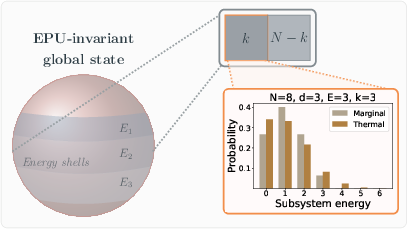
Figure 1: The symmetry-driven mechanism for the origin of thermalization—the finite-dimensional de Finetti theorem—shows that EPU invariance constrains k-qudit subsystems of an N-qudit system to exhibit thermal reduced states, with nearly constant temperature for narrow energy distributions.
Technical Framework and Main Results
EPU-Invariant Quantum States and the Method of Types
Consider a system of N qudits, each described by a nondegenerate Hamiltonian h with energy levels {Ex}. The global constraint of energy conservation restricts dynamics to the subgroup of unitaries commuting with the total Hamiltonian, UH={U∣[U,H]=0}. EPU-invariant states are characterized as mixtures that are block-diagonal in the energy eigenbasis and maximally mixed within each fixed-energy eigenspace.
The authors leverage the method of types (a large deviation tool) to formalize these notions combinatorially: energy shells are labeled by empirical type vectors whose structure ultimately controls local subsystem statistics.
The Finite de Finetti Theorem for EPU Invariance
The principal theorem establishes that, for any EPU-invariant state ρ(N) of N qudits, the k-qudit marginals converge (in trace norm and relative entropy) to convex mixtures of k-fold thermal product states: N0
where N1 are single-qudit Gibbs (thermal) states at different inverse temperatures and N2 is a probability measure over N3 determined by the energy distribution. These explicit finite-size error scalings are non-asymptotic and hold uniformly for N4.
Strong claims include:
- Thermal structure emerges deterministically in subsystem marginals of any EPU-invariant state, regardless of underlying microscopic dynamics.
- For states with sharply peaked total energy, the resulting mixture is close to a unique Gibbs state—subsidiary systems appear conventionally thermal.
Numerical Convergence
Illustrative examples (Appendix, Section 1) numerically examine marginals for finite ensembles (e.g., N5 qutrits, varying energy subspaces, marginals of size N6), demonstrating that the trace distance between marginals and the target thermal state exhibits the predicted N7 scaling, thereby corroborating the finite de Finetti estimates.
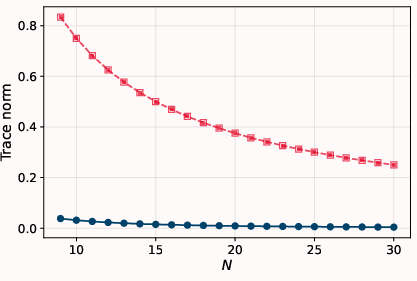
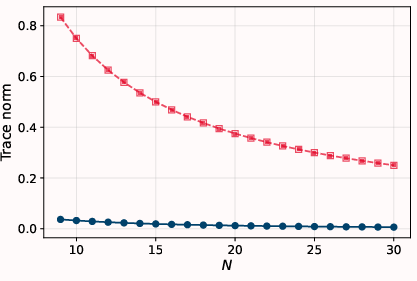
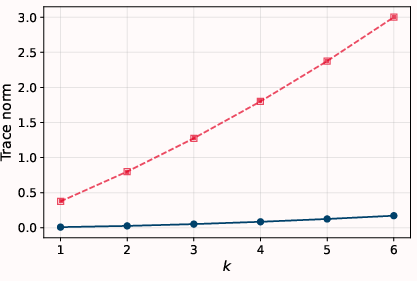
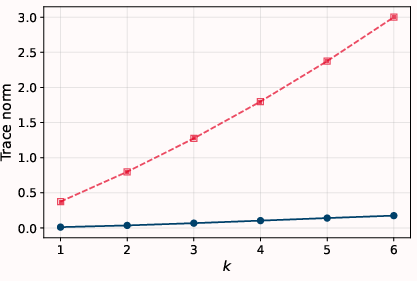
Figure 2: Numerical demonstration (for qutrit systems) of convergence of reduced marginals to thermal mixtures, with decreasing trace distance as N8 increases and N9.
Dynamical Realization of EPU-Invariance
The paper extends its static symmetry argument to an explicit dynamical scenario. It constructs an energy-conserving Lindbladian whose long-time evolution drives arbitrary states exponentially fast to their EPU-twirled versions: N0
with the rate set by the minimum of the block and dephasing rates across energy subspaces. This shows that such symmetry-induced "thermalization" can arise as the steady-state of physically plausible open-system dynamics.
Distinction from Statistical Thermalization
Contrary to ETH, canonical typicality, or approaches rooted in dynamical chaos, the de Finetti theorem proved here is:
- Purely deterministic and symmetry-based: It arises solely from group invariance under N1.
- Independent of randomness or typicality: No measure concentration, ensemble averaging, or assumptions about random pure states are invoked.
- Quantitatively explicit: The error between true marginals and thermal mixtures is tightly bounded for finite N2.
This structural approach positions symmetry itself as a sufficient mechanism for enforcing local thermality—a perspective not manifest in previously probabilistic accounts.
Operational and Theoretical Implications
Diagnosing Thermalization: From Dynamics to Symmetry
The work suggests a refocusing of tests for thermalization: rather than probing dynamical properties (ergodicity, chaos), one may efficiently check for EPU-invariance (symmetry under conjugation by all energy-preserving unitaries) as a sufficient witness of local thermal structure. This paradigm aligns with recent resource-theoretic formalisms, viewing EPU-asymmetry as a rigorous quantifier of deviation from thermality and reversible thermodynamic behavior.
Robustness to Approximate Symmetry
A further quantitative generalization (Theorem: Robust thermalization with symmetry breaking) shows that for states "close" to EPU-invariant in relative entropy, marginal thermalization persists (up to explicit N3 corrections), underscoring the robustness of the symmetry mechanism.
Prospects and Future Directions
This symmetry-driven framework opens new theoretical lines of inquiry:
- Extension to other conserved quantities and group symmetries (beyond energy).
- Interplay with constraints such as integrability and many-body localization, where dynamical symmetry selection rules may override statistical mixing.
- Efficient symmetry-testing algorithms as practical diagnostics in many-body and quantum simulation platforms.
Conclusion
This paper establishes deterministically that energy-conservation symmetry—captured by invariance under the group of energy-preserving unitaries—imposes thermal structure on reduced subsystems of quantum many-body systems, without statistical or dynamical assumptions. The finite de Finetti theorems and dynamical realizations provided here set a new benchmark in understanding the structural origins of thermalization, making symmetry a central operational tool in both theory and experiment. The approach's non-statistical, explicit control over error bounds strengthens the foundations of quantum thermodynamics and prompts further investigation into symmetry-induced phenomena in quantum many-body dynamics.