- The paper introduces Diachronic Sample Integration (DSI) to robustly reduce tail-risk estimation variance using ensemble sampling across training checkpoints.
- It leverages checkpoint diversity to average out stochastic fluctuations, achieving near-oracle accuracy in Value-at-Risk and Expected Shortfall metrics.
- Empirical tests on synthetic time series and market data confirm DSI’s effectiveness in structural preservation and reliable tail-risk calibration.
Diachronic Sample Integration for Robust Tail-Risk Estimation with Generative Models
Introduction
The estimation of tail-dependent risk functionals such as Value-at-Risk (VaR) and Expected Shortfall (ES) is a central challenge in quantitative risk management, especially under data constraints and nonparametric requirements. While deep generative models (DGMs) have become standard tools for generating synthetic scenarios, most are optimized to capture bulk distributional characteristics; tail regions remain vulnerable to high estimator variance and model misspecification. "Diachronic Sample Integration: Robust Tail-Risk Estimation with Generative Models" (2607.10810) introduces Diachronic Sample Integration (DSI), a purely inference-time approach for robust tail-risk estimation via ensemble sampling across training checkpoints, without modifying the generative objective, retraining, or imposing parametric tail structure.
Methodology: Diachronic Sample Integration (DSI)
Standard generative modeling practices fixate on a single, post-burn-in “converged” checkpoint from the model training trajectory to generate synthetic samples. However, the stochastic nature of deep optimization—including inherent noise and instability in low-probability regions—renders tail functional estimation highly sensitive and unstable at such single points. DSI addresses this instability by extracting checkpoint-level diversity: Instead of sampling solely from the terminal model, DSI draws samples from multiple, spaced checkpoints along the post-burn-in trajectory and pools them to form a mixture distribution.
For a fixed simulation budget N, DSI constructs a checkpoint set S={t0,t0+M,...,t0+(K−1)M} specified by burn-in t0, mixture size K, and stride M. Equal per-checkpoint sampling (m=⌊N/K⌋) forms a dataset targeting the mixture distribution PˉS=K1∑t∈SPθt, where Pθt are the DGM-induced distributions at different checkpoints. Risk functionals are then empirically estimated over the pooled samples.
This approach leverages the fact that tail estimation error consists of a persistent bias floor and checkpoint-specific fluctuation variance. DSI reliably reduces only the latter, as formalized by a trajectory-level bias-variance decomposition: E[(ψ^DSI−ψ(P⋆))2]=Bias2+KeffVariance+Lsam+o(⋅)
where Keff is the effective number of decorrelated checkpoints (sublinear in S={t0,t0+M,...,t0+(K−1)M}0 due to autocorrelation).
Theoretical Framework
Rigorous analysis establishes the conditions for DSI efficacy. Provided post-burn-in checkpoint-level tail errors exhibit mean-zero, weakly stationary fluctuations, DSI reduces estimation variance as S={t0,t0+M,...,t0+(K−1)M}1 increases, provided the autocorrelation between checkpoint errors decays with stride S={t0,t0+M,...,t0+(K−1)M}2 (see Figure 1). When persistent model bias dominates or checkpoint errors remain highly correlated, variance reduction saturates, and DSI becomes ineffective.
The bias-variance mechanics are characterized by three regimes:
- Variance-reducible regime: Small bias, decorrelated errors, DSI is highly effective (high S={t0,t0+M,...,t0+(K−1)M}4).
- Correlation-limited regime: Fluctuation variance present but checkpoint errors are autocorrelated, limiting gains.
- Bias-limited regime: Systematic bias dominates, DSI cannot reduce leading error terms.
DSI is thus architecture-agnostic; its advantage arises in the presence of substantial checkpoint fluctuation variance and limited bias.
Empirical Results
Synthetic Time Series
On a highly controlled five-dimensional AR/GARCH/Student-S={t0,t0+M,...,t0+(K−1)M}5 process, for risk levels S={t0,t0+M,...,t0+(K−1)M}6 and S={t0,t0+M,...,t0+(K−1)M}7 generated trajectories, DSI-ensembled DDPM achieves close-to-oracle accuracy:
- Relative error (VaR+ES, S={t0,t0+M,...,t0+(K−1)M}8): Single DDPM: S={t0,t0+M,...,t0+(K−1)M}9; DSI-DDPM: t00; sampling oracle: t01.
This substantial reduction in both mean and variance is visualized in out-of-sample error dynamics:
Backtesting using the Kupiec coverage and Fissler-Ziegel VaR/ES tests demonstrates high-fidelity tail calibration with DSI, closing the gap with the oracle (“truth”) reference.
Market Data
On real high-frequency NASDAQ limit order book data (AAPL, AMZN, GOOG, JPM, QQQ), DSI consistently improves tail-risk estimation under fixed computation budgets and across 65 strategy-level P&L mappings.
- Market Data (VaR+ES, t02): Single DDPM: t03; DSI-DDPM: t04; best tail-aware baseline (TailGAN): t05.
- DSI operates without explicit tail loss design, adversarial risk penalization, or reweighting.
DSI also stabilizes estimates across tail levels (see Table 1), and empirical rank-frequency plots show improved lower-tail fidelity.
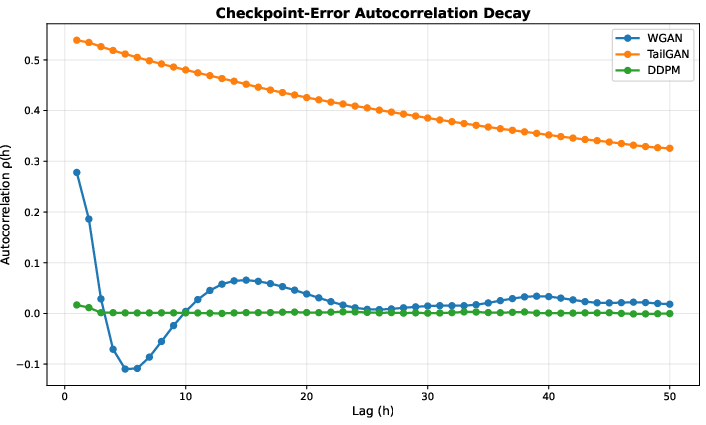
Figure 2: Market rank-frequency plots of strategy PnL for all methods, with DSI matching the empirical and oracle lower-tails (rightmost bins).
Preservation of Multivariate and Temporal Structure
Crucially, DSI’s sample-level ensembling preserves both multivariate cross-asset correlation and temporal dependence:
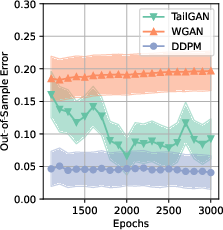
Figure 3: Heatmaps of cross-asset correlations for synthetic (left) and market (right) data, comparing DSI, DDPM, TailGAN, and WGAN; DSI matches the empirical structures most closely.
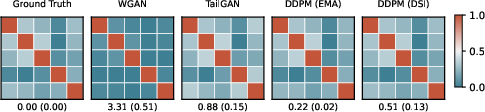
Figure 4: Summary plots of absolute errors in temporal autocorrelation and multivariate dependence; DSI achieves the lowest discrepancy.
Sensitivity and Diagnostics
DSI’s effectiveness increases rapidly with mixture size t06 up to values where t07 saturates; larger stride t08 improves diversity but with diminishing returns for large t09. Diagnostics on integrated ES error, effective checkpoint ratio, and sign-consensus directly explain when DSI provides gains (as in the DDPM “variance-reducible” regime).
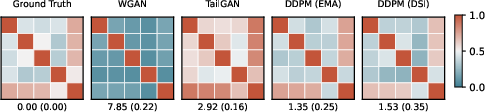
Figure 5: DSI sensitivity: relative error decreases and then plateaus with larger K0; larger strides K1 speed up error decay only for small ensembles.
Implications
Practical and theoretical implications:
- DSI provides a computationally lightweight, “drop-in” estimator to robustly improve finite-sample tail-risk estimates from any generative simulator, without additional training or tuning.
- It is architecture- and domain-agnostic, requiring only stored checkpoints.
- In variance-reducible regimes (which can be pre-diagnosed using post-hoc autocorrelation decay), DSI eliminates most stochasticity-induced tail functional error, attaining close-to-oracle accuracy and calibration.
- It does not reduce persistent model bias; integration with tail-constrained training or conditional modeling may improve systematic error.
- Structural preservation is empirically validated: DSI does not degrade learned dependence structures, critical for use in realistic simulation pipelines.
DSI is directly applicable to fields beyond finance, including energy grid stress-testing, extreme climate modeling, and any rare-event simulation task under finite computational budgets and heavy-tailed outcome topologies.
Conclusion
Diachronic Sample Integration constitutes a robust, architecture-independent, test-time improvement for finite-budget tail-risk estimation using DGMs. Its contribution is both theoretical—formalizing the bias-variance regime of checkpoint-level mixture estimation—and practical, as DSI consistently delivers lower error, better probabilistic calibration, and structural fidelity under standard evaluation protocols. Future research directions include coupling DSI with adaptive checkpoint selection, tail-guided training, and early-diagnostics for effective variance reducibility.
References:\
"Diachronic Sample Integration: Robust Tail-Risk Estimation with Generative Models" (2607.10810)