- The paper introduces a combined loss that augments strictly proper scoring rules with a differentiable decision loss, enhancing cost sensitivity.
- It employs implicit differentiation through an optimization layer to focus gradient updates on low-frequency, high-impact regions.
- Experiments in wind power dispatch and frost protection demonstrate improved calibration and up to 18% cost reduction in critical scenarios.
Decision-Aware Training for Sample-Based Generative Models
Motivation and Theoretical Framework
Sample-based generative models, including implicit generative and diffusion models, are standard in probabilistic forecasting due to their expressivity and sample-efficient estimation via scoring rules such as the energy score (ES) and continuous ranked probability score (CRPS). However, these training objectives are agnostic to decision costs encountered by downstream decision makers acting on model outputs. The absence of cost-awareness leads to suboptimal allocation of model capacity, especially in high-consequence regions of the output space where data frequency is low but error costs are high (e.g., extreme events in weather domains).
The central contribution is the augmentation of standard strictly proper scoring rule objectives with a differentiable decision loss. This decision loss penalizes the cost of the Bayes-optimal downstream action, computed via expected cost with respect to the model’s predictive distribution. Formally, for a cost function c(a,y) and model forecast F^, the decision loss is Sc(F^,y)=c(a∗(F^),y), where a∗(F^) minimizes the expected cost under F^. Notably, Sc is itself a proper scoring rule. A strictly proper scoring rule (e.g., ES) anchors the model, while the decision loss supplies targeted gradient signals focused on cost-relevant regions, resulting in a convex combination:
L=(1−wd)ES+wdSc,wd∈[0,1)
This combined loss is strictly proper for wd<1 and uniquely minimized at the true conditional distribution, provided distributional richness.
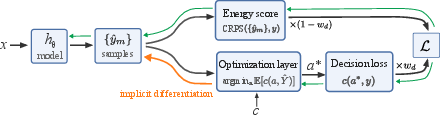
Figure 1: Method overview—model samples are evaluated by the energy score and a differentiable decision loss via an optimization layer. Gradients propagate through both paths using autodiff and implicit differentiation, respectively.
Gradient Analysis of Decision Loss
Optimization with decision loss integrates a differentiable optimization layer which computes a∗ over batch model samples. The gradient signal from Sc backpropagates through F^0 via implicit differentiation. The mechanism ensures the gradient is nonzero only for samples in regions where the cost function is sensitive to model error—i.e., nonzero cross-curvature. This concentrates model updates on cost-relevant support rather than on regions with abundant training density but low consequence for the decision. When F^1 hits constraint boundaries, the chain is blocked and only the scoring rule provides gradient flow.
This selective region-wise correction is crucial. For high-impact but low-frequency events (e.g. wind turbine cut-off), the model receives much stronger correction signals than scoring-rule-only training, where the gradient allocation is strictly proportional to sample frequency rather than anticipated cost.
Experiments
Synthetic Task
A bimodal Gaussian mixture illustrates the behavior: the mixture weight, not the central tendency, determines cost-active regions. With pure CRPS training (F^2), the model fails to track the optimal action transitions due to incorrect mode weights, as CRPS under-emphasizes rare, high-cost support. Introducing decision loss (F^3) results in accurate mode weight allocation, aligning the model’s action recommendation with ground truth.
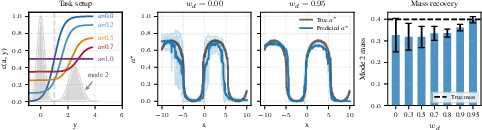
Figure 2: Synthetic task—cost structure, F^4 tracking vs ground truth, and correction of mode 2 mass with decision-aware loss.
Wind Power Dispatch
Dispatch decisions for wind farms must balance revenue and shortfall penalties, especially near the turbine cut-off regime, which is rare but operationally expensive to miss. Using real North Sea data, experiments demonstrate decision-aware training (moderate F^5) achieves up to 18% reduction in decision cost and 32% better calibration in the high-cost cut-off region at F^6, while the aggregate trade-off is well controlled around F^7. These improvements occur specifically in cut-off events, confirming that the decision loss localizes corrective gradients to data-sparse, cost-critical support.
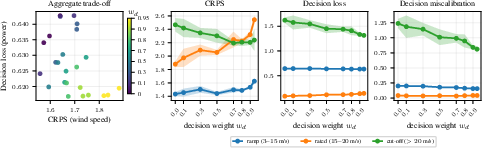
Figure 3: Wind power dispatch—aggregate trade-off and regional effect: improvements in cut-off, degradation in rated, negligible effect in ramp regions.
Frost Protection
The frost protection problem introduces a cost structure with a common event (25% base rate). Here, CRPS already allocates significant gradient density to the cost threshold. The addition of decision loss does not yield large further improvements in expected decision cost, but monotonic improvements (up to 15%) are observed in decision calibration—the alignment between estimated and realized cost—particularly at symmetric cost settings (F^8). Distributional adjustments (e.g., removal of warm bias for subzero observations) are visible at moderate F^9.
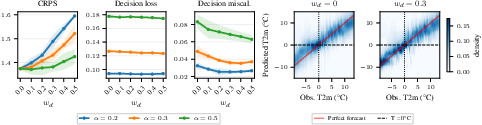
Figure 4: Frost protection—aggregate CRPS degradation, flat decision loss, and improved calibration through moderate decision-aware training.
Mechanistic Insights
The selective impact of decision-aware training is a consequence of the cost function, data distribution, and loss weighting. Boundary regions (actions at minimum/maximum) block decision-loss gradients; interior solutions redistribute mass toward lower-cost configurations. If the cost function is sharply localized or event rarity is extreme, decision loss must be emphasized to produce visible effects. However, large Sc(F^,y)=c(a∗(F^),y)0 risks overcorrection and distribution collapse in cost-insensitive regions.
Relation to Existing Literature
Decision-aware training for full generative models extends prior work in decision-focused learning, which has been largely constrained to point prediction settings. Weighted scoring rules provide cost-biased improvements but are incompatible with sample-based models or adaptive loss localization. Differentiable optimization layers have seen application in classical structured prediction; their use in generative model training to correct sample allocation for real-world, cost-structured forecasting is novel. This treatment unifies the theory of proper scoring rules with expected utility theory, establishing a robust pathway for integrating rational action with flexible, sample-based deep generative modeling.
Practical and Theoretical Implications
Practically, the approach enables alignment of sample-based generative model training with operational stakeholder costs, enhancing model value in safety-critical applications (e.g., power dispatch, hazard response) where the mismatch between statistical skill and decision value is acute. The necessity of tuning Sc(F^,y)=c(a∗(F^),y)1 for each setting and computational costs from the optimization layer are noted practical constraints. Theoretically, the results validate the equivalence of decision losses to proper scoring rules and the preservation of strict propriety in convex combinations.
Future work includes extending these methods to high-dimensional generative weather models, exploring generic score-based correction for diffusion dynamics, and analyzing societal implications when multiple (possibly competing or biased) cost functions are in play.
Conclusion
Decision-aware training for sample-based generative models—by combining strictly proper scoring rules with a differentiable decision loss—enables models to produce distributions that are not only statistically well-calibrated but also optimized for real consequential decisions. The methodology reallocates modeling capacity toward cost-relevant support without sacrificing global forecast validity (for moderate Sc(F^,y)=c(a∗(F^),y)2), closing the operational gap between traditional probabilistic model training and downstream decision making. The approach provides a generic, theoretically justified, and practically tractable path for aligning complex generative models with stakeholder utility.