- The paper introduces SS-GEN, which reformulates tail event estimation into nonparametric angular learning combined with an analytic handling of the radial component.
- It employs extreme value theory to derive uniform convergence guarantees for heavy-tailed (Pareto) and light-tailed (Gamma) distributions.
- Empirical results demonstrate robust VaR/CVaR estimation and stress test generation at extreme quantiles, outperforming traditional parametric approaches.
Extreme Value Theory Meets Deep Generative Modeling: The SS-GEN Method
Introduction
This paper introduces Self-Similar Generative Estimation (SS-GEN), an approach for rare event simulation and tail probability estimation in high-dimensional settings, exploiting the asymptotic structure of extreme value distributions. The method is designed for both heavy-tailed (regular variation) and light-tailed (Weibull-type) scenarios, and provides formal approximation guarantees for the resulting tail law. Unlike existing methods—many of which require bespoke generative model architectures or tailored latent priors—SS-GEN reformulates the tail learning task into the estimation of a nonparametric angular component on a compact domain, using off-the-shelf deep generative models (DGMs), while capturing the radial component analytically.
Asymptotic Radial-Angular Decompositions
A core contribution is the formalization of a general, nonparametric radial-angular tail decomposition for a random vector X∈Rd. Under regular variation (for heavy-tailed distributions), the radial component follows a Pareto law, and the angular law captures the dependence structure at extreme radii. In the Weibullian setting (light-tailed), the radial component converges to a Gamma law conditional on the angular direction, parameterized by a function Λ⋆ encoding local tail decay.
The key technical result is that, above a high threshold t, the joint tail density factorizes asymptotically into an explicit radial density and a conditional angular density. The "self-similar" property reflects the stabilization of the tail: for regularly varying data, Pareto limits are direction-independent, while for Weibull-type data, the parameters depend smoothly on direction, but are still sharply localized.
Decomposition and Generative Approximation
SS-GEN implements a structural reduction: rather than learning the complete tail density, it estimates only the angular law from the set of threshold exceedances, which is feasible for moderate thresholds in high dimensions. The analytic tail representation allows the separation of probability estimation from extreme scenario generation: the DGM is used only on the sphere, and the radial law is handled parametrically.
For regularly varying distributions, the SS-GEN tail density approximation is proven to converge in uniform relative error to the true tail law as t→∞ (Theorem 3.3). For Weibull-type tails, convergence holds in uniform log-relative error (Theorem 4.3). The method is accompanied by practical algorithms for both regimes.
Generation and Extrapolation Beyond Data
Crucially, SS-GEN enables accurate extrapolation far into the tail, well beyond the observed data, underpinning rare event estimation and stress scenario generation. The separation of threshold selection and extrapolation means that even when no extreme samples are observed at the final rarity level, the method supports probability estimation and scenario generation by leveraging the stability of the learned angular law.
The experimental section focuses on the heavy-tailed case, using a d=10 mixture of Pareto and multivariate t components. The method accurately estimates value-at-risk (VaR) and conditional value-at-risk (CVaR) up to the 99.9% quantile, with controlled errors, and consistently outperforms parametric multivariate t fits and naive empirical methods for conditional tail law estimation.
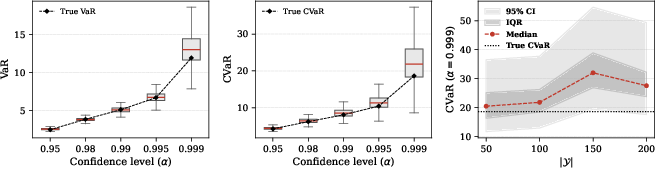
Figure 1: Left: distribution of VaR estimates across confidence levels. Middle: distribution of CVaR estimates across confidence levels. Right: CVaR at α=0.999 as a function of number of angular exceedances, showing estimation stability across thresholds.
Deep Generative Training Diagnostics
The method leverages a standard GAN to estimate the angular law from threshold exceedances, evaluated using random projection Wasserstein diagnostics and Kolmogorov-Smirnov (KS) distances on projected spheres. Model selection is based on early stopping at minimum Wasserstein distance, stabilizing generator performance before discriminator collapse.
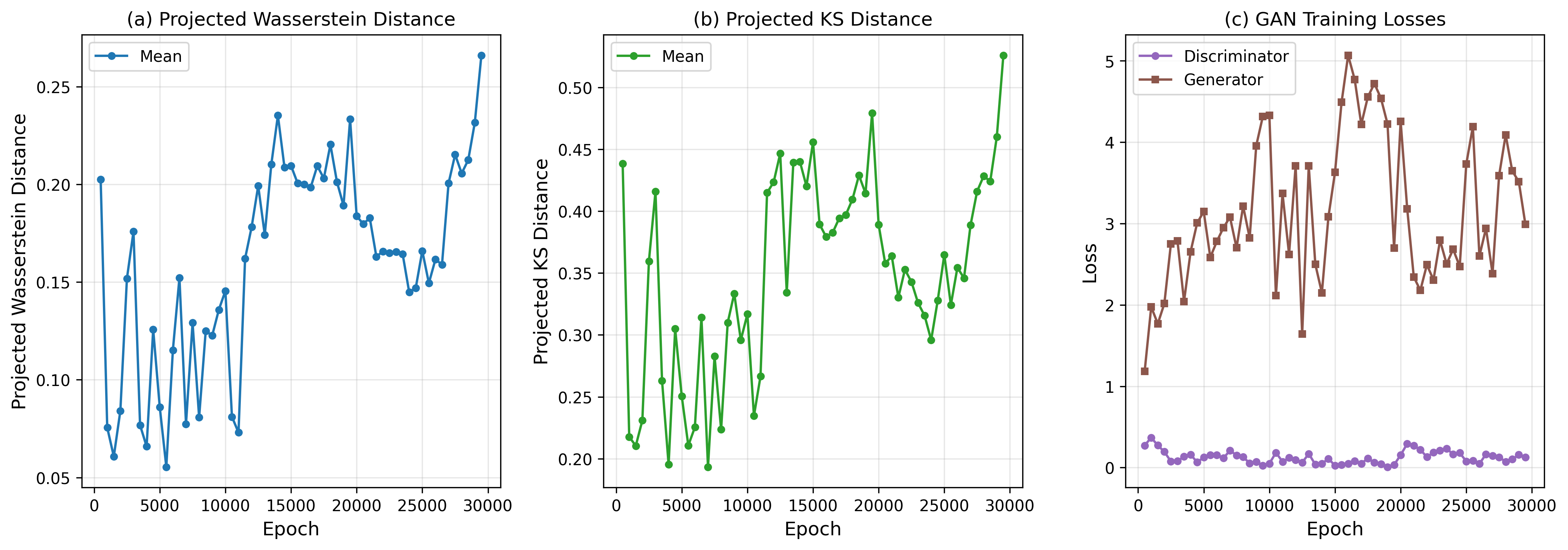
Figure 2: Training diagnostics for the d=10 mixture: mean projected Wasserstein and KS distances, plus generator/discriminator loss evolution.
The empirical results demonstrate that with Λ⋆0 observations and a 90th percentile threshold, SS-GEN delivers median relative VaR and CVaR errors below Λ⋆1 at the 99.9th percentile, with performance robust to the choice of threshold (number of angular exceedances). Increasing the sample size or relaxing the threshold further stabilizes the estimates at extreme quantile levels.
In conditional tail law estimation, SS-GEN’s samples most closely match the true conditional distribution (as measured by KS distances) in both moderate and extreme cases, outperforming finite parametric modeling and naive data-based resampling—which cannot extrapolate reliably into rare regions with no observed data.
Theoretical Properties
- Relative/log-relative error guarantees: For threshold Λ⋆2, the SS-GEN density error vanishes uniformly in relative error (heavy tails) or log-relative error (Weibullian tails).
- Conditional law preservation: Conditioning on rare events (e.g., Λ⋆3) preserves the approximation accuracy, enabling accurate scenario-driven stress testing.
- Nonparametric angular learning: The learning task is compact—angular empirical distributions on the high-dimensional sphere—making nonparametric DGM training feasible at moderate Λ⋆4 and intermediate thresholds.
Practical and Theoretical Implications
SS-GEN enables tail-risk analytics in data-limited, high-dimensional regimes by unifying EVT asymptotics with neural generative models. It addresses a central bottleneck in high-dimensional rare event simulation: the transition from nonparametric tail estimation (which is infeasible for the full density) to parametric angular estimation on the sphere. The framework allows for:
- VaR/CVaR estimation at probabilities far smaller than Λ⋆5
- Stress test generation under realistic dependence structures
- Incorporation of additional covariates or structural tail features via the nonparametric angular DGM
Theoretically, the work provides a bridge between classical EVT and modern generative neural likelihood modeling, offering uniform error guarantees and a clear modularization (analytic radial; learned angular) absent from prior art. It elucidates the conditions under which standard DGMs—without architectural tailoring—are sufficient for tail event learning, provided the correct structural decomposition is employed.
Future Directions
Anticipated future advances include adaptive threshold selection (choosing Λ⋆6 to optimize statistical and computational trade-offs), extension to broader elliptical and multimodal settings, application of more expressive DGM classes (e.g., diffusion models, spherical normalizing flows), tighter uncertainty quantification for finite samples, and large-scale applications to climate extremes, system reliability, and financial risk estimation. Handling directional instability, mixture tails, or regime shifts remains an open challenge.
Conclusion
This paper presents a rigorous, practically implementable methodology for tail event simulation and probability estimation in both heavy- and light-tailed regimes, reducing high-dimensional tail learning to a tractable, nonparametric compact domain task. The approach is grounded in sharp asymptotic theory, comes with formal error analysis, and is validated by robust empirical performance in high-risk estimation tasks. SS-GEN sets a clear methodological benchmark for principled deep learning of extreme event laws (2607.10700).