- The paper introduces a depth-efficient variational quantum algorithm using Pauli Correlation Encoding to estimate Betti numbers, reducing circuit depth compared to QPE.
- It employs Takens' embedding and Vietoris–Rips complexes to extract multiscale topological features from S&P 500 log returns, validated with classical methods.
- The approach shows robust noise tolerance and predictive power for market crises while highlighting challenges in optimization and regime-specific generalization.
Depth-Efficient Quantum Topological Data Analysis for Regime-Specific Detection of Financial Stress
Introduction
The paper "Depth-Efficient Quantum Topological Data Analysis for Regime-Specific Detection of Financial Stress" (2607.09906) introduces a novel application of Pauli Correlation Encoding (PCE) to quantum topological data analysis (qTDA). By transforming Betti number estimation—a proxy for high-order topological features—into a variational quantum optimization problem over a compressed qubit register, the work aims to alleviate known resource bottlenecks in quantum TDA approaches based on Quantum Phase Estimation (QPE). The primary domain of application is financial stress detection, focusing on regime shifts in equity markets, where topological signatures, derived from Takens-embedded S&P 500 return time series, offer non-local information missed by classical volatility metrics.
Methodology and Pipeline
The proposed pipeline comprises four main stages: Takens' delay embedding, Vietoris–Rips complex construction, combinatorial Laplacian construction, and quantum Betti estimation.
First, S&P 500 log returns are embedded with optimal parameters (τ=13, m=4) into a point cloud in R4, based on mutual information and False Nearest Neighbors criteria. The windowed embedding forms the basis for Vietoris–Rips complex construction at carefully selected thresholds to extract multiscale topology robustly across noisy financial signals.
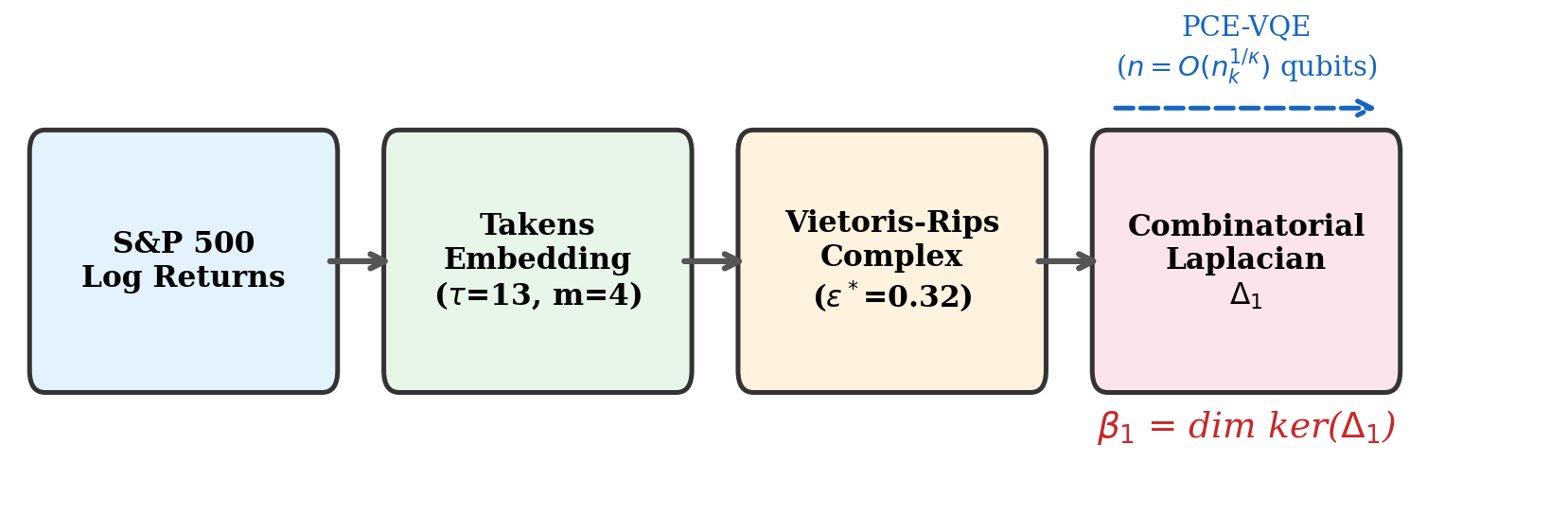
Figure 1: Overview of the qTDA pipeline with PCE qubit compression—(1) S&P 500 log returns to Takens embedding, (2) Vietoris--Rips filtration to point cloud, (3) combinatorial Laplacian assembly, (4) PCE encoding and variational optimization yielding estimated Betti number β~1.
The combinatorial Laplacian (Eq. 1) encodes topological information, where the first Betti number β1 counts non-contractible loops, a proposed harbinger of systemic instability in market dynamics. For each window (npts=461), Laplacians of sizes nk∈[31,429] are generated.
PCE is then employed: Rather than mapping the Laplacian to a q=⌈log2nk⌉-qubit space (as in LGZ-QPE), nk simplex indices are encoded into O(nk1/κ) qubits (e.g., quadratic PCE with m=40 or cubic PCE with m=41) via m=42-body Pauli correlators. The ansatz is variationally optimized such that the resulting Rayleigh quotient of the encoded state approximates the null space of the Laplacian.
Benchmarks: Classical Validation and Topological Sensitivity
The pipeline's classical block, comprising exact eigensolution (CE) and the established persistent homology software ripser, is validated exhaustively: Across 190 sliding windows spanning 2003–2010, CE and ripser agree exactly on both m=43 and m=44, reproducing key features from Gidea & Katz (2018). Notably, a rise in m=45 precedes the Bear Stearns and Lehman Brothers shocks, demonstrating the anticipatory capacity of topological loop formation over naïve volatility measures.
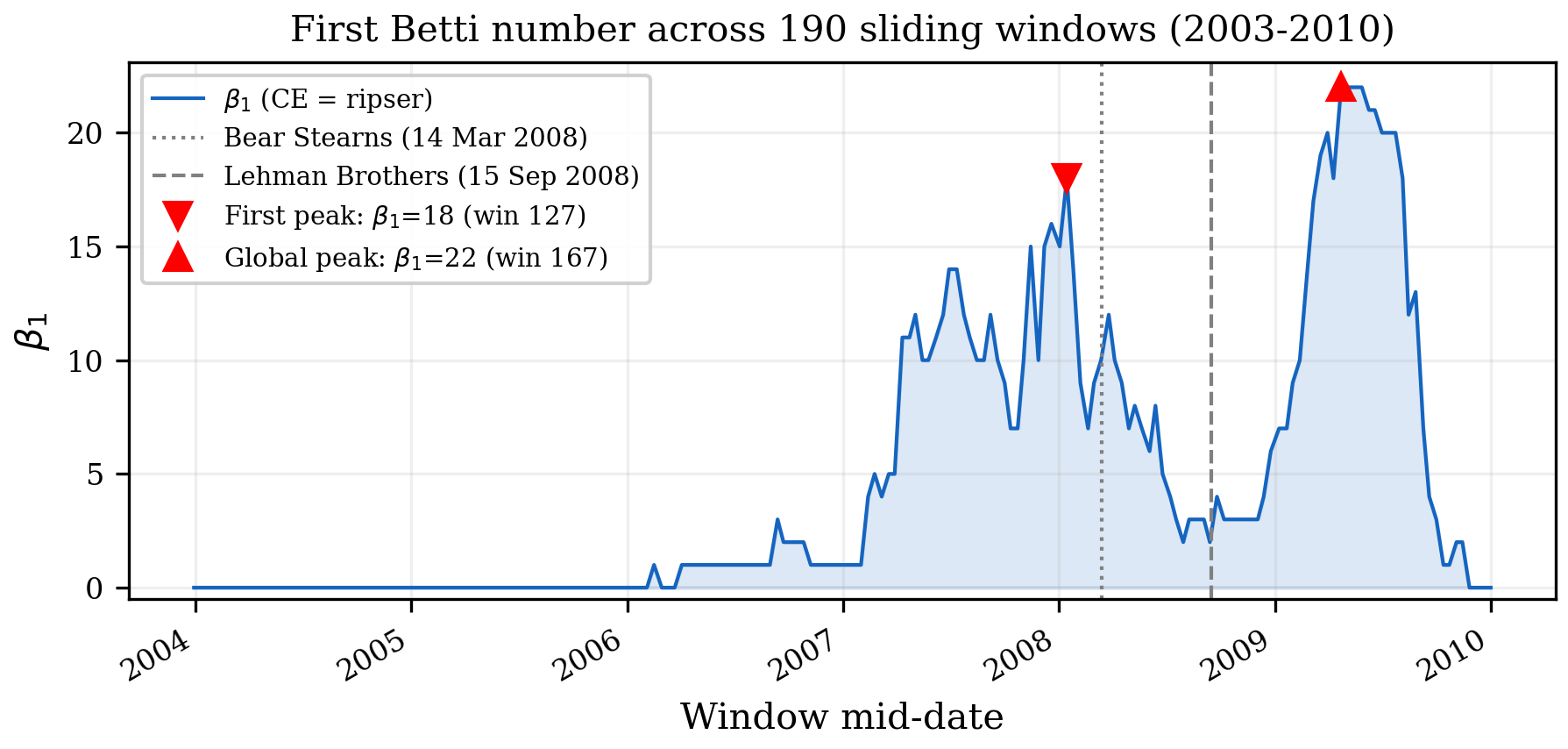
Figure 2: First Betti number m=46 over 190 sliding windows, showing time evolution in relation to market crises; vertical lines denote Bear Stearns and Lehman Brothers events.
PCE-VQE Quantum Protocol: Validation and Scaling
On synthetic Laplacians (toy graphs with m=47–m=48), quadratic PCE recovers the exact Betti number with high precision (m=49 for null vectors, abrupt jump otherwise), validating the variational protocol and deflation scheme at moderate null-space multiplicity.
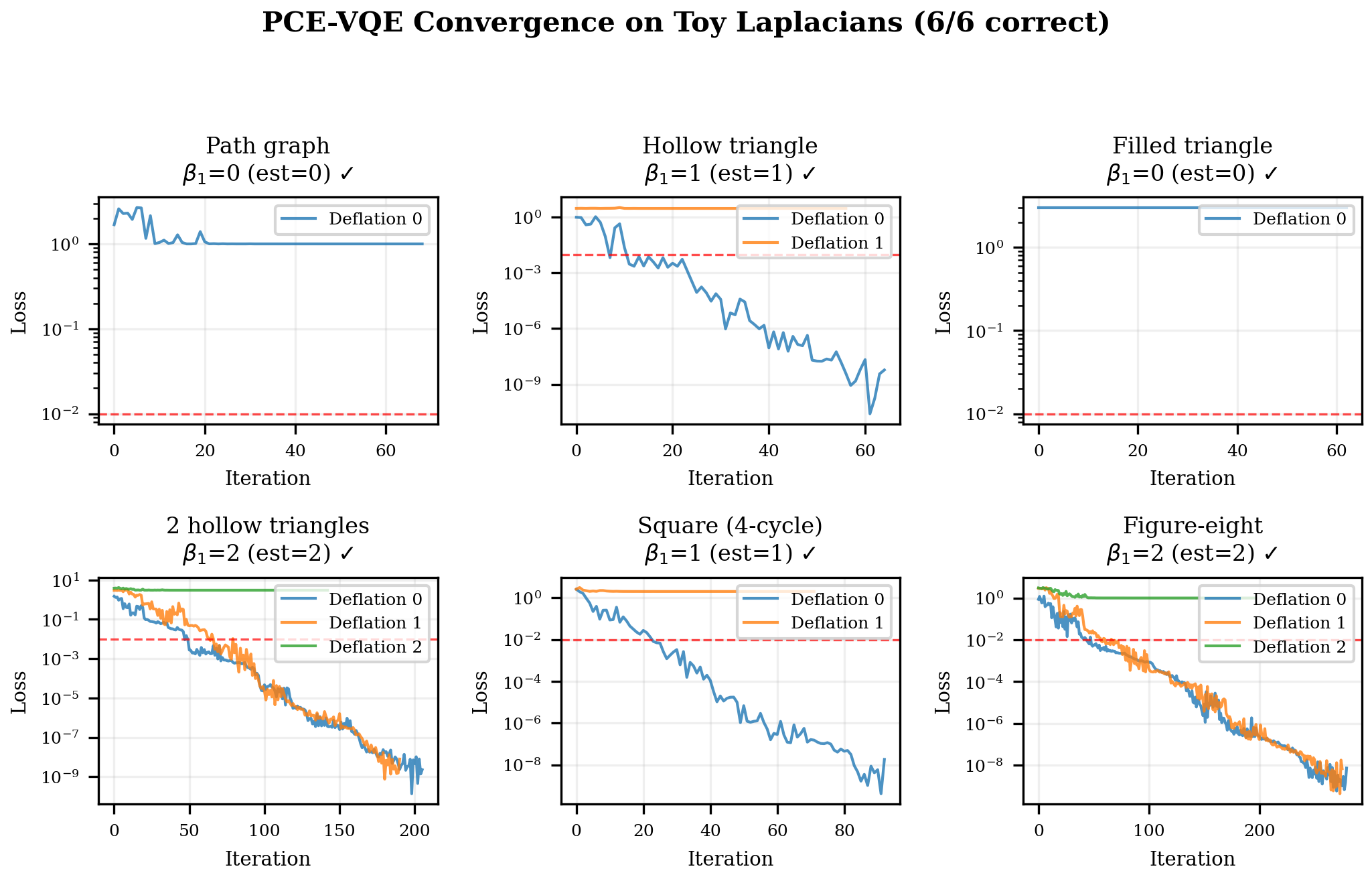
Figure 3: PCE-VQE convergence for six toy Laplacians, with each color corresponding to a deflation round and the red dashed line marking the null-space threshold.
Scaling analyses detail the trade-off versus QPE-based algorithms: PCE with R40 uses R41 qubits and R42 circuit depth, compared to R43 qubits but exponentially greater depth for LGZ-QPE. Analytical cost extrapolations predict a crossover regime (R44) where PCE attains parity with classical exact diagonalization, with ancillary-free, shallow circuits making it hardware-amenable.
Optimization Landscape, Trainability, and Warm-Start Strategy
Real S&P 500 Laplacians (R45–R46, R47–R48) surface a critical bottleneck: While the PCE encoding is demonstrably expressive enough to represent null vectors (as verified by exact-gradient optimization and classical warm-start), random-start optimization with a hardware-efficient ansatz fails, never entering the null space. The limitation thus lies not in the encoding per se, but in the complexity of the variational landscape induced by the ansatz at moderate size and high nullity.
Empirical gradient variance analysis up to R49 qubits under the full Rayleigh-quotient loss (outside proven PCE plateau-avoidance regimes) corroborates only polynomial decay, with no evidence of exponential barren plateaus seen in generic hardware-efficient VQE circuits.
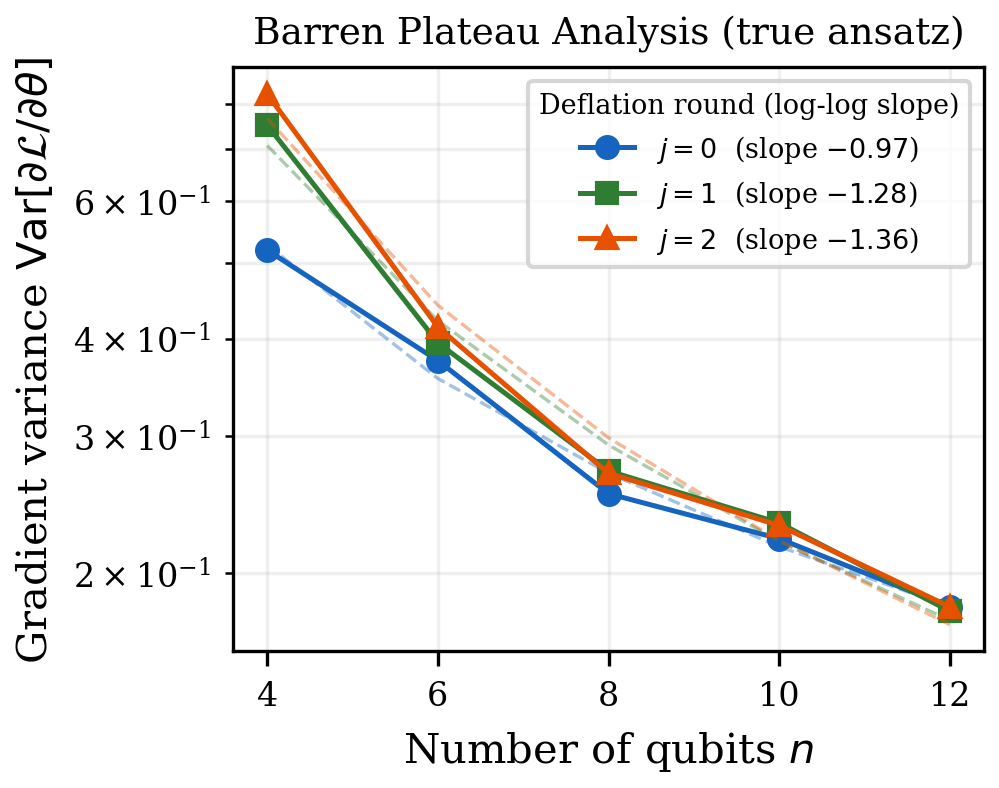
Figure 4: Gradient-variance scaling for PCE Rayleigh-quotient loss shows only polynomial decrease in variance, supporting empirically robust trainability for small to moderate register sizes.
A critical finding is that optimization can be rescued by initializing from a classically extracted null-space surrogate, yielding perfect convergence for all tested values of β~10 (up to β~11). This makes the present protocol classical-quantum hybrid. Improvement of quantum-native warm starts or problem-informed ansatze is identified as a primary avenue for future independent quantum Betti estimation.
Noise Robustness and Depth Advantage
Simulations establish that PCE-VQE circuits, by virtue of their shallow depth, endure significantly higher per-gate error rates before accuracy collapses, compared to QPE-based Betti estimation, which degrades rapidly even at modest noise levels.
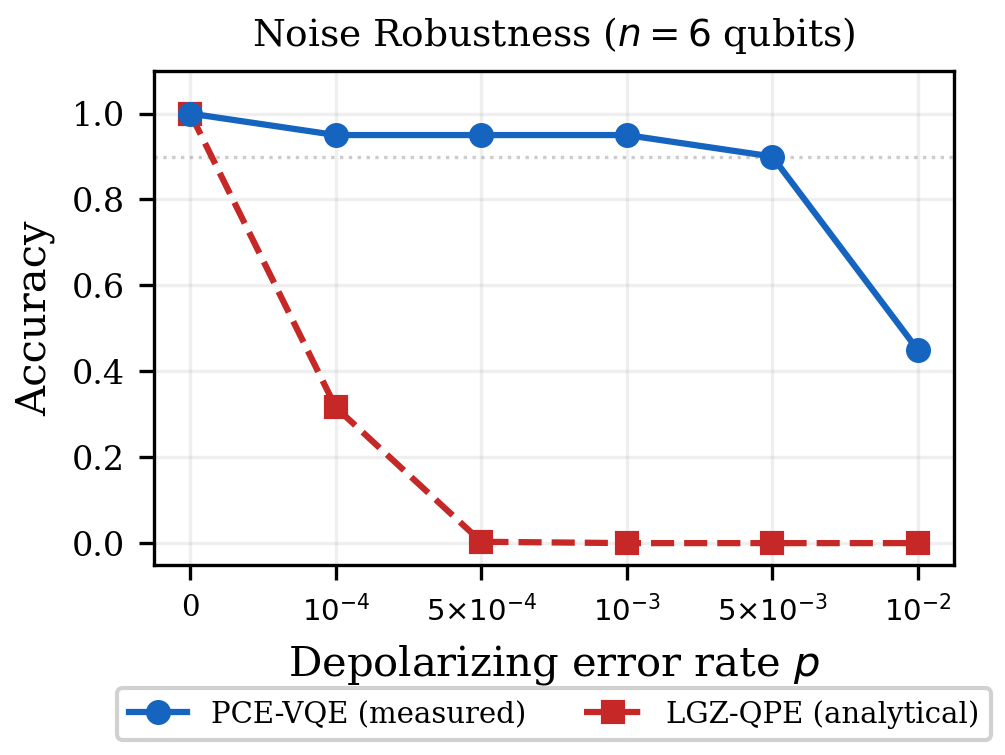
Figure 5: Noise robustness comparison—PCE-VQE maintains β~1290\% accuracy through β~13 per-gate error, while LGZ-QPE accuracy sharply collapses, a function of circuit depth rather than matched problem size.
Application to Market Crash Detection
Deploying the β~14 time series as a classifier of systemic risk on a chronological split achieves ROC AUC of β~15 in-regime, outperforming classical volatility proxies. However, out-of-distribution generalization fails: During the 2020 COVID shock, the pre-trained threshold yields inverted performance (AUC 0.009), indicating strong regime dependence of the topological indicator.
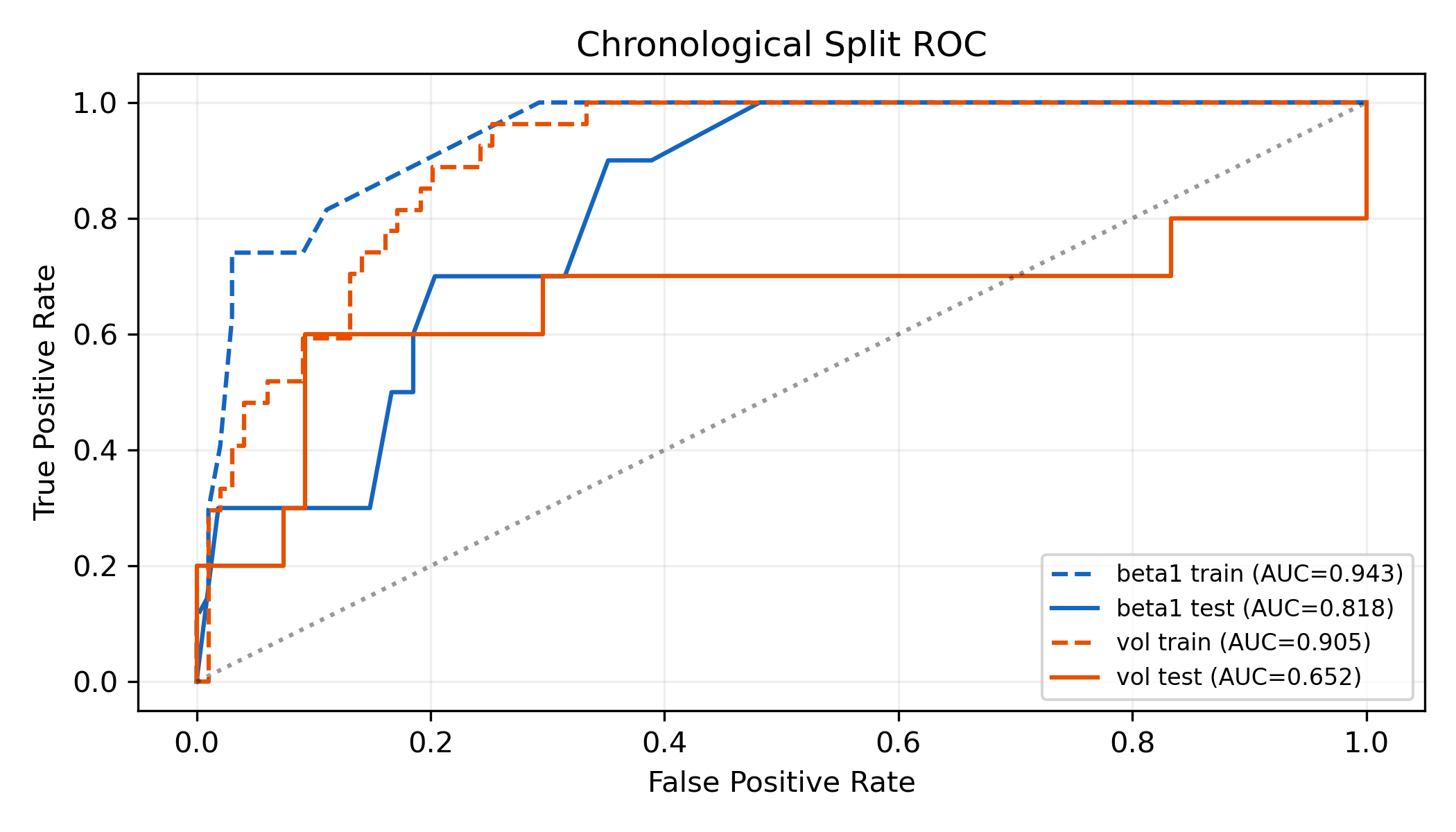
Figure 6: ROC curves for β~16 and volatility-based classifiers, highlighting in-regime utility but generalization failure across fundamentally distinct crises.
Implications, Limitations, and Future Directions
This work demonstrates that a depth-efficient, variational quantum approach can encode and optimize for topological invariants central to TDA, with circuits amenable to early fault-tolerant or advanced NISQ hardware. The main practical limitations are linear scaling of deflation rounds with β~17 (not viable for large null spaces), lack of a formal trainability guarantee for rational-loss PCE variants, and failure of random-start optimization on hard instances.
Theoretically, the work highlights the delicate balance between parameterization and expressivity in variational quantum protocols, and points to the need for quantum-native strategies to traverse barren or rugged landscapes in high-multiplicity spectral problems. Practically, the findings stress that the informativeness of topological signals such as β~18 is contingent on the stress regime—universal classifiers would require dynamic or regime-aware calibration.
Looking forward, critical directions include: (i) subspace-based quantum methods for simultaneous null-space discovery, (ii) regime-sensitive classifier construction, (iii) rigorous expressivity and gradient analysis of continuous-PCE loss, and (iv) hardware execution at the cost-crossover scale.
Conclusion
The paper operationalizes, for the first time, the adaptation of Pauli Correlation Encoding to quantum TDA, achieving Betti-number estimation in market data via shallow, ancilla-free circuits with empirically favorable trainability. While the method demonstrates classical-quantum hybrid recovery at real-data scales and strong classical validation, the absence of robust quantum-only optimization at high nullity and lack of universal classifier generalization remain as open scientific and engineering challenges. The introduced methodology charts a research direction for depth-efficient quantum TDA, with immediate implications for financial regime detection and the broader quantum machine learning landscape.