- The paper presents a fully quantum, measurement-free residual architecture using a messenger qubit to mitigate barren plateaus in variational circuits.
- It demonstrates up to a 10-fold improvement in convergence efficiency and maintains high gradient variance, even as qubit counts increase.
- The study shows that quantum residual connections preserve circuit expressibility while yielding smoother, more trainable loss landscapes.
Q-LINK: Residual Quantum Circuits via Messenger Qubit for Barren Plateau Mitigation
Introduction and Motivation
The performance of variational quantum algorithms (VQAs) is dramatically constrained by the barren plateau phenomenon: vanishing gradients obstruct circuit training as the system size or depth increases, limiting scalability on present and near-future NISQ architectures. Numerous approaches have sought to address this limitation, ranging from tailored ansätze to neural network-inspired parameter initializations. Recent proposals have utilized residual connections, similar to ResNets in classical deep learning, to alleviate gradient suppression, but often at the expense of quantum coherence due to intermediate measurements. The present work, "Q-LINK: Quantum Layerwise Information Residual Network via a Messenger Qubit for Barren Plateaus Mitigation" (2604.11831), introduces a fully quantum, measurement-free residual architecture leveraging a single messenger qubit. This mechanism promotes layerwise information flow across the circuit, reshaping the optimization landscape and enabling significantly more efficient convergence.
The Q-LINK Architecture
Q-LINK augments standard variational circuits (“Vanilla”) by incorporating a messenger qubit that mediates residual connections between layers, drawing direct inspiration from classical residual neural networks. Instead of relying on measurement-based information merging, information collected from data qubits is accumulated and then redistributed coherently via quantum operations.
The process entails two stages at every layer: (1) collection—the messenger qubit interacts with each data qubit through Rxx gates, enabling entanglement and information transfer; (2) distribution—after standard parameterized layers, the messenger qubit redistributes information to data qubits via CNOT gates. This cycle forms an identity-like information pathway, facilitating efficient backpropagation through the entire quantum circuit.
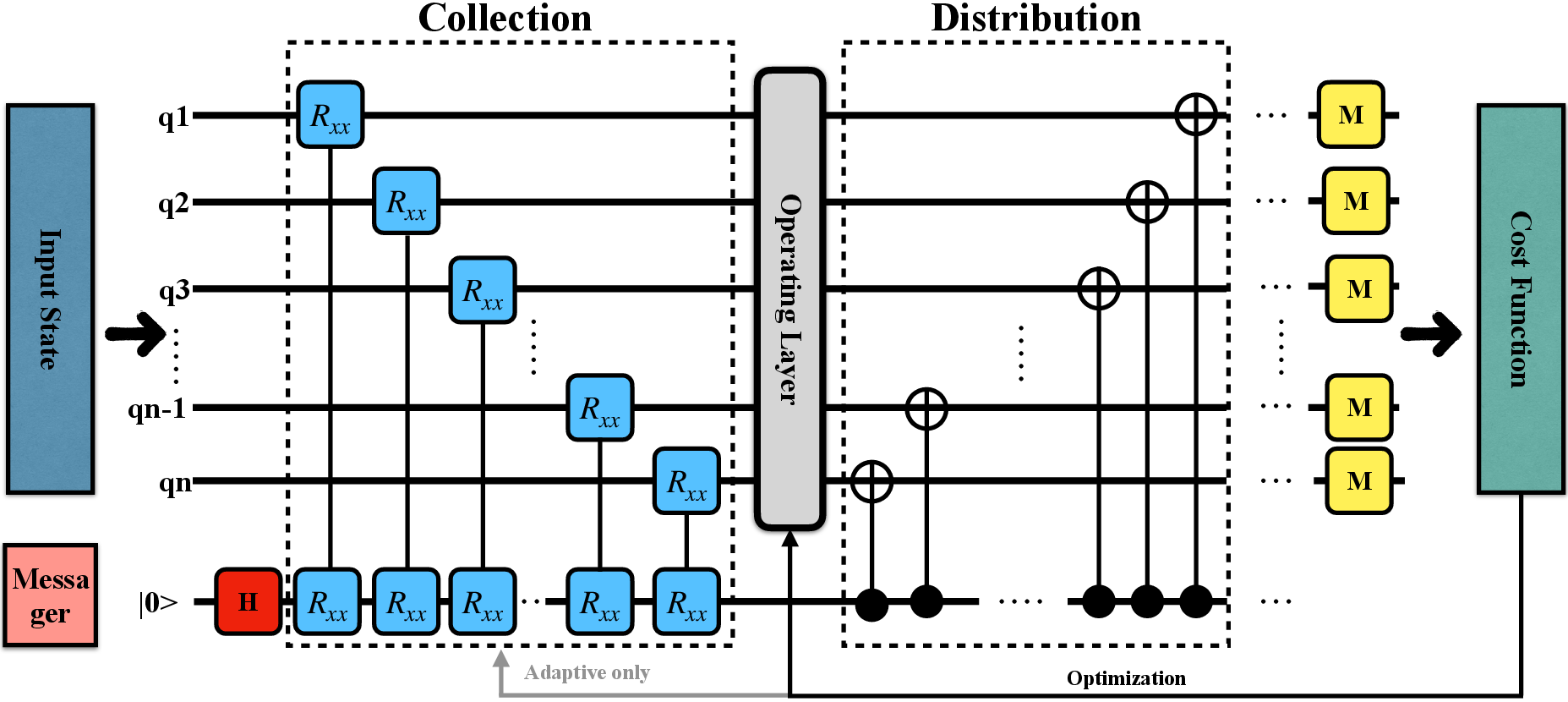
Figure 2: Detailed model structure of the Q-LINK, showing collection and distribution phases mediated by a single messenger qubit.
Q-LINK admits two main variants: Q-LINK (Fixed), where collection parameters are set to π/4, and Q-LINK (Adaptive), where they are optimized dynamically. Both paradigms preserve circuit unitarity and coherence throughout, thus maintaining the full quantum advantage and avoiding decoherence from mid-circuit measurements.
Numerical Evaluation and Results
The study systematically evaluates Q-LINK against standard variational circuits (Vanilla) on ground-state preparation tasks, using random initial quantum states over systems ranging from 5 to 10 qubits (including the messenger qubit). All circuits were initialized to guarantee the pronounced onset of barren plateaus in the baseline. Optimization employed stochastic gradient descent.
Empirical results demonstrate that both Q-LINK models achieve substantially faster convergence than the baseline. Q-LINK (Fixed) achieves up to a 10-fold improvement in convergence efficiency compared to Vanilla circuits, sustaining performance gains as the number of qubits increases. Notably, Q-LINK maintains convergence even for system sizes where Vanilla circuits fail due to severe gradient suppression.
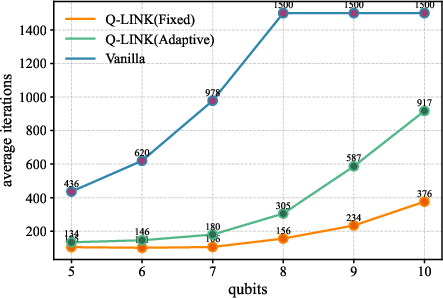
Figure 4: Average number of optimization iterations required for convergence across qubit numbers, showing the clear advantage of Q-LINK (both Fixed and Adaptive) models versus Vanilla.
Further analysis of the training dynamics exposes the core advantage: the messenger-qubit-enabled residual pathway preserves significantly higher gradient variance (up to two orders of magnitude greater), resulting in a more favorable optimization landscape. Visualizations of the loss surfaces reinforce this interpretation—the Q-LINK loss landscapes are smoother and exhibit fewer local minima near optima, in contrast to the highly fragmented, rugged profiles of the Vanilla circuits for larger qubit counts.
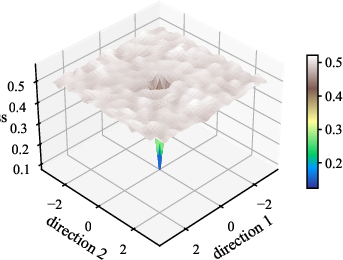
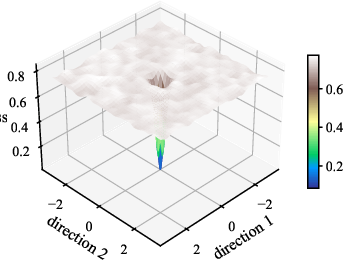
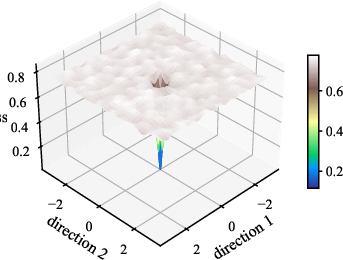
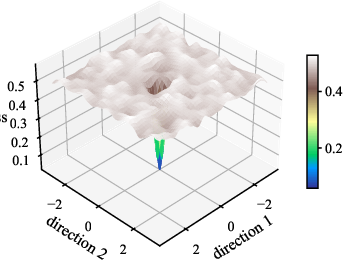
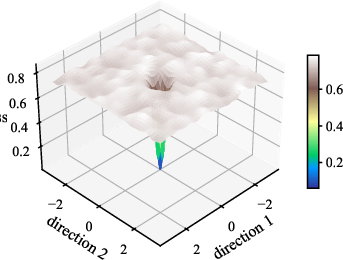
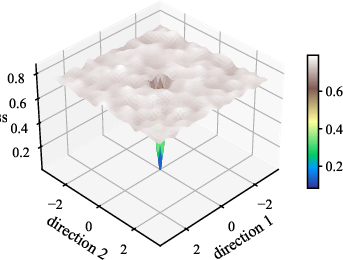
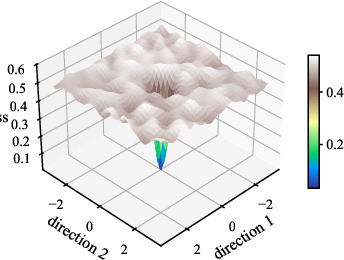
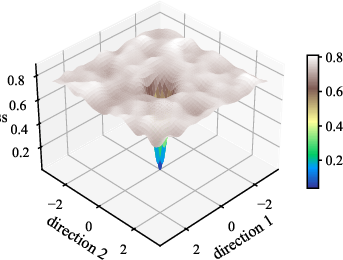
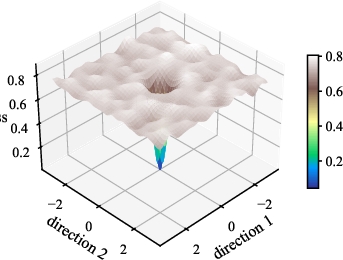
Figure 1: Loss landscape for Vanilla model with 10 qubits, characterized by numerous local minima and plateaus representative of poor trainability.
For Q-LINK, in contrast to the above:
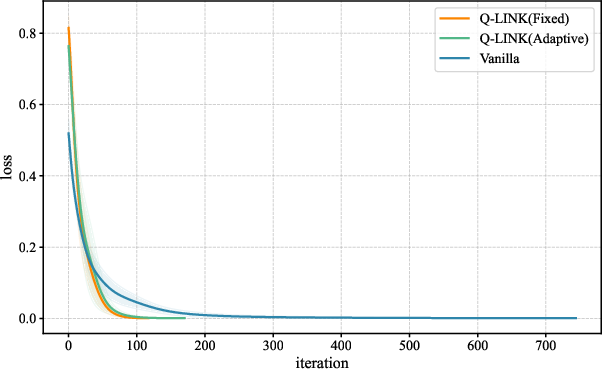
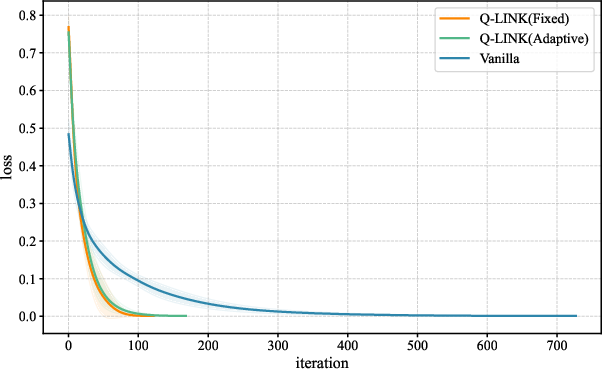
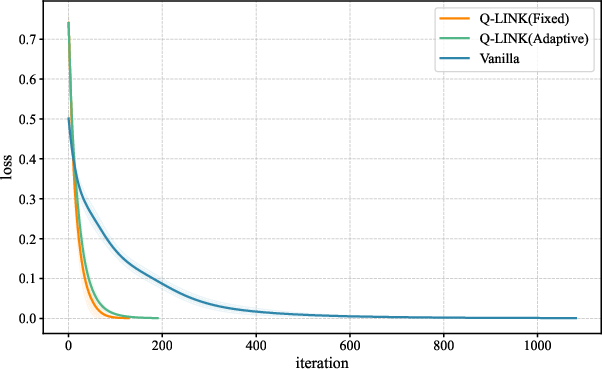
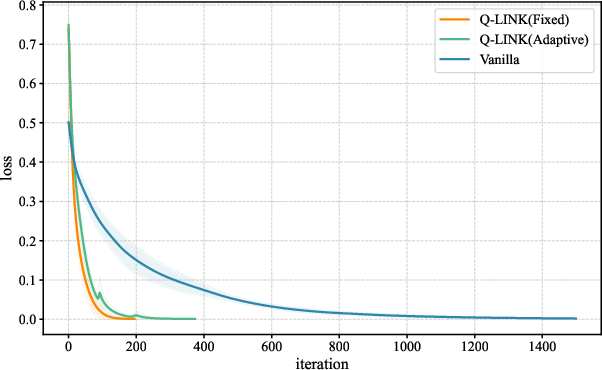
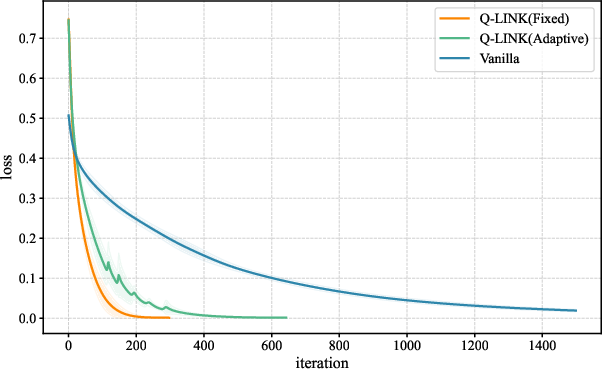
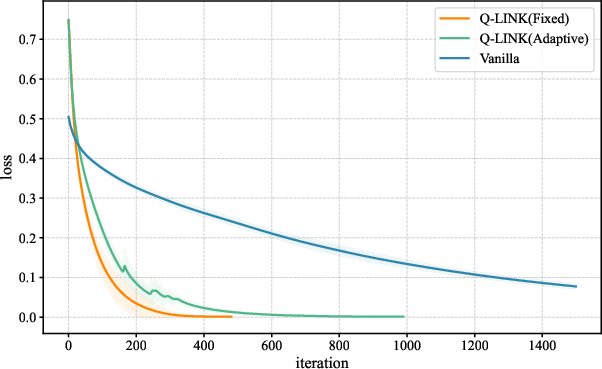
Figure 6: Loss landscape for Q-LINK (Fixed) model with 10 qubits, revealing a smoother landscape near the optimum, indicative of mitigated barren plateau effects.
Importantly, expressibility (quantified via KL-divergence from the Haar measure) remains statistically unchanged across all models and system sizes. This rules out trivial explanations—Q-LINK does not simply achieve better trainability by lowering circuit expressivity.
Theoretical and Practical Implications
This work provides a compelling demonstration that residual-inspired architectures can be realized in fully quantum settings without compromising circuit coherence, a foundational requirement for practical quantum algorithm design. By enabling large gradient variance and smoother optimization surfaces while preserving expressibility, the Q-LINK mechanism offers a scalable template for VQAs under NISQ constraints.
Layerwise residual connections via quantum ancillas (messenger qubits) generalize classical deep learning heuristics to the quantum domain, hinting at new circuit design principles for deep quantum models. This is especially relevant for quantum-enhanced optimization, quantum chemistry, and potentially for quantum neural network architectures, whenever the landscape of the cost function is a critical bottleneck.
The observation that a single messenger qubit suffices to significantly mitigate barren plateaus—without sacrificial measurements or circuit splitting—opens possibilities for efficient scaling in practical hybrid quantum-classical workflows.
Future Directions
Several compelling avenues for future study arise from this work:
- Extending Q-LINK to larger, deeper circuits with even higher qubit counts, and benchmarking under realistic noise models of current NISQ devices.
- Applying the Q-LINK framework beyond ground-state preparation, e.g., to quantum classifiers or VQE for quantum chemistry and combinatorial optimization.
- Investigating more complex messenger-qubit interaction protocols or multi-ancilla residual architectures for further scalability and robustness.
- Exploring integration of Q-LINK with classical-quantum co-design, e.g., adaptive learning-rate schedules or hybrid control policies synergistic with quantum residual pathways.
Conclusion
Q-LINK introduces a robust, physically coherent mechanism for mitigating barren plateaus in variational quantum algorithms by leveraging a single messenger qubit to implement residual-like information pathways. This architecture retains the full expressibility of parameterized quantum circuits, enables faster and more reliable convergence, and substantially increases gradient variance for circuits at scales where standard VQAs stall. The demonstration that quantum residual connections can be implemented coherently, with practical and theoretical benefits for trainability, presents a promising direction for scalable, deep quantum algorithm design (2604.11831).