- The paper introduces a classical-quantum proxy matrix to eliminate auxiliary qubits, enabling dense CVaR optimization with a strict asset-to-qubit mapping.
- It demonstrates that WS-QAOA achieves high expressibility but suffers from deep circuit routing overhead and decoherence, while HE-VQNN maintains shallow circuits at the cost of accuracy.
- Empirical analysis on IBM’s heavy hex hardware quantifies the trade-off between quantum circuit expressibility and hardware coherence, underscoring limits on NISQ devices for dense QUBO problems.
Quantum Algorithmic Resilience in CVaR Portfolio Optimization: Expressibility vs. Coherence
Introduction
The study "Benchmarking Quantum Algorithmic Resilience for CVaR Portfolio Optimization: The Expressibility-Coherence Trade-off" (2606.07727) rigorously investigates the operational trade-offs between two prominent quantum optimization paradigms for dense financial applications under Conditional Value at Risk (CVaR) constraints. Specifically, it benchmarks a Hardware Efficient Variational Quantum Neural Network (HE-VQNN) against Warm Start Quantum Approximate Optimization Algorithm (WS-QAOA) on IBM's heavy hex superconducting quantum hardware. The analysis is grounded in a hybrid portfolio objective combining Markowitz mean-variance and CVaR measures, focusing on the limitations imposed by hardware connectivity and algorithmic expressibility on Noisy Intermediate Scale Quantum (NISQ) devices.
Tail-Risk Portfolio Optimization Landscape
Robust portfolio optimization in contemporary financial markets requires not only maximizing expected return but managing systemic risk under extreme, non-Gaussian asset co-movements. CVaR provides a coherent tail-risk metric superior to traditional Value at Risk (VaR), allowing portfolios to be optimized for adverse market regimes using convex programming. However, integrating a hybrid mean-variance and CVaR objective results in a dense Quadratic Unconstrained Binary Optimization (QUBO) problem with an exponentially scaling solution space.
Modern quantum approaches aim to exploit quantum parallelism for such NP-Hard problems, mapping the QUBO onto an Ising Hamiltonian that can, in principle, be solved by algorithms such as QAOA or VQE. In practice, the transformation introduces severe hardware demands due to the required all-to-all qubit connectivity for dense asset graphs, which is fundamentally incompatible with the sparse connectivity of physical hardware such as IBM's heavy hex topology.
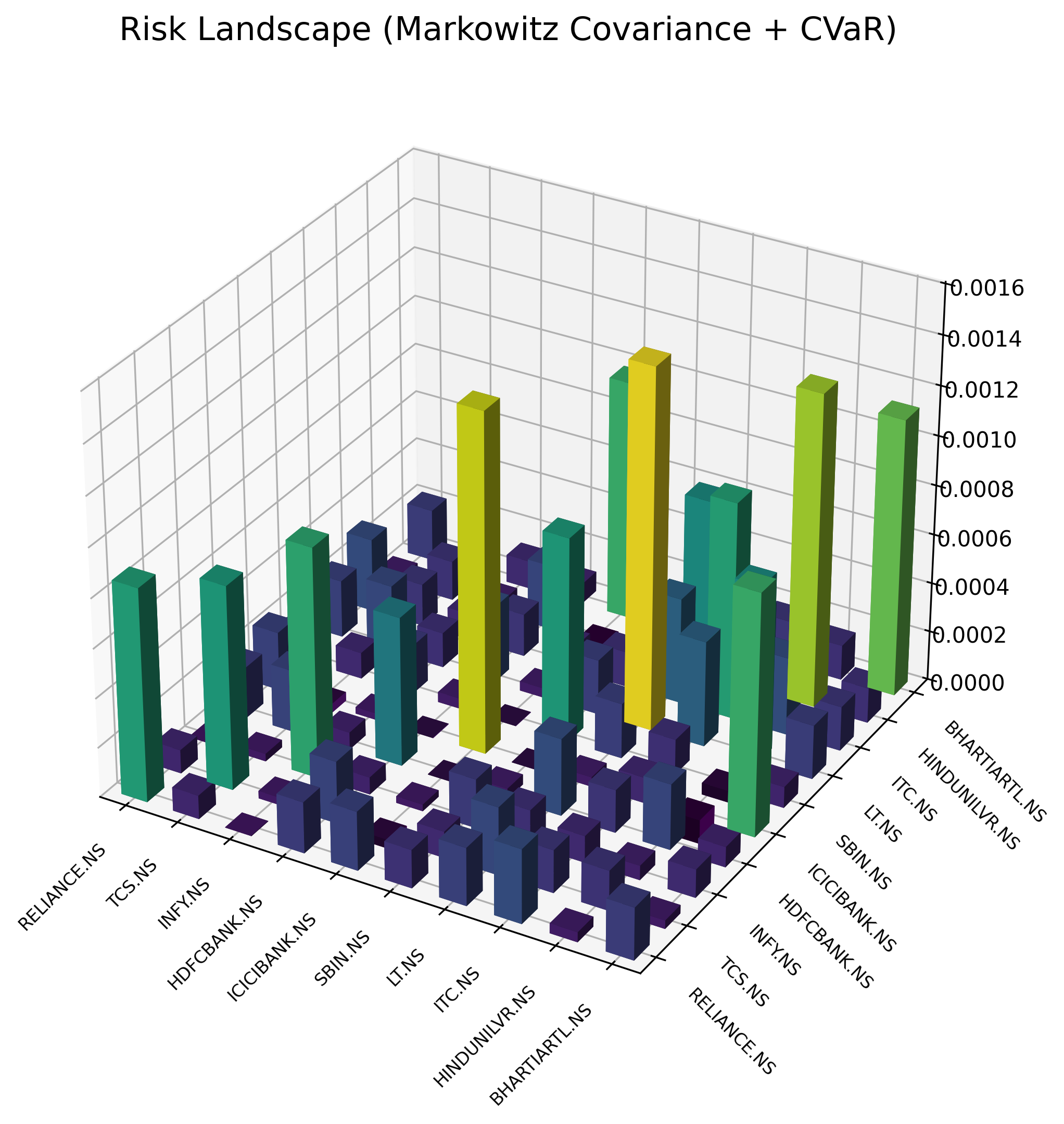
Figure 1: 3D visualization of the hybrid Markowitz CVaR risk landscape Σhybrid reflecting dense tail-risk asset correlations.
Circumventing the Auxiliary Qubit Bottleneck
Canonical CVaR quantum formulations require explicit representation of slack and threshold auxiliary variables, causing an infeasible rapid increase in qubit count: portfolios with moderate asset counts and precision quickly demand thousands of logical qubits. This study introduces a critical methodological innovation: a classical-quantum hybrid proxy matrix technique. By isolating worst-case (tail) market regimes and calculating the corresponding dense covariance submatrix classically, the authors achieve a QUBO representation that encodes deep tail-risk information but maintains a strictly asset-to-qubit mapping, eliminating the need for auxiliary qubit registers.
This approach enables mapping dense financial models onto NISQ processors by integrating the richness of CVaR-driven interactions while avoiding direct discretization with its prohibitive resource explosion. The result is a hybrid risk matrix Σhybrid, characteristically dense, necessitating complete graph embedding for accurate solution representation.
Quantum Algorithmic Strategies on Sparse Hardware
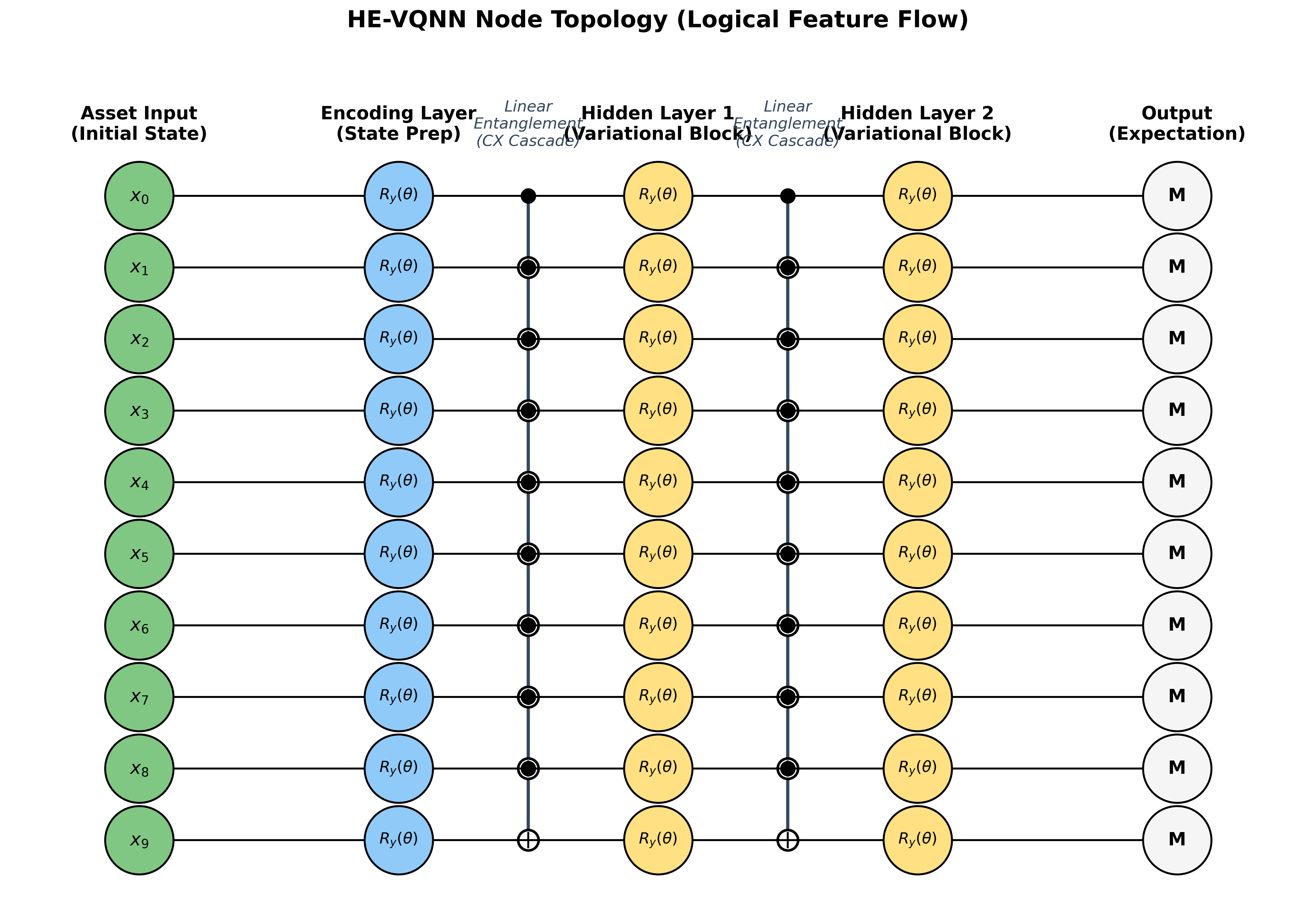
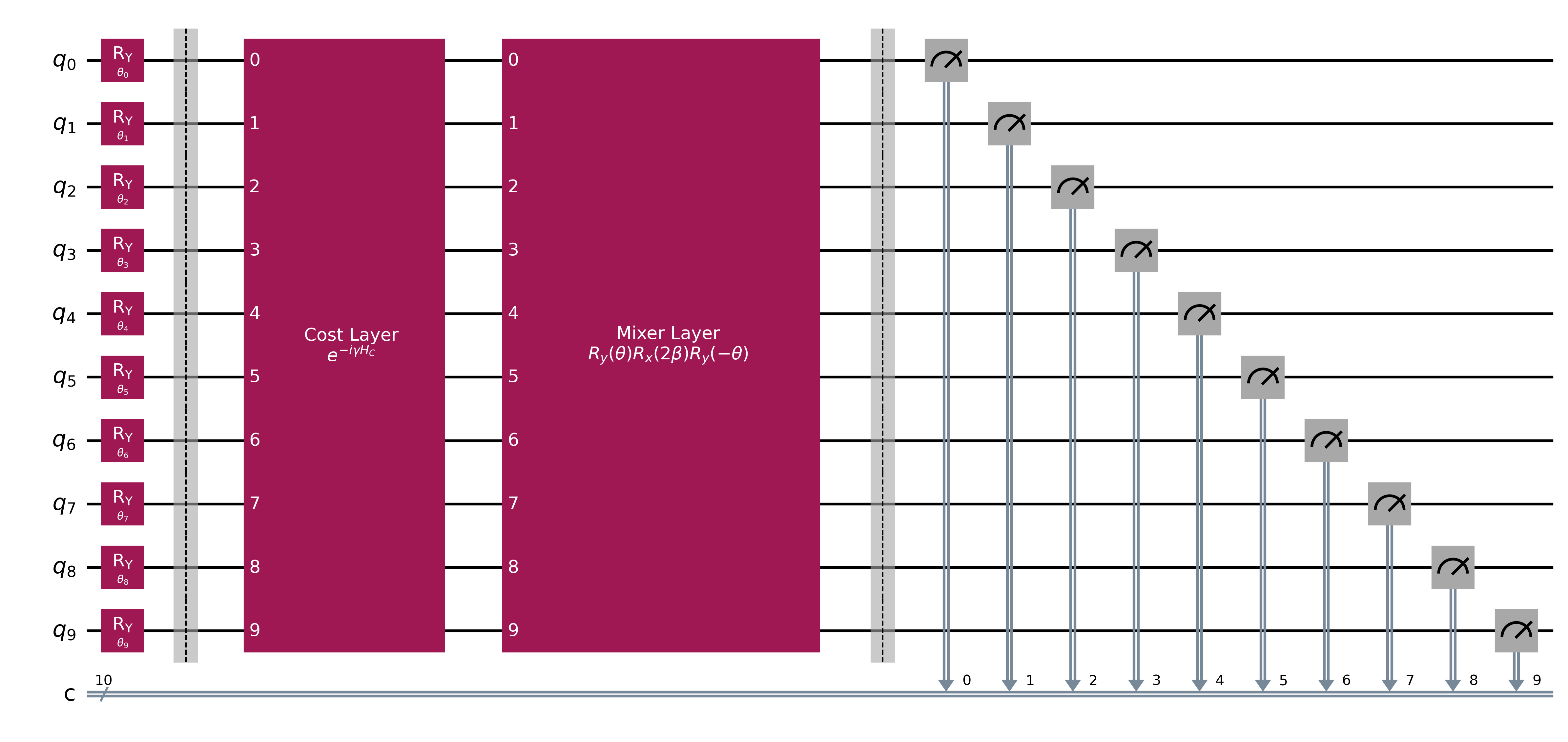
The benchmarking compares two contrasting variational quantum algorithms:
This dichotomy sets the stage for an empirical evaluation of the "Expressibility-Coherence" trade-off: HE-VQNN readily executes shallow circuits at the expense of solution accuracy, while WS-QAOA matches problem expressivity but succumbs to physical decoherence due to deep circuits and extensive routing operations.
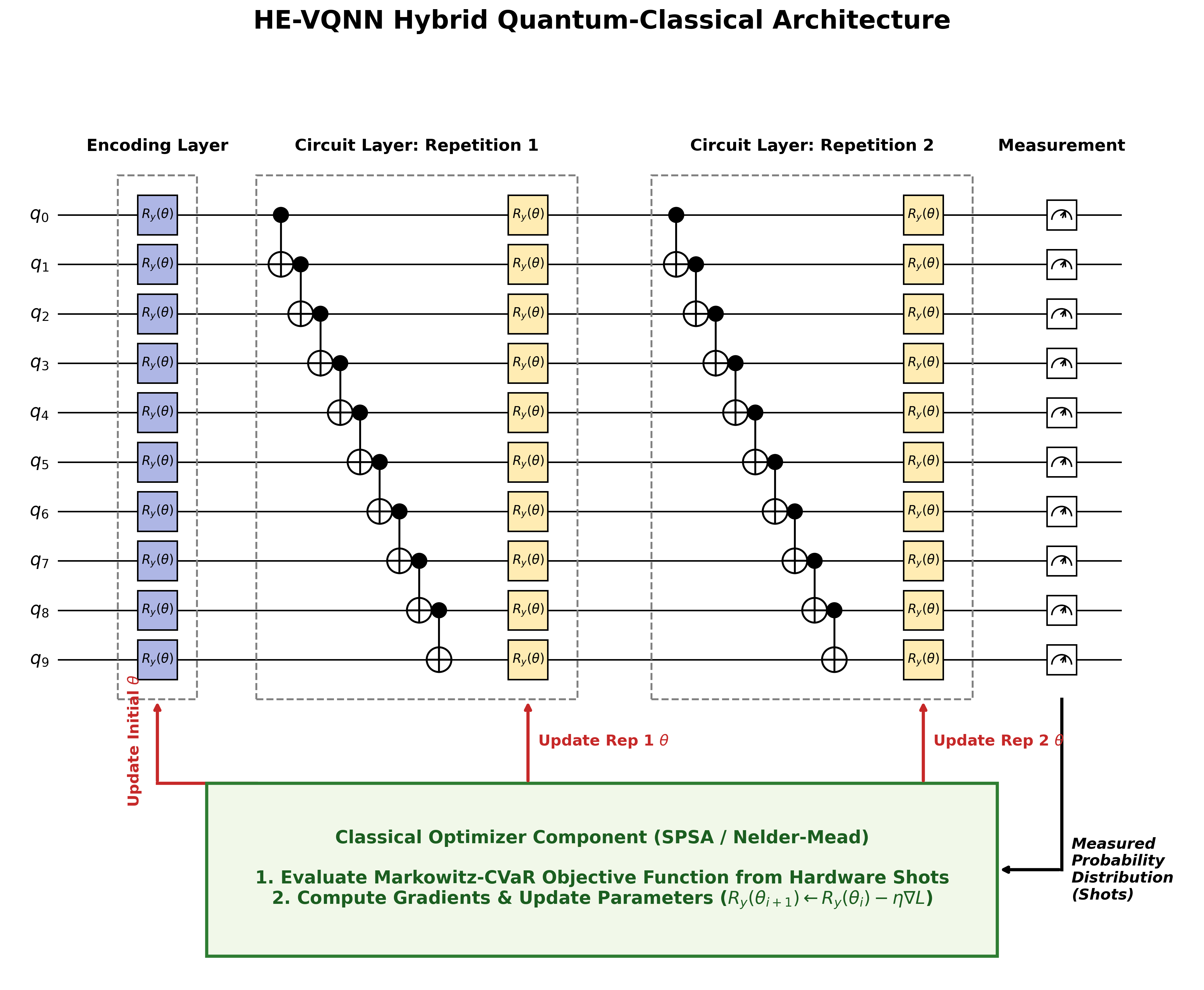
Figure 3: Hybrid quantum-classical feedback architecture for HE-VQNN parameter optimization in a variational loop.
Hardware Resource Scaling and Limitations
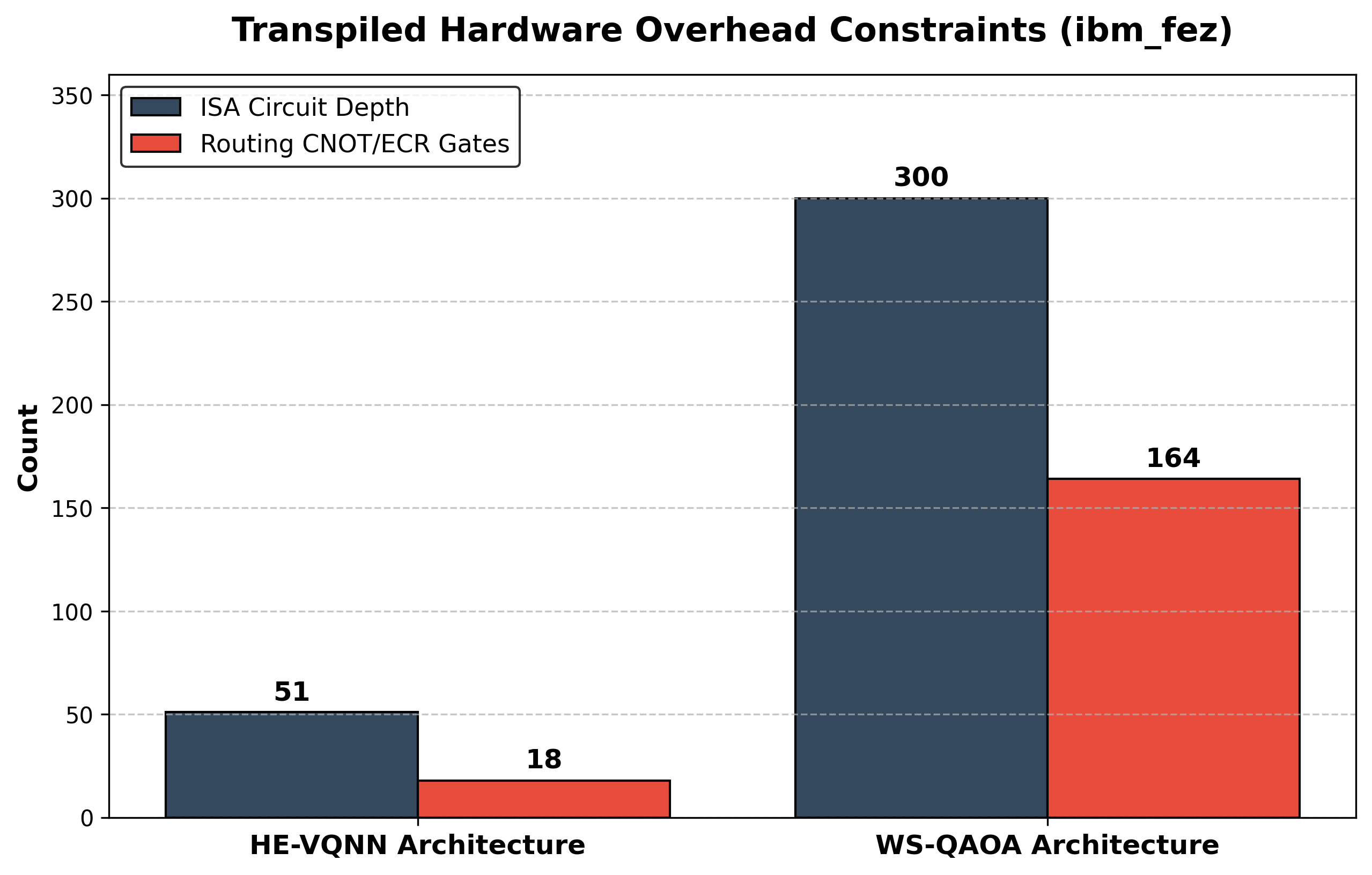
Transpilation and resource profiling of both algorithms on the ibm_fez architecture (127-qubit heavy hex) highlights the key bottlenecks:
At the physical implementation level, WS-QAOA's circuit duration approaches or exceeds the T2 limit, causing attenuation of quantum state fidelity before measurement. HE-VQNN's minimal depth ensures high probability of survival but does not guarantee solution quality for dense QUBOs.
Empirical Hardware Execution and Failure Modes
Execution on the actual ibm_fez QPU revealed starkly different failure pathways:
- HE-VQNN: Despite high hardware fidelity (ESP >95%), the measured output remains spread over many portfolio states, failing to converge to the global optimum. This diagnostic plateau arises from insufficient ansatz expressibility relative to the complexity of the objective landscape. The optimal configuration is not sufficiently represented in the spanned Hilbert subspace.
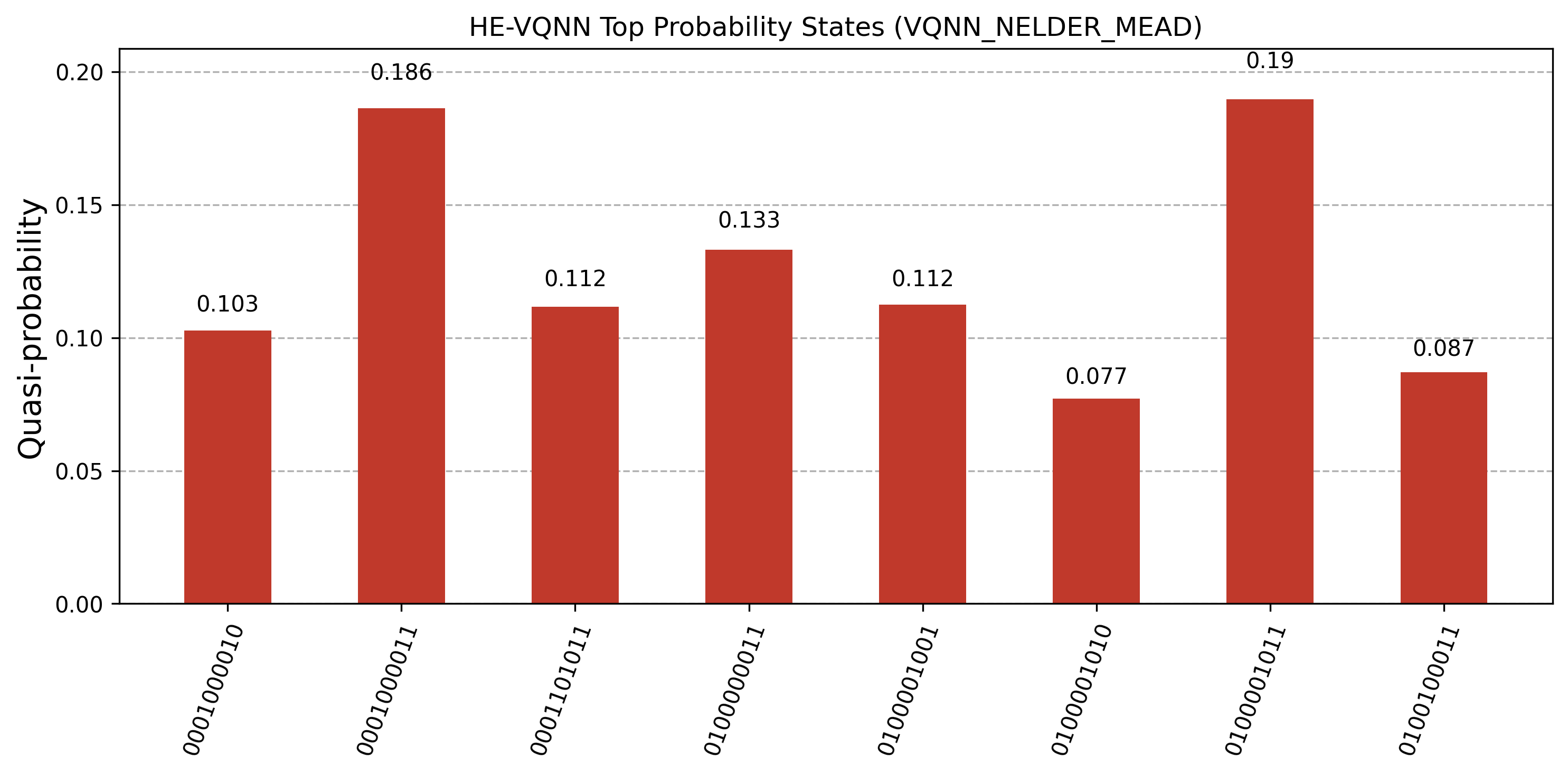
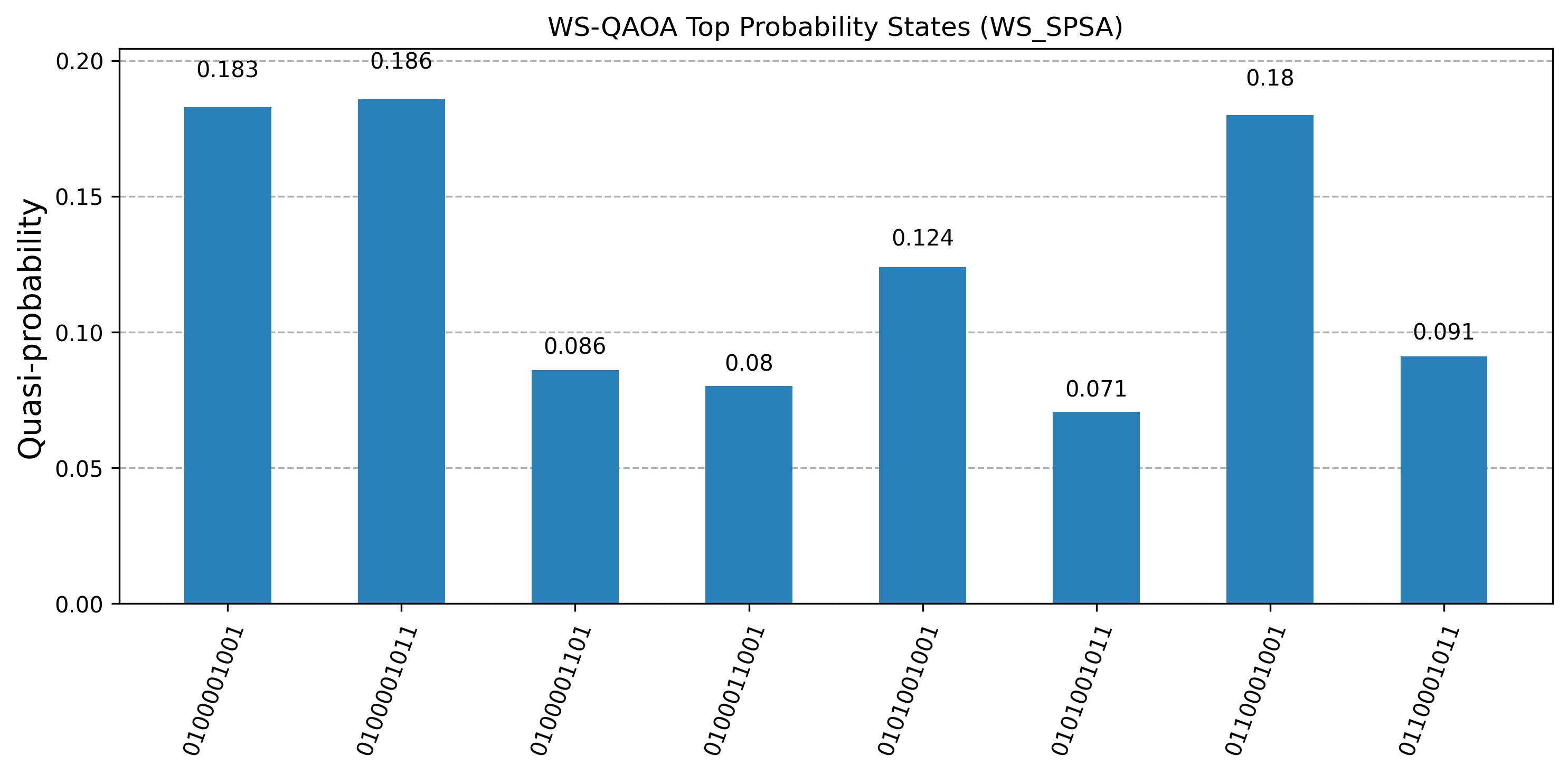
Figure 5: HE-VQNN output state distribution on hardware reveals lack of optimal state concentration due to expressibility limits.
- WS-QAOA: The output state is dominated by uniform noise, exhibiting no significant peak—an outcome entirely attributed to decoherence, which corrupts the solution long before readout. No meaningful optimization signal survives the circuit depth required for dense interaction mapping.
Scaling Analysis: The SWAP Tax and Expressibility Gap
Systematically increasing portfolio assets from 4 to 16 demonstrates that, for both algorithms, critical hardware or expressibility limits cap feasible problem sizes. WS-QAOA's exponential scaling of circuit depth with asset number (reflecting the growth in required pairwise interactions in a complete graph) results in total decoherence and unusable output past 12 assets. HE-VQNN remains feasible at the hardware level but achieves steadily worse energy approximation, diverging from classical ground truth due to intrinsic expressibility limitations.
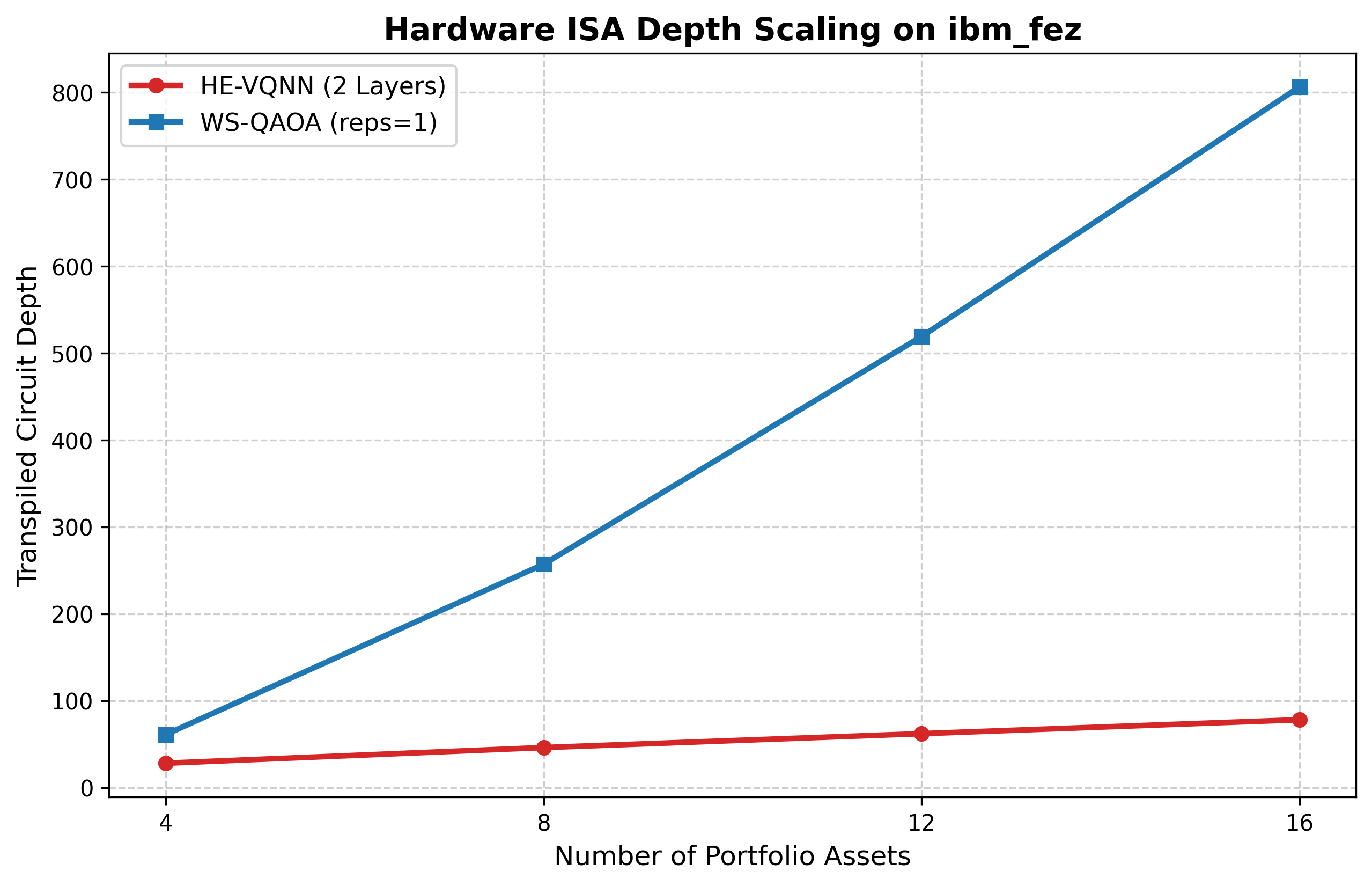
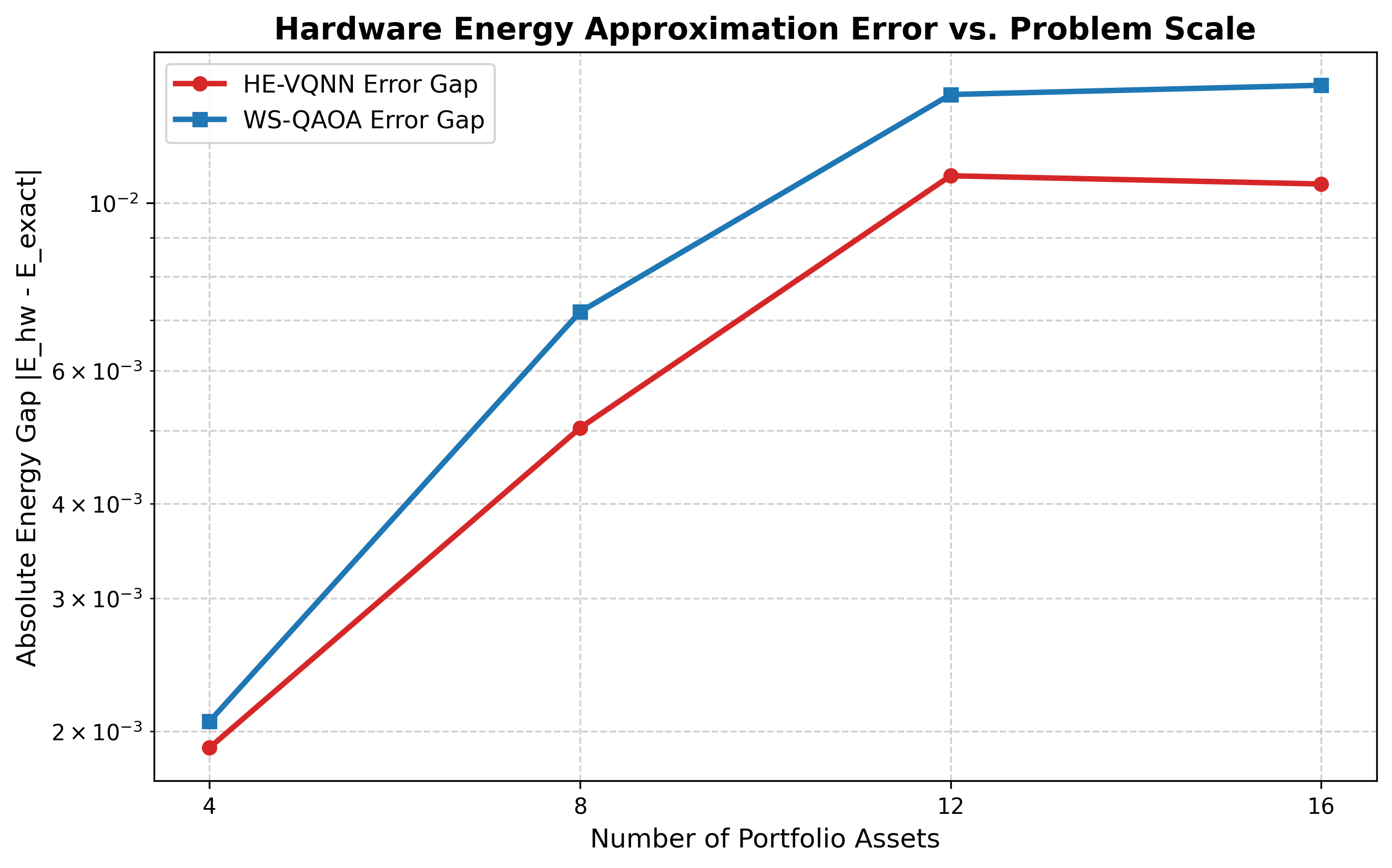
Figure 9: ISA circuit depth scaling with asset count; only HE-VQNN maintains acceptable values for NISQ hardware.
Implications and Future Research Directions
The study unequivocally demonstrates that for dense, risk-aware financial optimization, contemporary NISQ devices force a nonviable choice between algorithmic expressibility and coherence preservation. Current hardware makes it impossible to simultaneously realize deep tail-risk modeling and quantum state fidelity, limiting genuine quantum advantage in such applications.
Practical implications include the necessity for:
- Enhanced Error Mitigation: To extend the coherence window for expressible ansatzes, integration of strategies such as Zero Noise Extrapolation and Probabilistic Error Cancellation is mandatory for near-term hardware to bear meaningful results at the dense QUBO scale.
- Expressibility-Driven Ansatz Design: Development of adaptive, hardware-aware ansatzes that balance connectivity, expressibility, and shallow depth may unlock performance for portfolios beyond 12 assets.
- Hybrid Quantum-Classical Solvers: Embedding small quantum routines within classical tensor network trains or leveraging quantum subroutines for structured problems may circumvent the scaling bottleneck.
- Hardware Evolution: Topological enhancements in superconducting qubit layouts or advances in modular/connectivity paradigms (e.g., photonic all-to-all gates) are required to make dense QUBO embeddings practical on quantum hardware.
Conclusion
Through a rigorous benchmark incorporating a hybrid discrete CVaR objective, this work exposes the deep operational divide between quantum circuit expressibility and hardware-induced decoherence for dense, tail-risk portfolio optimization on NISQ architectures. It provides a clear quantification of the SWAP-routed coherence cliff for dense QUBOs while introducing an effective proxy method for auxiliary variable elimination. Achieving practical quantum-accelerated financial risk modeling will require advances in error mitigation, ansatz structuring, and hardware connectivity. This study establishes a foundation and reference point for future architecture-aware quantum optimization research in high-dimensional, dense application domains.