Quantum Learning of Classical Correlations with continuous-domain Pauli Correlation Encoding
Published 7 Apr 2026 in quant-ph | (2604.05637v1)
Abstract: We propose a quantum machine learning framework for estimating classical covariance matrices using parameterized quantum circuits within the Pauli-Correlation-Encoding (PCE) paradigm. We introduce two quantum covariance estimators: the C-Estimator, which constructs the covariance matrix through a Cholesky factorization to enforce positive (semi)definiteness, and a computationally efficient E-Estimator, which directly estimates covariance entries from observable expectation values. We analyze the trade-offs between the two estimators in terms of qubit requirements and learning complexity, and derive sufficient conditions on regularization parameters to ensure positive (semi)definiteness of the estimators. Furthermore, we show that the barren plateau phenomenon in training the variational quantum circuit for E-estimator can be mitigated by appropriately choosing the regularization parameters in the loss function for HEA ansatz. The proposed framework is evaluated through numerical simulations using randomly generated covariance matrices. We examine the convergence behavior of the estimators, their sensitivity to low-rank assumptions, and their performance in covariance completion with partially observed matrices. The results indicate that the proposed estimators provide a robust approach for learning covariance matrices and offer a promising direction for applying quantum machine learning techniques to high-dimensional statistical estimation problems.
The paper presents two quantum covariance estimators using continuous-domain Pauli encoding to map classical covariance parameters onto quantum state expectations.
It leverages hardware-efficient variational circuits with Cholesky-based and entrywise methodologies to ensure positive semidefiniteness and low-rank adaptability.
Numerical simulations demonstrate robust performance in covariance completion, gradient scaling, and mitigating barren plateaus in high-dimensional settings.
Quantum Learning of Classical Correlations with Continuous-Domain Pauli Correlation Encoding
Overview and Motivation
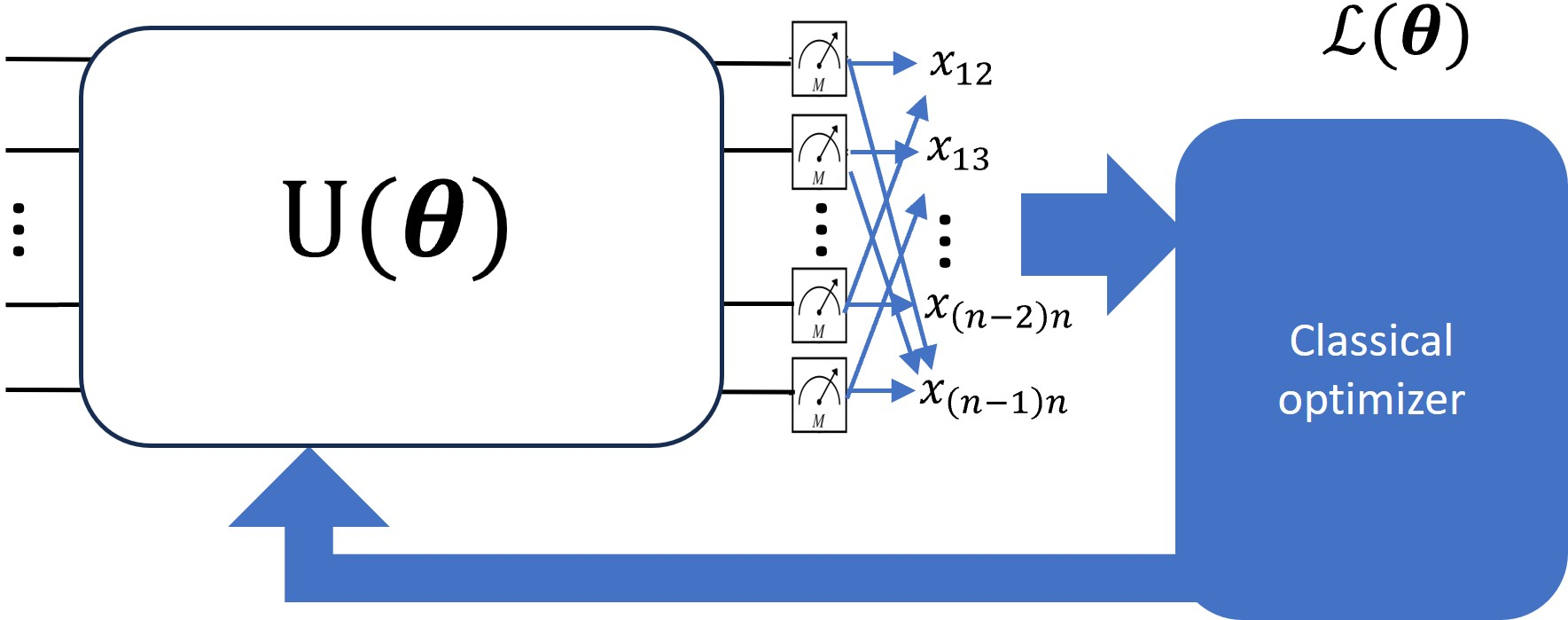
The paper “Quantum Learning of Classical Correlations with continuous-domain Pauli Correlation Encoding” (2604.05637) introduces a quantum machine learning methodology for estimation of classical covariance matrices, leveraging the framework of continuous-domain Pauli Correlation Encoding (cPCE). The authors present two quantum covariance estimators—C-Estimator and E-Estimator—designed to address high-dimensional statistical estimation challenges, including low-rank approximation, matrix completion, and precision matrix inference. The core paradigm is to encode the real-valued covariance parameters in quantum state expectation values of specific Pauli strings, followed by variational circuit optimization to minimize classical-quantum loss.
Figure 1: Schematic of the proposed quantum-classical workflow combining data-driven covariance estimation with quantum circuit-based variational optimization.
Methods: Covariance Estimation via Quantum Circuits
Pauli Correlation Encoding: From Discrete to Continuous
Building upon recent advances in Pauli Correlation Encoding (PCE), where combinatorial optimization variables are mapped onto binary observables in quantum circuits, the authors generalize the encoding to a continuous domain. Here, each covariance entry Σij is represented as xij=cij⟨Πij⟩ where ⟨Πij⟩ denotes the expectation value of a selected Pauli string with respect to the parameterized quantum state and cij is a normalization or regularization coefficient.
Parameterized Quantum Circuits and Ansatz Selection
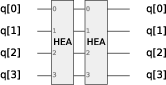
The quantum encoding utilizes hardware-efficient ansatzes (HEA), employing multiple layers of single-qubit rotations interleaved with linear or circular entangling gates (typically CZ or CNOT), which generate a parameterized variational state. The ansatz depth and entangling topology are tuned for expressivity and efficient implementation, as depicted in the block-wise/gate-wise architecture (Figure 2).
Figure 2: Illustration of a block-wise and gate-wise HEA for four qubits and linear entangling structure, designed for scalable evaluation of Pauli observables in the PCE approach.
Growth of Observable Set
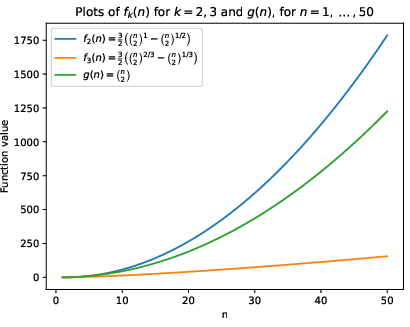
For n variables, O(n2) covariance parameters need encoding. To maintain qubit efficiency, parameter grouping and permutations of Pauli strings are adopted, ensuring scalable support for high-dimensional covariance learning (Figure 3).
Figure 3: Scaling of the number of observables required as a function of system size and encoding strategy, highlighting the resource trade-offs in cPCE.
Covariance Estimator Architectures
C-Estimator (Cholesky-Based)
The C-Estimator reconstructs the covariance via the Cholesky factorization Σ=LL⊤, with each upper-triangular entry of L defined by an expectation value over a Pauli string observable. Diagonal terms enforce consistency with prescribed marginal variances, while off-diagonal entries are learned and regularized through cij. This parametrization ensures positive semidefiniteness by construction if all Cholesky diagonals are non-negative, and can efficiently yield precision (inverse covariance) matrices.
Low-rank enforcement is achieved by nullifying select Cholesky diagonals, providing direct control over the effective rank without explicit eigen-decomposition.
E-Estimator (Entrywise Direct Estimator)
The E-Estimator encodes each off-diagonal covariance entry as a scaled quantum observable expectation value, Σij=cij⟨Πij⟩, with diagonal entries fixed as variances. While this approach requires an xij=cij⟨Πij⟩0-qubit register, the evaluation of all xij=cij⟨Πij⟩1 is highly parallelizable due to mutual commutativity. However, ensuring the final xij=cij⟨Πij⟩2 is positive (semi)definite necessitates careful selection of the xij=cij⟨Πij⟩3 regularization parameters, for which sufficient conditions are derived based on diagonal dominance.
Training, Regularization, and Barren Plateau Mitigation
Loss functions are defined as Frobenius norm differences between the quantum estimator (xij=cij⟨Πij⟩4) and the classical covariance estimator, with optional masking to permit matrix completion from incomplete data. The training proceeds via classical optimization of the quantum circuit parameters, informed by the variational measurement outcomes.
A significant theoretical contribution is the explicit analysis of barren plateau scaling. The authors establish upper bounds for the loss gradient variance as a function of scaling in xij=cij⟨Πij⟩5, showing that exponential growth in some regularization parameters can mitigate the exponentially vanishing gradients endemic to deep/global cost variational circuits. This enables stable training even as system dimension and depth grow.
Numerical Simulations and Results
Convergence Analysis
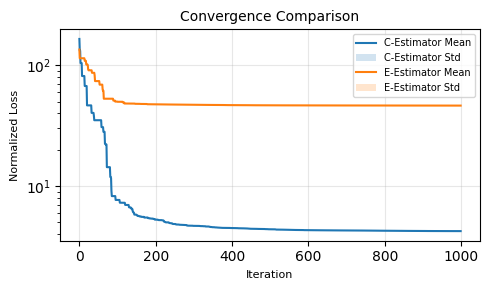
Performance validation is conducted using synthetic positive semidefinite covariance matrices generated from random ensembles. Both estimators are benchmarked on convergence speed and mean absolute error across multiple random trials.
Figure 4: Comparative convergence of the C-Estimator and E-Estimator: the C-Estimator achieves lower and more stable MAE, highlighting its robustness under variational training.
Low-Rank Covariance Learning
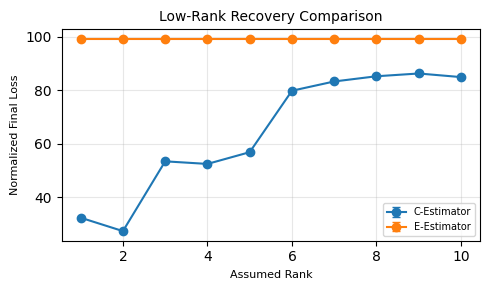
Experiments systematically vary the assumed rank in the Cholesky-based reconstruction for low-rank covariances. The mean error decreases sharply as the assumed rank approaches the ground truth, with minimal gains from overestimating the rank, supporting the estimator's sensitivity and adaptability.
Figure 5: Dependence of final MAE on the assumed covariance matrix rank: optimal error is reached precisely at the true underlying rank.
Covariance Completion with Missing Data
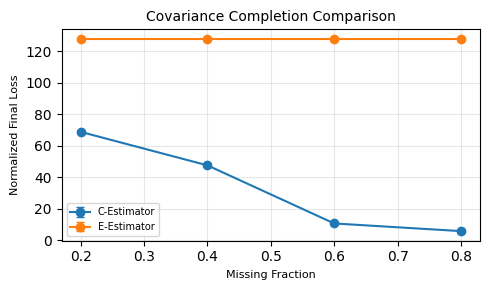
Robustness under partial observability is assessed by randomly masking entries. Both C- and E-Estimators are evaluated for their ability to impute missing covariances, with error increasing smoothly as the fraction of missing data grows. The C-Estimator generally outperforms the E-Estimator under high incompleteness scenarios.
Figure 6: Error in covariance reconstruction as a function of missing data fraction, demonstrating the graceful degradation and reliability of the C- and E-Estimators for matrix completion tasks.
Implications and Future Directions
The proposed quantum-classical framework offers a practical approach for robust, positive semidefinite covariance estimation in high-dimensional or incomplete-data regimes, addressing core limitations of classical sample-based methods. The explicit regularization-driven mitigation of barren plateaus provides an advancement for scalable variational quantum algorithms. The techniques outlined are immediately applicable in finance, network analysis, or any domain requiring reliable high-dimensional covariance/precision learning under noise or data scarcity.
For AI and ML, the ability to encode, optimize, and complete high-dimensional correlation structures using quantum circuits opens new directions in quantum-enhanced unsupervised learning, representation learning, and quantum data-derived manifold modeling. The geometric structure of solution manifolds encoded within expectation values via cPCE is a fertile area for theoretical and algorithmic exploration. Further integration with quantum state preparation, tensor network methods, and hybrid classical-quantum learning loops could yield new advances in the tractable modeling of complex, correlated systems.
Conclusion
The framework established in “Quantum Learning of Classical Correlations with continuous-domain Pauli Correlation Encoding” delineates a systematic route for quantum-enhanced estimation of covariance and correlation matrices in high-dimensional and incomplete data settings. Through the C-Estimator and E-Estimator, combined with careful ansatz design and regularization, the approach provides positive definiteness, low-rank adaptability, and practical tractability. The analysis of barren plateau mitigation via loss scaling is a notable step toward robust variational quantum learning in globally correlated objective landscapes. These contributions collectively position cPCE-based quantum learning as a promising methodology for quantum statistical inference and high-dimensional data science.