- The paper identifies Geometric Collapse as a failure mode where vision models mistakenly convert unsupported edge cues into erroneous predictions.
- It uses the Scrambled Edges diagnostic to isolate violations in surface continuity, illumination coherence, and occlusion ordering.
- Empirical results reveal that error propagation is global and recovery is severely limited, highlighting the need for explicit plausibility checks in model architectures.
Geometric Collapse: Dense Vision Models and Failure of Physical Causality Verification
Introduction and Motivation
Recent advances in monocular depth and surface normal prediction, driven by Vision Transformers (ViTs), self-supervised learning (SSL), and large-scale training datasets, have elevated average-case performance. However, these improvements do not inevitably equip models with inference-time mechanisms to verify physical plausibility. The paper "Geometric Collapse: When Vision Models Fail to Verify Physical Causality" (2607.06871) investigates whether dense vision models can reject edge cues that violate basic physical priors—surface continuity, illumination coherence, and occlusion ordering—or if they indiscriminately adopt visually salient but physically unsupported edges, leading to global failures termed Geometric Collapse. The core hypothesis is that scaling and SSL enhance benchmark scores but do not yield robust systems capable of quarantining unphysical edge evidence.
Scrambled Edges Diagnostic and Control Conditions
The central experimental protocol introduces Scrambled Edges: edge-like perturbations generated by extracting genuine image edges, then randomly relocating and rotating them to violate physical support without altering their visual salience. This manipulation breaks geometric, photometric, and occlusion priors yet remains energy-matched to high-pass noise controls, enabling isolation of causality violations from generic frequency content. Edge-Shaped noise serves as a structure control compliment: edges are perturbed in-situ, preserving physical plausibility.

Figure 1: Overview of the Scrambled Edges Diagnostic Pipeline—contrasting model behavior under physically unsupported edge cues vs. high-pass frequency-matched noise.
These perturbations operationalize violations across three axes:
- Surface Continuity: Placement of edges in smooth regions contradicts depth or normal gradients.
- Illumination Coherence: Introduction of contrast unaccounted for by plausible lighting scenarios.
- Occlusion Ordering: Disruption of junction geometry, breaking depth ordering cues.
Controls are calibrated for frequency, energy, and edge sparsity, rigorously disentangling geometric priors from statistical artefacts.
Empirical Findings: Collapse Severity and Propagation
Experiments span a suite of representative models—MiDaS v2.1 (ResNet-101), MiDaS DPT (ViT), DepthAnything (DINOv2), and cross-paradigm generative estimators (Marigold diffusion, DepthFM flow-matching). Scrambled Edges induce collapse ratios up to 3.2× relative to energy-matched noise. Crucially, this collapse is not a local artifact: errors propagate globally, rapidly contaminating unperturbed regions and imposing a hard ceiling on output-level oracle repair (maximum recovery only 47% even with perfect mask knowledge).
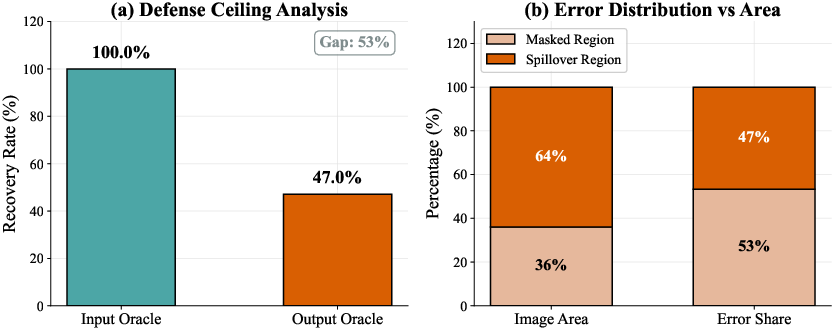
Figure 2: The spillover limit—local repair fails due to global error propagation; recovery is strictly capped.
Detection and quarantine mechanisms are notably absent. Adoption rates quantify the probability that models convert injected, unsupported edges into depth discontinuities; escalation in adoption rate closely tracks collapse severity. Generative estimators manifest attenuated collapse (Marigold: 1.55×), indicating partial resilience from iterative inference, but the phenomenon persists across paradigms.
Physical Prior Ladder and Mechanistic Insights
Ablation across individual prior violations reveals that causality disruption (edge direction and occlusion ordering) predominantly drives collapse, whereas mere surface continuity or edge shape are less hazardous. Occlusion causality violations—achieved via rotation/translocation of edge segments—trigger maximal deviation, consistent with classical visual perception theories.
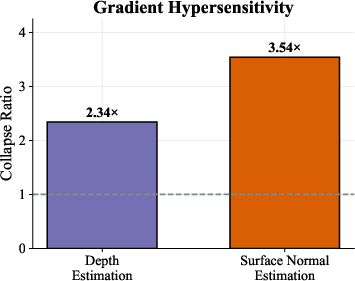
Figure 3: Gradient hypersensitivity—surface normal estimation degrades more acutely than depth; local derivative consistency is highly sensitive to scrambled edge perturbations.
Evaluation: Metric Paradox and Boundary Fidelity
Global accuracy metrics (e.g., RMSE) paradoxically improve under scrambled edges due to prediction smoothing, obfuscating boundary fidelity failures. Structural metrics, such as Edge F1, more accurately surface collapse severity, recording up to 66.7% degradation. Photometric multi-view consistency may also superficially suggest improved performance, yet analysis of depth-to-depth consistency exposes severe geometric incoherence.
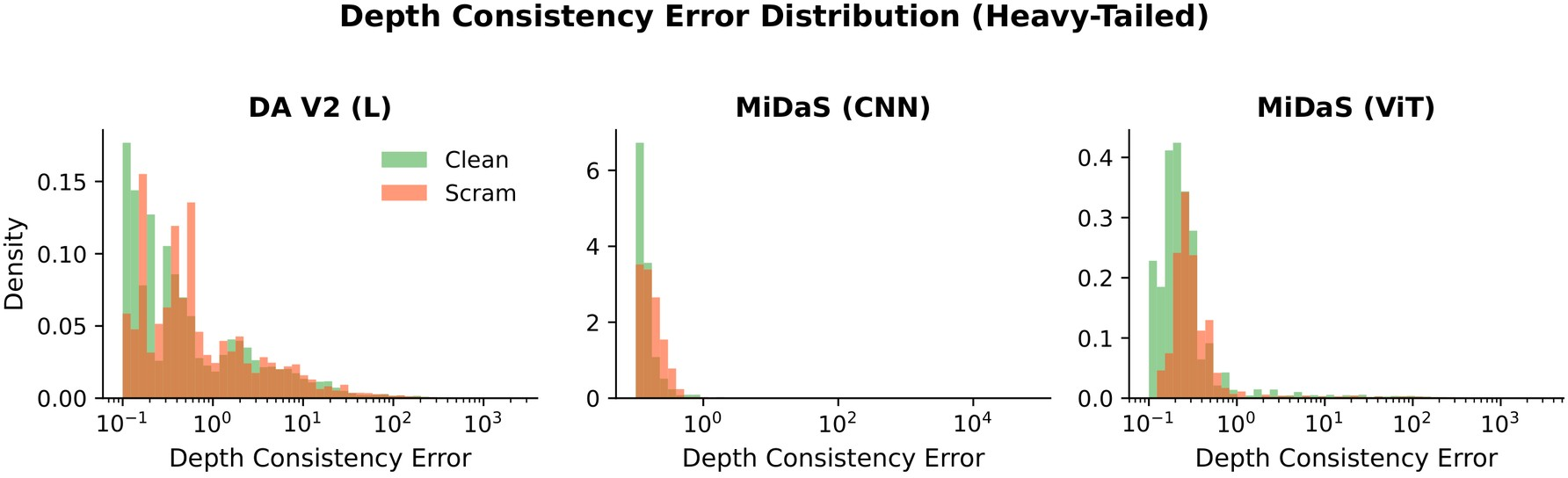
Figure 4: Depth consistency error distribution—collapse induces heavy-tailed inconsistency under all conditions; photometric error is misleadingly low.
Generalization and Downstream Consequences
Geometric collapse generalizes robustly across datasets (KITTI Odometry sequences show consistent patterns), tasks (non-geometric tasks like SAM segmentation are insensitive), and real-world scenarios (reflections, shadows, glass-induced ambiguities). Downstream impacts on surface integrity—normal variance, planarity error—and traversability (fragmentation, navigable area distortion) are profound.
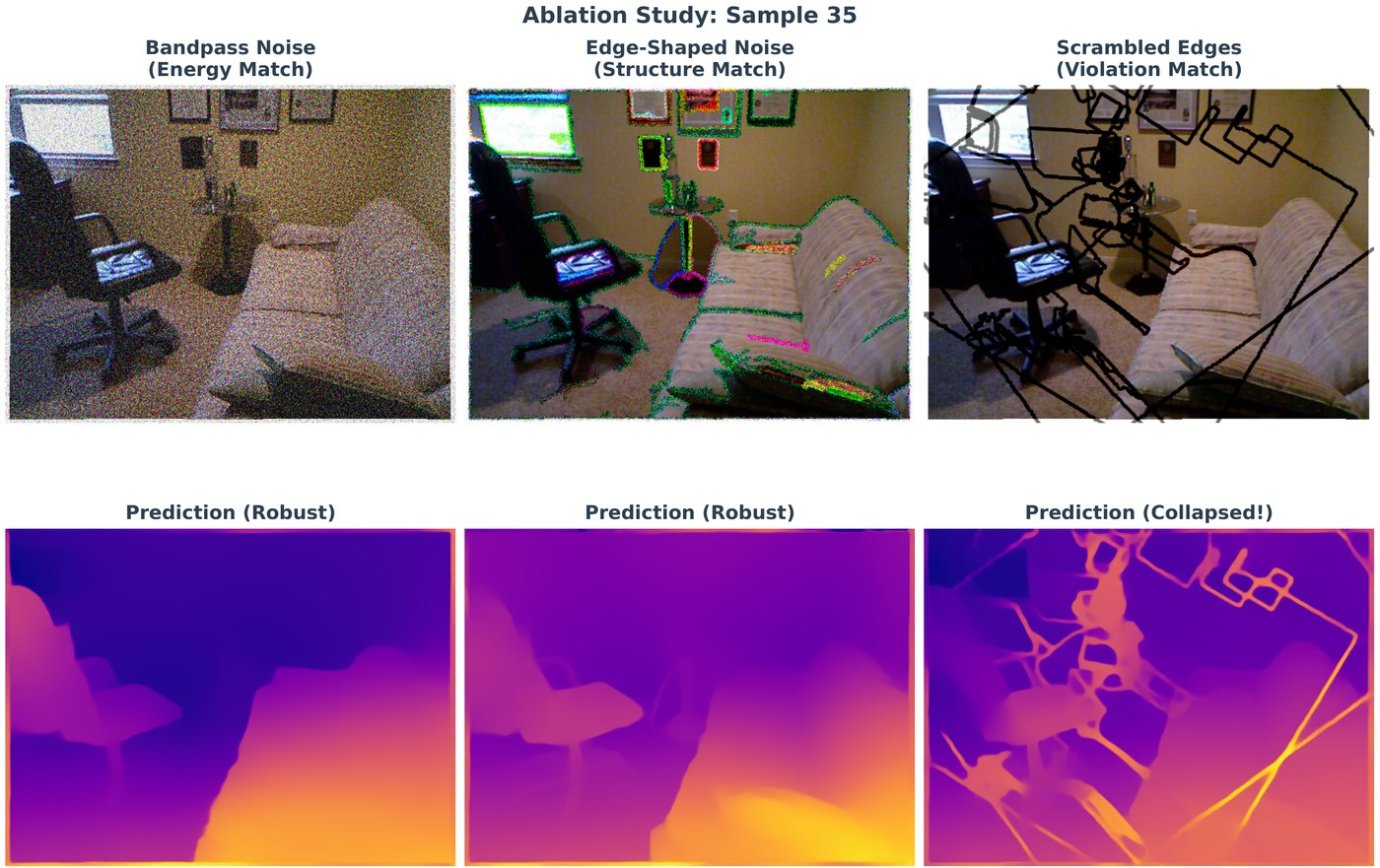
Figure 5: Visual ablation—models remain robust under energy-matched or structure-matched controls, but fail catastrophically under full geometric violation.
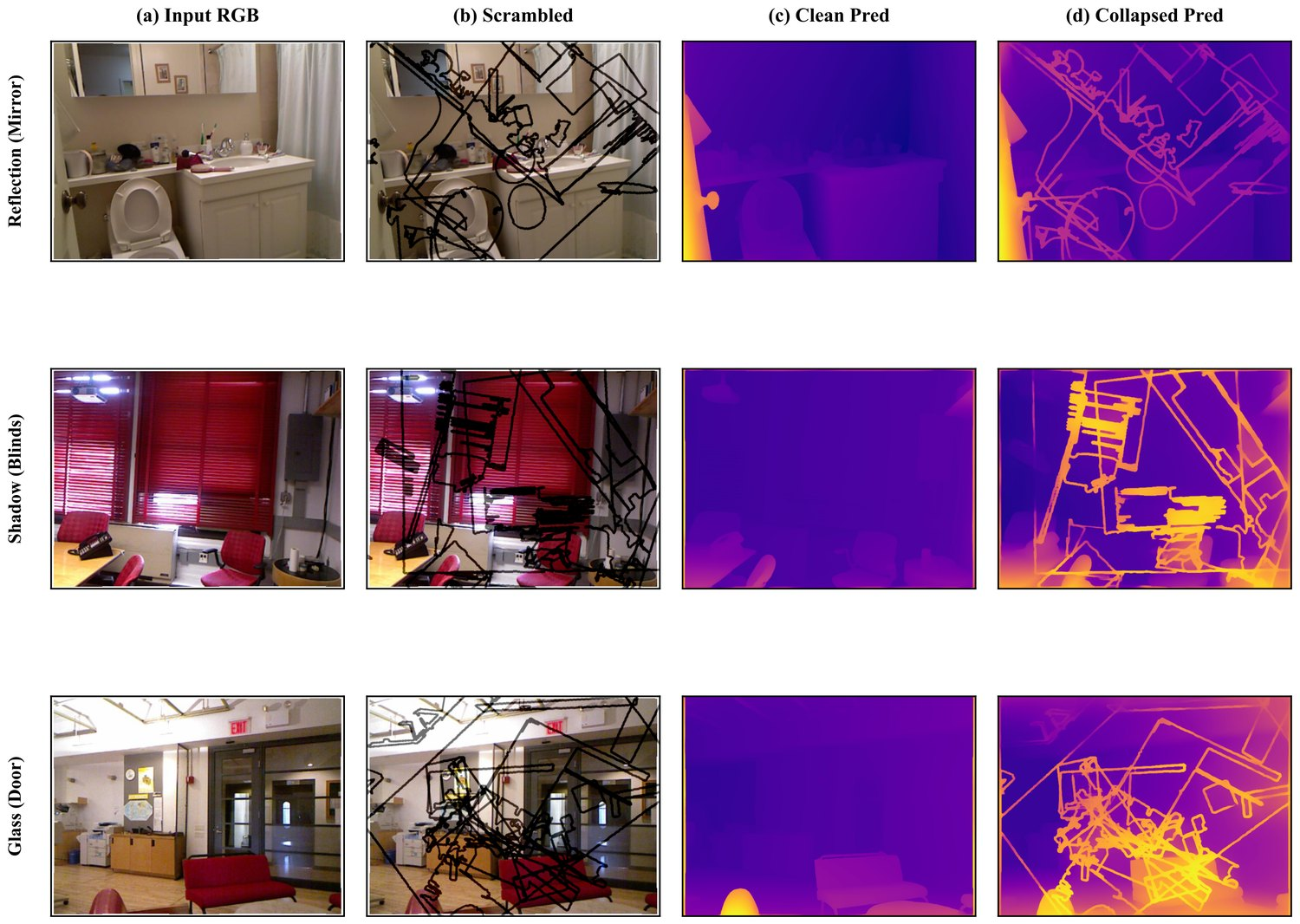
Figure 6: Qualitative case study—real-world edge ambiguities elicit identical collapse as synthetic scrambled edges.
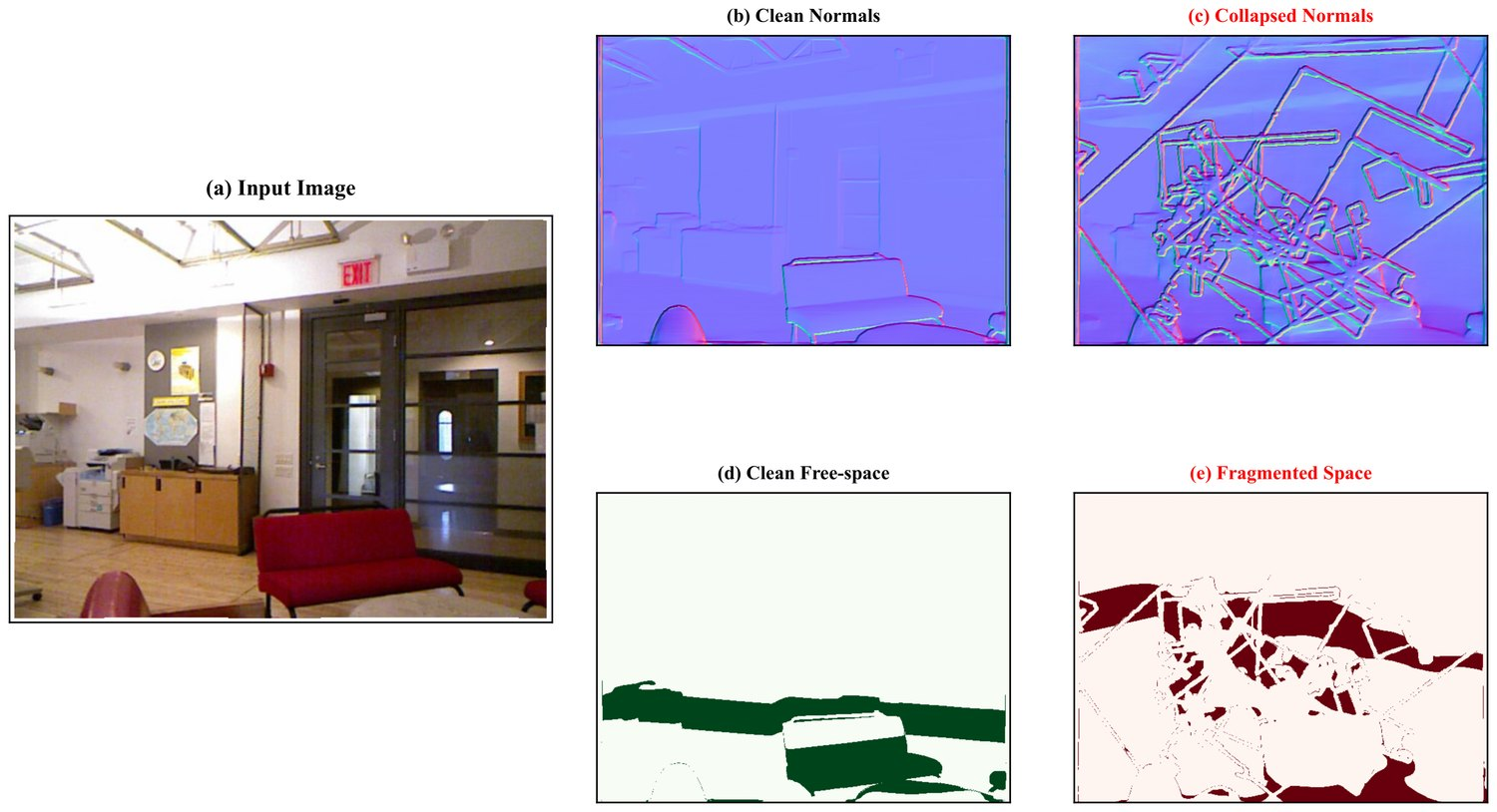
Figure 7: Downstream consequences — surface normals become noisy and incoherent, fragmenting free-space estimation.
Implications and Architectural Directions
The results highlight a structural vulnerability in dense geometric predictors: robust models must implement explicit plausibility checks for edge cues, selectively integrating evidence according to local geometric, photometric, and occlusion context. Post-hoc filtering and local repair are insufficient; predictive architectures must support uncertainty estimation and cue selection before integration. Iterative inference offers partial mitigation, but physically unsupported cues can still be adopted and propagate globally. The phenomenon is critical for safety-critical applications, where hallucinated geometry (e.g., phantom obstacles, fragmented free space) can compromise downstream systems.
Theoretical implications include the necessity of support-aware objectives and modules facilitating multi-view and inverse-rendering consistency. Simple augmentation strategies are not adequate; models require mechanisms to distinguish valid from invalid edge evidence based on physical priors, not statistical frequency or boundary sparsity.
Conclusion
The paper establishes Geometric Collapse as a failure mode whereby dense vision models indiscriminately convert unsupported, visually salient edge cues into structural predictions, absent physical-causality verification. Scrambled Edges, a controlled diagnostic probe, demonstrates that scaling and SSL do not guarantee inference-time robustness: models can be noise-robust yet fragile to geometric violations. Collapse effects propagate beyond local perturbations, resisting mask-based repair and eluding global metrics. Future directions demand architectures integrating explicit plausibility scoring, selective cue fusion, and uncertainty-aware inference, to move beyond statistical fitting toward physical consistency.